by Terri Jo Neff | Nov 30, 2021 | News
By Terri Jo Neff |
While President Joe Biden continues to ignore pleas from Arizona’s sheriffs to take back control of the southern border, one top federal law enforcement official in Arizona is revealing the true nature of the border crisis, one social media posting at a time.
John R. Modlin is the Chief Patrol Agent of the U.S. Border Patrol’s Tucson Sector and its 3,600 employees assigned to cover Cochise, Pima, and Santa Cruz counties. His frequent use of Twitter features significant arrests and apprehensions by his agents, while also highlighting efforts by local USBP to keep local residents and the country safe.
On Tuesday, Modlin announced that agents with the USBP Brian A. Terry Station in Cochise County arrested Jesus Tafolla-Beana near Naco. Records show Tafolla-Beana, a Mexican citizen, was previously convicted in Utah of felony unlawful sexual activity with a minor and then deported. As a result, Tafolla-Beana was unlawfully in the United States when taken into custody.
Cochise County Sheriff Mark Dannels told AZ Free News that USBP’s arrest of Tafolia Beana illustrates the continued dangers of an unsecure border. It is a concern Dannels and other border sheriffs have spoken about since Biden took office, particularly after he nominated Alejandro Mayorkas to be Secretary of the U.S. Department of Homeland Security.
“A secure border promotes safe communities and their quality of life,” Dannels said. “Border security shall never be discretionary, but a mandate by all elected officials, local, state and federal.”
Unfortunately, local and state law enforcement leaders have had little success getting the Biden Administration to engage in constructive discussions about the border or to even admit there is criminal activity occurring at the border. Modlin’s social media efforts are seen as a realistic, albeit small, glimpse of what is really happening.
“Beana is just another example of the aggravated criminals breaching our southern border,” Dannels said. “I applaud our Border Patrol agents for all they do in protecting our borders during a time where historical intrusions are challenging their efforts.”
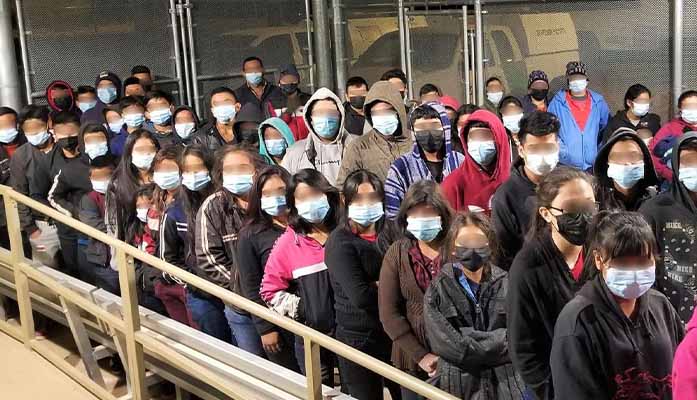
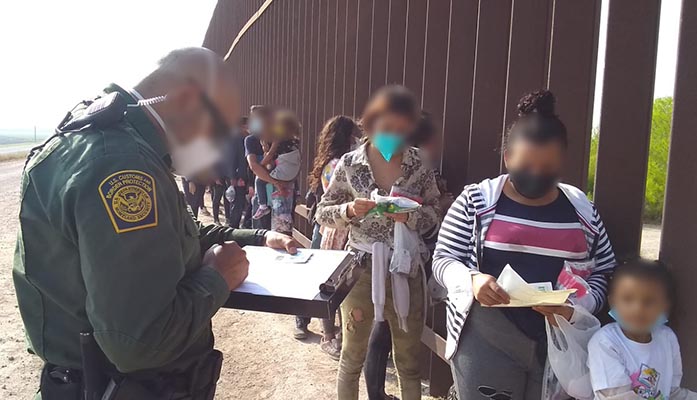
Modlin’s disclosure about Tafolla-Beana’s arrest came about 24 hours after he shared a photograph of 166 undocumented migrants apprehended in a remote area west of Sasabe by agents with the USBP Three Points Station. More than 70 minors were in the group, Modlin noted.
Earlier this month, journalist Terence Jeffrey reported in The Daily Signal that from February to October of this year, 23 undocumented migrants with prior homicide convictions have been taken into custody in Arizona. The 23 have since been charged in U.S. District Court with the federal crime of illegally reentering the United States after deportation.
The uncontrolled border situation recently prompted the Western States Sheriffs’ Association to issue a statement of No Confidence in Mayorkas’ leadership.
The group, which represents sheriffs in 17 states, called on the President to take immediate steps to remove Mayorkas. The statement also noted there already has been more than one million illegal border crossings this year, with “hundreds of thousands of illegal immigrants” who local authorities know were not intercepted by federal law enforcement at the border.
“After witnessing this disaster over the past several months and listening to the continued rhetoric and intellectual dishonesty from Secretary Mayorkas, the Western States Sheriffs’ Association and its membership must emphatically state our position of having NO confidence in the ability of Secretary Mayorkas, and his leadership within the Department of Homeland Security, to affect any positive outcome on this matter,” the statement reads.
by Terri Jo Neff | Nov 15, 2021 | News
By Terri Jo Neff |
One week after his inauguration, President Joe Biden issued Executive Order 14008 pausing new oil and gas leases on public lands. But perhaps the best known provision of the executive order was the goal of ensuring at least 30 percent of all federal land and coastal waterways are conserved by 2030.
The purpose, according to Biden, is to address climate change, protect biodiversity, and create equitable access to nature.
At the time of Biden’s announcement, about 12 percent of land across America was under sufficient oversight to be considered conserved, according to data from the U.S. Geological Survey. To meet the 30 percent goal would require conservation of about 440,000,000 additional acres.
By comparison, the State of Texas comes in at 171,057,000 acres.
The fact that the federal government already controls roughly 640,000,000 acres would seem to go a long way toward achieving the 30 by 30 goal, now better known as the America the Beautiful Initiative. However, nearly one-third of those acres are not conserved in a way that would likely comply with the unfinalized standards of the initiative.
Back in March, more than 60 members of the Congressional Western Caucus, sent Biden a letter expressing concerns with 30 by 30. The letter noted that with more than 90 percent of federally-managed lands lying west of the Mississippi, their constituents are concerned Western states will be disproportionately impacted by policies utilized to achieve the 30 by 30 goals.
“Stewardship of our lands is embedded in our Western values. Sustainable, healthy land is the lifeblood of our rural communities and our outdoor heritage and rural economies thrive when our lands are properly managed,” the letter stated. “However, the 30 by 30 initiative displays a dangerous thoughtlessness and far too many of our questions have been left unanswered.”
Yet seven months after that letter, very little is known as to how the Biden Administration intends to meet those goals. And that prompted an Oct. 12 letter to the President from Cochise County Sheriff Mark Dannels on behalf of the Arizona Sheriffs Association.
“As in the past, we have concerns including proposals such as these lacking specific measures, imposing unnecessary land use restrictions, and limiting economic opportunities that have existed for decades on these very lands,” Dannels wrote, also noting that federal officials were using the term “federally managed lands” instead of “public lands” in 30 x 30 documents.
But while Arizona’s sheriffs encouraged collaboration with state agencies and local governments to address climate change and drought impacts within the Western States, the letter cautioned that federal officials “should avoid imposing unilateral authority to further limit uses and impose increased land use restrictions on federal lands in the West that have been extremely divisive and controversial.”
Similar letters were sent to Sen. Kyrsten Sinema and Sen. Mark Kelly. A spokeswoman for the Arizona Sheriffs Association said no responses were received in the last month.
Some 30 by 30 documents mention the need for incentivizing voluntary stewardship efforts on private lands and by supporting the efforts and visions of States and Tribal Nations. The fact that privately owned lands are home to nearly two-third of all species on the U.S. Endangered Species list also has landowners in the western United States concerned about preservation of property rights.
“Traditional mechanisms of land protection like permanent acquisition, easement or federal designation will rightfully play a role in achieving 30 by 30,” the Western Landowners Alliance noted in a recent statement. “At the same time, over-reliance on these tools, or an insistence that these mechanisms are the only way to protect land fails to recognize the contributions to conservation of those already on the land.”
Deb Haaland, as U.S. Secretary of Interior, was tasked to coordinate with the Secretarys of Agriculture and Commerce along with the National Oceanic and Atmospheric Administration and White House Council on Environmental Quality to propose guidelines for determining what lands and waters qualify for conservation.
The America the Beautiful Interagency Working Group, as it is known, is also responsible for providing an annual progress report to the White House as well as ensuring federal dollars get distributed toward conservation programs.
The working group came under scrutiny earlier this year after questions were raised about the protocols utilized for awarding $17 million in federally funded grants for urban park projects. One of those projects sent $1 million to the City of Santa Barbara, California to renovate a park, including the installation of synthetic turf at the park.
by Terri Jo Neff | Sep 3, 2021 | News
By Terri Jo Neff |
A former justice of the Arizona Supreme Court who used to prosecute cross-border criminals before becoming a judge says many Arizonans along the border feel abandoned by President Joe Biden, but he has an idea to help stop the influx of undocumented immigrants and smugglers coming into the state.
During an interview with KFYI’s James T. Harris on Thursday, Andrew Gould agreed with a recent assessment by Cochise County Sheriff Mark Dannels that the situation at the border is out of control, but the crisis “is far, far worse than you could imagine,” he said.
“We’ve created an open border, and the Biden Administration has essentially abandoned American citizens just like he did with Americans in Afghanistan,” Gould said.
Gould told Harris that there are options for making Arizona unattractive to those illegally entering the United States via Arizona. The options could be undertaken without the help of federal authorities such as the U.S. Customs and Border Protection and U.S. Border Patrol, which get their orders from Biden.
One option which Gould believes can be easily implemented is establishing a No Trespass Zone from Cochise County to Yuma County on state and private lands along the 325 miles of border between Mexico and Arizona.
According to Gould, Arizonans are now “at the mercy of these cartels who are making billions of dollars off crime. They are pushing illegal immigration, fentanyl, methamphetamine, sex trafficking, extortion, murder, bribery. And there‘s no help for us coming from the federal government.”
The answer, Gould believes, is for local and state officials to join with property owners to post no-trespassing signs on private property and state land. The signs are necessary to satisfy the “reasonable notice” requirement in state law before anyone can be arrested for criminal trespass.
Gould brings a unique perspective to the subject, as a one-time prosecutor for Maricopa and Yuma counties where he handled major felony cases. He went on to serve as a judge with the Yuma County Superior Court and the Arizona Court of Appeals before being appointed to the Arizona Supreme Court by Gov. Doug Ducey in 2016.
The appointment as a supreme court justice came with a practically guaranteed seat on the bench until age 70. In fact, Gould was retained by voters in the November 2020 General Election for a six term.
But in April, the 57-year-old Gould shocked court watchers when he stepped down to run for Arizona Attorney General, who is not only Arizona’s top prosecutor but also its top legal advisor to dozens of state agencies. With illegal immigration and drug / human smuggling among the biggest legal challenges facing the state, Gould says Arizonans cannot wait on the Biden Administration to address the public safety, public health, and environmental harms posed by an uncontrolled border.
A no-trespassing zone is something Gould has discussed with border sheriffs, including Dannels and Yuma County Sheriff Leon Wilmot. Both expressed interest in the idea, he said.
A conviction for misdemeanor criminal trespass can carry a jail sentence of 30 to 180 days. Most non-U.S. citizens would be ordered held in custody pending resolution of the charges, so Gould says Arizona’s county jails would need financial support to handle the increased incarceration costs.
One option, he noted, is to aggressively target Cartel assets to help with the expense.
by Terri Jo Neff | Sep 1, 2021 | News
By Terri Jo Neff |
One Arizona sheriff sees too many similarities between U.S. immigration policy at the Southwest border and how the Biden Administration has handled the situation in Afghanistan, and he fears a perfect storm is brewing.
“It’s a mess down here all along the southwest border both on public safety, national security, and humanitarian,” Cochise County Sheriff Dannels told KFYI’s James T. Harris earlier this week. “The willful neglect, the willful avoidance to solve the problem, take responsibly for it, is the same thing he did on the Southwest border that’s now being played in a terrorist country with the Taliban.”
According to Dannels, just under 10,000 undocumented immigrants -what he calls “getaways”- were able to evade capture in July crossing from Mexico into Cochise County. The crisis is more frustrating, he said, because the Biden Administration ended President Donald Trump’s Stay in Mexico policy without having another plan in place.
The policy, Dannels said, worked well and allowed for a controlled situation at the Southwest border. Last month the U.S. Supreme Court ordered the Stay In Mexico policy reinstated despite objections from Biden’s appointees running the U.S. Department of Homeland Security.
“It’s amazing that our own Department of Homeland Security is fighting that,” Dannels said of the Stay in Mexico policy. “It’s not like Mexico is fighting that or another private group is fighting that. Our government is fighting that. Which is just a crying shame because the program worked in the past.”
For now, Dannels and his deputies are putting up a valiant stand while trying to respond to the continuous influx of undocumented immigrants and the accompanied increase in crime reports. He also says “it’s truly been beneficial” to have several dozen members of the Arizona National Guard assigned to work with his agency by order of Gov. Doug Ducey.
Dannels is also aware of recent warnings to New Mexico residents about a growing Middle Eastern presence among illegal border crossers. That concern, the sheriff said, has actually been on the radar of law enforcement officials for a while.
He worries a “perfect storm” exists right now with the upcoming 20-year anniversary of Sept. 11, 2001 and the U.S.’s open border philosophy under President Biden. It is a philosophy, Dannels said, that even those in federal leadership positions concede is not working, unless they are “a political puppet.”
And the chances are great that someone intent on doing harm to the United States is going to come through the Southwest border, Dannels said, because the White House has left law enforcement personnel unable to compete against the Cartel.
“Nothing is changing for the good down here,” Dannels said.
by Terri Jo Neff | May 3, 2021 | News
By Terri Jo Neff |
When Gov. Doug Ducey pledged $25 million last month to deploy the Arizona National Guard to the Mexico border he did so after the Biden Administration ignored pleas from state and local law enforcement officials to address the influx of immigrants and smugglers making it unhindered across the border.
The governor noted the National Guard troops would be on State Active Duty to assist with medical operations in detention centers, help with installation and maintenance of border cameras, monitor and collect data from the cameras, and analyze the situation at the border to identify trends in smuggling corridors.
The deployment was well received by two border sheriffs -Cochise County’s Mark Dannels and Yuma County’s Leon Wilmot- who spent the last three months trying to get federal authorities to come up with a plan for the escalating public safety threat and humanitarian crisis at and well beyond the international border.
However, Pima County Sheriff Chris Nanos has insisted his agency does not need National Guard support even though the county shares nearly 130 hundred miles of border with Mexico. The same “no thanks” approach was expressed by Sheriff David Hathaway of Santa Cruz County.
The difference in the positions of the sheriffs falls across political lines – Dannels and Wilmot are registered Republicans, while Hathaway and Nanos are Democrats.
The same political division is reflected in an April 21 letter signed by one county supervisor from each of the border counties in which they chastised Ducey for not asking for their input about the border situation. The signers -all of whom as Democrats- serve as their counties’ representatives on the Arizona Border Counties Coalition.
“We are disappointed that you failed to consult with the various Boards of Supervisors of each border county on this matter,” the Coalition letter states. “If asked, we would have requested assistance for transportation services, specifically buses and drivers, to provide those transportation services that we are now left to arrange on our own.”
The letter was signed by Sharon Bronson, Pima County; Ann English, Cochise County; Bruce Bracker, Santa Cruz County; and Tony Reyes, Yuma County.
Chief of Staff Mark Napier of the Cochise County Sheriff’s Office (CCSO) serves as his county’s point of contact with the Arizona National Guard. Last Thursday more than 30 troops arrived in Cochise County to perform a variety of non-law enforcement duties, including working with an extensive camera system utilized by the Southeastern Arizona Border Region Enforcement (SABRE) team to monitor cross-border traffic.
The troops are also providing support in CCSO’s jail and other clerical activities which allows sheriff’s personnel to deal with “other service demands and address the increase in challenges associated with the border crisis we currently face,” Napier explained.
On Friday, Napier told AZ Free News he and Sheriff Dannels had no advance notice that Supervisor English was signing the letter to Ducey, but they do not see the supervisor’s stance about deployment as being in conflict with CCSO’s position that the border crisis “presents a public safety, national security and human rights issue” which must be addressed in collaboration with federal, state, and local partners.
“The letter expresses some frustration over the lack of engagement between the Governor and Supervisors with respect to the deployment of AZNG personnel,” Napier said. “That is a matter between those Supervisors and the Governor.”
Napier added the Coalition’s letter also states border security is a responsibility of the federal government, “which in fact it is.” And the letter does not deny there is a public safety concern related to the current conditions along the border, he noted.
The Coalition’s letter makes no mention of the frequency or cost of transportation services any of the counties have had to provide or arrange for.