The federal government has watched over the Maricopa County Sheriff’s Office (MCSO) for well over a decade.
The Maricopa County Board of Supervisors says it’s no longer warranted.
The board filed a motion with the U.S. District Court for the District of Arizona to cease federal oversight of MCSO.
Chairman Thomas Galvin explained in a video announcing the court filing that the MCSO has not had an issue with racial profiling for years — the allegation at the heart of Melendres v. Arpaio which resulted in a federal court ruling against MCSO.
“After 14 years, four sheriffs, and hundreds of millions of spent tax dollars, it is essential to defend taxpayer money if federal oversight is no longer warranted,” said Galvin.
The county has spent over $300 million to comply with federal court orders; over $30 million in fees on a court-appointed monitor. That means every year, the county has spent around $25 million for federal oversight.
The Melendres case was a class action complaint alleging racially motivated detentions under former MCSO Sheriff Joe Arpaio. Under Arpaio, law enforcement would conduct sweeps targeting individuals suspected of being illegal immigrants, often in areas where day laborers abounded. The lead plaintiff in the class action complaint, Ortega Melendres, was detained despite having lawful presence. Other plaintiffs alleged they were stopped and questioned by law enforcement because they were Latino.
Galvin said the MCSO is “100 percent in compliance” with court-ordered policy changes, and has no evidence of ongoing civil rights violations.
The motion cited results from multiple periodic reviews, such as the Traffic Study Annual Reports from the last two years which found “no statistically significant differences between white drivers and [Hispanic drivers].”
The motion argued that MCSO hasn’t been able to devote full energy to public safety and “countless” other priorities due to the significant diversion of resources required to fund federal oversight.
“MCSO’s current practices do not violate federal law. But continued federal oversight diverts resources that could be used to serve the people of Maricopa County,” stated the motion. “It also upsets the democratic process and America’s federalist structure by making local officials accountable to a federal court — based on the conduct of a former Sheriff who has been out of office for eight years.”
Chairman Galvin characterized the county’s petition as a defense of federalism by restoring the power of accountability to voters.
“All that’s left to enforce are matters unrelated to discriminatory policing which should be left to the sheriff who was elected by you: the Maricopa County residents,” said Galvin. “In our federalist system, elected officials are accountable to voters.”
In a separate statement, Galvin said the MCSO was a “completely different agency” than when the Melendres ruling was handed down nearly 15 years ago.
“The voters held the responsible parties accountable and voted them out. Since then, MCSO disbanded immigration-related units, implemented new policies and anti-bias trainings, and is a law enforcement agency we can be proud of. Further federal oversight is unnecessary and only serves to divert taxpayer dollars away from true public safety needs,” said Galvin.
AZ Free News is your #1 source for Arizona news and politics. You can send us news tips using this link.
Maricopa County Recorder Justin Heap has announced that his office set a new speed record for processing Election Day ballot drop-offs, completing signature verification and curing ballots within 48 hours of the Nov. 4th elections. The matter was complicated when officials scrambled to process thousands of ballot envelopes discovered days later in a misplaced transport box.
In a Nov. 6 update on X, Heap wrote, “All calls to voters with signature inconsistencies have been completed.” He added that finishing both signature verification and voter calls “within just 48 hours of Election Day shatters all previous timeframes for elections with more than 100,000 Election Day drop-offs.”
RECORDER’S ELECTION UPDATE:
✅ All calls to voters with signature inconsistencies have been completed.
Finishing both signature verification and voter calls within 48 hours of Election Day shatters all previous timeframes for elections with more than 100,000 Election Day…
— Maricopa County Recorder Justin Heap (@azjustinheap) November 7, 2025
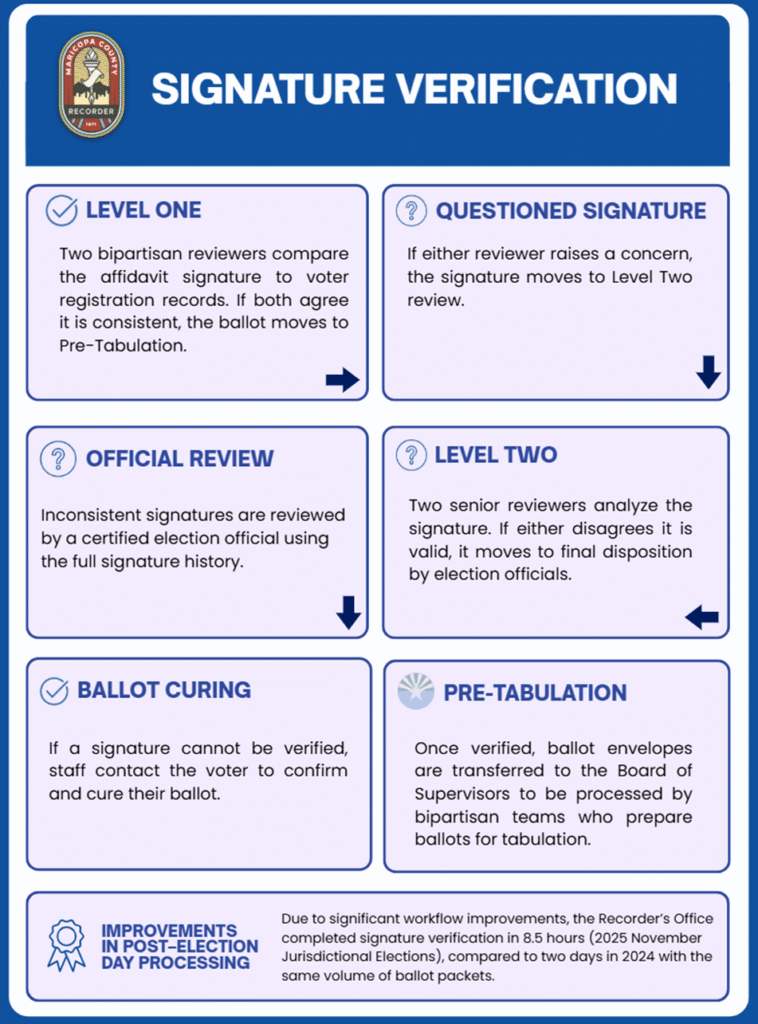
According to detailed metrics provided to AZ Free News by the Maricopa County Recorder’s Office, the November election included 117,664 ballot packets returned via mail or drop box on Election Day. Signature verification on those packets began at 6:00 a.m. on Wednesday, Nov. 5, and the office says the final file review was completed by 2:33 p.m., for an 8.5-hour turnaround on the Election Day returns.
For comparison, the Recorder’s Office pointed to the July 30, 2024, primary, when roughly 114,681 similar packets took about two days to clear signature review under then-Recorder Stephen Richer. In an emailed statement to AZ Free News, Maricopa County Director of Communications Judy Keane wrote:
“This represents a dramatic acceleration in post–Election Day processing: completing in 8.5 hours what previously required two days in the 2024 Primary, despite similar packet volumes. This outcome demonstrates the effectiveness of process improvements and the exceptional performance of the team.”
Two-Reviewer System and Quad-Screen Interface
Heap campaigned on tightening signature verification and has spent much of his first year in office overhauling the workflow while feuding with the Maricopa County Board of Supervisors over funding, control of election IT systems, and a controversial Shared Services Agreement now mired in litigation.
In response to written questions from AZ Free News, the county Public Information Office said that every early-ballot signature in the Nov. 4 election was reviewed by at least two human reviewers of different parties.
The office described the workflow this way:
Level One review uses a “quad-screen” interface on a single monitor:
Bottom left: the affidavit signature being reviewed
Above it: the voter’s latest signature on file
Upper right: second-latest signature
Middle right: third-latest signature
Bottom right: the voter’s registration signature
All signature exemplars can be rotated to the primary comparison position above the affidavit signature so reviewers can align shapes and slants.
According to the county, Level Two reviewers see the same layout. Still, they can also scroll through the voter’s full signature history when Level One reviewers either disagree or cannot comfortably verify a match.
County officials say that the combination of two reviewers of opposing parties and deeper access to a voter’s signature history at the second level was designed to increase both scrutiny and perceived neutrality, after years of partisan conflict over how Maricopa handles early ballots.
For voters whose signatures still couldn’t be confirmed, the office used multiple curing channels tied to identity verification: calls from election staff, text messages (for those who opted in), emails, and a secure online dashboard at BeBallotReady.vote, consistent with state guidance on signature curing windows.
Record Processing Claims Tested by Ballot Mishap
Heap’s announcement of “shattering” past performance landed just as Maricopa County was forced to acknowledge another election-administration black eye: the discovery of two sealed transport boxes with 2,288 returned ballot affidavit envelopes that had not been included in the initial post-Election Day processing.
On Nov. 7, county elections officials disclosed that poll workers had mistakenly placed the sealed transport boxes inside a blue drop box instead of returning them to the county’s election center on Election Night. Local outlets reported that the boxes bore intact tamper-evident seals and matched election-night serial numbers, but the ballots inside had not been counted, according to AZ Family.
Heap’s office responded with its own update, saying signature verification on all 2,288 ballot packets had been completed and that every voter whose signature needed curing had been contacted before the statutory deadline.
RECORDER'S ELECTION UPDATE:
The County Recorder’s Office has completed signature verification on all 2,288 of the missing ballot packets we received from the Board this morning. In the last hours, we have contacted all remaining voters with signatures requiring additional… pic.twitter.com/M1PGHj6Tkw
— Maricopa County Recorder's Office (@RecordersOffice) November 7, 2025
Jennifer Liewer, Deputy Elections Director, issued a statement following the report saying:
“Friday, Nov. 7, 2025: This morning, as part of standard post-election protocols, elections workers inspected equipment that had been returned from voting locations. This process includes unpacking and logging equipment.
“During this inspection, two sealed transport boxes of returned ballot affidavit envelopes were found inside a blue drop box. While the transport boxes did have tamper evident seals, ensuring the security of ballots, poll workers had mistakenly placed the sealed boxes inside a blue drop box rather than returning them on Election Night. Immediately after the discovery, a bi-partisan team of election staff took custody of the sealed bins and worked quickly to ensure chain of custody was followed. The green affidavit envelopes will now be signature verified and processed for tabulation.
“Per statute, green affidavit envelopes are to be counted at the close of voting on Election Night. Counted envelopes are then placed in a large bin, sealed, and returned to the Maricopa County Tabulation and Election Center.”
As previously reported by AZ Free News, Recorder Heap has been embroiled in a lengthy legal battle with the Maricopa County Board of Supervisors over funding to modernize and provide technical support for the county’s election equipment, and centered on the division of responsibilities created in a Shared Services Agreement (SSA) agreed to by Heap’s predecessor, Stephen Richer.
Heap sought a Temporary Restraining Order against the Board’s planned assessment of election systems and databases in early October, per KJZZ. However, on November 6th, Maricopa County Superior Court Judge Scott Blaney denied the motion, writing “The Recorder’s concerns regarding the assessment’s potential interference with the 2026 Primary Election are speculative at this point in the litigation,” according to the court order.
A dozen Maricopa County libraries have removed more than 50 books on sex education and puberty from their children’s sections. The move follows complaints from parents and advocacy groups who said the books contained inappropriate material.
As previously reported by AZ Free News, the Maricopa County Library District (MCLD) has been subject to increasing criticism from parents’ rights advocates like Arizona Women of Action (AZWOA) and EZAZ, who engaged with the Maricopa County Board of Supervisors (BOS) in June. The groups objected to books such as “It’s Perfectly Normal” by Robie H. Harris and “This Book Is Gay” by Juno Dawson for the titles’ graphic depictions of sex and sexual behavior.
Responding to a petition launched by AZWOA, the BOS approved a pilot program at the Queen Creek Library, allowing parents to submit a form listing books their children may not check out.
According to AZCentral, the Board later directed the books to be relocated in response to the concerns brought to them. Due to the administrative nature of the move, a formal vote was not required. Supervisor Steve Gallardo, the board’s only Democrat, expressed objections to the outlet, saying, “Call it whatever you want … it’s wrong, and we shouldn’t be engaging in this.” Gallardo claimed that although he “agreed with some of the changes,” parents should be responsible for monitoring their children in the libraries.
Republican Supervisors Lesko, Stewart, and Brophy McGee supported the measure fully, stating that the measure is intended to:
“Protect our youngest from their prying eyes and curiosity,” per Stewart.
“Relocate questionable books into areas of the library that are less, or not, accessible to children,” according to Brophy-McGee.
“Make sure that sexually explicit library books are out of the reach of minors,” as described by Lesko.
🚨🚨 YOUR VOICE IS NEEDED! 🚨🚨
The Maricopa County Board of Supervisors needs to know that residents are concerned about the sexually explicit books in the county libraries. Please sign & share this petition.
— Arizona Women of Action (@azwomenofaction) June 20, 2025
As reported by the Arizona Daily Independent, several books were brought to the BOS’s attention, though the complete list of inappropriate books is extensive. The AZWOA referred to a book rating site, ratedbooks.org, as well as a book list on Scottsdaleunites.com.
Merissa Hamilton of EZAZ later posted a list of egregious books found on MCLD shelves. Highlighted titles include “It’s Perfectly Normal: Changing Bodies, Growing Up, Sex, and Sexual Health” by Robie H. Harris, which features cartoon-like drawings with sexually graphic information. “This Book Is Gay” by Juno Dawson is also in question because it instructs children on how to engage in meetups for casual sexual encounters. Novels by Ellen Hopkins graphically depict sex, human trafficking, and abuse. These books may violate state statutes, including ARS 13-3506:
“It is unlawful for any person, with knowledge of the character of the item involved, to recklessly furnish, present, provide, make available, give, lend, show, advertise, or distribute to minors any item that is harmful to minors. C. A violation of this section is a Class 4 felony.”
“A. It is unlawful for any person knowingly to place explicit sexual material upon public display or knowingly to fail to take prompt action to remove such a display from property in his possession or under his control after learning of its existence. B. A person who violates any provision of this section is a Class 6 felony.
The potential prompted citizens to consider bringing these books to the attention of the county’s sheriff and attorney’s offices.
County Manager Jen Pokorski told Republic reporters in June that the county is contemplating a new rule, a new “software solution” which would permit parents to restrict their children’s access to different books by category.
“I think the goal of the new software would be, the books that we’ve deemed — or that have illustrative pornography, will be off limits to children under a certain age,” Supervisor Mark Stewart explained. “And then anything that a parent would want to opt their child into, they’re welcome to sign up and do that.”
However, he did clarify, to the Arizona Republic, “I did not say that sex-ed books are illustrative pornography.”
Robert “Bob” Corbin, a longtime Arizona public official who served as state Attorney General and played a pivotal role in some of the state’s most high-profile legal cases, has died. He was 96.
Corbin’s career in public service spanned decades, beginning as Maricopa County Attorney and later as a member of the Maricopa County Board of Supervisors. In 1979, he was elected Arizona’s Attorney General, a position he held through the 1980s.
Known for his commitment to integrity in government, Corbin gained recognition for prosecuting public officials accused of corruption and for pursuing justice in the 1976 car-bomb killing of Arizona Republic reporter Don Bolles — a case that shocked the state and the nation. His work in that era helped shape Arizona’s reputation for taking on organized crime and political misconduct.
Maricopa County Chairman Thomas Galvin expressed condolences, saying Corbin “was a man of integrity and a selfless public servant” whose leadership left a lasting mark on the state. “He played a central role in landmark judicial cases, went after officials who violated the public trust, and prosecuted those responsible for the murder of journalist Don Bolles,” Galvin said in a statement. “As both an attorney and elected official, I am humbled to follow in the footsteps of someone so influential and principled.”
Beyond his courtroom and public service record, Corbin was respected across party lines for his measured approach to law enforcement and governance. He also served as president of the National Rifle Association in the early 1990s, a role that reflected his deep involvement in public policy beyond Arizona.
Corbin is survived by his wife, former state senator Lori Klein Corbin, along with family, friends, and colleagues who remember him as a man deeply devoted to both his work and the people of Arizona.
Jonathan Eberle is a reporter for AZ Free News. You can send him news tips using this link.
The legal fight between Maricopa County Recorder Justin Heap and the County Board of Supervisors escalated Monday. America First Legal filed two motions on Heap’s behalf, and Arizona’s legislative leaders submitted an amicus brief supporting him.
In a press release, the County Recorder’s Office stated that the motionsfiled by America First Legal “reveal how the County Board of Supervisors and County Attorney Rachel Mitchell have weaponized county government against duly-elected Recorder Justin Heap simply because he dared to fulfill his statutory duties and protect the sanctity of Arizona elections.”
Heap said in a statement, “It’s unfortunate that the Board’s unprofessional and bad faith actions have forced us to litigate this issue; however, it’s significantly more unfortunate that the Board continues to deny the voters of Maricopa County the positive, common sense election integrity reforms that they voted for last November when they elected me. As I’ve promised from day one, I am working to ensure honest, secure, and transparent elections for every voter in Maricopa County. I am not, and will not, waiver in my commitment to executing on this promise. I’m grateful to America First Legal for standing by my side in this battle.”
Recorder Justin Heap Refuses to Back Down in the Face of Unprecedented Attack on Election Integrity in Maricopa County ⤵️ pic.twitter.com/p9db5ODufm
— Maricopa County Recorder's Office (@RecordersOffice) August 25, 2025
America First Legal detailed Heap’s allegations in the first filing: “The Defendants — the members of the Maricopa County Board of Supervisors (‘BOS’) — have crossed from fiscal oversight into outright sabotage. Ignoring [state law] and decades of precedent, the BOS has refused to fund the Recorder’s ‘necessary expenses’ — from modern ballot-processing equipment to indispensable IT staff — while simultaneously seizing control of the very election functions its stonewalling endangers. The BOS’s obstruction is not mere bureaucratic foot-dragging; it is a calculated power grab that throttles the Recorder’s constitutional duty to administer secure, timely elections.”
🚨Arizona voters deserve elections run according to the law—not confusion or overreach.
Today Senate President @votewarren filed a brief in Heap v. Galvin making it clear: only the Legislature sets election duties, and they must be carried out by the officials elected for the… pic.twitter.com/CRGOFYIb34
In an amici filing in support of Heap, Arizona House Speaker Steven Montenegro and Senate President Warren Petersen’s legal representation call for a strict interpretation of state statutes which govern the responsibilities of the county recorder and board of supervisors. They argue that the “court should narrowly conclude that, based on the statutes’ plain language, when the statute authorizes ‘the county recorder or other officer in charge of elections’ to act, it is the recorder’s duty to ensure the statute is complied with unless the recorder expressly agrees to delegate that duty to another ‘officer in charge of elections.’”
As previously reported by AZ Free News, the months-long negotiations between Heap and the Board, led by Chairman Thomas Galvin, devolved steadily since Heap’s election and the replacement of Stephen Richer in January until finally collapsing into litigation in June.
The crux of the disagreement between the Board of Supervisors and County Recorder Heap rests upon a Shared Services Agreement (SSA) agreed to by Heap’s predecessor, Richer, who ardently opposed the election integrity efforts that Heap ran for office to enact. For nearly six months, the two county offices negotiated; however, Heap and the Supervisors were unable to reach an agreement, culminating in a lawsuit filed by Heap.
Since then, Heap has alleged that the Supervisors have “taken retaliatory actions” describing a series of measures that “make it impossible for him to do his job, including removing nearly all his election-related IT staff; seizing the servers, databases, and websites necessary to fulfill his duties; and restricting access to necessary facilities and equipment,” as reported by The Federalist.
In a second filing, Heap and America First Legal introduced allegations involving Maricopa County Attorney Rachel Mitchell, bringing a third County office into the fray in a dispute over who may represent the County Recorder, an attorney chosen by Heap or Maricopa County Attorney Rachel Mitchell. In the legal brief, they allege, “Attorney Mitchell originally appointed a criminal defense attorney to advise the Recorder; however, in April, America First Legal agreed to represent Heap pro bono, a move that Mitchell objected to.”
“When the Recorder complained that the original attorney appointed for him lacked sufficient subject matter expertise, County Attorney Mitchell appointed former Arizona Supreme Court Justice Andrew Gould to advise the Recorder only during negotiations with the Board. However, County Attorney Mitchell and the Board did not allow Justice Gould to litigate on the Recorder’s behalf,” the filing revealed.
But according to AFL, that wasn’t the end of it. “In May of 2025, Justice Gould specifically asked the Maricopa County Attorney’s Office for permission to litigate on Recorder Heap’s behalf but was not allowed to do so because the scope of his representation was limited to negotiation of the SSA and did not include litigation, and, accordingly, the County would not compensate him for litigation-related work.”
Mitchell responded by penning a letter to the AFL attorneys, writing in part, “This letter is to inform you that I am the Recorder’s attorney and that you do not represent the Maricopa County Recorder’s Office or Recorder Heap in his official capacity.”
Per The Federalist, AFL attorney James Rogers retorted that the “County Recorder is allowed to pick his own lawyer in litigation,” adding that Heap “is not subject to the whims of the county attorney.”
In the midst of the complex legal battle between the Recorder’s Office and the Board of Supervisors, which has drawn the attention of legislative leaders, the dispute with Mitchell adds yet another layer of infighting within the already divided county government, with the calendar counting down to the 2026 elections.