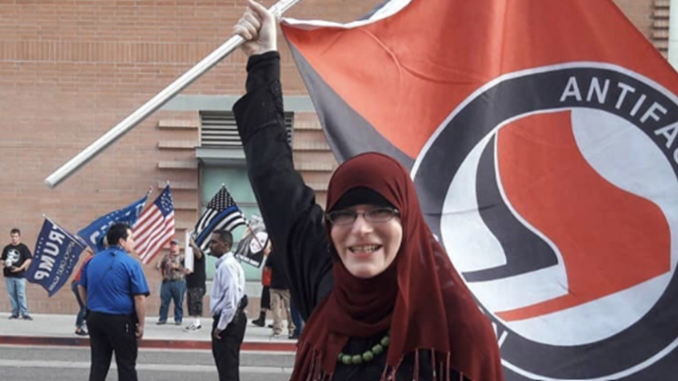
The transgender Muslim Antifa activist whom Attorney General Kris Mayes declined to prosecute for a 2024 murder has once again threatened gun violence ahead of scheduled anti-Trump protests.
Sumayyah Dawud posted the threat on Facebook last week. Dawud fatally shot Paul Franco, 51, on July 4, 2024.
By Franco’s girlfriend’s account, Franco was shot while defending Renteria from Dawud and other pro-Palestine protesters that had followed them home. By the protesters’ account, Franco instigated the confrontation, and was shot after he attacked a protester who assaulted Renteria.
In his most recent post, Dawud included a quote from Malcom X which warns that freedom doesn’t come peacefully.
“Armed resistance is the answer to oppression and violence,” said Dawud. “Not love, hugs, and peace with our enemies.”
Dawud identifies as a woman. His former aliases were Britney Erica Austin and Eric Austin.
Following Franco’s slaying, Dawud had his counsel through the People’s Law Firm submit a letter to the Maricopa County Attorney’s Office (MCAO) defending the shooting as self-defense, as reported by ABC15.
After some investigating, Phoenix Police Department (PPD) executed a search warrant on Dawud’s home. At the beginning of last year, PPD stated probable cause existed to charge Dawud with murder. Specifically, PPD recommended filing charges for second-degree murder and discharging a firearm within city limits.
Attorney General Mayes received this recommendation sometime around January 2025. The MCAO also referred the case to Mayes. Their agency recused itself because Dawud was involved in an ongoing lawsuit against them and PPD over his arrest during a Black Lives Matter riot in 2020.
Mayes’ office has not acted on those referrals. Without any charges pending, Dawud is free to attend another protest that could turn violent, based on the previous No Kings protests across the Valley last year.
Dawud issued his most recent comment advocating for gun violence just days before another series of scheduled No Kings protests are to occur.
Renteria recalled how Dawud approached Franco and shot him.
“I just remember a black shadow just walking up to Paul and then shooting him,” said Renteria.
In another post from last month, Dawud expressed a desire to burn down the planned ICE facility in Surprise.
“I am glad that ICE facility being built in Surprise was vandalized,” said Dawud. “Too bad it wasn’t burned to the f*****g ground.”
Per his social media posts, Dawud has been a constant presence at protests outside of ICE facilities.
In a recent post discussing white colonialism, Dawud made the argument that white people needed to martyr themselves for black and brown people, especially during protests. Franco, who Dawud shot, was a man of color and a father.
“White people have the most privilege. White people are occupying stolen land. And for the most part, white people don’t do s**t,” said Dawud. “There’s nothing a White person experiences here on Turtle Island that a person of color doesn’t experience ten times worse.”
Turtle Island refers to a Native American name for North America.
AZ Free News is your #1 source for Arizona news and politics. You can send us news tips using this link.
A Maricopa County judge sentenced a 21-year-old man to prison for his role in a fraud scheme that targeted elderly residents in the Phoenix area, according to the Maricopa County Attorney’s Office.
Maricopa County Attorney Rachel Mitchell announced that Jixiong Zhang was sentenced to 3.5 years in prison after pleading guilty to multiple felony charges related to the scheme.
According to prosecutors, Zhang served as a courier in a coordinated scam targeting elderly victims between October and December 2024. Victims were contacted by individuals who claimed their bank accounts or online purchases had been compromised and were instructed to withdraw large amounts of cash to protect their funds. Couriers were then sent to collect the money.
Jixiong Zhang has been sentenced to 3.5 years in prison for a fraud scheme that targeted elderly Arizona residents.
“Targeting seniors in fraud schemes is particularly cruel. These crimes steal more than money. They take away a sense of security and trust. We will continue to… pic.twitter.com/Se7Hso4PLK
— Maricopa County Attorney's Office (@marcoattorney) March 16, 2026
Authorities said the victims in the cases were 83, 93, 94, and 99 years old. Investigators determined Zhang collected or attempted to collect more than $112,500 from the victims as part of the scheme.
Zhang pleaded guilty to several felony charges across three separate cases, including theft, money laundering, and assisting a criminal organization, according to the Maricopa County Attorney’s Office.
The court ordered Zhang to pay $79,500 in restitution to the victims. He received 258 days of credit for time served, according to prosecutors.
“Targeting seniors in fraud schemes is particularly cruel,” Mitchell said in a statement announcing the sentencing. “These crimes steal more than money. They take away a sense of security and trust.”
Mitchell’s office stated that upon completion of his sentence, Zhang is “expected to face immigration proceedings.”
Investigators said fraud schemes like the one in Zhang’s case often involve impersonation tactics, in which victims receive calls or messages claiming to be from financial institutions or technology companies and are directed to withdraw funds or transfer money to protect their accounts.
Fraud targeting older adults has been the focus of increased enforcement and legislative attention in Arizona in recent years. Lawmakers have advanced legislation to address financial crimes and property-related fraud schemes targeting vulnerable residents.
Officials with the Maricopa County Attorney’s Office said they continue to investigate cases involving organized fraud operations and individuals who serve as couriers in financial scams.
The Arizona House passed a bill increasing prison time for adults who target teenagers with sexual extortion, or “sextortion.”
HB 2666 passed out of the House with unanimous bipartisan support on Monday. The bill increases the penalty for adults who commit sextortion against minors ages 15 through 17 by increasing the offense level from a class 3 to class 2 felony. It also requires sentencing to be consecutive to any other sentence imposed for sextortion.
The bill would prohibit offenders from eligibility for sentencing suspension, probation, pardon, or release from confinement unless the court-imposed sentence has been served or commuted.
Arizona statute already has sextortion of minors under the age of 15 listed as a class 2 felony.
The bill did receive an amendment to address certain concerns by stakeholders.
Vicky Lopez, an attorney with Arizona Attorneys for Criminal Justice (AACJ), spoke against the bill during its committee hearing. Lopez expressed concerns that the bill as written would provide offenders with an affirmative defense that they didn’t know their victim’s age, and that the bill failed to address the circumstance of both the offender and victim being minors.
The Arizona Anti-Trafficking Network and Maricopa County Attorney’s Office (MCAO) expressed support for the bill as written. The MCAO said it was against amending the bill.
Rebecca Baker on behalf of the MCAO rejected AACJ’s stance that this bill would provide an affirmative defense, and that minor offenders shouldn’t be held equally accountable.
“We’re talking about coerced conduct. We’re talking about one person forcing another person to have sex, and that’s analogous to sexual assault. I see that very differently than something like sexual conduct with a minor or even exchanging photos openly that are somehow later misused. This is forced conduct,” said Baker. “Regardless of whether the perpetrator is 15, 16, 17, or even 35, it’s still having that same effect on the victim.”
However, legislators who spoke up on the bill during the committee hearing seemed inclined to agree with AACJ. One committee member, Rep. Khyl Powell (R-LD14), agreed that minor offenders needed to have special considerations.
“I want discretion to be given back to judges. If we’re going to protect our juveniles who do something stupid, then we need to open up the door and give back to the judges’ discretion,” said Powell. “If we continue to mandate and we lock in these laws, then we will create additional victims.”
The bill author, Rep. Pamela Carter (R-LD4), said in a press release on Monday that sextortion of minors was an especially heinous type of exploitation that merits a harsher punishment.
“Sexual extortion is hitting Arizona teens hard, and the predators behind it know exactly what they’re doing,” said Carter. “If you prey on teens for money or sexual favors, you should face a class 2 felony and mandatory consecutive prison time. No probation. No shortcuts. No easy way out.”
Sextortion crimes occur often through social media platforms, namely Snapchat, Instagram, and Discord.
One recent case that occurred in Arizona concerned a ringleader of an online violent terror network, 764. The Tucson man arrested for those crimes, Baron Martin, was arrested in December 2024 for committing sextortion against minors. This past October, Martin was indicted on 29 charges.
AZ Free News is your #1 source for Arizona news and politics. You can send us news tips using this link.
The Maricopa County Recorder’s Office recovered $500,000 in overcharges from the federal postal agency.
County Recorder Justin Heap reported during Wednesday’s board of supervisors meeting that the United States Postal Service (USPS) had overcharged Maricopa County for “several years,” to the tune of $500,000. The recorder advised the supervisors that their office worked with USPS to recoup those lost funds.
“We discovered the United States Postal Services has been overcharging Maricopa County for quite a few years. We have worked with them, we will be receiving a refund of $500,000 from USPS to help defray the costs of everything going forward,” said Heap. “We used to give awards in this county for people who save the county money, now we get subpoenas.”
$500,000 makes up about two percent of the recorder’s budget under the 2026 fiscal year budget. It amounts to a little over one percent of the 2025 fiscal year budget.
The revelation of the recovered $500,000 emerged during a special meeting called by the board of supervisors requiring Heap to testify on the administration of his office and claims of disenfranchisement — a meeting which Heap made clear he opposed.
“This reaches to the level of administrative interference. We’re in the middle of an election, I’ve had to pull certified election officers off of this election to spend time compiling this report and these documents to comply with this demand,” said Heap.
Heap brought the report which he said contained “thousands of pages of documents” providing evidence of his office’s administration. The recorder said the compilation of this report strained his office due to the constrained timeline of less than a week.
As to the disenfranchisement claims that emerged during Maricopa County Superior Court testimony last month, Heap said the recorder’s office has struggled in previous elections to complete provisional ballots under the condensed time frame. In order to solve that problem, Heap asked the board for an Agilis sorting machine. That sorter would cost just under $600,000.
The recorder said relying on Runbeck for provisional processing wouldn’t be advisable considering their company doesn’t connect to the county’s voter database, and the requirement of transporting the ballots to Runbeck would expose the county to chain of custody complications.
Heap said disenfranchisement hasn’t occurred “so far this year” under his administration, and that claims made during court testimony were referencing past administrations. One of the staff members who cited disenfranchisement during their testimony, chief of staff Sam Stone, retained his own counsel.
Supervisor Thomas Galvin asked Heap to explain why the Maricopa County Attorney’s Office (MCAO) said they had not approved universal mail-in ballots during last year’s congressional district 7 special election, when the recorder’s office said they had.
Heap rejected the characterization of those mail ballots. He said his office only made a proposal to send ballots to a selection of 3,000 voters who lacked a polling place, but didn’t act on it.
“This proposal was not even put in our plan to the MCAO, and we never implemented it, I’m not sure why the board has continued to hang up on a proposal that was never actually implemented,” said Heap.
AZ Free News is your #1 source for Arizona news and politics. You can send us news tips using this link.
A Maricopa County man was indicted for falsifying signatures for last year’s ballot petition to legalize abortion.
53-year-old Anthony “Tony” Lee Harris — who appears to be registered as a Democrat per voter records — was charged with two felonies and eleven misdemeanors for falsifying the signatures: one count of aggravated taking identity of another, one count of fraudulent schemes and practices, one count of circulator registration violation, and ten counts of petition false signature.
Harris falsified the signatures to help qualify Proposition 139 for the November ballot, or the Arizona Abortion Access Act (AAAA). The proposition passed with over 61 percent of the vote (over two million voters for the measure versus over 1.2 million against).
Maricopa County Attorney Rachel Mitchell clarified in a press release issued Tuesday that the “dozens” of falsified signatures submitted by Harris weren’t large enough to disqualify the initiative from the ballot.
AAAA activists submitted over 823,000 signatures to qualify the petition for the ballot last July. The secretary of state’s office verified about 578,000 of those signatures. The initiative required just shy of over 384,000 signatures to qualify for the ballot.
Harris was ineligible to work as a petition signature gatherer “despite past convictions,” per the Maricopa County Attorney’s Office (MCAO). Yet, last April, Harris registered as a circulator for AAAA.
Past arrest records show another individual with the same name and birth date as Harris previously faced charges for armed robbery and kidnapping over a decade ago.
Arizona law prohibits individuals from registering as a circulator if they: have a civil or criminal penalty imposed for violating petition circulation law; have a conviction for treason or a felony and have not had their civil rights restored; or have a criminal offense conviction involving fraud, forgery, or identity theft.
Before the secretary of state considers a circulator to be properly registered, the applicant must submit a notarized affidavit of eligibility.
According to the secretary of state’s circulator portal, Harris worked as a paid circulator for Fieldworks LLC under circulator ID AZ89842. Harris was one of over 2,300 petition circulators paid by Fieldworks for the AAAA petition.
Per his circulator registration, Harris was added to the system on April 19 of last year. The indictment alleges Harris forged the signatures just days after his registration, between April 22 and 27 of last year.
Harris wasn’t the only one indicted this year for falsifying signatures for the abortion ballot initiative. The MCAO indicted another Democrat, Michele Brimmer, 52, with five felonies and nine misdemeanors in association with her alleged crimes. Again, the MCAO said Brimmer’s signatures didn’t impact the qualification of the proposition for the ballot.
“I want to make it clear that the number of signatures we are talking about would not have made a difference as to whether this proposition got on the ballot,” said Mitchell in the February press release announcing Brimmer’s indictment. “That said, we are talking about a case that involved fraudulent signatures placed on an election petition. That is a crime, and it undermines public trust in elections. It will not be tolerated and those who engage in such conduct will be held accountable.”
Brimmer was also a paid circulator for One Fair Wage Action’s initiative, Raise the Wage AZ. The signatures for this initiative were withdrawn following challenges to their validity in August.
AAAA received and spent over $36 million on their initiative, respectively. Over $9.2 million went to Fieldworks for signature gathering.
AZ Free News is your #1 source for Arizona news and politics. You can send us news tips using this link.