Of all the organizations tasked with overseeing Black Lives Matter’s millions, it was a nonprofit based in Tucson.
Alliance for Global Justice (AFGJ) handled over $36 million for Black Lives Matter (BLM) organizations: the controversial network facing scrutiny for the use of its funds. That $36 million was part of nearly $50 million handled on behalf of bail funds, other social reform organizations, and campaigns to free “political prisoners.”
Prior to 2020, this 24-year-old nonprofit was a lesser-known controversial group that averaged $3.1 million in revenue every year. Then, like many other social justice organizations, AFGJ’s revenues flooded with millions following George Floyd’s death and the BLM riots that swept the nation.
— Alliance for Global Justice (@All4GlobalJust) June 3, 2020
AFGJ’s History
AFGJ was established in 1998 by the Nicaragua Network, which was founded to support the socialist Sandinista regime and armed revolution. Key members of their leadership include Sandinistas, as documented at length by the Capital Research Center.
AFGJ’s express mission is to overhaul current social and economic systems to achieve justice, citing the current concentrations of wealth and power as the cause of all oppression. AFGJ maintains a list of “Political Prisoners,” or “prisoners of Empire,” for whose freedom or exoneration they advocate for: namely, murderers, terrorists, and other extremists, such as members of the Black Panther Party; BLM rioters; Ana Belen Montes, a 9/11-era Cuban spy; and Daniel Baker, an antifa activist.
AFGJ’s issuance of funds aligns with their mission to upend American law and social norms.
Over the years, AFGJ has funded a number of controversial organizations, including Fronterizo Fianza Fund (now Froterizx Fianza Fund): they bail out detained illegal immigrants to free them into the country. AFGJ has funded and serves as a fiscal sponsor of Assata’s Daughters: the Marxist revolutionary group dedicated to infamous cop killer and FBI Most Wanted Terrorist, Assata Shakur.
Comparisons of other tax filings by research groups revealed that AFGJ has received past funding from a number of major left-wing dark money benefactors, including George Soros and the Tides Foundation. However, AFGJ hides its donors from disclosure.
Once 2020 hit, the prior millions from these major benefactors became paltry by comparison.
Movement for Black Lives (M4BL): $30.6 million
The organization that received the majority of this influx was Movement for Black Lives (M4BL), a coalition of BLM and its affiliates for which AFGJ acted as a fiscal sponsor. That meant that it managed M4BL’s finances in exchange for an eight percent commission on revenues.
AFGJ’s fiscal sponsorship for M4BL ended on either January 6 or 7, 2021 — right as the Capitol invasion unfolded. After January 6, the Common Counsel Foundation became the listed fiscal sponsor on M4BL’s website.
AFGJ also issued over $145,000 to “Persist M4BL” in 2020, an advocacy arm of M4BL.
M4BL claims to be a coalition of over 50 member organizations. Although M4BL doesn’t reveal the names of these organizations, in the past it advertised the membership of the Black Lives Matter Foundation, or the “Black Lives Matter Global Network Foundation” — known simply by most as “BLM.”
According to their respective 2020 tax filings, M4BL and BLM headquarters were one mile apart: a mere five-minute drive without traffic. M4BL’s address was 1624 Franklin St, Oakland, CA 94612, and BLM’s address was 248 3rd St, Oakland CA 94612.
However, different addresses for BLM’s headquarters exist. The filing uploaded in May on BLM’s website displays the Oakland, California address just one mile away from M4BL, while the filing scanned into the IRS website in June displays the Elias Law Group address in Washington, D.C.
Elias Law Group is the firm belonging to Marc Elias: the Democratic Party’s top lawyer, infamous for his central role in Russiagate. Presently, where election-related controversy ensues, Elias is sure to appear. Elias’ firm stated on BLM’s IRS filing that it presently keeps all of BLM’s books and records.
BLM also listed a different address for its headquarters on its 2019 IRS form: a nonexistent address, as reported by The Washington Examiner in January. An unidentified BLM spokesperson told The Examiner that they don’t maintain a permanent office at the time.
BLM’s Exploited Millions
Floyd, the man whose death sparked nationwide racial unrest and boosted the fundraising for organizations like AFGJ, wasn’t the beneficiary of any of the BLM funds. As the “The Greatest Lie Ever Sold” documentary noted, Floyd’s roommates struggled to cover the portion of rent Floyd could no longer pay. They also couldn’t afford to pay a towing service to remove Floyd’s car from the driveway.
BLM reportedly didn’t offer Floyd’s roommates any financial assistance.
Prior to the release of the documentary, BLM dismissed the exposé as a “white supremacy” initiative. The woman behind the documentary is Candace Owens, a Black woman.
Today (or someday soon) Candace Owens will release a purported “documentary” that will attempt to further divide Black people and uplift white supremacy.
BLM co-founder and then-executive director Patrisse Cullors bought mansions for $3 million according to the New York Post, and then BLM secretly bought another mansion for around $6 million according to New York Magazine. That mansion, where Cullors resides, hosted several lavish parties, including a birthday party for her son and a celebration of President Joe Biden’s inauguration.
BLM paid Cullors’ brother $841,000 for security services; prior to 2020, her brother worked as a graffiti artist. BLM also paid the father of Cullors’ child, Damon Turner, nearly $970,000 to “produce live events” and nondescript “creative services.”
As The New York Post reported, over $8 million went to M4BJ: a Canadian nonprofit run by Cullor’s wife, Janaya Khan. Of that funding, $6.3 million was used to buy a mansion in Toronto, Canada.
$2.6 million went to LGBTQ organizations, namely transgender organizations. Just as with the other millions, a number of these organizations applied the funds toward real estate.
One of the LGBTQ organizations was Black Trans Media, a Brooklyn, New York organization whose fiscal sponsor is AFGJ.
AFGJ Fiscal Sponsorship: $49.6 Million
“AFGJ acted as fiscal sponsor for 19 groups affiliated with Black Lives Matter, Movement for Black Lives, bail funds, and long-existing prison abolition or reform organizations and campaigns to free political prisoners.” (AFGJ’s program service accomplishments disclosure, 2020 tax filing)
AFGJ’s fiscal sponsorship organizations circulated nearly $50 million in 2020. This was unprecedented. Prior to 2020, these organizations came nowhere near millions in revenue. Based on AFGJ’s commission rate on contributions, that would amount to around $4 million at least.
AFGJ served as a fiscal sponsor for three bail funds: Colorado Freedom Fund, Bukit Bail Fund, and Action Bail Fund New York. Altogether, these three bail fund organizations received over $2.8 million. According to AFGJ’s previous tax filings, none of the three bail funds received any funding from AFGJ in the past.
Action Bail Fund New York, which received over $417,000, lists its headquarters at the same address as AFGJ.
Notably, one bail fund organization that AFGJ donated to in 2020, but wasn’t a fiscal sponsor for, received half of what it got in 2019.
On its website, AFGJ states that it serves as a fiscal sponsor for 121 organizations.
BLM Chapters in Oklahoma City and Louisville: $5.4 million
BLM Oklahoma City (OKC) received the bigger cut of the two funds: $4.25 million even. AFGJ also serves as BLM OKC’s fiscal sponsor.
In the summer of 2020, BLM OKC posted around $3.5 million in bonds to release BLM rioters. Last June, BLM OKC posted a $400,000 bond for a man charged for murdering a man allegedly breaking into his unlicensed marijuana business.
BLM Louisville received shy of $1.2 million.
In February, BLM Louisville bailed out murder suspect Quintez Brown with $100,000. Brown was the 21-year-old activist accused of attempting to murder Craig Greenberg, then the mayoral candidate for Louisville and now mayor-elect.
BLM Louisville, who quickly paid the $100k to bail out attempted murder suspect Quintez Brown, says they're fully community funded. But they're fiscally sponsored by the Alliance for Global Justice. AfGJ receives money from Soros' Open Society Foundations.https://t.co/nNRRWiZ4Rrpic.twitter.com/BQ9X988hsK
BLM Louisville organizer Chanelle Helm, co-founder of their bail fund, toldWAVE that Brown was likely suffering from PTSD caused by two years of social unrest and the COVID-19 pandemic.
“They are calling for this individual, this young man who needs support and help, to be punished to the full extent,” stated Helm. “It is a resounding message that people are down for the torture that has taken place in our jails and prisons.”
Other Work
As part of the nearly $50 million in fiscal sponsorship funds managed, AFGJ noted that it published an e-book, “A Year in Review: Racism, Repression, and Fightback.” It’s an in-depth documentation of the racial riots of 2020.
Read our November “2020: Racism, Repression and Fightback” report highlights here: https://t.co/aCaBzG78wz
One lawmaker has a solution to the ballot drop box watcher controversy in Maricopa County, but the recorder says they won’t be modifying their operations.
State Senator Michelle Ugenti-Rita (R-Scottsdale) proposed removing the two controversial drop boxes situated outdoors, leaving voters with the drop boxes located indoors. However, Maricopa County Recorder Stephen Richer told AZ Free News that removing the two controversial drop boxes would be surrendering to cancel culture, not assuaging voter tensions. Richer explained that outdoor drop boxes enabled a 24/7 option for returning early ballots, whereas drop locations inside government buildings are limited to business hours.
“I don’t believe in surrendering to cancel culture. I don’t believe that we should cave to intentionally disruptive behavior (as some of the watchers appear to be; others not). I don’t think ASU should cancel speaker events because some people protest,” said Richer. “I don’t think the county should change the voting plan that has been in place for many months now — and that worked successfully for the August primary — because of these people.”
I tried to ban drop boxes last session. At a minimum, the county should remove the 2 outside drop box locations before someone gets hurt. Problem solved.
Ugenti-Rita proposed her solution on Sunday. By Monday, the Democratic Party’s top election lawyer renowned for his role in the Russiagate hoax, Marc Elias, had jumped into the Arizona elections ring again — ensuring that Arizona’s elections are once more the center of national attention.
Outdoor drop boxes have been the source of numerous complaints of voter intimidation and voter fraud this election season. Secretary of State Katie Hobbs announced in a press release on Monday that her office referred six complaints of voter intimidation to the Department of Justice (DOJ).
Arizona police were called to investigate 2 individuals parked near a ballot drop box Friday night, dressed in tactical gear & armed with guns. The Maricopa County Sheriff's Office said they were not breaking any laws because they were more than 75 feet away from the ballot box.
Those seeking to report voter intimidation may call 1-877-THE-VOTE or access Arizona.Vote. Those seeking to report voter fraud may submit their complaint to the attorney general here.
Elias sued to stop Arizona’s ballot drop box watchers on behalf of the Arizona Alliance for Retired Americans and Voto Latino against Clean Elections USA. The nonprofits allege that the drop box surveillance amounts to voter intimidation prohibited by the Voting Rights Act (VRA) and the Ku Klux Klan Act of 1871.
. @marceelias sounds an encouraging note on the speed with which the court is responding to the lawsuit against Arizona ballot box vigilantes. pic.twitter.com/ketOafu29B
Elias and the two leftist nonprofits have been busy resisting Republican-led changes to election law. In August, the pair sued to stop SB1260, a bill enacted in June to clean up the state’s voter rolls. The Arizona District Court issued a temporary injunction against provisions of the bill enforcing voter registration cancellation for those who register to vote in another county and issuance of felony charges against those who facilitate voter fraud, but didn’t block removals from the Active Early Voting List (AEVL). Elias’ team appealed.
In March, Elias’ law group sued on behalf of Voto Latino as well as Mi Familia Vota against HB2492, a bill signed into law earlier this year requiring proof of citizenship in order to vote (though it won’t go into effect until 2023). The Arizona District Court is hearing that case; at present, the court is considering the state’s motion to dismiss.
In that case, Elias and the nonprofits have the Biden administration’s support: in July, the DOJ sued the state over the new law. DOJ Assistant Attorney General Kristen Clarke claimed that Arizona’s required proof of citizenship to vote was “onerous” and “unnecessary.”
Prior to this year, Elias only represented Voto Latino in one other case: a 2020 lawsuit against Hobbs to extend the state’s mail-in ballot deadline. Although Elias’ team was unsuccessful in extending the mail-in ballot deadline, they did get Hobbs to expand Hispanic voter outreach efforts and increase funding for early voting across different counties.
Corinne Murdock is a reporter for AZ Free News. Follow her latest on Twitter, or email tips to corinne@azfreenews.com.
We have always known that the left is strongly opposed to election integrity. In their hearts, they want voting to resemble how they select the best performers on American Idol—no security, no ID, no paper ballots, and no concern if someone decides to vote a few extra times.
Usually though, the left is pretty good at not saying this out loud. They couch their desires as supporting “voter access” or “expanded voting rights.” Very rarely do they reveal their true intentions of supporting open fraud in the system—yet they have now. And in open court no less…
The legal team under the Democratic Party’s top election lawyer, Marc Elias, is suing to keep Arizona’s voter rolls as they are, even if they’re rife with ineligible voters.
According to a lawsuit filed on Monday, the legal team argued that SB1260, which Governor Doug Ducey signed into law in June, infringed on the right to vote as well as the rights of free speech and association. SB1260 requires county recorders to cancel voter registrations for persons registered to vote in another county, and makes it a felony to help cast a vote for an individual registered out of state.
Elias’ team claimed that SB1260’s language made it too easy for individuals or organizations to petition for the cancellation of voter registrations en masse. They asserted repeatedly throughout their complaint that it’s common for voters to have active registrations in more than one county, or even state.
“Though voting in more than one state is illegal, it is perfectly legal to be registered to vote in more than one state or more than one county in Arizona. In fact, it is quite common,” argued the lawyers.
Additionally, Elias’ team expressed a lack of confidence in the ability of county officials to cancel voter registrations upon request. They insisted that people who move frequently would be burdened by the new election integrity law.
“Being registered to vote in more than one state or county is not prohibited, and for good reason,” argued the lawyers. “People do not ordinarily think to affirmatively cancel their voter registration when they move, and there often is no obvious or easy way to do so. Nor is there any assurance that a jurisdiction will actually cancel a voter’s registration immediately upon receiving a request.”
Elias’ firm filed suit on behalf of the Arizona Alliance for Retired Americans, Voto Latino, and Priorities USA against Secretary of State Katie Hobbs, Attorney General Mark Brnovich, and all county recorders. Elias Law Group attorneys Aria Branch, Daniel Cohen, and Joel Ramirez joined Phoenix-based Roy Herrera of the Herrera Arellano firm to file the lawsuit.
Elias’ team posited that the felony provision of SB1260 would criminalize voter registration efforts made by the three plaintiff organizations, or even by a voter’s parents in the case of college students.
Elias offers updates on this and other election-related court cases via his media platform established in 2020, Democracy Docket.
Another lawsuit was filed on Monday challenging a separate election law in Arizona, HB2492 which requires individuals to provide proof of citizenship when registering to vote. The Biden administration filed a similar lawsuit against the state early last month. The Scottsdale-based firm Papetti Samuels Weiss McKirgan and Washington, D.C.-based firm WilmerHale filed the latest lawsuit on behalf of the Democratic National Committee (DNC) and Arizona Democratic Party.
Corinne Murdock is a reporter for AZ Free News. Follow her latest on Twitter, or email tips to corinne@azfreenews.com.
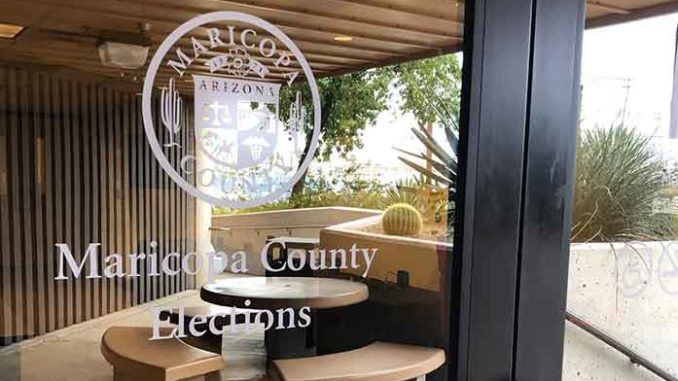
Maricopa County will operate 212 vote centers for the August 2022 primary — double what they had in 2020. By the general election, that number will increase up to 225; 14 of which were converted from outside drop boxes into full vote centers. The county promised to mail voters information about the closest vote centers.
The catch-all, “vote anywhere” system allowing voters to cast ballots at any location rather than a designated precinct has sparked controversy, with critics alleging that it makes fraud easier; namely, ballot harvesting. Voters may drop off their early ballots at vote centers.
Legislators made an attempt to prohibit vote centers. One such bill from State Senator Wendy Rogers (R-Flagstaff), SB1338, would’ve reinstated precinct voting as well as paper ballots and hand counting. It advanced out of one committee in the senate, but no further.
Another bill, HB2238 from State Representative Jake Hoffman (R-Queen Creek), sought to eliminate emergency vote centers. It failed in the Senate.
The county adopted vote centers amid the pandemic in 2020. They also released an informational video featuring their $10,000 “Phil the Ballot” mascot.
Pima County decided to follow in Maricopa County’s footsteps this year. They will halve their operations from nearly 280 voting precinct locations to 129 vote centers.
Democracy Docket, the brainchild of Hillary Clinton’s Russiagate hoax lawyer Marc Elias, congratulated Pima County for adopting vote centers.
Pima County, Arizona is making voting easier and more accessible by approving 129 vote centers.👏
Pima voters will be able to cast their ballot at any vote center in the county as opposed to precinct-specific polling locations.🗳https://t.co/LyI1GBtspG
Arizona allowed vote centers to be used rather than precincts beginning in 2011.
With less than a month to go before ballots hit mailboxes, Maricopa County Recorder Stephen Richer issued an announcement on Thursday about their increased number of vote centers.
Maricopa County will have 212 vote centers for the August 2022 primary. These vote centers can be used by any registered county voter.
— Stephen Richer—Maricopa Cnty Recorder (prsnl acct) (@stephen_richer) June 2, 2022
Republican National Committee (RNC) leader Tyler Bowyer criticized the county’s decision.
This is awful. Vote centers are terrible for election integrity and should not be implemented without a way for the recorders office to reorganize all ballots physically at the tabulation center. It’s a legitimate issue for hand counting actual precincts. https://t.co/NhIJ7kOeQX
Prior to 2020, contentions with vote centers concerned the fact that there were less of them than there were polling places. Some voter rights watchdog organizations expressed concern that the reduced number of voting sites would pack an adverse, disproportionate impact on minority and low-income voters.
Mailed ballots will be sent out on July 6. A complete list of all vote center locations will be made available on the Maricopa County website approximately 45 days before the election according to the county’s election plan — at some point later this month.
Corinne Murdock is a reporter for AZ Free News. Follow her latest on Twitter, or email tips to corinne@azfreenews.com.