by Daniel Stefanski | Jun 22, 2023 | News
By Daniel Stefanski |
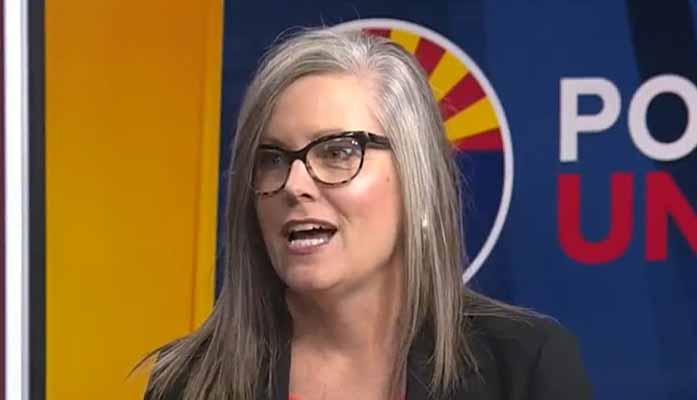
On Tuesday, Governor Katie Hobbs vetoed the Republican-led Prop 400 legislation, which was transmitted to her office last week.
Hobbs provided a statement on Twitter, justifying her decision, writing, “I just vetoed the partisan Prop 400 bill that fails to adequately support Arizona’s economic growth and does nothing to attract new business or create good-paying jobs. I strongly encourage the Legislature to vote on the compromise supported by a bipartisan majority in the House and Senate, business and labor leaders, and Maricopa County Mayors.”
Mesa Mayor John Giles, a Republican, praised the governor for her decision. Giles stated, “Thank you, Governor Hobbs, for your veto. We hope the Legislature will reconsider the cities’ Prop 400 compromise bill, to deliver quality-of-life benefits for all residents and strengthen our economy. Cities are committed to getting a balanced, multi-modal plan to the voters.”
On the other side of the political aisle, Democrat Mayor Kate Gallego also expressed her gratitude for Hobbs’ veto, tweeting, “Thank you, Governor Hobbs. We need a transportation plan that will support economic growth for years to come, and that’s not what this bill would have delivered. It’s time for the legislature to pass the plan that’s been endorsed by all our region’s mayors and tribal leaders.”
A spokesperson for the Arizona Senate Republican caucus told AZ Free News, “We put a good bill on her desk that passed with Majority support. Her and MAG’s proposal doesn’t have the votes she claims it does. We’re willing to come back to the table to negotiate in good faith, and we will consider all reasonable requests, but we won’t vote on a plan that doesn’t focus the majority of taxpayer dollars towards freeways and roads, which are the transportation options our citizens rely on to get to and from on a daily basis.”
SB 1246, as amended, passed the state house with a 31-26 vote (three members not voting) and the state senate with a 16-12 tally (two members not voting).
After the Legislature passed its proposal, the Arizona Freedom Caucus released a statement, touting the plan and calling on the governor to sign the bill on her desk. The Caucus wrote, “The passage of the conservative Prop 400 plan is a major victory for Valley commuters and taxpayers by fully funding highways and arterial roadway projects, eliminating any opportunity for the expansion of the utterly failed light rail system, and providing a guaranteed tax cut of $241 million. Additionally, the conservative Prop 400 plan provides voters the opportunity to cut their sales tax at the ballot box by more than $3.37 billion. Unlike the MAG and Hobbs’ plans, the conservative Prop 400 plan properly prioritizes building better freeways and roadways while simultaneously reducing commute times, traffic congestion, and taxes – a true win-win.”
A bipartisan group of Valley mayors, however – including Gallego and Giles – issued a statement last week to denounce the Republican legislators’ plan for Prop 400 and to threaten to circumvent the House and Senate. The six mayors stated that the Republican lawmakers’ “priorities involving transportation just don’t mesh with the realities of where we are as the fastest-growing county in the U.S. We are unalterably opposed to their plan, and if no solution is reached, we will have no choice but to get this before voters in 2024.”
House Speaker Ben Toma has taken exception to Hobbs’ public comments and negotiating abilities over Prop 400, telling reporters previously, “The Governor has chosen to be an uncompromising conduit for an inefficient MAG proposal that does not have sufficient votes to succeed in the House. I remain willing to negotiate, but their take-or-leave-it attitude is decidedly unproductive.”
Last month, the governor created unrest over ongoing negotiations, allegedly sending out a tweet that highlighted her fight with Republicans at the Legislature at the same time she was meeting with Senate President Warren Petersen.
Daniel Stefanski is a reporter for AZ Free News. You can send him news tips using this link.
by AZ Free Enterprise Club | Jun 13, 2023 | Opinion
By the Arizona Free Enterprise Club |
The Prop 400 package put together by the Maricopa Association of Governments (MAG) is in serious trouble at the legislature, and Katie Hobbs and the transit lobby knows it. So, in a desperate attempt to rescue their defective plan, they have phoned a friend to see if a little legacy media pressure will improve their flagging fortunes at the Capitol.
In recent weeks, the AZ Republic has unleashed a torrent of articles and opinion pieces attempting to scare the legislature into sending their transit slush fund package up to Hobbs’ desk. Most of their writings have been nothing more than recycled talking points from MAG and transit industry lobbyists attacking conservative lawmakers and critics (like the Club) for opposing a plan that slashes freeway funding and increases traffic congestion in the region.
A couple weeks ago it was in the form of an editorial that claimed to disprove our Prop 400 criticism by “relitigating” the merits of bus and light rail and proving its value in the region. And now over the weekend, their opinion writers couldn’t race out fast enough to promote the press release issued by Katie Hobbs and the transit lobby that the legislature needs to adopt a fake “compromise” MAG plan.
In short, their efforts to “relitigate” the merits of transit or to declare that there is any type of “compromise” only demonstrate how radical their position really is.
Here are just a few examples of how the Republic has veered from journalism to being nothing more than a lobbying arm of the transit lobby:
>>> CONTINUE READING >>>
by AZ Free Enterprise Club | Jun 3, 2023 | Opinion
By the Arizona Free Enterprise Club |
Last legislative session our organization led the opposition to the Maricopa Association of Governments’ (MAG) Prop 400 sales tax extension, SB1356, criticizing the plan for its massive expansion of transit spending, lack of oversight, and vague allocations of spending that amounted to a slush fund for government bureaucrats. It was astonishing the lack of answers we received to simple questions about the plan and how funds would be spent.
We suspected at the time that we weren’t being told the whole story and that ulterior motives were at play. Only now do we know how right we were.
Governor Ducey’s veto of MAG’s defective Prop 400 plan provided a reset of the Prop 400 debate. Coupled with new legislative leadership not beholden to MAG and the transit lobby, they could no longer avoid a debate of their unvetted proposal. So, after several months of legislative hearings and substantive meetings at the Capitol, what critical information has MAG been hiding from lawmakers and the public?
>>> CONTINUE READING >>>
by Daniel Stefanski | Apr 6, 2023 | News
By Daniel Stefanski |
As many California residents head east to Arizona in response to policies they find objectionable, Maricopa County appears to be taking a leap toward adopting some of those same policies.
The Maricopa Association of Governments (MAG) recently contracted with a California-based consulting firm to “identify and evaluate new and available ozone precursor control measures that could be implemented within the nonattainment area” – which is an “eight-hour ozone boundary for the 2015 ozone standard (2015 National Ambient Air Quality Standard). According to the Final Report from the consulting firm, the area runs north to south from the Yavapai County line to Hunt Highway; and west to east from 499th Avenue to the Gila and Pinal County lines.
One of the geneses of this report stems from a little-discussed published rule from the U.S. Environmental Protection Agency (EPA) in fall 2022, which moved “the region up the severity ladder for ozone pollution, reclassifying the region from ‘marginal’ to ‘moderate’ nonattainment for the ozone pollution standard.
In a press release dated September 2022, MAG revealed that “in 2015, the EPA tightened the ozone pollution standard from 75 parts per billion to 70 parts per billion,” and that the region encompassing “Maricopa County and portions of Pinal County missed that deadline.”
MAG wrote in the September release, that “the moderate nonattainment area classification requires new actions and measures, including:
- New control measures to reduce the types of emissions that create ozone.
- Emission offset requirement for new, large facilities locating in the nonattainment area and major expansions to large, existing facilities, which are required to offset every ton of emissions by 1.15 tons.
- Contingency measures (i.e., measures to be deployed if the nonattainment area does not meet yearly emission reduction milestones).
- Potential emission controls for intrastate facilities or other emission sources located outside the Phoenix-Mesa nonattainment area.”
Enter the consultant’s Final Report this spring, which suggested “approximately 50% reduction in nonattainment area anthropogenic NOx and VOC emissions” in order to bring the region into compliance with the EPA’s standard by an August 3, 2024, deadline. An Arizona Department of Environmental Quality Division Director recently admitted that “Maricopa County businesses and residents have done a fantastic job of reducing ozone pollution by 12.5 percent since 2000.” But Maricopa County would have to exponentially and substantially pick up the pace of slashing emissions in just over one year – compared to the two-plus decades of work to cut pollution by 12.5 percent. And that is likely impossible.
But MAG is still planning to move forward with this plan, and to meet this deadline, it included suggested measures to reduce ozone in the Maricopa Nonattainment Area to meet Clean Air Act requirements related to the 2015 ozone standard. Some of the suggested measures include adopting standards similar to California like banning the internal combustion engine, banning gas appliances, and a host of regulations on various business activities.
There is a tight turnaround for approval of these drastic measures to cut emissions in Maricopa County. Before the end of April, the “MAG Regional Council may approve the Draft Suggested List of Measures” after receiving recommendations from the MAG Management Committee. Then, over this summer, “implementing entities provide commitments to implement measures, or reasoned justification for non-implementation, to MAG for inclusion in a nonattainment area state implementation plan submission to EPA.”
The EPA guidance instructs that “states should consider all available measures, including those being implemented in other areas, but must adopt measures for an area only if those measures are economically and technologically feasible and will advance the attainment date or are necessary for reasonable further progress.” According to the March 6 Draft Suggested List of Measures to Reduce Ozone in the Maricopa Nonattainment Area, “if an entity decides that a measure on the Suggested List is not available or feasible for implementation, the entity will provide a justification for why the measure is not available or feasible.”
Cities, towns, and Maricopa County may soon be forced to decide between complying with extremely onerous measures to bring down a tremendous amount of emissions in a hurry or losing out on a generous offering of federal dollars (along with financial penalties that could be levied against those jurisdictions), setting up a potential battle over federalism that will determine Maricopa County’s (and eventually Arizona’s) commitment to its libertarian and freedom-minded roots or deviation to California’s environmentalism policies and politics.