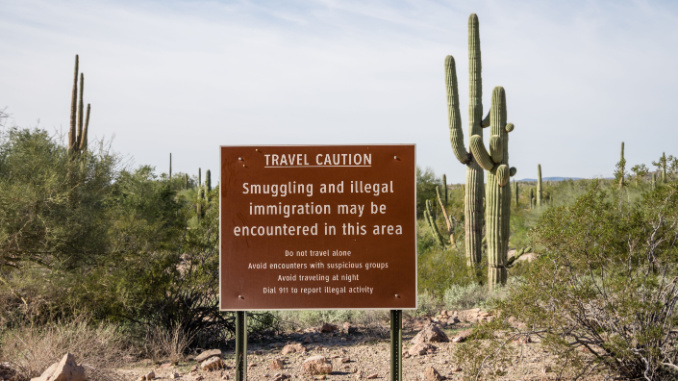
Arizona Senate President Warren Petersen hailed a “victory for Arizona” on Monday after Maricopa County Superior Court Judge Michael Valenzuela dismissed all challenges to the Secure the Border Act — a voter-approved initiative known as Proposition 314.
The ruling, issued October 10 and electronically filed October 13, upheld the will of voters who passed the measure in November 2024. In a statement on X , Petersen said the decision upheld “the will of voters who passed Prop 314 to protect our communities from illegal crossings and fentanyl,” calling border security “non-negotiable.”
“President Donald Trump truly delivered the most secure border in U.S. history,” Petersen wrote. “If our nation ever sees a repeat of lawlessness from an administration like we witnessed with Biden-Harris, Arizona will be ready to uphold the rule of law.”
🚨 VICTORY for Arizona!
Today, Maricopa County Superior Court dismissed baseless challenges to the Secure the Border Act—upholding the will of voters who passed Prop 314 to protect our communities from illegal crossings and fentanyl. Border security is non-negotiable.…
The lawsuit, Living United for Change in Arizona et al. v. State of Arizona, challenged several provisions of Proposition 314, arguing the law violated Arizona’s constitution. Plaintiffs included Living United for Change in Arizona (LUCHA), the Arizona Center for Empowerment, and two individual plaintiffs.
According to court documents, the Secure the Border Act — approved by voters and enacted in November 2024 — created new state laws addressing immigration enforcement and public benefits eligibility.
Judge Valenzuela’s 10-page ruling rejected all three counts brought by the plaintiffs, determining that counts 1 and 2 were not “ripe” for review, as the challenged provisions are not currently enforceable; plaintiffs lacked standing to bring certain claims, particularly regarding separation of powers and legislative delegation arguments; and the SAVE Provision did not violate Arizona’s Revenue Source Rule, because participation in the federal verification program does not impose costs on state or local agencies.
The court concluded that the plaintiffs’ complaint “fails to state a claim on which relief can be granted” and dismissed it with prejudice, making the decision final under Arizona civil procedure rules.
The ruling allows Proposition 314 to stand as enacted by voters, although parts of the law will remain unenforceable until triggered by developments in Texas or another state with similar legislation. The decision represents a significant victory for Arizona lawmakers who championed the measure, including Petersen and House Speaker Steve Montenegro, both of whom intervened in defense of the law.
Supporters say the ruling reinforces Arizona’s right to protect its borders and uphold voter-approved laws. For now, however, the court’s dismissal marks a legal and political win for backers of Proposition 314 — and for state leaders pushing for stricter border enforcement at the state level.
Jonathan Eberle is a reporter for AZ Free News. You can send him news tips using this link.
On Monday, Arizona lawmakers joined activists in hosting an anti-deportation discussion panel at South Mountain Community College.
The event, “Resisting Mass Deportation,” featured State Senator Catherine Miranda (D-LD11) and State Representative Brian Garcia (D-LD08) along with American Civil Liberties Union (ACLU) of Arizona executive director Victoria Lopez, Living United for Change in Arizona (LUCHA) Arizona members, and Arizona Luminaria staff writer John Washington (also the author of the books “The Dispossessed: A Story of Asylum at the US-Mexico Border and Beyond” and “The Case for Open Borders”).
The ACLU of Arizona and LUCHA Arizona arranged the panel.
“Trump’s mass deportation agenda has oversaturated the news. His administration is pushing the moral and legal bounds of our country to expedite deportations, disregarding people’s rights and humanity in the process,” read the ACLU event page. “At the same time, the Arizona state legislature is advancing several bills that would force our state to do the anti-immigrant bidding of the federal government, use state resources to fuel the mass deportation machine, incentivize police to prioritize immigration enforcement over public safety, and more.”
A press release from the ACLU described the panel as a means of organizing “to take direct action to stop anti-immigrant legislation advancing in the state legislature.”
One such bill of concern for the anti-deportation faction is SB1164, the “Arizona ICE Act.”
The Arizona ICE Act would enable officials or agencies of Arizona or a county, city, town, or other political subdivision to enter into agreements with any federal agency for the purpose of enforcing federal immigration laws. The legislation would also prohibit officials or agencies of Arizona as well as counties, cities, towns, or other political subdivisions from establishing, adopting, or enforcing “any policy, pattern, or practice” that hinders cooperation with federal immigration authorities in immigration enforcement. SB1164 also allowed local governments to access federal resources and state agencies to issue grants for purposes of immigration enforcement.
The House Government Committee passed the Arizona ICE Act last week.
Miranda, who co-chairs the Latino Legislative Caucus, spoke out against the bill recently. She claimed the bill would only “worsen public safety.” Miranda expressed confidence in Governor Katie Hobbs’ intent to veto the bill.
“Arizona knows from experience that encouraging local agencies to engage in federal immigration enforcement will lead to racial profiling and discrimination, particularly against Hispanic, Latino, and other immigrant communities,” said Miranda.
🚨 Bad bill alert: watch State Senator and Latino Caucus Co-Chair Catherine Miranda (LD11) talk about SB1164 or the Arizona ICE Act and how it will harm Arizona’s communities. pic.twitter.com/y7spIFaC1O
— AZ Latino Legislative Caucus (@AZLatinoLC) March 27, 2025
Hobbs’ lack of support for the bill would conflict with her recent pledge last month to secure the border and reduce illegal immigration. Hobbs issued an executive order reminiscent of her predecessor, Doug Ducey, which directed the Arizona Department of Public Safety and Arizona Department of Homeland Security to create a joint task force, Operation Desert Guardian, to expand border security. The task force partners with the federal government and local law enforcement to stop transnational crime organizations within the border counties.
Under the Trump administration, border encounters dropped by over 90 percent and drug smuggling has slowed tremendously. Cochise County Sheriff Mark Dannels confirmed as such in a recent interview with KTAR News.
“Whether you like Trump or not, it’s irrelevant. It’s working,” said Dannels.
AZ Free News is your #1 source for Arizona news and politics. You can send us news tips using this link.
Major cities nationwide resounded with this chant in the weeks following President Donald Trump’s inauguration. Pro-illegal immigration activists took over the streets with protests bordering on riots and engaged in coordination efforts to thwart deportations.
Younger grassroots activists, like those with the local Party For Socialism and Liberation or the MECHA chapters, bolstered their numbers with members of the most well-funded leftist activist operations in the state.
Anti-ICE protesters shut down traffic in Phoenix, AZ while waving foreign flags and signs saying we’re on stolen land.
These activist operations are nonprofits financed, in large part, by the wealthiest leftist donors in the nation—especially those dealing in dark money by the millions. But it doesn’t stop there. They’re also financed by reputable U.S. corporations and their leaders—and even federal grants. These nonprofits have similar goals: opening the border, abolishing immigration enforcement, and granting citizenship to illegal immigrants.
These leftist activist nonprofits are consistent in their messaging, outlined succinctly in collaborative efforts such as the United Nations Human Rights Council Immigration Working Group of 2020 report. That report advocated for the abolition of Immigration and Customs Enforcement (ICE) and the establishment of “Welcoming Centers” to process any who wish to come across the border in Yuma, Nogales, and in other states along the southern border.
The following are the powerhouse groups leading coordinated efforts in Arizona to undermine the Trump administration’s immigration enforcement.
Aliento Education Fund (Aliento) — Phoenix. Reported revenue for 2023: over $1.7 million.
Aliento’s founder and current leader is Reyna Montoya, a DACA recipient. Montoya’s partner and the nonprofit’s vice president of education and external affairs, José Patiño, is a 2024-25 Obama Foundation USA Leader.
Aliento provides illegal aliens with a defense and preparation plan to counter immigration enforcement efforts as well as resources on evading ICE.
Should the Supreme Court take on and overrule the active Deferred Action for Childhood Arrivals Program (DACA) case, recipients like their founder, Montoya, would be at risk for deportation. The Fifth Circuit Court of Appeals ruled DACA to be unlawful for new applicants but allowed renewals to continue.
The pressure of these pending changes to immigration law spurred Aliento to mobilize its forces.
Earlier this month, the Aliento chapter at Arizona State University led a protest against the advocacy of another campus group, College Republicans United, to aid deportation efforts.
Hundreds of student protestors at ASU stood up to fascists gathered to promote ethnic cleansing and report undocumented students. They protected their undocumented classmates by creating an impromptu march that overwhelmed the MAGA racists. #3E#USprotests#Arizona#ICEpic.twitter.com/gVQeGpvOwh
In a subsequent interview with Arizona PBS, Montoya defended illegal immigration as permissible so long as the illegal immigrants don’t get a criminal record while in the country. Montoya also claimed the media and the Trump administration were exaggerating the negative consequences of illegal immigration.
“I think that people are really afraid that people who have been paying taxes, folks who haven’t really gotten in any trouble with the law, they are now targeted to be deported,” said Montoya.
In response to those supportive of deportations, Montoya declared illegal aliens shouldn’t be held responsible for committing the crime of illegal immigration.
“What would you do if you were in our shoes?” said Montoya. “That you only made one mistake in your life that pushed you from different circumstances, what would you have done?”
Among Aliento’s top donors over the past decade are the Tides Foundation ($675k), Pharos Foundation ($450k), Arizona Community Foundation ($355k), Satterberg Foundation ($350k), Bob and Renee Parsons Foundation ($300k), and Rockefeller Philanthropy Advisors ($222k).
Last year, Aliento also received a $75,000 grant from Blue Cross Blue Shield to improve the mental health of illegal immigrants.
In 2022, Aliento received $250,000 from the GoDaddy founder’s charitable organization, the Bob & Renee Parsons Foundation.
The Arizona Center for Empowerment (ACE) — Phoenix. Reported revenue for 2023: nearly $7 million.
ACE is a Phoenix-based illegal alien advocacy nonprofit and a sister organization to Living United for Change in Arizona (LUCHA). ACE has regularly reimbursed LUCHA a little over a million in expenses for the past several years. ACE emerged as a response to SB1070 over a decade ago.
ACE’s founders are Alejandra Gomez and Abril Gallardo Cervera.
Gomez, the executive director, formerly served as deputy organizing director of United We Dream, an illegal immigration advocacy organization, and co-executive director of LUCHA.
Cervera is the chief of staff for LUCHA, which she also founded, and sits on the board of United We Dream Action. Cervera played a significant role in unseating former Maricopa County Sheriff Joe Arpaio as well as passing the Health Working Families Initiative to raise Arizona’s minimum wage.
Other key players in ACE’s short history include Democratic lawmaker Raquel Terán, who sat on ACE’s board and formerly served as its director. Now, Terán is the director of the newly-formed Proyecto Progreso — another entity resisting immigration enforcement.
In response to the Trump administration’s deportation efforts, ACE has issued advisories to illegal aliens on avoiding immigration enforcement detainment: instructing them to remain silent, obtain legal counsel, and refuse law enforcement entry into the home without a warrant. ACE is also providing free assistance to illegal aliens, such as the completion of DACA renewal paperwork.
ACE and LUCHA senior policy advisor, Lena Avalos, led recent efforts to oppose a new Republican-led bill in the Arizona legislature (SB1111) offering a $2,500 bounty for each illegal immigrant via an Arizona Deportations Fund.
“This bill is nothing more than Donald Trump’s 2025 agenda, and you are wasting taxpayer resources on hateful, racist legislation,” said Avalos during the Senate Government hearing on SB1111.
Among ACE’s top donors over the past decade were the Center for Popular Democracy ($1.7 million), the Voter Registration Project (for voter registration, over $3.5 million), and the Telescope Fund ($900,000).
Chicanos Por La Causa Action Fund, also known as “Si Se Vota” (CPLCAF) is the advocacy arm of the similarly named nonprofit, Chicanos Por La Causa (CPLC). Reported revenue for 2023: $4.4 million.
CPLCAF is resisting the Trump administration by tapping top elected officials and grabbing the ears of the state’s movers and shakers.
The week of Trump’s inauguration last month, CPLCAF’s executive director, Joseph Garcia, met with leaders at Arizona State University’s Hispanic Research Center to advocate against the Trump administration’s plans for mass deportation.
CPLCAF receives its funding from CPLC: over $10.4 million directly from CPLC the last two years. CPLC had a reported $200 million in revenue in 2023.
A significant portion of CPLC’s millions has come from federal government grants: the nonprofit was awarded nearly $72 million out of the approximately $500 million in obligations (about $297 million of these obligations incurred from 2020 onward, nearly 60 percent of total obligations incurred since the earliest available dataset provided in 2008). The majority of these grants came under the Biden administration:
In 2020, CPLC received a $101 million grant and a $68 million grant to carry out migrant head start programming, which doesn’t require proof of citizenship. $66 million and $53 million were outlayed, respectively; the performance period for the former doesn’t end until this August, and the latter grant ended last August.
In 2021, CPLC received a $4 million grant, again for head start programming. The total grant was awarded by the performance period’s end last year.
In 2022, CPLC received an $18 million grant to provide residential shelter and/or transitional foster care services for unaccompanied illegal immigrant children. Nearly $13 million has been outlayed; the performance period ends in June.
In 2023, CPLC received a $16 million grant to conduct home study and post-release services for unaccompanied illegal immigrant children. About $2 million of that grant has been outlayed; the performance period ends in September 2026.
In 2023, CPLC received a $12 million grant, again for head start programming. About $6 million of that grant has been outlayed; the performance period ends in December 2028.
In 2024, CPLC received a $21 million grant, again for migrant head start programming. About $7 million of that grant has been outlayed; the performance period ends in August 2029.
The Florence Immigrant and Refugee Rights Project (Florence Project) — Tucson. Reported revenue for 2023: $17.8 million.
The Florence Project provides free legal and social services to detained illegal immigrants of all ages in Arizona. The founders were immigration attorneys Christopher Brelje and Charlene D’Cruz. It is the largest organization of its kind in the state. The nonprofit is engaged in two of 22 lawsuits filed so far against the Trump administration’s immigration policies.
The Trump administration’s Interior Department recently gave the Florence Project a stop work order on the Unaccompanied Children’s Program. The program issues government funding to non-governmental organizations to provide legal services to illegal alien minors. Days later following outcry and pushback, the administration rescinded that order.
Last month, the nonprofit sued the Trump administration over a day-one executive order, “Protecting the American People Against Invasion,” which dropped the court hearing requiring to expedite deportations, barred federal funding for sanctuary jurisdictions, limited parole authority to a case-by-case basis, limited Temporary Protected Status awards, paused pending the review and audit of all funds to non-governmental organizations involved with illegal aliens, prohibited public benefits to illegal aliens, and hired more immigration enforcement.
Earlier this month, the nonprofit sued the Trump administration over the proclamation shutting down asylum at the border.
In 2022, the Florence Project received $10 million from MacKenzie Scott — ex-wife to Amazon founder, Jeff Bezos. Scott’s donation was the single-largest gift from a donor in the nonprofit’s 35-year history, enabling the organization to expand in an unprecedented way by providing a “representation-for-all legal services model.”
A close second in funding is the Lakeshore Foundation, which gave the nonprofit about $7.6 million within the last decade.
Another top donor is the Arizona Foundation for Legal Services and Education, which gave about $600,000 over the past decade. This nonprofit was founded for the purpose of serving Arizonans.
Among other top donors over the past decade were Together Rising ($487k), the Norman E. Alexander Family Foundation ($308k), and the Immigrant Justice Corps ($309k).
The Florence Project also received over $500,000 in independent contract payments from the Acacia Center for Justice in 2022 for legal services.
PODER in Action (Poder) and PODER Arizona (AZ Poder) — Phoenix. Reported revenues for 2023: $2.1 million and $1.1 million, respectively.
Poder was founded in 2013 as “Center for Neighborhood Leadership” by Ken Chapman and Joseph Larios. It was run by individuals from illegal immigrant families.
Chapman has spawned a number of activist efforts in his name. Alongside LUCHA’s Cervera, Chapman played a significant role in unseating former Maricopa County Sheriff Joe Arpaio. Prior to Poder, Chapman was the executive director of the Maricopa County Democratic Party. Last year, Chapman sued the city of Phoenix for not producing records of elected officials’ communications with the Phoenix Police Department union.
Poder is the 501(c)(3) sister organization to its 501(c)(4), AZ Poder. Per the latest tax returns, the two organizations share identical leadership: executive director Viridiana (Viri) Hernandez and board members Nichole Cassidy (Chispa Arizona’s director of development; formerly: senior director of development for Women’s March, deputy director for Equality Arizona, director of development for Mijente, director of philanthropy for ACLU), Maher Osman (board member of CAIR Arizona, development coordinator for Instituto), Stephanie Cordel, and Zarinah Tavares.
Last November following Trump’s election, Hernandez, who came into the U.S. illegally, pushed the Phoenix City Council to refuse to assist deportations carried out by the Trump administration. Hernandez said the council needed to deprioritize immigration calls the way it has deprioritized abortion calls.
Since President Trump took office, AZ Poder organized protests at the Capitol against immigration enforcement efforts. They have also held workshops coaching illegal immigrants on ways to avoid immigration enforcement authorities.
Their top donors include the Alliance for Youth Organizing ($780k), Borealis Philanthropy ($700k), Marguerite Casey Foundation ($780k), and the Satterberg Foundation ($470k).
Puente Human Rights Movement, or Puente Arizona (Puente) – Phoenix. Reported revenue for 2023: nearly $900,000
Jovana Renteria (currently a director of the Maricopa County Bar Association’s division board) and Carlos Garcia (formerly the vice mayor of the city of Phoenix and co-founder of One Arizona) founded the nonprofit in 2007. Both left the organization in 2021.
Puente is helping illegal aliens evade immigration enforcement and other law enforcement officials assisting in deportation efforts.
Days into Trump taking office, Puente launched a hotline to warn illegal aliens of immigrant agent whereabouts and activity. The nonprofit sends out messages to illegal aliens so they may evade capture. Puente also arranged a network of scouts, “Migra Watch,” and the organization announced its plan to hold training sessions for those who sign up.
The nonprofit also scrubbed their website in preparation for their efforts to resist immigration enforcement. Their homepage currently reads, “We Are Cooking Something New.”
Puente’s executive director, Natally Cruz (Ireta), came to the U.S. illegally. In February, Cruz told NPR that she and the rest of Puente’s team are hands-on with the immigration authority hotline. Cruz has been leading workshops advising illegal immigrants on avoiding immigration authorities and taking advantage of constitutional rights.
“Instead of texting your comadre, or spreading the word, or putting a picture on social media, text it to us and we’ll make sure we’ll go out there and verify that information,” said Cruz.
Among Puente’s top donors over the past decade were Neo Philanthropy (over $1 million), the Arizona Community Foundation ($400k), Borealis Philanthropy ($300,000), and the Vanguard Charitable Endowment Program ($300k).
Puente is the local hub of the national social justice organization also based in Phoenix: Mijente. Puente acts as a fiscal sponsor for the Mijene Support Committee, a digital and grassroots hub founded in 2015. Mijente has given at least $265,000 to Puente in reported pass-through grants in recent years.
Mijente is currently organizing groups for “deportation defense” to “organize against ICE raids” through its Community Defense Brigada, part of its Equipo Hormiguero program.
At the helm of Mijente are Marisa Franco, its co-founder, executive director, and president; Rafael Navar, its co-founder and treasurer; and Priscilla Gonzalez, secretary and campaign director.
Navar also founded Division Del Norte, a California activist group, and formerly served as the California state director for Bernie Sanders’ 2020 presidential campaign, and several directorships for the major labor unions AFL-CIO and SEIU.
Last December, Mijente and 61 other organizations launched an unsuccessful attempt to persuade the Biden administration to scale back ICE’s Intensive Supervision Appearance Program (ISAP), the immigration agency’s supervision program, to hinder the Trump administration’s deportation efforts.
Back in December 2024, we joined @JustFuturesLaw and 60+ organizations to call on Secretary Mayorkas to immediately scale back ISAP before Trump could weaponize it for mass arrests & deportations. And now there’s indications of those concerns becoming reality.
One of Mijente’s top donors is the Open Society Foundations (OSF or “Open Society Institute”), the nonprofit launched by leftist billionaire and dark money financier George Soros. OSF gave Mijente over $2.5 million from 2019 to 2022, along with $25,000 to Puente.
The Protests Will Go On
Mass protests against the Trump administration’s immigration policies and deportation efforts may not die down but could take different shapes in the coming months. Activists shifted their focus recently to protesting the Arizona legislature’s bills complementing federal immigration policies like SB1164: the Arizona Immigration, Cooperation, and Enforcement Act (Arizona ICE Act). This bill proposes restrictions on local governmental resistance to federal immigration authorities by adopting or passing anything prohibiting or restricting cooperation. It also requires law enforcement agencies to comply with federal immigrant detainers.
The Senate’s committee hearing on SB1164 drew a similar crowd of protesters as those who appeared in preceding weeks protesting the Trump administration. LUCHA organized that protest; an organizer, Gina Mendez, said LUCHA plans to protest every Monday at the state capitol against immigration enforcement efforts.
“NO PEACE, NO JUSTICE,” chanted the activists at one of the latest protests. “THIS IS WHAT DEMOCRACY LOOKS LIKE.”
AZ Free News is your #1 source for Arizona news and politics. You can send us news tips using this link.
A progressive Democrat incumbent legislator is key to her party’s hopes of flipping both chambers in Arizona.
Mariana Sandoval is running for reelection to the Arizona House of Representatives in Legislative District 23. She was first elected in November 2022 and has served alongside Republican Michele Peña in the state House over the past two legislative sessions. In the House, Sandoval is a member of the Land, Agriculture & Rural Affairs Committee and the Ways & Means Committee.
On her campaign website, Sandoval proudly promotes endorsements from left-leaning organizations, including, Human Rights Campaign PAC, Save Our Schools Arizona, Living United for Change in Arizona, National Organization for Women Arizona Political Action Committee, Sierra Club, Arizona Education Association, Climate Cabinet, Moms Demand Action, and others.
Over her first term in office, Sandoval has proven that she does not share the values of many of the men and women who she represents. In 2023, she voted no on SB 1063, which would have “prohibit[ed] a city, town or other taxing jurisdiction from levying a transaction privilege tax, sales, use, franchise or other similar tax or fee on the sale of food and certain beverage items intended for home consumption.” After Republicans passed the bill out of both chambers, Democrat Governor Katie Hobbs vetoed it, writing, “From potential cuts to service – including public safety – to increased property taxes, it’s clear that this bill doesn’t actually eliminate costs for our residents.”
When Hobbs rejected the proposal, Arizona Senate President Warren Petersen blasted her decision in a statement. He said, Senate Republicans have been working toward introducing legislation necessary to provide financial relief to all Arizonans, especially low-income families who are feeling the tremendous burden of inflation. It’s very clear the governor has no interest in helping with that financial burden.”
Sandoval also opposed legislation that protected Arizona’s children. In February, she voted against HB 2586, which would have “add[ed] a new section of statute regulating the publishing and distribution of material harmful to minors on the internet.” Hobbs vetoed this bill, claiming that it went “against settled case law.” Other advocates for the proposal disagreed with Hobbs and her Democrat allies, including Arizona Women of Action. Amid the legislative process, the organization posted, “This nonpartisan bill needs SUPPORT. It would effectively protect AZ kids from accessing pornography. Age verification is a must.”
Terry Schilling, the president of the American Principles Project, also weighed in on the governor’s action. She said, “Up until now, protecting kids from online porn had been a cause with nearly unanimous, bipartisan support. Polls have shown the vast majority of American voters, across the political spectrum, back these laws. Both Democrat and Republican governors in a dozen states from Louisiana to Utah to Virginia have signed this legislation. And many more are on track to join this list shortly.”
This week, Arizona Governor Katie Hobbs (@katiehobbs) vetoed HB 2586, which would have required that adult websites implement age verification in order to prevent minors from accessing pornographic content. pic.twitter.com/Mb8myTVpdD
Additionally, Sandoval opposed efforts to enhance safeguards for law-abiding Arizonans who have increasingly fallen prey to the rising tide of criminal activity across the state. This year, she voted against SCR 1021, which would “statutorily require an adult who is convicted of a class 2 felony for any child sex trafficking offense to be sentenced to natural life imprisonment.” The measure was passed by the Arizona Legislature and transmitted to the Secretary of State for inclusion on the November General Election ballot.
When the legislation was introduced, Senator Shawnna Bolick, the Republican sponsor of the effort, said, “We believe in holding traffickers accountable for their heinous crimes, and that’s why we’ve filed legislation for a ballot referral to put convicted child sex traffickers behind bars for life. Our message is clear: our children are not for sale, and we will not tolerate heinous crimes against them. Join us in this fight to protect our most precious resource – our children. Perpetrators, not here, not now, not never.”
According to the Arizona Independent Redistricting Commission, Legislative District 23 has a competitive vote spread of 16.9% between Democrats and Republicans over the past nine state elections. Out of those elections, Democrats have won all nine contests.
Sandoval will run in November’s General Election alongside Matias Rosales, who emerged from the July 30 Primary Election for the Democrat Party. She obtained 9,194 votes, and Rosales acquired 6,811 votes. James Holmes finished third in the primary, garnering 2,919 votes.
Both Sandoval and Rosales will face off against Peña. In November 2022, Peña had more votes than either of her Democrat opponents with 12,850, compared to 10,101 for Sandoval and 8,030 for Jesus Lugo Jr.
AZ Free News is your #1 source for Arizona news and politics. You can send us news tips using this link.
The District of Columbia attorney general is investigating Arabella Advisors, the dark money giant operating a national funding network for leftist nonprofits, including in Arizona.
The Washington Free Beacon discovered that the DC attorney general issued subpoenas last month to Arabella Advisors, as well as its largest clients, concerning investigative reporting about tax law aversion and illegal profiteering.
Arabella Advisors manages five nonprofits that funnel dark money funds into other leftist nonprofits and initiatives: New Venture Fund, Sixteen Thirty Fund, Hopewell Fund, Windward Fund, and the North Fund. Their influence is expansive, both nationally and in Arizona.
The five nonprofits all funded One Arizona, a coalition of leftist nonprofits, who in turn funded Living United for Change in Arizona (LUCHA), Chispa AZ, Arizona Advocacy Network, ProgressNow AZ, and Mi Familia Vota. Those nonprofits used that funding to advance their causes in Arizona’s elections.
An outgrowth of the New Venture Fund’s front initiative, We Mean Business Coalition, collaborated with the Carbon Disclosure Project and World Resources Institute to create the Science Based Targets initiative (SBTi). Last November, the Biden administration proposed granting decision-making power on defense contracts to SBTi. In February a key initiative of SBTi, the Advanced and Indirect Mitigation (AIM) Platform, launched at GreenBiz 23 in Scottsdale.
Another New Venture Fund initiative, Campus Vote Project, has a presence across 41 states. In Arizona, the initiative coordinates with Arizona State University, Mesa Community College, South Mountain Community College, Northern Arizona University, Eastern Arizona College, Cochise College, Chandler-Gilbert Community College, and Phoenix College to increase voter turnout among college students.
Prior to the 2020 election, only Mesa Community College and South Mountain Community College were recognized by the dark money-originating initiative.
Also concerning higher education, the New Venture Fund created a scholarship program fund that partnered with Northern Arizona University (NAU) last year to pay illegal immigrant students’ tuition.
The Sixteen Thirty Fund was a major funder to the nonprofit Way to Win, which spent $110 million in key states, including in Arizona, to ensure Democratic victories in 2020. Way to Win served as the sponsor to Progress Arizona (formerly ProgressNow Arizona), who was led by Gov. Katie Hobbs’ ousted spokeswoman, Josselyn Berry, until at least 2021.
Those listed as running Progress Arizona, according to their latest available tax return (2021), were:
Emily Kirkland (executive director): Arizona Education Association communications director; former senior political strategist for the Colibri Collective; former director of Organizing for 350 Massachusetts and communications coordinator for Better Future Project
Ariel Reyes (director): Instituto political director; former Arizona Wins political director; former lobbyist for the Torres Consulting and Law Group
Elsa O’Callaghan (director): consultant with Prickly Pear Consulting; executive director of Arizona Democratic Legislative Campaign Committee; former staffer for California Rep. Karen Bass (D); and former Planned Parenthood Los Angeles staffer
Belen Sisa (director): unemployed DACA recipient; former Democracy Initiative campaign manager; former communications staffer for Democratic congressional candidates Victor Reyes (New Mexico) and Mike Siegal (Texas), independent presidential candidate Bernie Sanders; and former staffer for Arizona Wins and Mi Familia Vota
Alexa-Rio Osaki (director): director of Arizona Asian American Native Hawaiian and Pacific Islander (AZ AANHPI) Advocates; Arizona Coalition for Change communications director
Josselyn Berry (chairman)
The Hopewell Fund and Sixteen Thirty Fund have issued much of the funding for Opportunity Arizona. Until 2021, one of the individuals behind that organization was Dacey Montoya: a principal player in many of the dark money groups, Democratic candidates, and progressive initiatives in Arizona.
Those listed running the organization, according to their latest available tax return, were:
Ben Scheel (executive director): director of Bright Phoenix; former deputy campaign manager for Phoenix city council candidate Karlene Parks
Ed Hermes (board president): attorney; Osborn Elementary School District governing board president; vice chair of the city of Phoenix’s Vision Zero Committee; Maricopa County Superior Court judge pro tempore; and Move Osborne Forward treasurer
Josh Zaragoza (board member): political consultant involved in Phoenix City Councilwoman Yassamin Ansari’s council campaign and ongoing congressional campaign; former chief of staff to Phoenix Councilwoman Laura Pastor; and former Human Rights Campaign organizer
Monica Pimentel (board member): Arizona Latino School Board Association president; Glendale Elementary School District governing board member; Maricopa County Deferred Compensation Committee member; and former Movimiento Estudiantil Chicanx de Aztlan (MEChA) vice president
Corinne Murdock is a reporter for AZ Free News. Follow her latest on Twitter, or email tips to corinne@azfreenews.com.