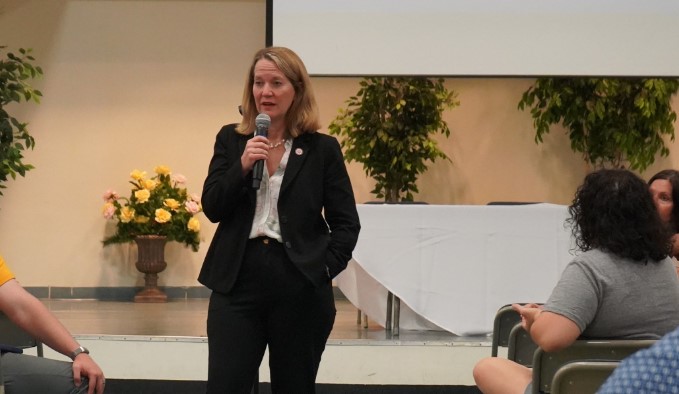
Lisa Everett, a Dysart Unified School District Governing Board candidate who describes herself as a Republican activist, has recently drawn attention for criticizing conservative candidates, including Arizona Corporation Commission nominee Ralph Heap, and the conservative groups that supported his campaign.
Everett has filed two campaign-finance complaints against Heap, one with the Arizona Citizens Clean Elections Commission and one with the Secretary of State’s Office while publicly defending his primary rivals, Kevin Thompson and Nick Myers. She has also repeatedly called on Heap to withdraw from the race, even after he advanced to the general election over Myers.
Everett’s public support for the two Republican incumbents Heap challenged predates the complaints. In her June 1 “Patriotnheels” newsletter, Everett published a section titled “Truth vs. Lies: The Record of Arizona Corporation Commissioners Kevin Thompson and Nick Myers.” The newsletter summarized Thompson and Myers’ defenses of their records on renewable-energy mandates, President Donald Trump’s energy agenda, utility rate mechanisms, and grid reliability.
Heap challenged Thompson and Myers for one of two Republican nominations to the Corporation Commission. In the July 21 primary, Thompson finished first with 35.8% of the vote, Heap finished second with 33%, and Myers finished third with 31.2%. Thompson and Heap advanced to the November general election.
After the primary, Everett escalated her public opposition to Heap. She announced her Secretary of State complaint, publicly thanked Clean Elections when commissioners denied Heap’s request to leave the public-financing program, and subsequently urged Republicans to call for Heap’s withdrawal. She has continued publishing updates about the campaign-finance proceedings through her Patriotnheels account.
Heap entered the Corporation Commission race with support from the Arizona Free Enterprise Club and Turning Point Action. Everett has previously criticized Turning Point’s influence in Arizona Republican primaries. In May, she told the Arizona Capitol Times that Turning Point “puts their money behind people, and that machine rolls, but it turns off the independent voters.”
Everett has also directly criticized the Arizona Free Enterprise Club’s involvement in Corporation Commission races. In a post to X on August 4 she wrote, “Some have asked me why I am pursuing this. – Accountability. Some are concerned a Democrat could get elected. My prayer is Heap removes himself from the ballot and the Party appoints a great candidate. If we lose this seat the blame lays at the feet of Arizona Free Enterprise Club and their partners. They ran candidates against two great incumbents simply because the incumbents could not be controlled. The blame also lies at the feet of Heap for violating campaign finance laws. This is truly a case of don’t blame the messenger.”
Some have asked me why I am pursuing this. – Accountability. Some are concerned a Democrat could get elected. My prayer is Heap removes himself from the ballot and the Party appoints a great candidate. If we lose this seat the blame lays at the feet of Arizona Free Enterprise… pic.twitter.com/VbzS6qRbhH
In an August 7 reply on X, she added, “Arizona Free Enterprise Club continues to recruit candidates that know nothing about utilities. They do this because they want a puppet at the ACC. Nick and Kevin follow statutes and understand the issues.”
Everett describes herself as a conservative Republican. Her Patriotnheels website identifies her as a longtime Republican organizer and describes the outlet as a West Valley platform that promotes conservative viewpoints and candidates. The same site also features an essay written by Everett titled, “The Republican Party Is Still A Big Tent — Let’s Start Acting Like It.” In that piece, she criticized Republican “purists” and “RINO” labeling and argued against isolating “McCain Republicans” and “moderate Republicans.” She also urged Republicans to engage with political opponents rather than limit their political activity to people who already agree with them.
Everett has applied that argument to disputes over Republican political figures as well. During an August 7 discussion on X over whether former Mesa Mayor John Giles (now the running mate for Democrat Governor Katie Hobbs) should be described as a leftist, Everett wrote, “The far right does not understand that concept. If you fail their purity test – you are a leftist.”
The far right does not understand that concept. If you fail their purity test – you are a leftist.
Everett drew attention for that approach in 2025 while serving as chair of the Legislative District 29 Republican Committee. In April of that year, Everett organized Republican counter-protests against Northwest Valley Indivisible demonstrations targeting President Donald Trump and Rep. Abe Hamadeh (R-AZ-08). Everett told AZ Free News at the time that she organized supporters after seeing the anti-Hamadeh demonstrations and said the Republican participants supported the Trump administration’s agenda.
Four months later, Everett joined Brent Peak, co-chair of Northwest Valley Indivisible, in advocating for Peoria-area restaurant owner Lai Kuen “Kelly” Yu after Yu was detained by U.S. Immigration and Customs Enforcement. AZ Free News reported in August 2025 that Everett and Peak were working on Yu’s behalf even as Democratic Senators Ruben Gallego and Mark Kelly, along with Rep. Greg Stanton (D-AZ-04), also supported Yu. Everett told The Center Square that Yu came to the United States while pregnant, sought asylum, and became active in the Peoria community. Department of Homeland Security Assistant Secretary Tricia McLaughlin said Yu had entered the country illegally in 2004 and had exhausted her legal avenues to remain. Court records cited by AZ Free News showed the Ninth Circuit denied Yu’s asylum appeal in 2016.
The Maricopa County Republican Committee subsequently censured Everett by a 23-6 vote over her advocacy for Yu and her work with Peak. It also called for her resignation from her district leadership position. Everett defended her actions and later wrote on X that the county party was increasingly controlled by people she considered extremists, describing them as “so far right they are turning left.”
MCRC Censures LD29 Chairwoman Lisa Everett
Last night, the Maricopa County Republican Committee voted to censure me, Lisa Everett, Chairwoman of LD29. With that vote, my name is now listed alongside an ever-growing roster of Republicans who have been censured by MCRC: County… pic.twitter.com/5hvdhA5iTZ
Everett is now campaigning for the Dysart Unified School District Governing Board, where her campaign lists protecting the district’s A rating, supporting teachers and staff, and maintaining facilities among her priorities.
Heap and Thompson will appear on the Nov. 3 Corporation Commission ballot alongside Democrats Clara Pratte and Jonathon Hill and Green Party candidate Mike Cease.
Arizona Republicans selected their nominees for several of the state’s highest-profile offices on Tuesday, with several races called later in the evening. Additional ballot counting continued Wednesday in closely divided legislative, congressional, and county races.
The Associated Press called Rep. Andy Biggs (R-AZ05) the winner of the four-way Republican primary for governor, setting up a November contest against Democrat Gov. Katie Hobbs. The AP also called the Republican secretary of state primary for state Rep. Alexander Kolodin.
The attorney general primary race was subsequently called for State Senate President Warren Petersen shortly before midnight in Arizona. Petersen led attorney Rodney Glassman by 56.4 percent to 43.6 percent as of publication.
WASHINGTON (AP) — Warren Petersen wins Republican nomination for attorney general in Arizona. #APRaceCall at 2:58 a.m. EDT. https://t.co/TS3eIpQI5W
Republican Elijah Norton defeated Katherine Haley for the state treasurer nomination, leading 56.1 percent to 43.9 percent at the time of publication. Norton will now face Democrat nominee Nick Mansour.
Decision Desk HQ called State Treasurer Kimberly Yee the winner of the Republican primary for superintendent of public instruction. Yee led incumbent Superintendent Tom Horne 53.2 percent to 46.8 percent with approximately 89 percent of the expected vote counted in the highly competitive race. Former state lawmaker, Democrat Teresa Leyba Ruiz, had nearly 80 percent of the vote against Brett Newby and will advance to the general election.
Decision Desk HQ projects Kimberly Yee wins the AZ Superintendent of Public Instruction Republican Primary#DecisionMade: 8:18 AM EDT pic.twitter.com/hCr78WcgTt
Commissioner Kevin Thompson secured one Republican nomination for the Arizona Corporation Commission, while former lawmaker Ralph Heap appeared set to secure the second after Commissioner Nick Myers conceded the race in a statement posted to X. Thompson led with 291,934 votes, or 35.89 percent. Heap followed with 267,085 votes, or 32.84 percent, while Myers had 254,321 votes, or 31.27 percent, leaving Heap ahead by 12,764 votes at the time of publication.
Congressional Primaries
Former state Rep. Amish Shah has won the Democratic nomination for U.S. House in Arizona’s 1st Congressional District against former television journalist Marlene Galán-Woods, 39.8 percent to 34.1 percent, according to the AP. Jonathan Treble held 17.62 percent, and Rick McCartney had 8.51 percent. Shah will face Thomas “Jay” Feely in one of Arizona’s most competitive congressional districts.
WASHINGTON (AP) — Amish Shah wins Democratic nomination for U.S. House in Arizona's 1st Congressional District. #APRaceCall at 10:07 p.m. EDT. https://t.co/TS3eIpQI5W
Rep. Greg Stanton held a commanding lead over progressive challenger Kai Newkirk in the Democratic primary for the Fourth Congressional District, 63.5 percent to 36.5 percent.
Former Pinal County Sheriff Mark Lamb won the Republican primary for Biggs’ open Fifth Congressional District seat, defeating Daniel Keenan 58.3 percent to 41.7 percent. The Associated Press also called the Democrat primary for Elizabeth Lee, who received 65.5 percent. Chris James received 21.2 percent, and Brian Hualde received 13.28 percent.
WASHINGTON (AP) — Elizabeth Lee wins Democratic nomination for U.S. House in Arizona's 5th Congressional District. #APRaceCall at 11:18 p.m. EDT. https://t.co/TS3eIpQI5W
Bernadette Greene-Placentia defeated Raymond Keeler approximately 65 percent to 35 percent in the Democratic primary for the Eighth Congressional District. She will challenge Republican Rep. Abe Hamadeh in November.
WASHINGTON (AP) — Bernadette Greene-Placentia wins Democratic nomination for U.S. House in Arizona's 8th Congressional District. #APRaceCall at 11:20 p.m. EDT. https://t.co/TS3eIpQI5W
Republicans currently hold narrow majorities in both chambers of the Arizona Legislature, giving several down-ballot primaries consequences extending well beyond the individual districts.
In Legislative District 2, Republican Sen. Shawnna Bolick led Timothy Ferrara 71.4 percent to 28.6 percent. Democrat Amelia Gallitano led Daniel Toporek 77.3 percent to 22.7 percent in the same district.
Republican Sen. John Kavanagh led Robert Wallace 85.2 percent to 14.8 percent in Legislative District 3.
In the Democratic primary for Legislative District 6, former Sen. Jamescita Peshlakai led Rep. Myron Tsosie 54.8 percent to 45.2 percent.
Sen. Lauren Kuby, a former Tempe city councilwoman, led Deborah Nardozzi 76 percent to 24 percent in the Legislative District 8 Democratic primary.
Christopher King led Anthony Dunham 63.2 percent to 36.8 percent in the Republican primary for Legislative District 17.
Rep. Alma Hernandez led Rocque Perez 53.8 percent to 46.2 percent in the Democratic primary for Legislative District 20.
The closest contested Senate primary was in Legislative District 27, where Republican Sen. Kevin Payne led former Sen. Anthony Kern with 8,368 votes to 8,096, a margin of only 272 votes.
State House Primaries
Arizona House districts elect two representatives, meaning the two leading candidates in each party primary generally advance to November.
In Legislative District 1, Republican Reps. Selina Bliss and Quang Nguyen held the two qualifying positions. Bliss led with 42.45 percent, Nguyen followed with 42.04 percent, and Shawn Wildman trailed with 15.51 percent.
George Khalaf led the four-candidate Republican contest in Legislative District 3 with 33.69 percent. Cody Reim held the second nomination position with 27.12 percent, only 612 votes ahead of Jay Schlum, who received 26.21 percent. Thomas Walsh held 12.8 percent.
Republican Rep. Matt Gress led Legislative District 4 with 45.28 percent, while Pamela Carter held the second position with 33.67 percent. Sandra Christensen trailed with 21.05 percent.
In Legislative District 6, Democratic Rep. Mae Peshlakai led with 42.5 percent. Ian Teller held the second qualifying position with 29.76 percent, followed by Angela Maloney with 27.73 percent.
Rep. Walt Blackman led the Legislative District 7 Republican primary with 34.73 percent. Rep. David Cook held second with 27.25 percent, followed by Andrew Costanzo with 21.34 percent and Barby Ingle with 16.67 percent.
Brian Garcia and Janeen Connolly held the two Democratic nomination positions in Legislative District 8 with 42 percent and 32 percent, respectively. Claudia Kline trailed with 26 percent.
Rep. Justin Olson, a former corporation commissioner, led the Republican primary in Legislative District 10 with 43.82 percent. James Rogers held second with 34.41 percent, followed by Ciara Anderson with 21.77 percent.
Chandler Mayor Kevin Hartke led the Legislative District 13 Republican primary with 43.31 percent. Janet Weninger held the second nomination position with 34.62 percent, while Debra Schinke trailed with 22.07 percent.
In Legislative District 14, Tyler Farnsworth led with 41.63 percent, and Rep. Laurin Hendrix followed with 38.29 percent. Jed Lyons received 20.08 percent.
Sen. David Gowan, a former Senate president, led the Legislative District 19 Republican House primary with 43.98 percent. Rep. Lupe Diaz held the second position with 32.09 percent, followed by Cheryl Caswell with 23.93 percent.
On the Democrat side, Rep. Sally Ann Gonzales led the Legislative District 20 House primary with 33.37 percent. Rep. Betty Villegas, a former Pima County supervisor, held second with 31.81 percent, followed by Genoveva Diaz with 19.41 percent and Ben Koehler with 15.42 percent.
Rep. Consuelo Hernandez led the four-way Democrat primary in Legislative District 21 with 30.21 percent. Miranda Lopez held the second nomination position with 24.92 percent, ahead of Rep. Stephanie Stahl Hamilton at 24.24 percent. Maritza Higuera held 20.63 percent.
Rep. Elda Luna-Nájera led the five-candidate Democratic primary in Legislative District 22 with 29.36 percent. Betsy Munoz held second with 27.60 percent, followed by Veronica Bejarano-Malone with 24.78 percent, Steve Chapman with 9.86 percent, and Gwen Johnston with 8.4 percent.
Rep. Mariana Sandoval led the Legislative District 23 Democratic primary with 38.35 percent. Emilia Cortez held the second nomination position with 25.49 percent, followed by Juan Manuel Guerrero at 18.3 percent and Naomi Miguel at 18.19 percent.
In Legislative District 24, Alberto Flores and Lisbeth Arescurenaga held the two qualifying positions with 39.87 percent and 37.02 percent. Democratic Rep. Lydia Hernandez trailed with 14.34 percent, followed by Rosa Cantu with 8.77 percent.
Republican Reps. Beverly Pingerelli and David Livingston led the Legislative District 28 contest with 41.72 percent and 38.98 percent, respectively. Heather Rooks received 19.30 percent.
Mike Gannuscio led the five-candidate Republican primary in Legislative District 30 with 33.97 percent. David Rose held the second nomination position with 29.16 percent, followed by Grace Hecht with 19.89 percent, Catherine Lopez-Rajaniemi with 10.68 percent, and Caroline Strecker with 6.29 percent.
County Races
Most countywide offices on Tuesday’s ballot had only one candidate seeking each party’s nomination. Contested county and local races included the Apache County clerk of the Superior Court primary, the Santa Cruz County school superintendent primary, the Yavapai County Board of Supervisors District 2 primary, and the Yuma County clerk of the Superior Court primary.
In Apache County, Samceita Begay led Wendy Shepherd in the Democratic primary for clerk of the Superior Court. Begay received 5,653 votes to Shepherd’s 4,195 at the time of publication.
In Santa Cruz County, incumbent County School Superintendent Maya Donnelly led Sonia Sanchez by 2,545 votes to 2,222 in the Democratic primary. Miguel López also led Adriana Olaiz by 2,754 votes to 2,066 in the Democratic primary for justice of the peace at the time of publication.
Camp Verde Mayor Marie Moore led Wiley Cline in the Republican primary for the Yavapai County Board of Supervisors District 2 seat. Moore received 3,633 votes, approximately 57 percent, while Cline received 2,746 votes or approximately 43 percent.
In Yuma County, Chief Deputy Clerk Bobbie Jo Daily led Malba Alvarez by 6,801 votes to 2,530, or 72.9 percent to 27.1 percent, in the Republican primary for clerk of the Superior Court. The Arizona Secretary of State’s county-results portal continued to list Yuma County’s results as pending Wednesday afternoon, although the county had opened its separate online results system.
Additional Ballots Remain
The results remained unofficial on Wednesday as county election officials continued processing ballots. The Arizona Secretary of State’s Office estimated that voters deposited 93,368 early ballots at polling locations on Election Day. That figure represents Election Day ballot drop-offs and does not represent the number of ballots remaining to be counted. The Secretary of State’s Office reports outstanding ballots separately through its ballot-progress reports.
The early results demonstrated President Donald Trump’s continued influence in Arizona’s Republican statewide and congressional primaries. The legislative contests followed a more localized pattern, with incumbency, district organizations, and candidate-specific disputes producing several close races beneath a decisive statewide result.
Margins of only a few hundred votes in several legislative primaries could shape the composition of Arizona’s Republican and Democrat legislative caucuses as the parties prepare for the larger fight over control of the House and Senate in November. The statewide canvass is scheduled for Aug. 6.
Vote totals and percentages are current as of 8 p.m. MST on July 22.
Arizona’s public utilities governing body is exploring its options for legal action against Attorney General Kris Mayes.
The Arizona Corporation Commission (ACC) accused Mayes of illegally impeding its ratemaking authority for political gain. Mayes is running for reelection. Although she has no primary candidates, she will either have to face off against one of two Republicans: Arizona Senate President Warren Petersen (R-LD14) or Air Force reservist prosecutor Rodney Glassman.
As part of a commission press release sent out on Monday, ACC Chairman Nick Myers issued a statement saying the ACC had to “force” Mayes to fulfill her attorney general duties toward the commission.
“She was unlawfully pocket vetoing our commission ratemaking authority by delaying the process pertaining to the repeal of the natural gas subsidies,” said Myers.
Myers also accused Mayes of “play[ing] politics,” naming Mayes’ disapproval of the ACC’s appeal of the Renewable Energy Standard and Tariff (REST) rules. The ACC submitted that appeal and one other for the Gas Utility Energy Efficiency Standard (Gas EE) rules to Mayes’ office for review.
“These costly mandates forced Arizona ratepayers to pay almost $4 billion more than they should have over the last 20 years,” said Myers. “The commission will continue to protect the ratepayers and will not allow the Attorney General to arbitrarily increase rates against the decision of the commission.”
In 2006, the ACC gave utility companies a new mandate through the establishment of the REST rules: generate 15 percent of their energy from renewable resources by 2025, and submit annual implementation plans describing compliance. Mayes was on the commission at the time.
The ACC unanimously voted to repeal the REST rules in March, citing in part a $2.3 billion financial burden for compliance passed on to customers through surcharges.
The ACC said in its most recent press release that Mayes had gone beyond her statutory authority — which they described as ministerial — since she had conducted a substantive review of ACC’s ratemaking rules authority. ACC contends their ratemaking rules authority is constitutionally exclusive and leaves no room for interpretation by the attorney general.
In her denial of the ACC appeal, Mayes claimed in a letter to the commission that it had violated its own rulemaking procedures. The commission denied this assessment and accused Mayes of vetoing rulemaking based on policy disagreement.
Mayes approved those impacted rules which mandated renewable energies while she was on the ACC.
The ACC called these “unnecessary subsidies,” and claimed Mayes’ denial of the rule appeal was a cover for her alleged ulterior motive: preventing the ACC from undoing her work to push renewables.
“As a commissioner, Kris Mayes voted for these expensive subsidies that have cost ratepayers billions of dollars,” said Commissioner Kevin Thompson. “It is an abuse of her position as Attorney General to use the ministerial rule approval process to substantively veto our lawfully enacted ratemaking rule repeal. Every day that goes by, she is responsible for increasing costs on ratepayers.”
This is the latest development in an ongoing power struggle between Mayes and the ACC.
Back in 2024, Mayes sued the ACC over its decision to reverse a Power Plant and Transmission Line Siting Committee order regarding environmental oversight for a UniSource Energy power plant project. A superior court judge ruled against the ACC last October.
And in April, Mayes hit the ACC with three rehearing requests for three different alleged issues.
Mayes spokesman Richie Taylor told the Arizona Capitol Times that Mayes had to take on ACC responsibilities because the ACC was giving “sweetheart deals” to data centers while raising utility rates on senior citizens.
“Chairman Myers should focus on fulfilling the constitutional obligations of the Commission on behalf of Arizonans so the Attorney General doesn’t have to step in and do it for them,” said Taylor.
AZ Free News is your #1 source for Arizona news and politics. You can send us news tips using this link.
The Arizona Corporation Commission approved a temporary bill credit for UNS Electric customers, expected to reduce monthly costs during peak summer usage.
According to a Wednesday press release, the Commission approved an $18.50 monthly credit for customers with average usage of 884 kilowatt-hours. The credit will be in effect from May 1, 2026, through December 31, 2026. The measure was approved in a 5–0 vote during the Commission’s open meeting on April 8.
Open Meeting Adjourned: The ACC held its April Open Meeting on 4/8/26, voting on 30 agenda items. pic.twitter.com/EuLUQlYx13
— Arizona Corporation Commission (@CorpCommAZ) April 8, 2026
The adjustment is tied to the Purchased Power and Fuel Adjustment Clause (PPFAC), a mechanism which utilities use to recover fuel and purchased power costs. The Commission stated that utilities do not earn a profit on expenses recovered through the PPFAC.
Commissioner Kevin Thompson said in the release that the credit follows the Commission’s earlier action to address a significant under-collection in the PPFAC balance.
In May 2023, the Commission approved a temporary surcharge to reduce the balance, which was accruing interest costs that were being passed on to ratepayers.
“The Commission had to make a tough vote in 2023 to pay down significant fuel cost debt that had been allowed to build as a result of circumstances outside the utilities’ control,” Thompson said. “As a result of the temporary surcharge, UNS was able to rapidly pay down the debt and save ratepayers money in the long run. Asking ratepayers to pay more in their monthly bills to pay down costs is never an easy task, but this solution removes the massive debt hanging over the heads of the ratepayers and provides additional bill relief when customers need it most.”
The surcharge was eliminated in December 2025 after the balance was paid down. The Commission said that the change reduced the average residential customer’s bill by approximately $20 per month.
Following the removal of the surcharge, the utility reported a positive PPFAC balance of $5.6 million in mid-February 2026, which has continued to grow.
According to the release, UNS Electric began experiencing under-collection in October 2021, which grew to approximately $48 million. The deficit was attributed to increased natural gas prices during the COVID-19 pandemic, extreme weather events including Winter Storm Uri, and global energy market impacts related to the Russian invasion of Ukraine.
“As we are approaching the summer heat, I am glad the Commission was able to provide some rate relief for customers in Kingman, Lake Havasu, Nogales, and other smaller communities in Mohave and Santa Cruz counties,” Chairman Nick Myers said in a statement.
ELECTRICITY BILLS REDUCED FOR UNS ELECTRIC CUSTOMERS: The ACC approved 2 items at the 4/8/26 Open Meeting that will slash UNSE customers' monthly bills by approximately $15.50, from May-Dec 2026. See news releaseshttps://t.co/jyvjpm9NMX… &https://t.co/Dq9oBbytHq…
— Arizona Corporation Commission (@CorpCommAZ) April 8, 2026
With the new temporary credit in place, the Commission said a typical residential customer is expected to see an average monthly reduction of approximately $38 this summer compared to the same period last year.
“As regulators we often have to make difficult decisions as we balance the various interests involved in ratemaking,” Myers said. “In this case, I am pleased that our difficult decision to address the PPFAC in 2023 has resolved the problem and resulted in a meaningful reduction in rates for UNSE customers through the end of the year.”
A retirement community in Eloy had its water rates raised significantly through a recent Arizona Corporation Commission (ACC) vote.
The ACC approved the rate increases narrowly, 3-2, during its meeting on Wednesday. Commissioners Kevin Thompson and Lea Marquez Peterson voted against the rate increases.
Marquez Peterson said the utility companies should have done more to conduct public outreach prior to engaging in the rate increase process.
“We received many public comments concerning the dramatic rate increase though an increase was certainly expected from a utility who hadn’t filed a rate case in over 25 years. I believe that more could have been done to promote gradualism in the sewer rate case,” said Marquez Peterson.
Picacho Water and Picacho Sewer Company serve the retirement community Robson Ranch, located south of Casa Grande. The community has historically enjoyed low water and sewer rates due mainly to subsidization from the developer behind the community, Robson Companies. The developer absorbed the cost of increased expenses rather than pass them onto the residents.
The rate increases would result in increases of just shy of $7 for water and $65 for sewer, for a combined increase of about $76. No rate changes have occurred since the 1990s. For years, residents paid an average of about $30 per month for water and $42 per month for sewer services.
ACC declined to impose a phased increase of rates.
Commissioner Thompson said that was where the rate increase plan lost his vote.
“For decades, the developer chose to operate the water utility at a loss. No one disputes that the new owner is entitled to recover lost revenues and earn a reasonable profit on those investments,” said Thompson. “But rate increases should adhere to principles of gradualism, and as a regulator, I felt I had a duty to advocate for a resolution that strikes an appropriate balance between all parties and not subject these ratepayers to the consequences of business decisions that were no fault of their own.”
The decision to adjust utility rates after nearly 30 years came after another company, JW Water, acquired both companies from Robson Companies in 2024.
Robson Ranch residents spoke out against the rate increases during Wednesday’s meeting. They accused JW Water of seeking to maximize shareholder return.
The residents also blamed Robson Companies for covering increased expenses rather than passing the cost along to the customers. Residents said they had no knowledge their rates were being subsidized all those years; they said low rates were marketed as a perk of buying within the community.
Jay Shapiro, speaking on behalf of Picacho Water and Picacho Sewer during the meeting, said the rate case was “difficult for everybody involved” and that no one would be happy with the final results.
Shapiro denied exploitation of customers. He argued the longstanding rates were no longer recovering the cost of service. He said the rates were “just and reasonable,” and not a result of “price gouging” to benefit foreign investors. Shapiro accused critics of the rate increases of conducting a smear campaign.
“Rate shock was inevitable — rate shock sure sucks,” said Shapiro. “It’s an unintended consequence of some rate filings.”
Chairman Nick Myers agreed with JW Water that these rate increases were a necessity for services provided, not a means of making up for lost profits.
“Though I personally would prefer not to approve rate increases, we have a constitutional duty as Commissioners to set just and reasonable rates,” said Myers.
Vice Chair Rachel Walden concurred.
“JW Water is NOT recovering revenue losses over the course of the past 25+ years, nor are they recovering the purchase price of the utilities,” said Walden. “This rate case is ONLY about setting rates to cover the cost of service. I put forth a verbal amendment that was supported in full to ensure that future growth will pay for itself.”
AZ Free News is your #1 source for Arizona news and politics. You can send us news tips using this link.