by Staff Reporter | Apr 22, 2025 | News
By Staff Reporter |
Arizona’s prisons are now under investigation by lawmakers following multiple inmate murders in a Tucson prison.
The chair of the Senate Public Safety Committee, Kevin Payne, announced the investigation Monday into the Arizona Department of Corrections, Rehabilitation, and Reentry (ADCRR) over the recent murders of three inmates at the Arizona State Prison Complex-Tucson: Saul Alvarez, Thorne Harnage, and Donald Lashley. Alvarez was serving time for first degree murder, Harnage was serving time for sexual conduct with a minor, and Lashley was serving time for sexual conduct with a minor and molestation of a child.
Payne said in a statement the murders were “inexcusable and incredibly troubling,” and expressed concern for the safety of prison staff and officers. Payne also extended prayers to the families of the murdered inmates and said ADCRR had “failed” the three men.
“I fear for the lives of the correctional officers and staff who are reporting to duty every day and risking their safety in a facility that has proven it cannot prevent dangerous criminals from inflicting violence,” said Payne. “Director Thornell has some explaining to do, and the more time that passes by before we can determine the missteps that lead to these murders, the longer our law enforcement will be in danger of losing their own lives at the hands of inmates.”
The sole suspect in the murders, Ricky Wassenaar, was one of two men behind the two-week-long prison hostage crisis in 2004 — the longest in the nation’s history. At the time, Wassenaar was serving time for armed robbery and assault. The prison hostage crisis earned Wassenaar 16 life sentences.
Wassenaar previously claimed to prison officials and advocates that he murdered his cellmate, 81-year-old Joseph Desisto, last November. ADCRR ruled the cause of Desisto’s death as “undetermined” but clarified the medical examiner’s report didn’t find traumatic injuries supportive of Wassenaar’s alleged method of murder (strangulation).
Last week, ADCRR announced two other prisoners died from potential homicides while in facilities in Buckeye and Florence, respectively.
Then, last Friday, ADCRR acknowledged the uptick of inmate on inmate violence. ADCRR attributed the violence to its close custody units, including: Eyman’s Running Unit; Lewis’s Buckley, Morey, and Rast units; Tucson’s Cimarron unit; Winslow’s Kaibab unit; and Yuma’s Dakota unit.
These close custody units house the most high-risk prisoners with “histories of institutional violence, significant behavioral problems, [and] long-standing disciplinary issues.” Those categorized as “high-risk” account for about 5,000 of the over 35,000 inmates statewide.
ADCRR rolled out a series of immediate and forthcoming protective measures for staff and inmates, such as restricted movement with indefinite closed visitation. ADCRR assured the public that affected prisoners will still maintain access to showers, phones, mail, tablets, legal visits, mental and physical health appointments, medication, and in-unit work.
ADCRR Director Ryan Thornell condemned the uptick in violence as unacceptable.
“Violence is not, and should never be an acceptable part of incarceration,” said Thornell. “We will not allow continued negative behavior to disrupt our orderly operations or jeopardize the security of our institutions.”
AZ Free News is your #1 source for Arizona news and politics. You can send us news tips using this link.
by Daniel Stefanski | Feb 11, 2025 | News
By Daniel Stefanski |
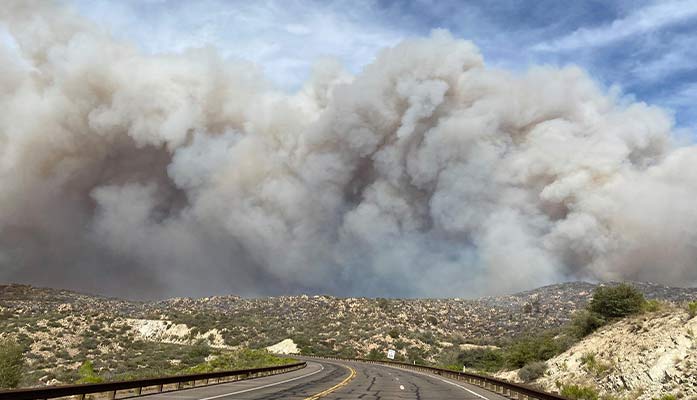
Arizona legislative Republicans continue to prioritize the state’s wildfire mitigation efforts in anticipation of another active season this summer.
Earlier this week, the Arizona Senate Republican Caucus issued a press release to update on two wildfire mitigation-related bills that had passed out of committees in the chamber.
One of those bills was SB 1297, which “directs $6.5 million to the Department of Administration for local fire departments to implement a Fire Incident management System, provid[ing] funding to equip fire engines with state-of-the-art communications systems that will improve coordination between local fire departments, emergency responders, and state authorities.” The proposal, which was sponsored by Senator Kevin Payne, passed the National Resources, Energy & Water Committee, with an overwhelmingly bipartisan 7-1 vote (one Democrat voting in opposition – Senator Sundareshan).
The other piece of legislation was SB 1285, which “appropriates $12.5 million to the Department of Forestry and Fire Management [to be] awarded as grants to fire districts for the purchase of tactical water tenders, as well as type 3 and type 6 fire engines for wildfire response.” This bill, which was sponsored by Senator David Gowan, was approved by the Appropriations Committee with a 9-0 result (with one member not voting – Senator Epstein).
In a statement, Senator Gowan said, “With the ongoing development of lands adjacent to natural forested and desert areas, the wildfire threat is front and center for Arizona communities. I am committed to providing our first responders with the resources they need to save lives and property from wildfire tragedy.”
Senator Payne added, “While California’s government prioritized progressive political agendas like DEI over the resources needed to fight wildfires efficiently, Arizona Senate Republicans remain focused on what truly matters – protecting our communities and preparing for the annual fire season. We will continue to invest in the tools and technology necessary to ensure our firefighters have what they need so that what happened in California never happens here at home.”
Fire Chief Jake Rhoades, the President of the Arizona Fire Chiefs Association, also weighed in on the efforts to pass these bills, writing, “Ensuring firefighters are properly trained and equipped to respond to wildfire emergencies is a top priority for fire districts across the state. The passage of SB 1285 and SB 1297 would significantly assist our efforts, by equipping our personnel with essential firefighting apparatus needed to complete the mission.”
The bills from Senate Republicans to help combat another dangerous fire season in Arizona come at the same time House Republicans are also attempting to pass similar proposals in their chamber. In a press release issued earlier this week, State Representative Lupe Diaz highlighted that Governor Katie Hobbs’ proposed budget “offers zero funding for hazardous vegetation removal or forest thinning despite recognizing that wildland fire costs have been ‘much higher in recent years’ due to neglected forest maintenance.” Hobbs did not mention plans to address wildfire mitigation efforts in her State of the State address to the Arizona Legislature at the beginning of the 57th Regular Session last month, which stood out due to the very recent example with the destructive Los Angeles fires.
Daniel Stefanski is a reporter for AZ Free News. You can send him news tips using this link.
by Daniel Stefanski | May 30, 2023 | News
By Daniel Stefanski |
Two Arizona west valley lawmakers are eyeing a return to the Arizona Legislature in 2025.
On Friday, State Senator Anthony Kern and Representative Kevin Payne announced that they had filed paperwork to run for re-election in the 2024 election cycle. Their news release revealed that the two would be switching spots in the Legislature due to Payne’s term limits in the House. Kern will now be running for the Arizona House of Representatives, and Payne for the state senate.
Senator Kern shared his thoughts about the swap, highlighting that the idea to take this course of action originated with him: “Kevin Payne is a solid conservative who is doing great and important work on a number of issues, especially those related to public safety and Arizona’s military and veterans. With him reaching his term limits in the State House I asked if he would consider switching places with me so that he could keep fighting for those issues.”
Payne also issued a statement on the news, saying, “First off, let me just say that Anthony Kern hasn’t just been one of the hardest working State Senators in Arizona, he’s a selfless guy who wants what is best for Arizona.” responded Payne, “So I appreciate his offer and I’ll be glad to work hard for both my own election as well as his. We need his solid conservative presence in the State House!”
The two legislators quickly received one high-profile endorsement for the re-election bids, coming from House Speaker Ben Toma, who also serves in the same district. Toma said, “This is great news for the district and the state. Kevin and Anthony are hard-working, solid conservatives, who focus on getting the work done. I look forward to voting for both of them!”
Kern and Payne’s district is extremely crucial for Arizona Republicans in November General Elections as they enjoy a solid-red electoral advantage. Both lawmakers have been instrumental in helping legislative Republicans hold the line against the new Democrat state officials: Governor Katie Hobbs, Attorney General Kris Mayes, and Secretary of State Adrian Fontes. Legislative Republicans hope that these two are at the core of an expanded majority in 2025.
Daniel Stefanski is a reporter for AZ Free News. You can send him news tips using this link.
by Daniel Stefanski | Mar 5, 2023 | News
By Daniel Stefanski |
A bill that was widely supported by Arizona law enforcement and passed out of committee with broad bipartisan approval met a partisan crowd when it arrived for a vote in the full State House of Representatives.
HB 2485, sponsored by Representative Kevin Payne, would enhance sentencing for convicted criminals who ambush police officers in the line of duty. According to the overview of the legislation provided by the Arizona House, this bill “increases the penalties for aggravated assault on a peace officer if the defendant is found to have lain in wait for or ambushed the peace officer while committing the assault.” The bill requires that “a person who is convicted of aggravated assault on a peace officer, and found to have lain in wait for or ambushed the peace officer in committing the assault, be sentenced to two years more than what would otherwise be imposed for the assault.”
This piece of legislation seemed like a slam dunk for passage out of the Arizona Legislature, but the final clearance from the House of Representatives was anything but. All but one Democrat voted against HB 2485, with Representative Amish Shah not voting. All Republicans voted to send the bill to the Senate.
Freshman lawmaker Cory McGarr noted the shocking vote against a bill designed to protect members of Arizona’s law enforcement community, writing, “All of the Dems voted against protecting police from AMBUSH. Might want to call your Democrat representative and ask why only Republicans voted to protect police.”
The result of the vote on the House floor was unlike the actions out of House committees earlier in the legislative process. When the bill was heard before the Committee on Military Affairs and Public Safety (MAPS) – chaired by the sponsor, Representative Kevin Payne, it passed with an overwhelmingly bipartisan vote; 13 members voted yes, one Democrat voted no, and another Democrat was recorded as present. Representative Sun, who voted no on the bill in committee explained that she had pause on supporting the bill because the “definition of ambush is very vague,” and she was concerned about “further criminalizing our constituents and adding to our privatized prison system.” HB 2485 cleared the House Rules Committee with a unanimous 8-0 vote.
Several representatives of the Arizona law enforcement community testified in support of the bill before the MAPS Committee. Don Isaacson, on behalf of the Arizona Fraternal Order of Police (Arizona State Lodge), relayed the endorsement of HB 2485 from the 10,000 police officers who comprise his organization. The key for Mr. Isaacson and his police officers was the change from “optional” enhancement for convictions of ambushing a police officer to “mandatory.” Rebecca Baker, the Legislative Liaison for the Maricopa County Attorney’s Office also testified in favor of the bill; as did Joe Clure, the Director of the Arizona Police Association, who made clear that it’s important to send a clear message to those who ambush police officers will be dealt with “harshly and firmly.”
But the most convincing testimony in front of the House MAPS Committee came from the President of the Arizona Fraternal Order of Police, Paul Sheldon, who has served for more than 23 years as a police officer. He expressed regret that this legislation was even necessary – especially since there was a time in his career, where these types of crimes against police officers were extremely rare. However, he noted that last year was the deadliest year for law enforcement in more than twenty years. He told the committee that 21 Arizona police officers were shot in the line of duty in 2022, and 16 of those were ambush attacks. Two of those ambushed officers died in the line of duty.
HB 2485 now heads to the Arizona Senate for its consideration.
Daniel Stefanski is a reporter for AZ Free News. You can send him news tips using this link.
by Corinne Murdock | Mar 24, 2022 | News
By Corinne Murdock |
The House Transportation Committee approved SB1356, legislation to give Maricopa County residents a vote for or against a transportation tax and excise tax plan. The committee passed with bipartisan support, with the exception of three: State Representatives Neal Carter (R-Queen Creek), Kevin Payne (R-Peoria), and Leo Biasucci (R-Lake Havasu City).Two didn’t vote either way: State Representatives Brenda Barton (R-Payson) and David Cook (R-Globe).
Arizona Free Enterprise Club Vice President Aimee Yentes expressed opposition to the bill, noting that 40 percent of the money was allocated for public transit. Yentes explained that the 1985 transportation tax plan was successful because it built freeways, but that over the decades the plan shifted from essential infrastructure like roads and freeways to “transit,” despite a steep, increasing decline in its use. That number sits at half a percent currently.
“As we’ve seen post-COVID, that ridership number has fallen off a cliff. There are actually more people who don’t own a vehicle that take a car to work than actually use public transit. That’s kind of astonishing,” said Yentes.
Yentes also noted that the bill sets aside funding for something already covered by statute: “regional programs.” She said the definition of that term was problematic because it doesn’t distinguish street intersection improvements but, rather, “arterial roads and regional programs.”
“It really is a catch-all that can be used to siphon off local city slush funds for whatever: complete streets, air quality,” said Yentes.
The bill sponsor, State Senator Tyler Pace (R-Mesa) said that the bill’s rejection, either by the legislature or by Maricopa County voters, would necessitate the Arizona legislature to find the funds for transportation projects themselves. Pace insisted that the committee members shouldn’t nitpick at the provisions of the bill because the greater good concerned Arizona’s legacy of quiet, fast roads superior to those of other states.
State Representative Richard Andrade (D-Glendale) compared SB1356 to previous efforts to expand and extend the state’s two major highways: Loop 101 and the I-17. Andrade argued that creating more public transit like light rails would increase their use.
Those in opposition explained that they weren’t confident this bill would actually meet transportation needs. Carter said that he supported infrastructure, but said that the legislation had room for improvement. Carter said his reservations included provisions for expenditures related to air quality, and the expansion beyond a 20-year authorization.
Payne expressed displeasure that legislators impacted by the bill weren’t included in stakeholder meetings. He explained that his constituents were requesting another bus route down Bell Road, for example, and that he couldn’t vote for the bill in good conscience because of that.
Echoing Carter and Payne’s statements in his “no” vote was Biasucci. Biasucci argued that the legislature should utilize its $4 billion in surplus instead of passing the costs on to taxpayers.
“I think this is, really, how it needs to be done: the money should come from the general fund to be spent on major projects, I’m talking billions of dollars’ worth, in my opinion. For me, when we’re sitting on this huge surplus, it’s hard for me to say, ‘Yes, I agree with a tax increase or an extension,’” said Biasucci.
Corinne Murdock is a reporter for AZ Free News. Follow her latest on Twitter, or email tips to corinne@azfreenews.com.