The Maricopa County Board of Supervisors is divided on moving forward with a pathway that may result in the recorder’s removal, even with little time left before the primary election.
The board published a statement Wednesday announcing their vote requiring Recorder Justin Heap to provide a written report and sworn public testimony on February 18.
The board statement accused Heap of “lying to the public” and stonewalling the board.
“He has been unreliable. He has been unprofessional. He has been untruthful. He has been unaccountable,” read the statement. “The Board cannot responsibly set a budget, make policy decisions, or oversee county operations, including an active election in Tempe right now, without complete and truthful information from Mr. Heap.”
The board made its decision during its formal meeting on Wednesday. State law authorizes the board to require any county officer to make reports under oath concerning office duties.
The written report would address key issues identified in Chair Kate Brophy McGee’s letter to Heap last month concerning expenditures and prepayments, signature verification and curing, and the special election board and deputy registrar program.
Heap will also be required to provide the identities of the provisional voters his office said were disenfranchised; records of requests by his office for federal funds, legislative appropriations, or county funds; communications with the Maricopa County Attorney’s Office concerning the distribution of mail-in ballots to voters who didn’t request them in the 2025 special election in Congressional District 7; and records of the reassignment of the space in the Maricopa County Tabulation and Election Center from the Maricopa County Sheriff’s Office to his office.
Although the supervisors voted unanimously to impose these requirements on Heap, not all supervisors supported the official statement condemning Heap.
Supervisor Mark Stewart said the statement wasn’t approved by him. Not only that, Stewart said, but the remarks were disrespectful and potentially damaging to current negotiations with Heap.
“We are in active negotiations on the Shared Services Agreement, and my focus remains on reaching a constructive resolution that delivers results for the people we serve,” said Stewart.
District 1 did not review or approve this post and does not share its tone.
I respect my colleagues, Recorder Heap, and most importantly our residents, and I believe our public communications should reflect that respect.
We are in active negotiations on the Shared Services…
— Mark Stewart Maricopa County Supervisor District 1 (@MarkStewart_AZ) February 12, 2026
Other supervisors fanned the flames of the statement.
Supervisor Debbie Lesko shared her remarks from Wednesday’s meeting, in which she said she endured over a year of frustrations with Heap. Lesko lodged multiple accusations against Heap, such as that he had something to hide.
“I feel Recorder Heap has left us no alternative,” said Lesko.
The only alternative for the board would be to continue negotiations with the recorder’s office through public discussions and the court.
This pathway by the board may lead to the largest county in the state and fourth-largest county in the nation without its elections leader with a few months left to go before elections begin. The primary election was moved up from August to July recently.
Should Heap refuse to comply with Wednesday’s order, the board may opt to remove the recorder from office with just five months to go before the primary elections.
This latest action by the board appears to be their response to the Maricopa County Superior Court striking down the board’s attempt to subpoena three staff members within Heap’s office. This court restraining order occurred within the case initiated by Heap last summer to restore elections powers to his office.
AZ Free News reached out to Heap regarding the board’s decision. As of this report, no response has been received.
AZ Free News is your #1 source for Arizona news and politics. You can send us news tips using this link.
Several of the Maricopa County Board of Supervisors reviewed the recorder’s new signature verification process this week.
Supervisors Mark Stewart and Debbie Lesko visited the recorder’s office on Friday to observe what Recorder Justin Heap has promised to be a stronger approach to signature verification.
Also present were members of the Maricopa County Republicans and local election integrity advocates.
Currently with Maricopa County Recorder @azjustinheap, Supervisor @DebbieLesko, @MaricopaGOP, and several election integrity enthusiasts (@MerissaCaldwell) learning about the Recorder's new signature verification process.
— Mark Stewart Maricopa County Supervisor District 1 (@MarkStewart_AZ) February 6, 2026
Supervisor Stewart publicized some of the training materials given to elections workers tasked with signature verification, including metrics for accepting or flagging signatures based on broad and local characteristics.
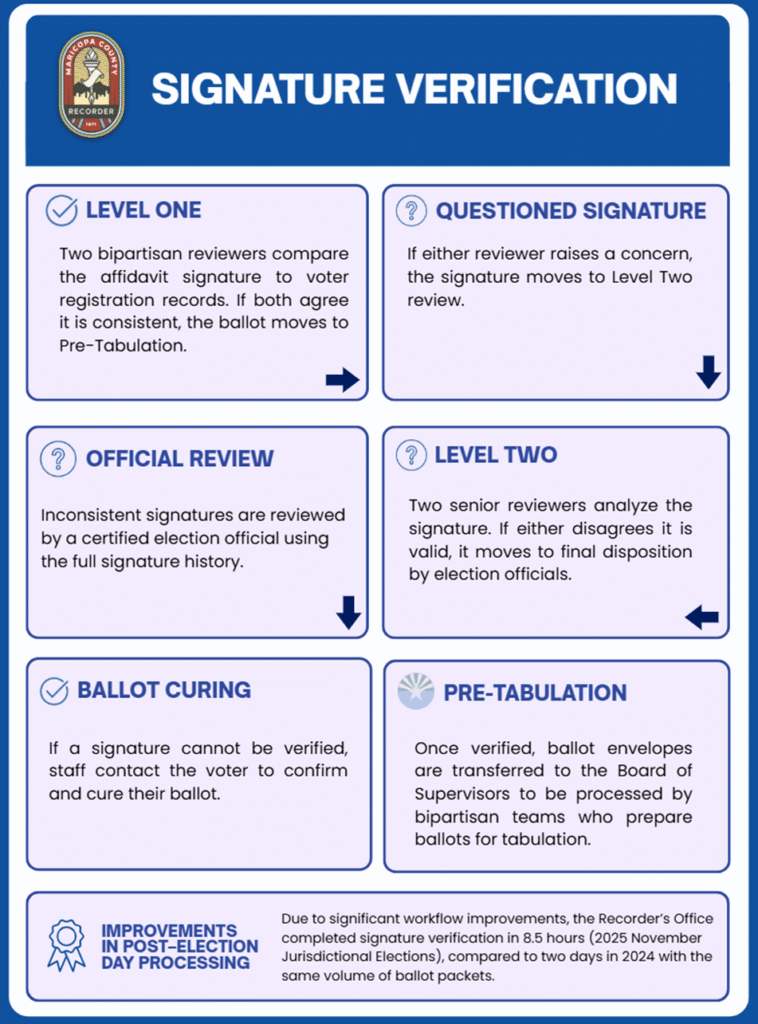
The new format for signature verification has two levels of review, the first for the user and second for the manager. At the level one user review, two signature reviewers of differing political parties compare signatures with the reference signature on file.
Signatures with obvious matches based on characteristics may be accepted as good signatures, while signature comparisons that yield differences outweighing similarities must be flagged for level two review by a manager.
The level two managerial review concerns the review of all available signatures in a voter’s registration record, which can be upwards of 50 samples. The signature pool could include signatures from voter registration forms, verified early voting affidavits, and in-person sign-ins from rosters.
Signatures consistent with the signature pool would be approved and sent to another level two manager of a differing political party for review, while nonmatching signatures would be set aside for further action. The recorder’s office has a set limit of disposition types: no signature, household exchange, need packet (a catch-all disposition type), deceased (which flags National Voter Registration Act research), and pre-questioned signature.
That last disposition qualifies for automatic submission to another manager of a differing political party for level two review.
All signatures with any discrepancy at any levels are required to be part of a mandatory audit review, set at two percent currently.
Training materials also made clear the efforts by the recorder’s office to integrate user-friendly updates to signature review software.
Level one reviewer screens will display the current election affidavit signature alongside the historical affidavit signatures from newest to oldest, removing the old requirement for users to scroll to compare signatures.
The training materials also stressed that users should default to flagging signatures for review for any reasons other than a “good signature” determination.
The visit marked an unusual bright point in the strained relationship between the board and the recorder.
The board and recorder have been engaged in a year-long legal battle in the Maricopa County Superior Court over elections administration powers.
This week marked a particularly tenuous moment in the battle after board leadership issued subpoenas against three of the recorder’s staff members.
The Maricopa County Superior Court sided with the recorder on the issue and put in place a temporary restraining order against the board to halt the subpoenas.
Friday’s visit was not a signal by the two visiting supervisors that they were on the recorder’s side in this court battle. Lesko reposted statements from Board Chair Kate Brophy McGee addressing the subpoenas. Stewart issued his own statement recognizing the validity of arguments from both his fellow board members and the recorder’s office.
Supervisor Calls Out SSA Deadlock: Push for Transparent Talks, Voter-Centric Fixes, and Immediate Action
I have watched with growing frustration as the Board of Supervisors, our Elections Subcommittee, and the County Recorder’s Office have struggled to reach a resolution on the… pic.twitter.com/N1JRPQ1x5e
— Mark Stewart Maricopa County Supervisor District 1 (@MarkStewart_AZ) February 6, 2026
AZ Free News is your #1 source for Arizona news and politics. You can send us news tips using this link.
In the latest escalation between Maricopa County leaders’ legal jockeying for elections authority, the Board of Supervisors reportedly subpoenaed staff with the Recorder’s Office.
Recorder Justin Heap issued a statement on Tuesday accusing the board of attempting “to intimidate and bully” his staff and “unduly influence” the pending court ruling. The recorder and board have been fighting for months in the Maricopa County Superior Court over who has proper authority over which elections administration powers.
“Their actions are beyond inappropriate,” said Heap. “My staff has bent over backwards to work with the Board, yet despite our earnest efforts the Board continues to engage in unhinged, emotional, and unprofessional behavior.”
🚨 BREAKING ELECTION INTEGRITY UPDATE
My office is currently involved in an Election Integrity lawsuit against the Maricopa County Board of Supervisors for their unlawful seizure of my statutory duties.
— Maricopa County Recorder Justin Heap (@azjustinheap) February 4, 2026
Within the hour of Heap’s post, supervisor and former chair Thomas Galvin quoted Scripture that appeared to allude that the truth of the matter was beyond Heap’s remarks.
“‘And you will know the truth, and the truth will make you free.’ – John 8:32,” posted Galvin.
“And you will know the truth, and the truth will make you free.” -JOHN 8:32
— Thomas Galvin: Maricopa County Brd of Supervisors (@ThomasGalvin) February 4, 2026
Galvin also shared a video from Chair Kate Brophy McGee addressing the accusations from Heap. McGee said their subpoena concerned an apparent conflict between Heap’s remarks during his annual budget request and sworn testimony on voter disenfranchisement from Heap’s staff, both of which took place last week on separate days.
“At Maricopa County, we count every lawful vote. That’s why we take any claim of disenfranchisement seriously, and have asked the Recorder’s office to provide further testimony regarding conflicting claims recently made by Recorder Heap and his staff,” said McGee. “This is an important issue and we need straight answers. If any voters are being disenfranchised, we will fix it immediately. If not, then the Recorder’s office must clarify to the court why it provided such testimony. Maricopa County voters need the truth.”
— Thomas Galvin: Maricopa County Brd of Supervisors (@ThomasGalvin) February 4, 2026
During last week’s board hearing, Heap said no voters had been disenfranchised since he took office in January 2025.
“We stated that we want this machine to make sure that we don’t disenfranchise voters. We didn’t say that any voters have been disenfranchised since I took office in the administration,” said Heap.
Two days earlier, Heap’s chief of staff, Sam Stone, issued sworn testimony in the Maricopa County Superior Court that disenfranchisement was occurring in the present.
“We had two potential places we would have made the substantial changes to one or the other to bring this in, to not disenfranchise voters, which is happening now,” said Stone.
Stone directed the court to testimony from Janine Petty, senior director of voter registration, who said disenfranchisement occurred during the 2024 election when certain provisional ballots were processed as federal-only due to time constraints even though they were voted as a full ballot.
“[Those provisional ballots] would be counted, but they would not be afforded the full ballot. So they would be duplicated by the elections board to be a federal ballot, when that voter was entitled a full ballot and voted a full ballot,” said Petty.
🚨Maricopa County: Legal Voters' Full Ballots Not Counted in 2024 Under Former Recorder Stephen Richer
Maricopa County Sr. Director of Voter Registration testified under oath this week that legal voters didn’t have full ballots counted in 2024 General Election🗳️
Heap earned a legal win on Wednesday against the board after the Maricopa County Superior Court rejected the board’s move to stop America First Legal (AFL) from representing Heap in court going forward.
AFL sued the board on behalf of Heap last summer over the contested elections administration powers, a battle stemming from a “lame duck” agreement between the outgoing recorder, Stephen Richer, and a board majority also on their way out.
AZ Free News is your #1 source for Arizona news and politics. You can send us news tips using this link.
Maricopa County leadership is dissatisfied with the rejection rate of ballot signatures.
Following Wednesday’s canvass of this month’s election, Board of Supervisors Chairman Thomas Galvin said the new signature verification policy was problematic for having yielded a much higher rejection rate compared to years past.
“At this rate, 15,269 ballots would’ve been rejected in ‘24 prez election,” said Galvin. “Only 7,220 were rejected in ‘24.”
At today’s Canvas, I expressed my deep concern that too many valid ballots were rejected by Justin Heap’s office because of the new signature verification policy. At this rate, 15,269 ballots would’ve been rejected in ‘24 prez election. Only 7,220 were rejected in ‘24. Stay tuned https://t.co/vmPWaa5XHi
— Thomas Galvin: Chairman, Maricopa County BOS (@ThomasGalvin) November 19, 2025
About 30,000 ballots were subject to further review, and of those 15,000 went through the curing process. Altogether, about 5,900 ballots were rejected following the curing process out of about 700,000 total cast ballots. An additional 1,000 ballots were rejected for having no signatures and the voter failing to respond to the county’s curing attempts by deadline.
The rejection rate rose to .8 percent this go around. Last year and in 2023, the rejection rate was .3 percent. It was .1 percent in 2022.
The recorder’s office also clarified that this was the first election in decades to send mailed ballots to all voters, which they say also contributed to the higher rejection rate.
Heap responded to Galvin’s criticism by accusing the chairman of deflecting from the county’s election bungles with fabricated, nonexistent issues in his office.
“Instead of holding his own staff accountable for misplacing thousands of Election Day ballots and illegally seizing control of the Recorder’s statutory responsibilities, Chairman Galvin chose to attack the only part of the process that worked flawlessly,” said Heap.
Instead of holding his own staff accountable for misplacing thousands of Election Day ballots and illegally seizing control of the Recorder’s statutory responsibilities, Chairman Galvin chose to attack the only part of the process that worked flawlessly.
— Maricopa County Recorder Justin Heap (@azjustinheap) November 20, 2025
Heap was referencing the misplacement of two sealed transport boxes with nearly 2,300 ballots by election workers this month. The ballots were discovered several days after the election occurred, on the day of the ballot curing deadline. This forced the recorder’s office to complete ballot processing in record time, and attempt to cure ballots in a matter of hours.
Galvin acknowledged the 2022 election was a disaster in private, sources say, but publicly he defended the county’s administration.
The Heap administration implemented certain changes to ease and strengthen signature verification efforts: side-by-side screen viewing of a voter’s on-file signature and their cast ballot signature, rather than having a worker scroll up and down; and requiring three separate levels of review rather than relying on the same person double-checking their work.
During Wednesday’s board of supervisors meeting, Heap repeatedly defended his position that the signature on the cast ballot must match the voter’s historic signatures on file in their record.
“In the end, if we have a signature, and the signature on the envelope does not match the signatures we have on file, and it’s now been reviewed through multiple phases, we cannot accept that signature unless that person calls,” said Heap. “We can make all diligent efforts to reach out but, in the end, the signatures either match or they don’t.”
The supervisors were divided on Heap’s approach — and whether the changes were worth it — although they did agree that the bipartisan review was a good step.
Supervisor Debbie Lesko approved of Heap’s signature verification process.
“I’ll give you credit when credit’s due, and I think if you’ve done it faster and it’s still accurate and you’re able to make it easier for the people, it sounds like a good thing,” said Lesko.
Supervisor Steve Gallardo questioned how time-consuming the process was in comparison to Heap’s predecessor, Stephen Richer. Heap responded that the signature verification has sped up due to the bipartisan team setup, and that they concluded their work the day after the election.
Some familiar voices chimed into the social media chatter over the bristling interactions between select supervisors and Heap.
Maricopa County’s former recorder, Stephen Richer, said Heap’s approach went against the state’s signature verification law.
“That’s not even how statute works,” said Richer.
Richer told KJZZ that election fraud through stolen mail-in ballots in an off-year election was so far-fetched as to be humorous.
“It’s laughable to think 5,000-plus people stole ballot envelopes and forged signatures so they could cast one more vote in a school bond election,” said Richer.
ABC15’s Garrett Archer said Heap’s multiple levels of review was problematic because matching signatures has a certain level of subjectivity that can cause individuals to disagree on what they’re seeing.
“In the old process, private information was on screen that could be used as a second check. This has been stripped to allow observers to be closer to the process,” said Archer. “If they so choose to proceed this way, there will likely be 80,000+ signature elevations in 2026. They need to staff accordingly or this could become a major problem.”
An elections advocate, Merissa Hamilton, countered that signature verification is “ultimately subjective,” and that the elimination of the private information component allows for a more unbiased review of the ballot.
DISINFORMATION PUPPET🤡
Here's the correct info:
1. Bipartisan teams don't review the signatures.
➡️ Two individuals from separate parties review the signatures independently. Not the same as duplication.
Maricopa County Recorder Justin Heap has announced that his office set a new speed record for processing Election Day ballot drop-offs, completing signature verification and curing ballots within 48 hours of the Nov. 4th elections. The matter was complicated when officials scrambled to process thousands of ballot envelopes discovered days later in a misplaced transport box.
In a Nov. 6 update on X, Heap wrote, “All calls to voters with signature inconsistencies have been completed.” He added that finishing both signature verification and voter calls “within just 48 hours of Election Day shatters all previous timeframes for elections with more than 100,000 Election Day drop-offs.”
RECORDER’S ELECTION UPDATE:
✅ All calls to voters with signature inconsistencies have been completed.
Finishing both signature verification and voter calls within 48 hours of Election Day shatters all previous timeframes for elections with more than 100,000 Election Day…
— Maricopa County Recorder Justin Heap (@azjustinheap) November 7, 2025
According to detailed metrics provided to AZ Free News by the Maricopa County Recorder’s Office, the November election included 117,664 ballot packets returned via mail or drop box on Election Day. Signature verification on those packets began at 6:00 a.m. on Wednesday, Nov. 5, and the office says the final file review was completed by 2:33 p.m., for an 8.5-hour turnaround on the Election Day returns.
For comparison, the Recorder’s Office pointed to the July 30, 2024, primary, when roughly 114,681 similar packets took about two days to clear signature review under then-Recorder Stephen Richer. In an emailed statement to AZ Free News, Maricopa County Director of Communications Judy Keane wrote:
“This represents a dramatic acceleration in post–Election Day processing: completing in 8.5 hours what previously required two days in the 2024 Primary, despite similar packet volumes. This outcome demonstrates the effectiveness of process improvements and the exceptional performance of the team.”
Two-Reviewer System and Quad-Screen Interface
Heap campaigned on tightening signature verification and has spent much of his first year in office overhauling the workflow while feuding with the Maricopa County Board of Supervisors over funding, control of election IT systems, and a controversial Shared Services Agreement now mired in litigation.
In response to written questions from AZ Free News, the county Public Information Office said that every early-ballot signature in the Nov. 4 election was reviewed by at least two human reviewers of different parties.
The office described the workflow this way:
Level One review uses a “quad-screen” interface on a single monitor:
Bottom left: the affidavit signature being reviewed
Above it: the voter’s latest signature on file
Upper right: second-latest signature
Middle right: third-latest signature
Bottom right: the voter’s registration signature
All signature exemplars can be rotated to the primary comparison position above the affidavit signature so reviewers can align shapes and slants.
According to the county, Level Two reviewers see the same layout. Still, they can also scroll through the voter’s full signature history when Level One reviewers either disagree or cannot comfortably verify a match.
County officials say that the combination of two reviewers of opposing parties and deeper access to a voter’s signature history at the second level was designed to increase both scrutiny and perceived neutrality, after years of partisan conflict over how Maricopa handles early ballots.
For voters whose signatures still couldn’t be confirmed, the office used multiple curing channels tied to identity verification: calls from election staff, text messages (for those who opted in), emails, and a secure online dashboard at BeBallotReady.vote, consistent with state guidance on signature curing windows.
Record Processing Claims Tested by Ballot Mishap
Heap’s announcement of “shattering” past performance landed just as Maricopa County was forced to acknowledge another election-administration black eye: the discovery of two sealed transport boxes with 2,288 returned ballot affidavit envelopes that had not been included in the initial post-Election Day processing.
On Nov. 7, county elections officials disclosed that poll workers had mistakenly placed the sealed transport boxes inside a blue drop box instead of returning them to the county’s election center on Election Night. Local outlets reported that the boxes bore intact tamper-evident seals and matched election-night serial numbers, but the ballots inside had not been counted, according to AZ Family.
Heap’s office responded with its own update, saying signature verification on all 2,288 ballot packets had been completed and that every voter whose signature needed curing had been contacted before the statutory deadline.
RECORDER'S ELECTION UPDATE:
The County Recorder’s Office has completed signature verification on all 2,288 of the missing ballot packets we received from the Board this morning. In the last hours, we have contacted all remaining voters with signatures requiring additional… pic.twitter.com/M1PGHj6Tkw
— Maricopa County Recorder's Office (@RecordersOffice) November 7, 2025
Jennifer Liewer, Deputy Elections Director, issued a statement following the report saying:
“Friday, Nov. 7, 2025: This morning, as part of standard post-election protocols, elections workers inspected equipment that had been returned from voting locations. This process includes unpacking and logging equipment.
“During this inspection, two sealed transport boxes of returned ballot affidavit envelopes were found inside a blue drop box. While the transport boxes did have tamper evident seals, ensuring the security of ballots, poll workers had mistakenly placed the sealed boxes inside a blue drop box rather than returning them on Election Night. Immediately after the discovery, a bi-partisan team of election staff took custody of the sealed bins and worked quickly to ensure chain of custody was followed. The green affidavit envelopes will now be signature verified and processed for tabulation.
“Per statute, green affidavit envelopes are to be counted at the close of voting on Election Night. Counted envelopes are then placed in a large bin, sealed, and returned to the Maricopa County Tabulation and Election Center.”
As previously reported by AZ Free News, Recorder Heap has been embroiled in a lengthy legal battle with the Maricopa County Board of Supervisors over funding to modernize and provide technical support for the county’s election equipment, and centered on the division of responsibilities created in a Shared Services Agreement (SSA) agreed to by Heap’s predecessor, Stephen Richer.
Heap sought a Temporary Restraining Order against the Board’s planned assessment of election systems and databases in early October, per KJZZ. However, on November 6th, Maricopa County Superior Court Judge Scott Blaney denied the motion, writing “The Recorder’s concerns regarding the assessment’s potential interference with the 2026 Primary Election are speculative at this point in the litigation,” according to the court order.