While the White House touts the success of “Bidenomics,” American families are drowning in debt, especially on credit cards. The latest data from the Federal Reserve Bank of New York show Americans ended the first half of this year with over a trillion dollars of credit card debt for the first time ever. At the same time, credit card interest rates are at record highs, pushing many Americans to the financial brink.
How we got here is a lesson in basic economics, something the Biden administration has willfully ignored.
Contrary to the White House talking points, President Joe Biden did not inherit a “reeling” economy and inflation was not “already there.” When he entered the Oval Office, the economy was growing at a $1.5 trillion annualized rate and inflation was 1.4 percent, comfortably below the Federal Reserve’s target inflation rate. But Bidenomics changed all that.
In just a year and a half, Mr. Biden managed to deliver two consecutive quarters of negative economic growth (a recession). Moreover, inflation reached 40-year highs, with prices rising in a single month about as fast as they rose in the entire year before Biden took office.
This is the bitter fruit of the Bidenomics tree. The seed was trillions of dollars in excessive government spending; it was watered with trillions of borrowed dollars and fertilized by the Fed’s printing trillions of dollars. The results are fast-growing prices, a sluggish economy, and family budgets getting squeezed.
Since Mr. Biden took office, prices have risen about 16 percent, but average hourly wages have risen less than 13 percent, and average weekly hours have been cut back. That has left the average American with an effective pay cut of about 5 percent, and families have been using credit cards to make up for that lost purchasing power.
In just two and a half years, outstanding credit card balances have exploded 34 percent, but it gets worse—much worse. The Fed has been steadily raising interest rates to combat the very inflation which it helped cause. That has pushed up borrowing costs, especially on credit cards; their average interest rate is now at an all-time high.
The combination of large balances and high interest rates is a financial death spiral for many American families. When the financing charges on your credit card bill are equal to or greater than what you can afford to pay each month, it becomes impossible to pay down your balance. You are effectively trapped in debt. On top of the higher cost of living, you’re now paying higher financing charges too.
And it’s not just credit card debt that has exploded during Bidenomics. Consumer spending during the last two years has been partly fueled by higher balances for auto loans and mortgages, the latter of which has grown almost $2 trillion in just two and a half years.
Mr. Biden’s false promises of a student loan bailout along with a moratorium on student loan payments have also encouraged young people to take on additional debt for schooling and not pay those loans back. In fact, instead of using the savings from the moratorium to responsibly pay down their debt, most borrowers have been further increasing consumer spending.
American families going deeper into debt is a hallmark of Bidenomics, so much so that even members of Mr. Biden’s administration are beginning to say the quiet part out loud. Vice President Kamala Harris recently claimed that most Americans would go “bankrupt” if they had a $400 emergency expense.
While there is no evidence to support Ms. Harris’ claim, her statement is an indictment of the administration’s economic agenda. For most Americans, a much more likely scenario than bankruptcy is that they would have to put that emergency expense on a credit card—which many families have already had to do.
The squeeze on Americans’ family budgets will continue until we clean up the federal budget. If Washington doesn’t cut trillions of dollars in spending, the bills will keep piling up, both at the Treasury, and in your mailbox.
E.J. Antoni is a contributor to The Daily Caller News Foundation, a public finance economist at The Heritage Foundation, and a senior fellow at Committee to Unleash Prosperity.
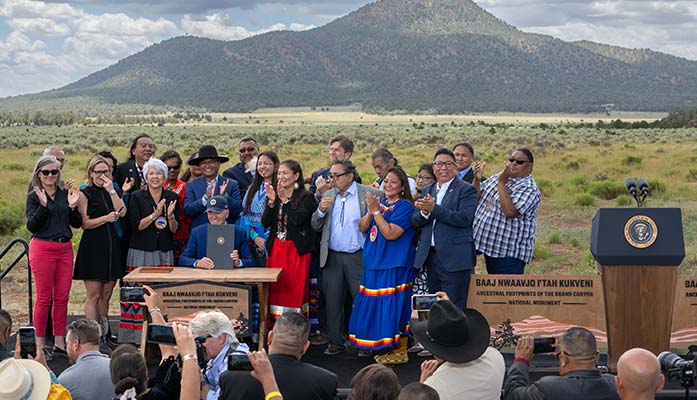
Arizona Legislative Republicans are furious over President Joe Biden’s announcement about the Grand Canyon.
During his visit to Arizona on Tuesday, President Joe Biden established the Baaj Nwaavjo I’tah Kukveni – Ancestral Footprints of the Grand Canyon National Monument. In his signed proclamation, Biden stated, “Protecting the areas to the northeast, northwest, and south of the Grand Canyon will preserve an important spiritual, cultural, prehistoric, and historic legacy; maintain a diverse array of natural and scientific resources; and help ensure that the prehistoric, historic, and scientific value of the areas endures for the benefit of all Americans.”
Today marks a historic step in preserving the majesty of the Grand Canyon.
First among American landmarks. Sacred to Tribal Nations. Revered by every American.
Arizona Republicans were quick to oppose the president’s action in their state. Senator Frank Carroll said, “Halting uranium mining in this region will only promote our country’s dependence on communist China for the minerals needed every day to support our energy supply. Even the FBI has sounded the alarm that China is the greatest long-term threat to our nation’s ideas, economic security and national security, yet President Biden is welcoming a greater reliance on this government with this action.”
Senator David Gowan also issued a statement: “There was entirely inefficient notice from the Biden Administration to the residents, business owners and elected officials of Mohave County. This is not how government should conduct itself within Arizona or within the United States. We don’t need the federal government coming in and dictating to Arizonans how to protect Arizona. We’ve been doing a fine job of conserving our precious resources and will continue to do so. This federal overreach is unacceptable and unconstitutional.”
Last week, Arizona House Majority Leader Leo Biasiucci and Senate Majority Leader Sonny Borreilli requested that an emergency, joint committee hearing be convened in Kingman in order to “hear testimony on President Biden’s radical proposal to circumvent Congress and unilaterally declare a new 1.1 million acre ‘national monument’ near the Grand Canyon in Mohave and Coconino Counties.”
The plea was directed to the Chairs of the House and Senate Committees on Natural Resources, Energy and Water (Rep. Gail Griffin and Sen. Sine Kerr) and the Chair of the House Committee on Land, Agriculture and Rural Affairs (Rep. Lupe Diaz).
The call for the emergency meeting was adhered to by the Chairs of the legislative committees, where Republicans met Monday night in Kingman and “voted to formally oppose the move that promises to adversely impact the state’s economy and our national security by devastating critical industries like mining and cattle ranching.”
Republican Representative John Gillette also chimed in, posting, “Arizona Democrats refuse to show up for public input on the Biden Land Grab. As Biden is planning to designate 1.1 million acres of AZ people land to build wind and solar via executive order 14008. Democrats call public comments a sham. We must vote them out!”
Arizona Democrats refuse to show up for public input on the Biden Land Grab. As Biden is planning to designate 1.1 million acres of AZ people land to build wind and solar via executive order 14008. Democrats call public comments a sham. We must vote them out! pic.twitter.com/cd4Oog2kKR
— Rep. John Gillette AZ House LD30 (@AzRepGillette) August 8, 2023
Senate President Pro Tempore T.J. Shope was at the hearing and shared his support for his fellow Republicans’ efforts to highlight this issue, writing, “Excited to be in Kingman today to discuss my strong opposition to the over 1 Million Acre land-grab in Northern Arizona that President Biden is expected to announce in the coming hours.”
Excited to be in Kingman today to discuss my strong opposition to the over 1 Million Acre land-grab in Northern Arizona that @POTUS Biden is expected to announce in the coming hours. #AZLeghttps://t.co/mhcBMFuWKm
After Biden’s establishment of the National Monument, Shope issued another statement, saying, “The Biden Administration is determined to halt mining across our country and here in Arizona, crippling our ability to meet demands. We must immediately open up mining in Arizona and address other national security risks here locally that are associated with China’s influence. Shame on President Biden for putting our citizens, our resources and our economy at risk.”
Daniel Stefanski is a reporter for AZ Free News. You can send him news tips using this link.
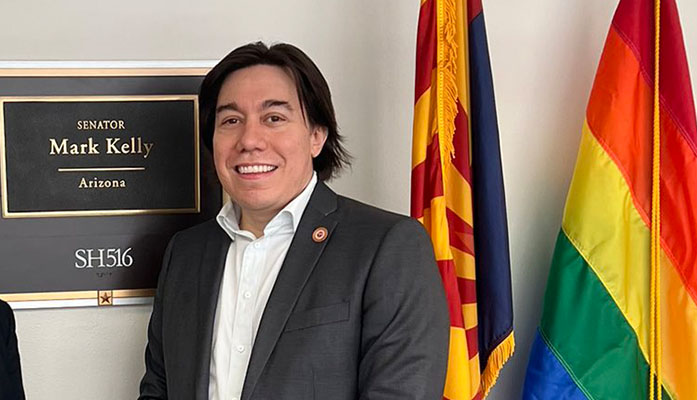
Arizona Democratic lawmakers representing the border issued a public announcement on Tuesday declaring the border to be improved.
Neither of the senators behind the announcement, Brian Fernandez (D-LD23) and Rosanna Gabaldon (D-LD21), acknowledged the state of the border as a crisis.
"Despite the sensationalized reporting about the border, we are trending in the right direction."
— Arizona Senate Democrats (@AZSenateDems) August 1, 2023
Gabaldon indicated that ongoing concerns over the border were overblown, likening the border to a “political pawn” used to score points for voting bases. Gabaldon said that the 25 percent decline in border arrests last month and the decline in border encounters indicate an improvement in border security.
Customs and Border Protection (CBP) documented about 144,600 encounters last month, a decline from the 206,700 encounters in May. Last month’s encounters were 63,200 less than last June’s total, and 44,400 less than the total for June 2021. However, the total remains four times as many as the total for June 2020 (33,000) and 40,200 more than June 2019.
Under President Joe Biden, there has been an historic total of nearly 5.7 million illegal immigrant encounters at the southwest border.
With one more month in this fiscal year, terrorist illegal immigrant apprehensions by CBP at the southern border have reached 140, already surpassing last year’s total of 98.
Gabaldon did allude that illegal immigrants do continue to suffer in their attempts to evade legal ports of entry on their journey to the U.S., though she didn’t expand on her remark.
“We must begin to recognize the human cost of failing to address the border properly,” said Gabaldon.
Fernandez said that the public’s current understanding of the border as a crisis was due to “misinformation” and “pointing fingers” to assign blame. Fernandez added that reporting over the border crisis is “sensationalized” due to the decline in encounters and arrests.
Fernandez further said that leadership, including Gov. Katie Hobbs, were taking the right actions to mitigate the border crisis. He cited one meeting with Homeland Security Secretary Alejandro Mayorkas as proof of action.
“Governor Hobbs has already made a concerted effort to address our border needs,” said Fernandez.
Hobbs also held listening sessions in March to better gain a grasp on the state of the border. That same month, Hobbs began the process of ending former Gov. Doug Ducey’s Border Strike Force. Hobbs already removed the shipping containers closing up the border wall installed in the waning weeks of the Ducey administration.
The senators called for increased funding for legal ports of entry, declaring that’s where a majority of illicit trafficking occurs. The pair also called for citizenship opportunities for illegal immigrants.
“It is our responsibility to better protect our communities and those seeking asylum,” said Gabaldon.
“Our policies must offer a pathway to citizenship for those paying into our economy and communities,” said Fernandez. “It’s time we look at our immigration policy and present Arizona with a pathway forward that offers security and opportunity for all.”
The southern border hasn’t been alone in handling the illegal immigrant influx: the northern border has seen a marked increase in attempted illegal entries, especially by those wanted on criminal or terrorist charges. In June, Rep. Andy Biggs (R-AZ-05) began investigating reports of the northern border left unmanned while remaining open for 24 hours.
Corinne Murdock is a reporter for AZ Free News. Follow her latest on Twitter, or email tips to corinne@azfreenews.com.
From the South Lawn of the White House to the pulsing heartbeats of North America’s bustling metropolises, Democrats are stepping into the 2024 electoral fray armed with a transgender-dominated platform that makes the riots of 2020 look like a block party.
This time, the spotlight is focused on the very future of the country: our children.
In a repudiation of the family as the foundation of society, the Democrat platform contends, “Your children are not your children.” And it doesn’t stop there. The Democrats are loud and proud that they’re “coming for your children.”
This was echoed by President Biden himself in April when he proclaimed at a White House event, “There’s no such thing as someone else’s child. Our nation’s children are all our children.”
His sentiment was further reinforced by the LGBTQ activists during their Pride Month celebrations. The rallying cry of “We’re here. We’re queer. We’re coming for your children!” may have escaped the notice of those consuming mainstream media, but as Tucker Carlson has demonstrated, the traditional news platforms no longer control the narrative.
America is turning to Twitter for an unfiltered snapshot of reality, and reality is not pretty. The videos of the LGBTQ agenda are being shared, as citizen journalists take over telling a truth that legacy media won’t touch.
One could write off a single declaration of seizing the children as a mere slip of the tongue, but the unwavering commitment of the progressives suggests deliberate intent to make it a bedrock principle woven into the very fabric of the Democratic Party.
The party finds itself flanked by a president whose mental acuity is questionable at best and demonstrators whose behaviors set a new standard for raunch. By raunch, I refer to the naked men dangling their parts at children along the Pride parade route, and naked women in heavy makeout sessions in a public fountain, while children played nearby.
These individuals are the ones taking over our schools, libraries, parks, and city councils.
Even a top cabinet official – Rachel Levine, the Secretary of Health and Human Services – has officially declared that it’s not just Pride Month but Pride Summer.
Levine, a transgender individual, is determined to see the Democratic Party transgender platform permeate the cultural fabric of America. Levine’s aim is to dismantle the traditional family unit and supplant it with the state, utilizing the powers of the DHHS to cement this agenda ahead of the 2024 elections.
Democrats like Levine appear to be drawing from the Marxist ideology of Frederick Engels and Karl Marx, who famously critiqued the family and foresaw its inevitable demise.
Engels said “On what foundation is the present family, the bourgeois family, based? On capital, on private gain. In its completely developed form, this family exists only among the bourgeoisie. But this state of things finds its complement in the practical absence of the family among the proletarians, and in public prostitution.”
Thus, he predicted, the family “will vanish as a matter of course.”
His colleague Marx explained how that would be achieved: “The education of all children, from the moment that they can get along without a mother’s care, shall be in state institutions at state expense.”
The American middle class, with its inherent kindness and compassion, has proven to be fertile ground for this Democrat redefinition of “love,” which amounts to actual hatred of the nuclear family.
Leveraging the tolerance of centrists, the Left has weaponized the Christian principle of “What Would Jesus Do” to quell debate and sway major Christian denominations to their cause. It has worked with many mainstream Christians, who haven’t found a good response to that rhetorical question.
The platform for 2024 looks set to feature a triumvirate of transgender dominance, the sexualization of children, and a critique of the traditional family. Why this direction? Because the Democratic Party, now under the influence of its most radical elements, finds itself incapable of reining in its fringe. The genie cannot be returned to the bottle.
Parents, brace yourselves: They are coming for your children. Alphabet agencies and unions like the National Education Association, and even the State of California, have made it clear and are leading the charge.
California Republican State Sen. Scott Wilk issued a warning: A new bill that would criminalize parents who don’t affirm their child’s “gender transition” is a bridge too far. It’s time for parents to run for the border.
“If you love your children, you need to flee California,” he said.
Democrats, seemingly emboldened by favorable polling in the 18- to 34-year-old demographic, are confident they have the winning issues for 2024.
For much of America, however, Democrats have simply packed the powder keg, stretched out the fuse, and are holding a match aloft.
The field of Republican presidential hopefuls grows larger by the week. But do any of them stand a chance of beating Joe Biden next year?
The president’s approval ratings remain anemic. He can take comfort, though, by thinking back to what happened last year.
Every indication pointed to a Republican landslide in the 2022 midterms. Yet the polls and pundits were wrong. The GOP barely scraped together a House majority and actually lost a Senate seat.
Unless Republicans figure out what went wrong in November, they risk a similar humiliation in 2024 when their nominee takes on Biden. In this political mystery, there are all too many suspects. Many seem obvious: The GOP nominated bad candidates. Voters wanted to punish Donald Trump. Women alarmed by the overturning of Roe v. Wade flocked to the Democrats. Or maybe the polls were just wrong.
In a meticulous study for RealClearPolitics, the political scientist James E. Campbell considers and rejects each of those explanations.
If the nominees were so bad, why did they poll so well?
If voters wanted to rebuke Trump, why didn’t that hurt Republican numbers long before Election Day?
Most attempts to account for the “red wave’s” failure to swell fall short for the same reason. If voters soured on the GOP for whatever reason, polls should have picked up on their feelings. The trend should have been visible in advance.
Yet the polls weren’t exactly wrong, according to Campbell. They were inadequate.
A poll isn’t a prediction; it’s a survey of a limited number of respondents. Reputable polls try to survey the most likely voters. Last year, that led them astray.
Campbell proposes a “Breakwater Theory” of the 2022 election. In eight key states, which made the difference between the predicted red wave and the eventual red puddle, Democrats beat the polls by mobilizing unlikely voters.
Those eight states — Michigan, Wisconsin, Pennsylvania, Arizona, Colorado, Nevada, Washington and New Hampshire — all had “Democrat-friendly easy and early mail-in voting rules,” Campbell notes. And Democrats maximized their opportunity by concentrating midterm spending in those states.
Seven of those eight states had Senate races, and as Campbell reports, “The Democratic Party and its supporting outside groups and individuals spent in excess of $700 million on these seven races, over $200 million more than Republicans spent.”
There is more in Campbell’s analysis. But the bottom line is that Democrats picked their battles more wisely than Republicans did.
Extra campaign spending and accommodating election rules brought out marginal Democratic votes that pollsters mostly missed. Those eight states were the breakwater that stemmed the red tide.
Two Republican countermeasures for 2024 require no imagination. The party has to target its spending better.
And as much as the GOP would like to see stricter election laws, it must play the game by the rules now in place. That means pouring resources into getting out the early vote and mail-in vote for Republican candidates, rather than conceding those categories to the Democrats.
But another smart tactic goes against one of the most cherished cliches of campaign consulting. With good reason, campaign professionals tell their clients to “hunt where the ducks are.” Look for voters where you already know you have support. Don’t waste limited resources hunting in unlikely places.
In 2016, however, Donald Trump defied the experts’ advice. He ran an old-fashioned in-person campaign, showing up in places that hadn’t seen a candidate from either party in years, if not decades. His roving rallies were in contrast to the familiar circuit Hillary Clinton followed. And they won him states like Wisconsin and Pennsylvania that hadn’t gone Republican since the 1980s.
COVID-19 worked to Joe Biden’s advantage in 2020. His presence on the campaign trail wasn’t much missed at a time when most Americans were avoiding public gatherings. And while Trump held some rallies, especially toward the end of the campaign, he couldn’t do what he had done in 2016.
The Republican nominee will have to do it in 2024.
Just as the GOP has to compete with Democratic mail-in and early-vote efforts, Biden will be competing in a sport he would rather not play if the Republican forces him to take to the trail in state after state.
Donald Trump enjoys that game. Ron DeSantis is young enough that he should play it well. The contrast between his youth and Biden’s senescence will only be more striking when voters witness it firsthand.
Yet the most important thing is that Republicans be as smart and enterprising about mobilizing less likely voters as Democrats were last year.
Even as they aim to beat him in next year’s primaries, Trump’s rivals must learn from his example. They have to find unlikely voters in unlikely places.
The road to the White House runs through factory towns and flyover country.
Daniel McCarthy is a contributor to The Daily Caller News Foundation and the editor of Modern Age: A Conservative Review. To read more by Daniel McCarthy, visit www.creators.com.