With the New Year upon us, the freedom to freelance will surely be under attack in 2024 just as it has been throughout the Biden reign on a variety of fronts—be it the impending regulatory restrictions soon to be imposed by the U.S. Department of Labor, or prospective bills seeking to limit independent contracting in states like Minnesota and Michigan.
Meanwhile, the ongoing destruction of the independent workforce in California is still unfolding in real-time, thanks to the disastrous AB5 law enacted in 2020, a law so restrictive that it has put hundreds of thousands of Californians out of business across a vast swath of professions.
Proponents of these onerous labor laws have seized on a new tactic to hijack the “flexibility” argument from those of us who advocate for self-employment. They assume that flexibility is our sole reason for desiring freelance careers—whether it’s a single mom needing to stay at home with the kids, or a person with a chronic illness unable to participate in the traditional workplace, to name a few.
While flexibility is just one factor that makes independent contracting appealing, it’s not the “be-all-end-all” for why millions of Americans choose to be in business for themselves. The anti-freelancer forces cite current work trends that began during the pandemic when employees discovered the convenience of at-home work arrangements, equating this to flexibility. But these remote-work arrangements are not the same as being your own boss. Not by a long shot.
For freelance journalist JoBeth McDaniel, the ability to pick and choose clients is imperative, along with being able to charge top rates per project. Also important: not having to be beholden to a single employer or difficult boss.
“I choose self-employment in part due to harassment I endured as a low-level employee in my 20s,” said Daniel. “When you’re a small business, it’s a simple matter to replace one bad client with nine or more others wanting to work with you.”
Another benefit of being your own boss is the opportunity to avoid workplace discrimination, particularly for seniors like audio-visual tech Roger Zeilinski, who lost his career in California due to AB5. “No one wants to hire a senior like me as a full- or part-timer because of the added costs for healthcare, liability, and workers’ comp,” he said.
With ageism rampant in corporate America, professionals in their 50s, 60s, and 70s like Roger find themselves completely shut out of the job market in favor of younger workers. With self-employment, however, age is often not a factor. Certified Medical Transcriptionist Debbie Gosselin lets her work speak for itself: “In most instances,” she said, “my clients don’t even know my age because is irrelevant.”
For writers, journalists, cartoonists, and graphic designers, independent contracting allows an individual to retain intellectual property rights. Freelance writer/photographer Kristina Anderson posed this scenario: “Imagine a newspaper columnist wanting to compile her columns into a published book, or a still photographer who desires to sell their images to another outlet. If I were an employee, those options are off the table, as the copyright belongs to the publisher and not the original creator.”
For those who file Schedule C on their federal tax returns, deducting expenses is crucial, especially if expensive equipment is required in a particular field such as independent filmmaking. Prior to AB5, film producer Dan Cheatham could write off his office costs, vehicle usage, fuel, software, hardware, equipment, healthcare, and self-advertising. “AB5 is poison for the self-employed in California unless we are willing to just volunteer our services and turn this into art for art’s sake,” he said.
Finally, the opportunity to hone one’s craft is inherent in the freedom to freelance. Whether it’s a videographer working with different clients in different settings, a writer growing their skill sets to include photography and web design, or a wedding vendor expanding her offerings, the chance to try on different hats is one of many essential attributes of being self-employed.
According to Gail Gordon, executive director of Numi Opera in Los Angeles, an aspiring opera singer can perform as a freelancer in a mid-tier opera company in hopes of someday joining a major opera house. “Freelancing opens up new horizons and new career opportunities for up-and-coming artists,” she said. “Laws like AB5 take that all away.”
This New Year, the opportunity to freelance will be more essential than ever, be it a full-time career or a side hustle to supplement one’s income. Here’s to hoping the Biden administration will cease and desist its continued assault on legitimate, thriving independent contractors just to appease the selfish wish list of organized labor.
Karen Anderson is a contributor to the Daily Caller News Foundation, a visiting fellow at Independent Women’s Forum (iwf.org), and the founder of Freelancers Against AB5.
As Christmas approaches, Americans are making a list and checking it twice — not to determine who’s been naughty or nice, but to determine what they can afford this Christmas. For all too many of them, the answer is, not much, and certainly not as much as before Joe Biden became president.
That creates a political problem for the president, because even as he’s spent the better part of the past six months touting the benefits of “Bidenomics” (suggesting the word connotes a rising standard of living for the majority), the American people have come to a different far different conclusion. For them, “Bidenomics” means, “I can’t afford it.”
A recent Bloomberg News analysis shows why: A basket of goods for the average family that cost $100 before the COVID-19 emergency costs $119.27 today. “Since early 2020,” says the piece, “prices have risen about as much as they had in the full 10 years preceding the health emergency.”
Electricity is up 25% since January 2020, and groceries the same. A pound of ground beef is up from $3.29 to $5.23; two pounds of chicken breast have risen from $6.12 to $8.44; and coffee has gone from $4.17 to $6.18.
You won’t save any money going out to eat — restaurant food is up 24%.
And getting there isn’t any less expensive, either. After peaking around $5 per gallon last year, gasoline has dropped somewhat, but gasoline prices today are still 60% higher than they were on the day Joe Biden took office.
Because of Biden’s bad energy policies (read: shutting down pipelines; stricter EV regulations; no leases for drilling; and new taxes on coal, oil, and natural gas, among others), energy prices have gone up overall by 30% in less than three years — electricity is up 25%, propane gas is up 23%, natural gas is up 25%, and diesel fuel is up 47%.
Housing, too, is far more expensive, and nearing unaffordable. In January 2021, the monthly mortgage payment on a median-priced home was $989. Today, that number has more than doubled, to $2,041. Mortgage rates have more than doubled since Biden took office, pricing many families out of the market – and forcing sellers to pull back and sit on properties they’d prefer to sell, but cannot.
Not surprisingly, American families have turned to their credit cards just to make ends meet. The result: Americans now hold more than $1 trillion in credit card debt. That’s a record high.
It’s no wonder Biden’s approval ratings, and, specifically, his approval rating on his handling of the economy, are down. In this recent survey, he’s at 40% approve, 49% disapprove on his overall job rating, and 36% approve, 61% disapprove on his handling of the economy. A full 76 percent said the economy was either “not so good” or “poor” when asked to rate economic conditions right now. Just 26% of the survey respondents said Biden’s economic policies had helped the economy “a lot” or “somewhat,” while 48 percent said his policies had hurt the economy “somewhat” or “a lot.”
And in this poll’s version of the killer question Ronald Reagan posed in his one debate with Jimmy Carter in October of 1980 – “Are you better off today than you were four years ago?” – just 4% say they are “much better off” and 10 percent say they are “somewhat better off” when asked how they have fared since Joe Biden became president.
Policies have consequences, and Americans are suffering under the real-world consequences of Joe Biden’s policies.
It’s bad enough that Americans have to suffer under the consequences of Biden’s bad policies. What makes it worse is that Biden and his administration are doubling down on their bad policies. They refuse to learn from the real-world experience of seeing the results of their policies; instead, they continue to act as if those consequences are not visible to anyone, let alone everyone.
Biden and his Democrat allies know they want more government spending, more government programs, more government regulation, more government power and control over our lives.
Meanwhile, Rudolph goes hungry, because Santa can’t afford to feed his reindeer.
This week, national Republican and Democrat candidates for President of the United States met the filing deadline to appear on a March 19th election ballot in the Grand Canyon State. Nine Republicans and seven Democrats will be on the ballot for voters of their respective parties to choose from.
The 45th President of the United States, Donald J. Trump, headlines the Republican side, which also includes fellow challengers Ron DeSantis (Governor of Florida), Nikki Haley (former Ambassador to the United Nations), Chris Christie (former Governor of New Jersey), and Vivek Ramaswamy (Entrepreneur).
President Joe Biden, the 46th American Commander in Chief, overshadows the field for his Democrat Party.
A fair number of candidates with significant name ID remain on the Republican side in addition to the former president, but the choices for Republicans will likely be whittled down to two candidates by the time March 19th rolls around – thanks to several primaries in states around the country before Arizona’s contest. In 2016, the last time the state hosted a competitive Republican preference election, Trump and U.S. Senator Ted Cruz were essentially the last two candidates standing in Arizona, even though more names were on the ballot.
Though there are more than three months remaining until the Arizona Presidential Preference Election, former President Trump appears to have a commanding lead over any of his Republican competitors. According to a November poll of the primary field by Noble Predictive Insights, Trump’s numbers in the November survey grew to 53% of the Republican electorate (up from 50% in July), while Governor Ron DeSantis lost three points (19% from 16%). Ambassador Nikki Haley doubled her standing from the July report, acquiring eight percent of the Arizona GOP field (from four percent in July). Vivek Ramaswamy remained at nine percent.
A recent AZ Free News voter poll conducted by Data Orbital also revelead that nearly 4.5 percent more of Arizona voters prefer former President Donald Trump over current President Joe Biden
The primaries and causes will soon start when the calendar turns to 2024, and candidates look to shore up the requisite number of delegates to win their party’s nomination. On Monday, January 15, Iowans will caucus to kick off the election schedule. New Hampshire will then follow on Tuesday, January 23. There will be 14 states holding primary elections on ‘Super Tuesday,’ March 5.
Daniel Stefanski is a reporter for AZ Free News. You can send him news tips using this link.
In an exclusive poll for AZ Free News, nearly 4.5 percent more of Arizona voters revealed that they prefer former President Donald Trump over current President Joe Biden. The poll also showed that Arizona voters have a low favorability of Gov. Katie Hobbs.
When asked who they would vote for should Trump and Biden serve as the 2024 presidential candidates, 39.5 percent picked Trump and 35.2 percent picked Biden. 19 percent said they would pick a third party candidate, and five percent were undecided.
George Khalaf, president of Data Orbital who conducted the poll, told AZ Free News that the polling serves as a troublesome portent for Democratic candidates in 2024.
“Arizona Democrats should be very concerned that we enter 2024 with Governor Hobbs and President Biden both having favorability ratings that are under 40 percent,” said Khalaf. “Former President Trump’s ballot test advantage of nearly 4.5 percent shows a strong early position for Republicans in Arizona. Both of these data points are in line with broader numbers coming out nationally from other swing states.”
When asked about Hobbs, only 38 percent of voters found her favorable. The disapproval rating comes close to other recent polling published this month. Hobbs was one of seven governors with an approval rating below 50 percent. The Morning Consult reported the governor had a 48 percent approval and 40 percent disapproval rating.
The favorability rating marks an improvement from over the summer, when Hobbs dipped to a 40 percent approval rating via Morning Consult: second to last for least-liked governor.
23 percent found Hobbs to be strongly favorable, and 15 percent found her to be somewhat favorable. 27 percent found her to be strongly unfavorable, and 11 percent found her to be somewhat unfavorable. 16 percent were neutral or had no opinion on Hobbs. Two percent were undecided or refused to answer.
In terms of general favorability, apart from serving as the 2024 candidate, 42 percent of voters found Trump favorable, with 29 percent finding him strongly favorable and 13 percent finding him somewhat favorable. About four percent were neutral or had no opinion, and about one percent were undecided or refused to answer.
Comparatively, only 36 percent of respondents found Biden favorable, with 20 percent finding him strongly favorable and 16 percent finding him somewhat favorable. Six percent were neutral or had no opinion of Biden. About two percent were undecided on the issue or refused to answer.
Over 52 percent of respondents were females, while over 47 percent were males.
38 percent of respondents were Republicans, 32 percent were Democrats, 27 percent were independents or unidentified, and two percent were “other.”
When asked to identify themselves outside party lines and along ideological descriptors, 37 percent identified as conservative, 38 percent identified as moderate, 20 percent identified as progressive, and about three percent were undecided.
Voter age groups were nearly split evenly, with the exception of the elderly crowd. Only six percent of polled voters were 18 to 24, 12 percent were 25 to 34, 14 percent were 35 to 44, 15 percent were 45 to 54, 18 percent were 55 to 64, and 34 percent were 65 and older.
71 percent of respondents were white, 19 percent were Hispanic, four percent were African American, three percent were Asian or Pacific Islander, and four percent identified as “other.”
Most respondents had some college but no degree: nearly 42 percent. Over 24 percent had a bachelor’s degree, 15 percent had a graduate degree or higher, 15 percent had a high school degree or equivalent, and over two percent had less than a high school diploma.
Most of the respondents had better turnout for the general elections compared to the primary elections. Only 18 percent voted in all four of the last four primary elections, but nearly 50 percent voted in all four of the last four general elections.
The poll had an approximated four percent margin of error.
Corinne Murdock is a reporter for AZ Free News. Follow her latest on Twitter, or email tips to corinne@azfreenews.com.
Social Security and Medicare are so popular they are commonly known as the “third rail” of politics. Any politician who touches them gets a nasty shock. The politically smart thing for decades has been to periodically increase benefits and not worry too much about adequately funding these supposedly self-sufficient programs
Congress designates SS/Medicare as non-discretionary spending, which allows even fiscal conservatives to earnestly explain that Congress is unable to touch them, not even to reduce the benefit increases they themselves bestowed in the past. Of course, this is ridiculous since Congress could legally eliminate the programs if it chose to do so (not recommended).
As the population has aged and birth rates have fallen, SS/Medicare have descended into serious financial distress. This year, the programs will spend $69 billion more than they take in. The programs’ trustees recently moved the date for expected insolvency up to 2031 for Medicare, 2034 for Social Security.
Yet there is little acknowledgment from the political class that a problem exists. To acknowledge it creates a mandate for making highly unpopular choices. Even Donald Trump, the would be “conservative” leader, has decreed that no part of making America great again will involve touching our major entitlements. The endless quest for re-election continues to dominate decision making in Washington.
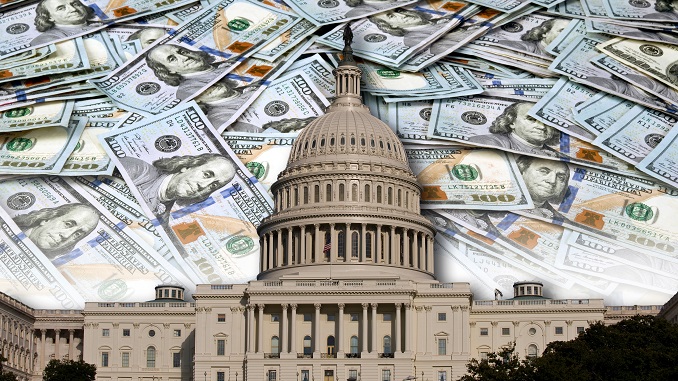
Even beyond entitlements, America has a spending problem. The federal government spends about 25% of GDP but only takes in revenues of 19%. The rest is charged off to future generations. With interest rates returning to normal levels, federal debt service will soon exceed $1 trillion a year, roughly what we spend to defend our country.
Why do we continue to spend so recklessly in times of peace and prosperity? It’s partly our perverse politics, where spenders dare opponents to suggest fiscal reforms and then rip them for bringing it up.
It’s also a mindset. Not long ago, families were considered the primary caregivers for each other. It was contemptible to neglect your own.
Americans today believe they are entitled to have government assume what were formerly family duties. Politicians gain millions of grateful dependents and family structure suffers, but there’s no going back.
Federal decision-makers have adopted an all-purpose solution to the problems that plague us: throw dollars at it. Schools failing? Send money. Semiconductor industry struggling? More money. People still living in poverty? Appropriate even more money. Money papers over our problems but affords no actual solutions.
Nobody even talks about the monetary implications of our ongoing border crisis. Over seven million mostly unskilled illegal immigrants breached our borders. Immediately upon successfully registering their fraudulent asylum claims, they expect food, shelter, medical care, transportation, eventually education, and social services all without a thought of paying for them.
The direct and indirect costs are incalculable, but California already reports annual direct expenses of $21.76 billion while Texas pays $8.8 billion and Arizona $3.2 billion.
Yet Democrats contend only more money can solve the problem. Biden and border czar Kamala Harris claim Republicans are responsible for the border mess because they once blocked further spending increases, even though the money goes to accommodate more illegal immigration. It’s time to end this massive farce and lawfully control the border. Democrats will have to find some less costly way to recruit future voters.
Our response to the COVID epidemic was another giant boondoggle. There wasn’t much to do about the virus. Protect the vulnerable, treat the ill, develop a vaccine, and allow it to run its course.
Instead, we embraced an orgy of spending. Trillions went to infrastructure improvements, solar energy, daycare, schools, businesses, and even individuals, all inexplicably in the name of COVID. It didn’t affect the course of the disease, but our descendants will pay for this spree far into the future.
It gets worse. In 2025, the spending caps on Obamacare and other discretionary items are set to expire as are the low interest bonds the government issued when money was cheap. There will be tremendous pressure to spend yet more just to maintain the spending status quo.
Thomas Jefferson, 250 years ago, extolled the benefits of a “wise and frugal” government. We didn’t listen. We will soon wish we had.
Dr. Thomas Patterson, former Chairman of the Goldwater Institute, is a retired emergency physician. He served as an Arizona State senator for 10 years in the 1990s, and as Majority Leader from 93-96. He is the author of Arizona’s original charter schools bill.