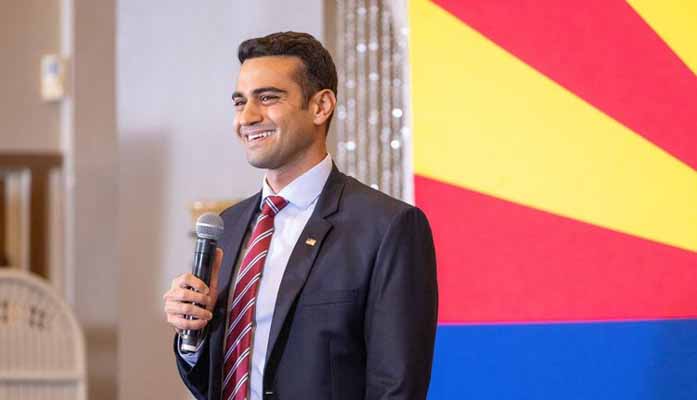
Reports have emerged that voters may have had their registration addresses moved by Arizona’s Motor Vehicles Division (MVD) without their consent, potentially jeopardizing their ability to vote.
Such unintended disenfranchisement occurred for thousands of voters in the 2022 midterm election.
The renewed concern for the eligibility of an untold number of legal voters emerged after GOP congressional candidate Abraham Hamadeh’s counsel, Jen Wright, brought up their discovery from earlier this year that the MVD moved the voter registration address for thousands of voters without their consent.
🚨ATTN: ARIZONA VOTERS🚨
In @AbrahamHamadeh’s case we found THOUSANDS of voters’ registration address was moved based on ANY interaction with MVD.
CHECK YOUR REGISTRATION NOW TO CONFIRM YOU ARE REGISTERED AT YOUR CURRENT, PRIMARY RESIDENCE.https://t.co/So7VKN545E
Wright was referencing the Hamadeh v. Mayes case, which the Arizona Court of Appeals decided in April.
In that case, Hamadeh’s counsel explained that they discovered voters who owned other properties in addition to their primary residence and found themselves disenfranchised.
“[A]fter interviewing hundreds of those voters, we found that many are voters who have connections to properties outside of their home county; and due to no fault of their own, but instead changes to the statewide computer system, their registration was moved from their county of residence to the county where they had some connection without the voter’s express knowledge, consent or intent in a way that lacks a requisite procedural due process requirement necessitated before depriving someone of their sacred right to vote,” stated counsel. “[I]t appears that more than 1,100 election day provisional voters were, we believe, wrongly disenfranchised. Turns out, with many of these declarations we have their voting record and history, and we can see when and how it was changed, and it was not by their own intent; and we know their intent because they did not show up to vote in the secondary county that was assigned to them.”
The MVD process that impacted those 1,100 voters went into place in April 2020. The court of appeals said that those Arizonans’ votes still couldn’t count since their registrations reflected an address outside the precinct they attempted to vote in, regardless of the change being made by MVD without the knowledge or consent of the voters.
“[E]ven if voters cast provisional ballots in the wrong precinct because of the alleged faulty but unchallenged election procedure, the voters still were not registered to vote in the precincts where they cast those provisional ballots,” stated the court. “Arizona law simply does not authorize opening the envelopes and counting those ballots.”
This hasn’t been the only case recently in which MVD interactions jeopardized Arizonans’ right to vote.
Last month, the Arizona Supreme Court ruled that nearly 100,000 longtime Arizona voters caught up in an MVD coding error were allowed to vote, despite a challenge from Maricopa County Recorder Stephen Richer, who put the blame on voters and asked that they be limited to voting a federal ballot only.
The Arizona Supreme Court ruled that those voters were eligible to vote. Chief Justice Ann Scott Timmer ruled that the fault was with the state, not the voters, for their registration changing.
“[A] state administrative failure permitted the Affected Voters to be registered without confirming that they provided DPOC when they received their driver’s licenses and where there is so little time remaining before the beginning of the 2024 General Election,” said Timmer.
AZ Free News is your #1 source for Arizona news and politics. You can send us news tips using this link.
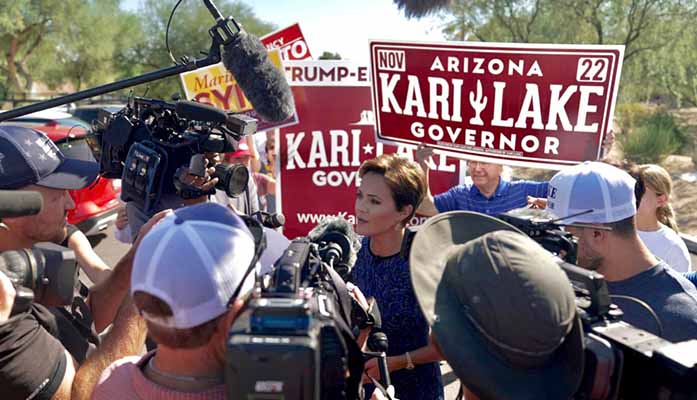
On Tuesday the legal team for former GOP gubernatorial candidate, now Senate candidate, Kari Lake argued for the dismissal of Maricopa County Recorder Stephen Richer’s defamation lawsuit against her.
Richer filed his defamation lawsuit against Lake in June over her claims of his administration of the 2022 election. Lake filed a motion to dismiss in August.
In his amended complaint, Richer alleged that Lake had “falsely and with actual malice” accused him of intentionally printing improperly-sized ballots and inserting 300,000 illegal or invalid early-vote ballots during his administration of the 2022 general election. Richer said that the accusations have caused him and his family real harm, including threats of violence and death.
I'm suing Kari Lake.
I'd hoped the defamation would stop after the election. I waited.
I'd hoped it would stop after the first election trial. I waited.
I'd hoped it would stop after the appeal. I waited.
I'd hoped it would stop after the second trial. I waited.
I'd…
— Stephen Richer—MaricopaCountyRecorder (prsnl acct) (@stephen_richer) June 22, 2023
Lake’s motion to dismiss argued that she voiced legitimate concerns about the 2022 election, and that Richer’s lawsuit amounted to retaliation following two failed attempts at obtaining sanctions against her. In those denied requests for sanctions, Maricopa County Superior Court found that Lake’s claims weren’t groundless or brought forth in bad faith.
“The types of statements that Recorder Richer complains of are the types of statements directly related to his job performance that political foes and constituents critical of elected officials ordinarily make,” read the motion.
During Tuesday’s arguments in the Maricopa County Superior Court, one of Richer’s attorneys, Cameron Kistler, said that Lake’s speech wasn’t hyperbole, but a statement of facts.
“She’s making statements where she’s asserting these are actual facts that happened in the world, these are actual accusations of falsifiable criminal conduct,” said Kistler.
Jen Wright, the former assistant attorney general serving on Lake’s team, countered that Lake did believe her speech to be true based on the facts at hand: the county’s admission that there were ballots that lacked chain of custody, and that printer problems did occur for some, still unknown reason.
“I don’t think it’s a question of fact as to whether or not the printers malfunctioned, it’s a question of opinion as to how they characterized them,” said Wright.
Richer accused Lake of issuing dozens of defamatory statements.
Jessica Banks-McDowell, an Arizona State University (ASU) law student on Lake’s team, said that court precedent clarifies that Richer’s intent via his filings is to stifle Lake’s speech. ASU’s First Amendment Clinic signed onto Lake’s defense.
“There is very clear intent of his motivation to deter, retaliate against, or prevent Kari Lake’s lawful speech,” said Banks-McDowell.
Richer seeks an injunction that would force Lake to delete the allegedly defamatory statements.
Banks-McDowell further argued that Richer hadn’t met the burden of proving defamation occurred as required by A.R.S. 12-751, Arizona’s anti-SLAPP (Strategic Lawsuit Against Public Participation) law.
Kistler said that the anti-SLAPP law didn’t apply here because Lake’s team didn’t provide evidence to prove Lake’s disputed statements as true.
Corinne Murdock is a reporter for AZ Free News. Follow her latest on Twitter, or email tips to corinne@azfreenews.com.
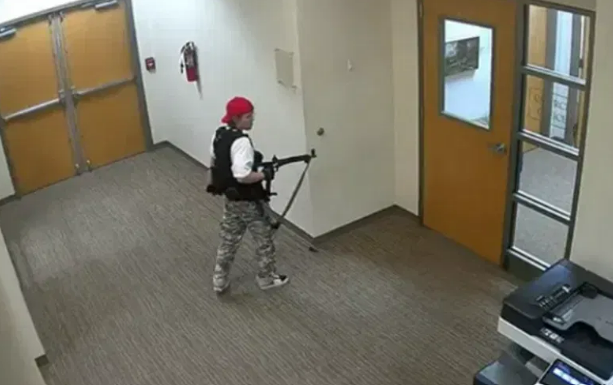
Former assistant attorney general Jen Wright questioned the location of videos made by the Nashville, Tennessee school shooter, as identified in the manifesto leaked Monday.
Wright drew attention to a detail in one of the manifesto pages, obtained exclusively by conservative pundit Steven Crowder through “Louder With Crowder.” That page detailed shooter Aiden (nee Audrey) Hale’s proposed “Death Day” schedule — the day where she would take the lives of three children and three faculty members at The Covenant School.
“11:20 am – Final Video Tape (10 min),” read the schedule.
However, Hale deviated from the leaked manifesto schedule. She entered The Covenant School shortly after 10 am. The other two leaked manifesto pages were dated Feb. 3, 2023 and March 27, 2023, the latter dated for the day of the shooting.
The reasons for Hale’s massacre have largely been up for speculation, due to law enforcement’s refusal to release Hale’s writings.
The former page from February, titled “Kill Those Kids,” appeared to be a poem of sorts expressing her hatred for white, well-off children. Hale had attended The Covenant School herself.
“Kill those kids!!! Those crackers going to private fancy schools with those fancy khakis [and] sports backpacks [with] thier [sic] daddies mustangs [and] convertables [sic]. F**k you little s***s[;] I wish to shoot you weaka** d***s [with] your mop yellow hair[.] Wanna [sic] kill all you little crackers!!! Bunch of little f*****s [with] your white privlages [sic] [;] f**k you f*****s[.]”
In the latter page from the day of the shooting, titled “Dark Abyss: Death Day,” Hale expressed the hope that she would kill many people, and issued a prayer of sorts to God to help her kill. Hale referenced a time in 2021 when she was nearly “caught” planning a mass shooting. More information on that detail has not surfaced.
“Today is the day. The day has finally come! I can’t believe it’s here. Don’t know how I was able to get this far, but here I am. I’m a little nervous, but excited too. Been excited for the past 2 weeks. There were several times I could have been caught, especially back in the summer of 2021. None of that matters now. I’m almost an hour [and] 7 minutes away. Can’t believe I’m doing this, but I’m ready… I hope my victims aren’t. My only fear is if anything goes wrong. I’ll do my best to prevent any of the sort. (God let my wrath take over my anxiety). It might be 10 minutes tops. It might be 3-7. It’s gunna [sic] go quick. I hope I have a high death count. Ready to Die. Haha. Aiden.”
Big Tech is scrambling to hide the truth from you & it’s never been clearer since the release of the #NashvilleManifesto.
Thank God for Rumble & Mug Club. We have updates & we’ll be exposing the media misrepresenting the manifesto.
The leaked manifesto pages represent just three of many others that have yet to be released by law enforcement. As journalists have pointed out, law enforcement seized up to 20 journals, a suicide note, other miscellaneous notes, a psychiatric/medical folder, three home videos, several cell phones, multiple computers and hard drives. None of these other materials have been released.
🚨 WHAT ELSE ARE NASHVILLE PD & FBI HIDING?
Nashville PD, just a FEW HOURS after the shooting, was able to execute a warrant on Audrey Hale’s home
Here are some of the assets they seized and are STILL withholding:
Republican Attorney General candidate Abe Hamadeh has taken his appeal for a new trial to the Arizona Supreme Court.
In the petition filed on Thursday, Hamadeh’s team argued that the state’s judicial branch had thus far failed to provide timely decisions in such a time-sensitive case. The trial court took 161 days to issue its order denying Hamadeh’s motion since the initial January filing, which included over 60 days for the judge to set oral argument, and another 60 days for the judge to issue his denial.
“Pointedly, the parties’ rights to speedy decisions have been grossly and repeatedly violated,” stated the petition. “Given the urgency to resolve all of these matters and the lack of a plain, speedy, and adequate remedy, a special action to this Court is warranted.”
Hamadeh declared that the public had the right to a full, unfettered review of the evidence. According to his petition, that amounts to “hundreds, if not thousands” of uncounted votes that would heavily weigh in his favor and, ultimately, determine him the rightful winner of this past election.
“Our justice system cannot tolerate the government withholding evidence,” tweeted Hamadeh. “Count the votes.”
🚨🚨BREAKING🚨🚨
We just filed a Special Action with the Arizona Supreme Court asking for a new trial regarding the November 2022 election.
Our justice system cannot tolerate the government withholding evidence. Count the votes. pic.twitter.com/hmqdq9lasE
This evidence, according to Thursday’s petition, indicates critical vote count discrepancies that undermine the integrity of the recount result’s 280-vote lead that declared Democratic opponent Kris Mayes the victor. This included the allegation that machine tabulators misread valid votes as undervotes.
Last month, the trial court rejected Hamadeh’s bid to further undertake the process and exploration of alleged vote count discrepancies uncovered through the recount.
Hamadeh filed a motion for a new trial in January based on alleged evidence of uncounted votes discovered through the recount process. In Thursday’s petition, Hamadeh counsel explained it wasn’t possible to obtain this evidence warranting a new trial until after the late-December evidentiary hearing.
“[T]he newly discovered evidence was information and data that government bodies not only failed to disclose but that they also wrongfully withheld,” stated the petition. “[S]tate and county officials used the power and purse of the government to take a substantive position in an election contest and to actively tip the scales of justice by withholding public records and concealing information that validated the vote count issues Petitioners raised at trial.”
The petition further argued that the trial court’s denial was due to a lack of procedural clarity in election contests, not lack of evidence.
“If elections in Arizona are to truly be free and equal, Arizonans must be assured that government bodies cannot use resource and information asymmetry to favor one candidate over another with impunity,” concluded the petition.
Corinne Murdock is a reporter for AZ Free News. Follow her latest on Twitter, or email tips to corinne@azfreenews.com.
Abe Hamadeh argued for a new trial on Tuesday before the Mohave County Superior Court.
The judge, Lee Jantzen, seemed interested in sampling the evidence presented by Hamadeh’s team in the case, Boyd v. Mayes, despite multiple objections from opposition. Arguments presented by the opposition — the attorney general, secretary of state, and Maricopa and Pima counties — mainly focused on the amount of time that’s transpired since the election and Hamadeh’s December trial. Arguments presented by Hamadeh’s team focused on evidence of allegedly disenfranchised voters, claiming that hundreds of “lost” (uncounted) votes from undervotes and provisional ballots proved that Hamadeh won the race.
Lawyers present for the oral arguments included former assistant attorney general Jen Wright, State Rep. Alex Kolodin (R-LD03), and James Sabalos for Hamadeh; Alexis Danneman and Paul Eckstein for Attorney General Kris Mayes; Craig Morgan for Secretary of State Adrian Fontes; Daniel Jurkowitz for Pima County; and Joseph La Rue for Maricopa County.
Sabalos opened up the oral arguments, quoting Thomas Jefferson and summarizing general discoveries in the course of their months-long review of voter data as a precursor to Wright’s arguments.
“We do not have a government by the majority; we have a government by the majority who vote,” quoted Sabalos.
Sabalos insisted their case wasn’t about fraud, but about the evidence and facts supporting the reality of Hamadeh as the winner of last November’s election contest. He claimed that Gov. Katie Hobbs, in her former capacity as secretary of state, was aware of and neglected to immediately publicize 63 Pinal County undervotes that lent to Hamadeh’s claims last December of lost votes.
Sabalos said this intentional concealment of facts served to handicap their team’s due diligence of reviewing election data for the courts. Sabalos further claimed that there were 76,339 votes counted as undervotes in the attorney general’s contest. Of the approximately 2,000 ballots they inspected, 14 were misread (.61 percent). With that percentage applied to the larger total of undervotes statewide, Sabalos said that amounted to 466 or more votes — more than the 288-vote lead Mayes holds over Hamadeh.
Sabalos then claimed that there were uncounted provisional ballots that constituted legal votes, and that the majority of those would’ve turned in favor of Hamadeh.
“We don’t come today with hyperbole or speculation. We come with some reasonably solid evidence, and we need a heck of a lot more for this judge and this court to get its hands around,” said Sabalos.
Wright followed up Sabalos’ arguments by first focusing on Hobbs. She said that Hobbs didn’t fulfill her duty of being a neutral, nominal party, since Hobbs argued heavily that Hamadeh had no evidence to support his claims, while allegedly knowing of the dozens of undervotes recovered during the recount, and pushed for his case to be dismissed. Wright further noted that Maricopa County Elections Director Scott Jarrett admitted during the December trial that he wasn’t sure why certain votes weren’t counted, and instead counted as undervotes.
Wright expanded on Sabalos’ claim of the 63 undervotes, noting that they were counted as valid during the recount. Wright asserted that Hobbs knew of this fact, which she said rendered Hamadeh’s claims during the December trial valid. Wright also dismissed Hobbs’ claim that she was under an order preventing her from disclosing the undervotes, since the order only applied to counties discussing the recount results from vote totals. Wright claimed that the judge would’ve permitted Hamadeh a review of the evidence had Hobbs been forthright all those months ago.
“I find it questionable that a government agent would take support of or opposition to a candidate in an election contest,” said Wright.
Wright further noted that Hamadeh was unable to obtain the provisional ballot data from Maricopa County until days after the trial occurred, further hindering his ability to meet statutory deadlines.
When Wright attempted to discuss the evidentiary numbers on undervotes, both Mayes and Fontes’ legal teams raised objections. The judge overruled their objections, however.
Wright claimed that their team interviewed hundreds of high-propensity voters affected by statewide computer system changes, which allegedly altered their registration address without their consent and therefore deprived them of the right to vote. She claimed that over 1,100 Election Day provisional voters were disenfranchised.
Election Day votes went overwhelmingly for Hamadeh: over 69 percent to nearly 29 percent for Mayes. Wright said that this would mean about 760 of provisional ballots would be for Hamadeh, and 316 for Mayes. By Wright’s math, Hamadeh would prevail on the provisional ballot issue alone by 165 votes.
Wright further noted that their team had collected sworn affidavits of hundreds of voters claiming disenfranchisement due to bureaucratic failures. When she attempted to read the account of one allegedly disenfranchised voter, Mayes’ team raised an objection. The judge promptly overruled.
The allegedly disenfranchised Maricopa County voter, Marlena, attempted to vote on Election Day but was denied. Marlena had reportedly experienced issues with the county’s registration system for months: earlier that year, she discovered that her registration had changed without her knowledge and consent. Wright presented evidence that on October 10, 2022, Marlena attempted to correct her voter registration before the deadline. Wright also presented evidence from Maricopa County confirming Marlena’s registration. Yet, she was denied on Election Day.
Danneman, Mayes’ lawyer, said Hamadeh’s claims were speculative and based on unsworn opinions. She emphasized repeatedly the timeliness of his contest, noting that it has been over five months since the December trial and that their team could only present an argument that they needed more time to look for votes.
Danneman further rejected the argument that Hamadeh should be granted a new trial to undertake further investigation. She said that evidence must be material, in existence at the time of trial, and not be discovered with reasonable diligence.
She added that Hamadeh’s request for a more complete ballot inspection proved there wasn’t any newly-discovered evidence warranting a new trial.
The provisional voters list didn’t hold much weight in Danneman’s view. She claimed Hamadeh was undertaking a “fishing expedition” for evidence, which she pointed out was prohibited by court precedent.
“This list of names proves nothing,” said Danneman. “The plaintiffs had their day in court.”
Morgan, with Fontes, added that it was “long past time” for this election contest to end. He said that Hamadeh’s challenge impugns the validity of election processes as well as the integrity of election officials.
La Rue with Maricopa County concurred. Jurkowitz with Pima County argued further that statute time bars any further contest.
Following the hearing, Hamadeh expressed optimism that the oral arguments ultimately were in his favor.