by Daniel Stefanski | Mar 14, 2023 | News
By Daniel Stefanski |
A bill to better secure the integrity of Arizona elections is making its way through the legislature, but it is meeting resistance from Democrats along the way.
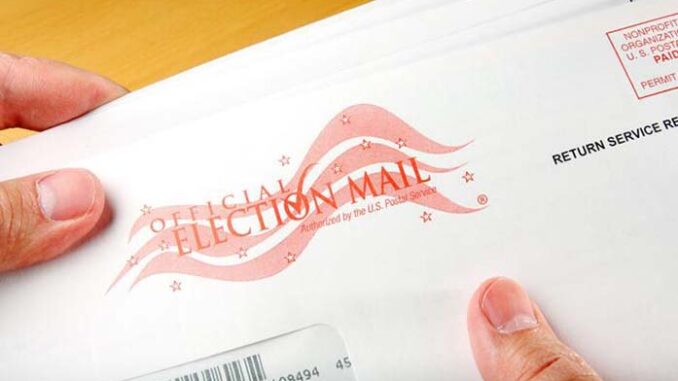
SB 1595, which was sponsored by Senator J.D. Mesnard, deals with the identification and tabulation of early ballots. Last week, it cleared the Senate chamber with a 16-14 party-line vote. All Republicans supported the bill, and all Democrats opposed its passage.
According to the purpose of the legislation, which was provided by the State Senate, SB 1595 “prescribes additional requirements for an early ballot to be counted and valid. It requires a voter to present valid identification by the prescribed days after an election for a ballot that was delivered by a voter’s agents or a voter who does not provide sufficient identification. Also, it removes the requirement that the period of early voting must end at 5:00 pm on the Friday preceding the election.”
Senators Ken Bennett, Frank Carroll, Jake Hoffman, John Kavanagh, and Wendy Rogers joined as co-sponsors for Mesnard’s bill.
Senator Mesnard explained his reasoning for introducing this bill back in January: “An important bill I’m currently working on this session will speed up our election counts. I’ve heard from a number of you regarding the extended time it took to finish counting ballots this year. Folks across the country were asking, ‘Doesn’t Arizona know how to count?’”
The extended time is mostly a result of vote-by-mail voters who drop it off on Election Day instead of mailing their ballot back ahead of time, which take days or weeks to count because of signature verification requirements. If such folks were treated like those who vote in-person at the polls on Election Day—that is, be required to show ID prior to turning in their ballot—it will dramatically expedite election night results without compromising security, accuracy, or transparency.”
In a newsletter this week, Senator Mesnard announced the Senate action on his bill, writing, “Several of my bills that focus on improving our elections process by speeding up ballot tabulation, while preserving accuracy, security and transparency, have now passed the Senate and are advancing in the House. SB 1595 would ensure we treat people voting on or near election day the same, regardless of whether they were mailed a ballot. Those wishing to drop off their early ballot after the Friday before Election Day would have to adhere to the same ID requirements that those voting at the polls must follow. This will avoid the need to spend weeks signature verifying these last-minute ballots, a top reason for the constant delay in Arizona’s election results.”
Democrat Senator Priya Sundareshan voted no on SB 1595, explaining her rationale that “this bill falls under the category of bills that are making it harder to vote.” She also said that the legislation would change “the ability of people to drop their ballots off through Election Day,” and the increased identifications requirements for late drop-offs of early ballots would add “hurdles upon hurdles” for Arizona voters.
Before voting in favor of his bill, Senator Mesnard stated that there was “universal contempt for the time it takes us to count” the votes after Election Day, noting that 2022 voters for both Hobbs (Democrat candidate for governor) and Lake (Republican candidate for governor) shared this feeling.
Senator Juan Mendez also rose to explain his vote against SB 1595, continuing the Democrats’ fascination over highlighting so-called “election integrity conspiracies,” saying, “Earlier results will not reduce conspiracies,” and “appeasing conspiracies with further confusion only risks voter suppression.”
Representatives from the League of Women Voters of AZ, AZ State AFL-CIO, State Conference NAACP, and AZ Association of Counties all opposed SB 1595 as it progressed through the Arizona Senate. The bill now resides in the House of Representatives and will be considered there in the coming weeks.
Daniel Stefanski is a reporter for AZ Free News. You can send him news tips using this link.
by AZ Free Enterprise Club | Mar 5, 2023 | Opinion
By the Arizona Free Enterprise Club |
Who wouldn’t want more money in their pocket? As Bidenflation continues to crush the American people—and in particular the people of Arizona—our elected leaders should be looking for every way possible to provide relief.
Just look at the anti-tax mood among Arizona voters this past November. They rejected Prop 310, which would have increased the statewide sales tax by 0.1% to fund fire districts throughout Arizona. They voted down ill-conceived transportation taxes in Pinal County and Kingman. And they passed Prop 132 to protect against future tax increases. That should be proof enough that Arizonans want to ensure that their hard-earned dollars stay in their wallets.
Now, a new bill recently passed by the Arizona Senate would do just that…
>>> CONTINUE READING >>>
by AZ Free Enterprise Club | Jan 18, 2023 | Opinion
By the Arizona Free Enterprise Club |
From their pulpit at press conferences, they shrugged off questions and concerns about the potential for long lines on election day and whether they would have their voting centers properly equipped. For weeks, the mainstream media blasted out to Arizonans that they are competent election officials, about to implement the “safest, most secure” election in history.
Then it all came crumbling down in what was one of the worst election days in recent history. Long lines, yes. But more importantly, critical equipment failures resulted in the complete inability to tabulate ballots at dozens of voting locations for several hours. It didn’t stop there. The issues persisted in the coming weeks for Maricopa County, who responded to requests for information with hostility. And then, we found out Pinal County (following major problems in their primary election) had miscounted hundreds of ballots, shrinking the already miniscule gap between the candidates for attorney general.
Two months later, these issues are still being litigated. But regardless of how the election contests being pursued by Kari Lake and Abe Hamadeh turn out, nothing changes the fact that Maricopa and Pinal Counties bungled the election.
Going forward, Arizona must learn from what happened, craft meaningful solutions, and focus efforts on productive goals ahead of 2024…
>>> CONTINUE READING >>>
by Terri Jo Neff | Jun 9, 2022 | News
By Terri Jo Neff |
Two election integrity bills sponsored by Sen. JD Mesnard were signed into law by Gov. Doug Ducey this week in an effort to ensure consistency among the state’s 15 counties and more quickly remove ineligible voters from the rolls.
Senate Bill 1260 amends Arizona’s election law to require the state’s 15 county recorders to cancel someone’s voter registration upon confirmation that the person has registered to vote in another county. This will include removing the voter from the Active Early Voting used to mail ballots to voters signed up to received them in advance of election day.
SB1260 also makes it a Class 6 felony for any person to “knowingly” assist someone to vote in Arizona if the voter is registered in another state. This allows criminal charges to be filed is if someone forwards an Arizona early ballot to a voter at an address other than what is listed on the early ballot packet.
The legislation takes effect 90 days after the Legislature adjourns for the session, so the provisions could be in place before the 2022 General Election.
Meanwhile, Senate Bill 1362 adds a new statute describing the process for on-site tabulation of early ballots brought by voters to a polling place on Election Day. Currently, those in-person “drop offs” might not be tabulated until the next day, a practice each county recorder or election director will now have the authority to set.
SB1362 also tweaks the criteria for when a county’s board of supervisors may reduce the number of polling places during an election. And it better defines the methods which election officials can use to reduce voter wait times at in-person polling places.
It too takes effect 90 days after the Legislature adjourns for the session.
According to Mesnard (R-Chandler), the bills will help improve voter confidence in our elections.
“Democratic systems only work if our elections are secure and their integrity unmatched,” he said after the signing. “That means ensuring that each person has one vote and that their vote is properly counted.”
Cochise County Recorder David Stevens is one of the election officials across Arizona who closely followed Mesnard’s bills. He told Arizona Daily Independent his county already has a procedure for when a voter reportedly moves away, but there is a delay in dropping the voter until a notice to be mailed and a response received.
Under SB1260, the process will be sped up by not having to wait to hear back from the voter. This allows county recorders to cancel the voter’s registration upon official confirmation of new registration in another county.
As to the section of SB1260 making it a crime to forward someone’s early ballot to another address, Stevens noted he is waiting to hear what the consequences will be, and whether the statute applies to U.S. Postal Service personnel involved in the forwarding process.
Stevens explained that some counties already offer election day tabulation of early ballots as described in SB1362. On-site tabulation provides a “a more complete election total” which Stevens calls “a good thing.”
He added that while the provisions of SB1362 will entail more work, it will be minimal.
“In the long run, any attempt to have clean rolls is worth the work,” Stevens said.
by Corinne Murdock | Apr 21, 2022 | Economy, News
By Corinne Murdock |
On Wednesday, the State Senate approved legislation lowering the percentage of assessed valuation for commercial property to 15 percent. SB1093 would reduce the property assessment ratio gradually over the next five years.
According to the bill sponsor in a press release, State Senator J.D. Mesnard (R-Chandler), explained that the aim was to ensure that Arizonans have more money to spend and, ultimately, invest back into the economy.
“Property taxes are a critical issue to all businesses, but especially for our smaller establishments. This bill will provide broad relief to our job creators,” said Mesnard. “Reducing the tax burden allows our small businesses to invest more money in their workforce and in expanding operations.”
The bill passed along party lines in both the House and Senate.
SB1093 would impact class one property: commercial and industrial properties that include those for mining, telecommunication companies, utilities, standing timber, airport fuel delivery, oil and gas production, pipelines, shopping centers, golf courses, and property devoted to any commercial or industrial use. Additionally, SB1093 prohibits fire district tax from increasing beyond $3.75 per $100 of assessed valuation.
State Senator Kelly Townsend (R-Mesa) commended Mesnard for the bill.
Legislature Democrats disliked that funds accrued from those property taxes would no longer be available, arguing that the state would turn elsewhere for the lost funds: homeowners, sales taxes, and the general fund.
State Senator Lela Alston (D-Phoenix) insisted during the Senate floor vote that the legislation would result in a tax increase on homeowners down the road.
State Representative Mitzi Epstein (D-Chandler) offered similar sentiments last month during the House floor vote. She added that the fund was a slippery slope mindset that would ultimately lead to steep cutoffs of education funding. State Representative Pamela Powers Hannley (D-Tucson) argued that the bill was based on trickle-down economics that she said only made the rich richer and the poor poorer.
“This bill picks winners and losers with the regular folks being losers in the state of Arizona,” said Powers Hannley.
State Representative Kelli Butler (D-Phoenix) added that the bill would result in county deficits that must either be mitigated or result in cuts. Butler said that the deficit would hurt rural areas the most.
“If you want to continue to fund law enforcement, like I do, if you want to continue to fund really important things in your counties and rural Arizona, you need to vote against this bill,” said Butler.
State Representative Neal Carter (R-Queen Creek) rebutted the arguments put forth by his Democratic colleagues. He insinuated that their calculations were simplistic and neglecting the potential for exponential and possibly unprecedented growth inspired by low tax rates.
“In reality, the loss is less than it may appear by simply subtracting the revenue that’s brought in,” said Carter.
State Representative Shawnna Bolick (R-Phoenix) noted that the assessment ratio is applied across the state equally and would eventually make Arizona more competitive with Texas, Colorado, and Utah.
SB1093 now heads to Governor Doug Ducey for approval.
Corinne Murdock is a reporter for AZ Free News. Follow her latest on Twitter, or email tips to corinne@azfreenews.com.