by Daniel Stefanski | Aug 8, 2024 | News
By Staff Repoter |
A lawmaker who has seen his share of competitive election contests is key to maintaining Republican control of the Arizona State Senate.
State Senator J.D. Mesnard is running for re-election to Arizona Legislative District 13, which covers Chandler, Gilbert, and Sun Lakes in the East Valley of the Phoenix-metro area. Mesnard first entered the state legislature in January 2011 in the Arizona House of Representatives, and he served eight years in that chamber, including two years as the Speaker of the House. In November 2018, after being termed out of the House, Mesnard won his election to the state Senate.
While Mesnard has spent considerable time in the Arizona Legislature, his interests and passions are well rounded and give him insights into his work for the people of his district. His campaign website informs readers that his “compassion for those less fortunate – who struggle in places outside of the greatest country on earth – led him to help establish Voices of the World, a non-profit Christian charity whose mission includes providing humanitarian aid to the poor and destitute of the world.” He serves as the Treasurer and one of the Board Members of this organization, which is based in Queen Creek.
The leadership board of Voices of the World, per information provided on its website, “is made up completely of volunteers who have a heart to see missionaries sent and supported to all corners of the world.” The organization appears to focus on the African country of Mozambique, for the health care challenges faced by citizens in its capital, Maputo, sharing that there is an “urgent need for a healthcare approach that not only addresses medical needs but also fosters a compassionate, supportive environment to help patients and their families cope with the immense physical and emotional burdens of cancer.”
Back in 2013, the organization was instrumental in opening Casa Ahava (“Home of Love”) in Maputo. The house, “is a 19 bed home which is open to Mozambican men and women who journey alone with cancer, especially those who are in late stages.”
The East Valley lawmaker’s compassionate side extends to some of his efforts at the state legislature. On his website, Mesnard writes that he “believe[s] in helping and protecting the vulnerable in our society, whether its women who’ve faced domestic violence, children who’ve been abused, veterans who are trying to return to the workforce, seniors who’ve been exploited, or animals who’ve been mistreated.” He assures voters that he “will continue to take on the challenge of tackling these and other issues as long as I serve in the Legislature.”
Mesnard highlights two bills he wrote in office to illustrate his commitment to the promises he is making to his longtime constituents. The first is HB 2001, which was passed by the Arizona Legislature and signed by then-Governor Doug Ducey in 2016, to “modif[y] the statute governing the unlawful distribution of images that depict nudity or sexual activities.” Among several provisions of the legislation, HB 2001 “makes it unlawful to intentionally disclose an image of another person if the person is identifiable from either the image itself or information displayed with the image, and: the person is in a state of nudity or engaged in specific sexual acts, the person has a reasonable expectation of privacy, and the image is disclosed with the intent to harm, harass, intimidate, threaten or coerce the person.”
HB 2001 passed the Arizona House with a 58-0 vote (with one member not voting and one seat vacant), and the Senate with a 29-0 vote (with one member not voting).
Before the bill sailed through the state House and Senate, Mesnard commented on the purpose of his proposal, saying, “For folks, mostly guys, who are using technology to hurt ex-girlfriends, we really need to put a stop to it. It’s not okay to use things done in a trusting relationship to hurt them. This can damage them personally and professionally. It follows them the rest of their lives.”
The other bill that Mesnard features on this website page is HB 2302, which was passed by the legislature and signed by then-Governor Jan Brewer in 2011, to “require the Secretary of State to establish an Address Confidentiality Program to protect the residential addresses of victims of domestic violence sexual offenses and stalking.” This legislation was passed by the Arizona Senate with a 27-0 vote (with three members not voting), and by the House with a 57-0 tally (with three members not voting).
According to the Arizona Independent Redistricting Commission, Legislative District 13 is one of the most competitive in the state, with a 1.6% vote spread between Republicans and Democrats in the past nine statewide elections. In those contests, Republicans have won five times, compared to four for Democrats.
Mesnard will be facing off against Democrat nominee, Sharon Winters, in the November General Election.
AZ Free News is your #1 source for Arizona news and politics. You can send us news tips using this link.
by Corinne Murdock | Aug 30, 2023 | News
By Corinne Murdock |
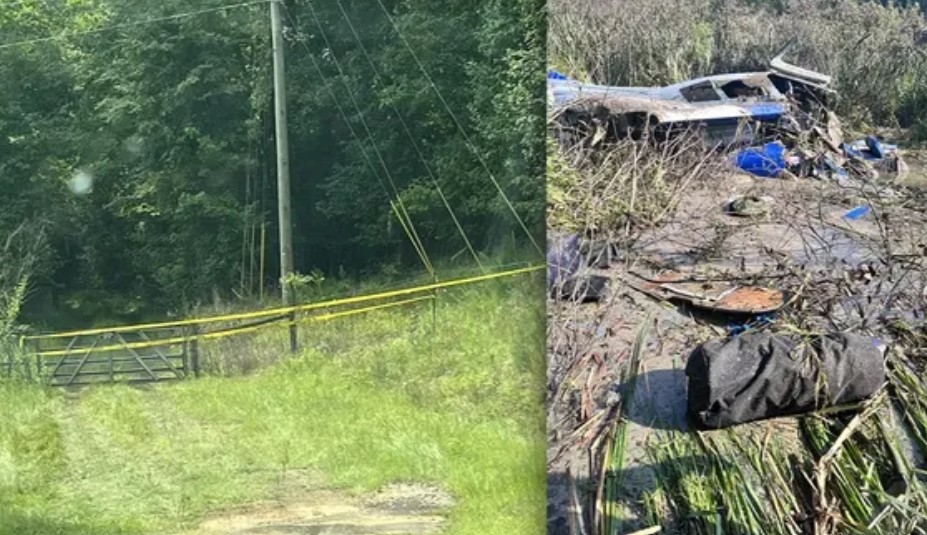
The father of State Sen. J.D. Mesnard (R-LD13), Daniel Mesnard, remains in critical condition after his twin-engine plane malfunctioned and crashed in Georgia.
The crash paralyzed the elder Mesnard from the waist down. His passenger and longtime friend, Timothy Fiser, died from his injuries despite initial reports reflecting his condition as stable. The crashed plane was a Velocity Twin model certified by the Federal Aviation Administration (FAA) last November.
On Monday, the senator issued a statement that his father remains critically injured and in need of funding to recover the plane. Without recovering the plane, the FAA won’t be able to complete its investigation to determine the malfunction that caused the plane to crash. The senator petitioned for financial aid through GoFundMe.
“The longer the plane sits there in the marsh the more it disintegrates and the prospect of losing the data contained in the plane and engines becomes very real,” said Mesnard.
The elder Mesnard had served as a pilot for decades: 21 years as an Air Force fighter pilot, 35 years as a commercial pilot for Delta Airlines, and owner of a charter plane business for the last three years.
According to Sen. Mesnard, his father prevented the plane from flipping by pulling a “fighter pilot manuever” to regain control, and then directed the plane to crash-land into the bank of a marsh in a tree clearing rather than the surrounding forest to avoid a potential fuel tank explosion.
The senator also relayed that the plane ejected his father and Fisher despite both wearing seatbelts. The younger Mesnard thanked those first responders who braved the marsh to rescue his father and family friend.
“We are so grateful for their herculean efforts to get to my dad and Tim – including wading through waist-deep mud and ignoring the prospect of snakes and alligators,” said Mesnard.
About 15 minutes before crashing, the elder Mesnard had stopped at the Kaolin Field Airport in Sandersville, Georgia to refuel.
A preliminary report from the National Transportation Safety Board (NTSB), obtained by WDRW, revealed that a Kaolin Field Airport mechanic had cleared the plane for flight a day before and the day of the crash. Also according to the report, a local police officer heard the plane “change pitch” mid-flight before “banking right” and “descend[ing] quickly.”
As of that report obtained last week, the FAA and NTSB were going to investigate. According to Sen. Mesnard, the FAA hasn’t been able to get access to the plane due to its remote location and difficult terrain.
The Mesnards require $23,000 to recover the plane and conduct an investigation. As of press time, the GoFundMe has raised over $14,000.
Corinne Murdock is a reporter for AZ Free News. Follow her latest on Twitter, or email tips to corinne@azfreenews.com.
by AZ Free Enterprise Club | Jun 24, 2023 | Opinion
By the Arizona Free Enterprise Club |
For years, Arizona has been a target of out-of-state special interest groups that want to put their radical ideas in our state. The process usually goes something like this.
- Liberal groups from outside Arizona take an issue that is unpopular with the electorate, like tax hikes.
- They come in and hire an army of paid circulators to flood the streets of Phoenix and Tucson to collect their signatures—hardly bothering with the rest of the state.
- Bad policy and sweeping reforms are placed on our ballots with only a small fraction of the state’s support.
One of the most recent examples of this was Prop 208, which narrowly passed in 2020. Out-of-state teachers’ unions spent more than $30 million over four years in their effort to buy the largest tax hike in history—lying to Arizona voters to get signatures and lying to get the slimmest of majorities to approve it. Had it not been for the court system killing Prop 208 once and for all, Arizona would be a high tax state today.
Now, a proposed constitutional amendment sponsored by Arizona Senator J.D. Mesnard would put a stop to this abuse…
>>> CONTINUE READING >>>
by Daniel Stefanski | Jun 23, 2023 | News
By Daniel Stefanski |
If it wasn’t already apparent, the Republican-led Arizona Legislature and the state’s Democrat chief executive will not be coming together anytime soon on measures pertaining to election integrity.
On Wednesday, Senator J.D. Mesnard issued a press release to announce that Governor Katie Hobbs had vetoed a number of his bills “aimed at increasing voter confidence, convenience, transparency and timeliness of election results.”
The bills Mesnard was referring to were SB 1595, SB 1596, and SB 1598. SB 1595 would have “prescribed additional requirements for an early ballot to be counted and valid, required a voter to present valid identification by the prescribed days after an election for a ballot that was delivered by a voter’s agents or a voter who does not provide sufficient identification, removed the requirement that the period of early voting must end at 5:00pm on the Friday preceding the election, and deemed the early ballot of a voter who is issued an early ballot during the early voting period after confirming identification and stamped as ready for tabulating.”
SB 1596 would have “required a state, county, city, town or school district office to provide sufficient space for use as a polling place for an election when requested by the officer in charge of elections.”
SB 1598 would have “allowed a candidate for federal office to designate a representative who may act as an observer at a counting center and prescribed requirements relating to the conduct of party representatives, challengers and observers.”
Senator Mesnard released a statement in conjunction with his release, saying, “To say I’m disappointed is an understatement. Elections are becoming more chaotic and more controversial in Arizona with each passing cycle. We’ve seen it take weeks, sometimes more than a month, to count ballots and determine the winners of races. Following the last election, I heard more complaints across the political spectrum about the length of time it takes Arizona to finish counting than I did any other issue, and it’s a problem we can easily solve. Ignoring these problems is a complete disservice to our voters who are taking their precious time to exercise their civic duty. We can’t just kick the can down the road every year. My proposals were commonsense, practical to implement and would have made a real difference in tackling some of the issues voters continue to complain about. I look forward to trying again to provide impactful election reform next session.”
The governor didn’t have much to add in her veto letters for the three bills. For SB 1595, she wrote, “This bill fails to meaningfully address the real challenges facing Arizona voters.” For SB 1596, Hobbs explained: “This bill creates an unfunded and untenable mandate for schools and communities. This bill once had an appropriation, demonstrating that it needs funding to be viable. However, it was not included in the budget, and as such, I cannot support it.” And for SB 1598, Hobbs stated, “As it is not clear what problem this bill is attempting to address or if any such problem exists, I cannot support it.”
Daniel Stefanski is a reporter for AZ Free News. You can send him news tips using this link.
by Daniel Stefanski | May 4, 2023 | News
By Daniel Stefanski |
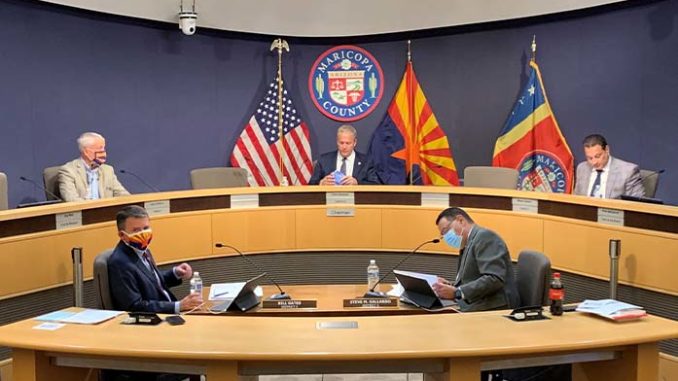
The animosity and distrust between the Maricopa Board of Supervisors and the Republican-led Arizona Legislature continues to deepen with a new issue finding a wedge between the two sides.
On Wednesday, Arizona Senator J.D. Mesnard took to the floor of his chamber to address the Maricopa County Supervisors’ ongoing consideration of two legislative vacancies in both the House and the Senate.
One of the vacancies is due to an expulsion of a Republican member of the Arizona House of Representatives. The other for a resignation of a Democrat member of the State Senate.
The Maricopa County Board of Supervisors is statutorily required by law to select the replacement for the vacancy from a pool of three same-party nominees chosen by their party. Republican precinct committeemen transmitted three names for the open House seat (Liz Harris, Julie Willoughby, and Steve Steele) as did the Democrats for the Senate seat (Representatives Cesar Aguilar and Flavio Bravio in addition to Quant’a Crews).
Mesnard’s frustrations boiled over on the Senate floor as he laid out his charge against the Supervisors’ alleged delay in filling the two vacancies for 19 (Senate) and 20 (House) days. He informed his colleagues “the length of these vacancies is the longest, while we’ve been in session, in a half a century – 56 years!” The East Valley lawmaker also said that 8.76 days is the historical average to fill the vacancy.
What seemed to bring Senator Mesnard to this point were some of the rumors he recounted hearing about for the reasons in the delay to fulfill the vacancies. According to the senator, “one of the rumors is there may be a belief that the county can reject all three of the nominees put forward.” The other rumor “is that (the supervisors) just want to sit on this for a while and hold out for some piece of legislation that they want to see passed” – in other words, “leverage” on the Arizona Legislature.
Senator Mesnard spoke on behalf of the 120 Republican precinct committeemen who rearranged their schedule back in April to nominate the three individuals to fill the open House seat. He bemoaned the fact that such a lengthy delay was not previously an issue, and he hinted that maybe his colleagues should take future action to change the statute to force the county board of supervisors to act with more urgency when filling vacancies during a legislative session. He stated that the “Board of Supervisors should have held a special meeting to hasten what should be an important priority for them.”
The members of the Maricopa County Board of Supervisors were definitely paying attention to Senator Mesnard’s words. Supervisor Steve Gallardo quickly responded on Twitter, writing, “Thanks for taking us all the way back to the 70s Senator. We didn’t receive nominees until the 4/18. Some didn’t respond right away to request for background info. Board is performing due diligence. As always, Arizona Senate Republicans are ignoring the facts.”
Daniel Stefanski is a reporter for AZ Free News. You can send him news tips using this link.