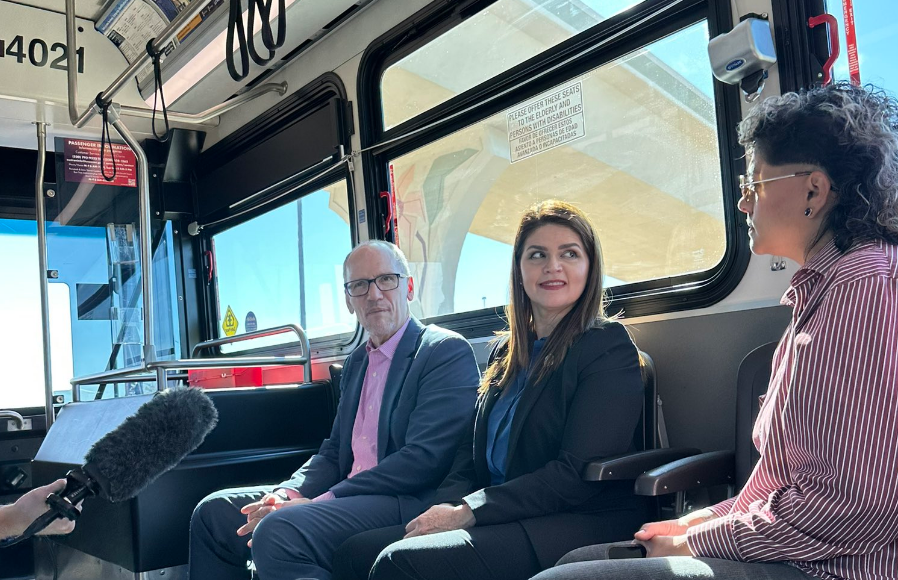
Tucson Mayor Regina Romero played host to President Joe Biden’s senior advisor last week to discuss public infrastructure.
Tom Perez, senior advisor and assistant to the President and director of the White House Office of Intergovernmental Affairs, visited the city of Tucson on Tuesday. Perez, the former chairman of the Democratic National Committee, visited as part of the Investing in America tour highlighting initiatives funded by the Bipartisan Infrastructure Law (BIL) and Inflation Reduction Act (IRA).
In a press conference, Perez said that the Biden administration prioritizes giving awards to those projects rooted in equity.
“There has never been in our lifetime a more robust investment in building America, building out our infrastructure, making sure in that process that we view everything through that equity lens, understanding that zip code will no longer determine destiny,” said Perez. “We have this opportunity folks, and we are not going to squander this opportunity to build an Arizona, and to build an America where everybody has access to good middle-class jobs, where high speed, affordable internet is a reality so that if you have a behavioral or mental health issue, you can do telemedicine.”
Among the initiatives for which Tucson received millions in federal funding under IRA and BIL was the 22nd Street Bridge revitalization, TARP Facility, Tucson Million Trees (TMT), and relinquishment of their water rights.
The Biden administration gave Tucson $25.9 million to build the 22nd Street Bridge. According to the Department of Transportation (DOT), it was the city’s focus on equity for the project that secured the funds.
Tucson also received a $5 million grant from the USDA last September for TMT. Despite the funding, TMT has fallen far short of its goal to plant one million trees by 2030. Only about 100,000 trees were planted as of last year.
However, Romero claimed in a one-on-one meeting with President Joe Biden earlier this month that TMT was on track.
Tucson also traded its water rights for $44 million in federal infrastructure funds last summer: over 110,000 acre-feet through 2025.
Perez also made a stop with another major Arizona city that has received millions in BIL and IRA funds.
Last Monday, Perez visited with Phoenix Mayor Kate Gallego to discuss the availability of funds to both public and private entities for “clean” energy initiatives, such as electric buses for schools or solar panels for churches.
Our partnership with local leaders like @MayorGallego is crucial to ensuring communities take advantage of the unprecedented opportunity in the Investing in America agenda. https://t.co/3yEZbTpOMY
— White House Intergovernmental Affairs (@WhiteHouseIGA46) February 20, 2024
Earlier this month, Perez and National Economic Advisor Lael Brainard met with county elected officials through the National Association of Counties Legislative Conference to discuss Biden’s Investing in America agenda. Santa Cruz County Supervisor Manuel Ruiz was among those elected officials to attend.
Per White House data on federal awards, the Biden administration has issued over 1,800 BIL discretionary and formula grants in Arizona. USDA data reflects that Arizona has requested over $2.1 billion in clean energy funding.
Corinne Murdock is a reporter for AZ Free News. Follow her latest on Twitter, or email tips to corinne@azfreenews.com.
The word “liberal” was once considered a compliment. It meant fair, principled, and thoughtful. The Age of Enlightenment was birthed by “classical liberals” with their then-fantastical notions about government by consent of the governed, legal equality of all, and individually owned rights.
Later as ideologies like collectivism and class oppression gained favor among the intelligentsia, the word “liberal” was hijacked and mangled beyond recognition. It was used to describe almost anything from well-meaning do-gooders to hard-bitten class warriors, from big government socialists to tyrants who silence and ostracize their opponents, for the good of society.
With time, “liberal” lost favor. When the label became a political epithet, Leftists dropped it like a hot potato, moving on to “progressive” as their new favorite label, even though “socialist” and “Marxist” are also accurate.
Here’s the point: in the unceasing war of democratic persuasion we call politics, what you say often matters less than how you say it and the phrasing you use. Somehow, the Left always seems ahead in the game of word messaging.
Take abortion. Since the heyday of the eugenics movement, Democrats have generally been for abortion and Republicans not. The two sides were labeled pro-abortion and pro-life.
Eventually Democrats, realizing that “pro-abortion” was off-putting to many, changed their label to “pro-choice” which made the decision to terminate a pregnancy seem more like a normal consumer transaction. “Pro-life” came to mean that Republicans demanded all babies must be carried to term.
Most Americans are abortions centrists, willing to support legal abortion up to 12 weeks or so. Yet Gallup polls reveal that 60% of “pro-choice” Democrats believe abortion should be legal at any time until the moment of birth, while less than a quarter of “pro-life” Republicans believe all abortions should be prohibited. Thus the Left, by the adroit use of labels, is able to obscure the fact that their views on abortion are much further from the mainstream than are Republicans’.
“Racist” might be the most abused word in the language. During the civil rights movement, there was a broad consensus that “racism” meant the practice of judging fellow humans by their skin color rather than by the “content of their character.”
But even as race relations broadly improved, for race hustlers like Al Sharpton and Jesse Jackson, that definition wasn’t good enough. They denied that color blindness was a positive goal in itself. They insisted instead that racial identity was our defining, inherent attribute that explained virtually all human behavior.
In support, the media and the Left subtly changed the language around racial equality. Equality before the law is a precious right bequeathed to all Americans under the Constitution. As a substitute, the Left devised a new definition for “equity,” now meaning equality of outcomes, a supposedly superior goal that assures permanent employment for the professionals in the field.
Nevertheless, the SAT, welfare reform, legitimate law enforcement, and anything smacking of merit were all deemed racist. Consequently, today the charge of “racism” has lost much of his coherence. “Playing the race card” is recognized as being bereft of real arguments for your point. Worse, if all racial discrepancies are blamed on “racism,” then the hard work of addressing the real causes of racial inequality can be deflected.
Institutions typically don’t like to admit that they use gender and racial discrimination in personnel decisions. Rather than come clean about their practices, however, they adopted the term “affirmative action” which did exactly the same thing. A majority of Americans are neither fooled nor amused.
There is obviously a world of difference between the legal immigration that has nurtured and defined America and the tsunami of lawlessness now plaguing us. Yet media commentators use “immigrant” to describe lawbreakers and lawful immigrants alike, as if only bigots believe there are real differences.
Finally, congressional bills are often given intentionally deceptive names. The Inflation Reduction Act was a recent laughable example. The bill was actually a package of green subsidies still chasing the climate chimera and other outrageous handouts that had zero possibility of reducing inflation.
Words can be powerful tools in the pursuit of truth or falsehood. Classical liberals should call out those who deliberately use words to lie.
Dr. Thomas Patterson, former Chairman of the Goldwater Institute, is a retired emergency physician. He served as an Arizona State senator for 10 years in the 1990s, and as Majority Leader from 93-96. He is the author of Arizona’s original charter schools bill.
Manchin and Sinema had a chance to go down in history as heroes. They courageously withstood withering criticism to save the republic from trillions of dollars of inflation-fanning intergenerational theft.
But finally, they fell for the oldest trick in the book—the “dad can I have a pony” swindle, traditionally practiced by clever youngsters who were willing to settle for a puppy in the first place. Exhausted by the mental energy required to resist intraparty pressure and not wanting to be responsible for poor election outcomes, they caved.
Manchin and Sinema supported the Inflation Reduction Act for $740 billion after sinking (again, thank you) the original $3.6 trillion version.
But what they got was possibly the most deceitful bill in the history of bills. The “IRA will reduce the deficit by $300 billion,” claimed huckster-in-chief Joe Biden. “And we’ll do it without raising taxes a penny on those making less than $400,000 per year.”
Are you joking? Let’s start with the IRS, which received an $80 billion spending boost, an amount the Treasury Department reported would result in 87,000 new FTEs, mostly auditors and examiners.
That’s bad news for the middle class. Only 1.8% of American taxpayers earn more than $400,000 yearly. It’s inevitable that the other 98.2%, who make about 75% of the total income, will also receive increased scrutiny.
The only purpose of hiring an army of new auditors would be to increase collections. Anyone familiar with IRS audits knows that even taxpayers who have done no wrong often capitulate to aggressive harassment. The bottom line is that the Congressional Joint Committee on Taxation estimates that 70% to 90% of the money raised from unreported income would likely come from those making less than $200,000 per year.
The bill writers, sensing the problem, added this gem: “Nothing in this section is intended to increase taxes on any taxpayer or small business with a taxable income under $400,000.”
Get it? Nothing here provides actual protection to any lower income taxpayers. Instead, the party of good intentions is attempting to avoid accountability while claiming any unfortunate outcomes won’t be their fault.
The Inflation Reduction Act, it is now well established, will not reduce inflation and won’t reduce the deficit either, according to the bipartisan Joint Committee on Taxation. Instead, all of us will pay for this boondoggle 1) by forking over more money to the IRS (see above) 2) through the effects of the new 15% corporate minimum tax passed on to workers and consumers and 3) through another government spending spree which will (again) be inflationary. Even Bernie Sanders gets it this time.
But the damage doesn’t stop there. As Steve Moore recently noted in the Wall Street Journal, the IRA will transfer $250 billion from Big Pharma to Big Climate.
Bad idea. Pharmaceutical companies spend $100 billion yearly on R&D, bringing us lifesaving and misery-reducing drugs which have, among other benefits, reduced death rates from cancer and heart disease by half in the last 50 years.
The IRA price controls will inhibit innovation with a resulting cost in lost years of life estimated to be 30 times that from COVID, in addition to the increased human suffering and economic losses.
The climate change funds will go mainly to subsidies of wind and solar, which after decades of “startup” funding, produce 7% of America’s total energy. They’re not only unreliable but expensive too. A University of Texas study showed subsidies per megawatt hour of electricity range from 50 cents for coal up to $43 to $320 for solar. Yet we’re going to spend $380 billion more to chase the chimera of avoiding mostly inevitable climate change by vastly reducing our quality of life.
Americans deserve better governments than this. Passing trillion-dollar spending bills for no essential reason has become the new normal.
It’s tempting to feel helpless, but what we can do is vote smarter. For starters, Arizonans should remember this in November: Mark Kelly was a tie-breaking vote on the Inflation Reduction Act. With just 51 votes, it couldn’t have passed without him.
He campaigns as a bipartisan centrist but votes like a socialist. It’s time for us to wise up.
Dr. Thomas Patterson, former Chairman of the Goldwater Institute, is a retired emergency physician. He served as an Arizona State senator for 10 years in the 1990s, and as Majority Leader from 93-96. He is the author of Arizona’s original charter schools bill.
With the primary election over and the general election drawing near, Senator Mark Kelly (D-AZ) is leaning into his image as an independent candidate.
On Tuesday, Kelly republished an edited version of campaign messaging issued from last month announcing a 50-person bipartisan coalition of constituents. The senator shifted his presentation from an official with bipartisan support to an “independent voice” for Arizonans.
I’m in the Senate to be an independent voice for all of Arizona and I’m proud to have the support of nearly 50 Republican and Independent leaders in this election.https://t.co/KgszYN4ZrM
Last week, Kelly aided the passage of President Joe Biden’s controversial Inflation Reduction Act (IRA) without the hesitation initially posed by Senator Kyrsten Sinema (D-AZ). The senator said that the IRA would lower prescription drug costs, implement funding to combat drought and “climate change,” and reduce the deficit. Kelly promised that the IRA wouldn’t result in increased taxes for small businesses and middle-class Arizonans.
Kelly aligned with the Democratic Party on all fronts concerning the IRA, rejecting across the board amendments that would finish the border wall, approve coal leases, increase domestic oil production, protect those making under $400,000 from additional tax audits, limit price controls for treatments on conditions like cancer and Alzheimer’s disease, require oil and gas lease sales in the outer Continental Shelf, provide discounted insulin for low and middle-income Americans, remove $45 million in climate-related expenditures, retain Title 42, strike a tax increase resulting in higher energy prices for those earning under $400,000, hire more Border Patrol agents, reduce drug prices, invest in violent crime prevention, and prohibit tax credits for electric vehicles built with slave labor.
With Kelly’s support of the IRA expansion of the IRS by 87,000 more agents, it’s likely that most Americans making under $200,000 a year will be audited. 2021 IRS data revealed that over half of their audits focused on individuals making less than $75,000 a year.
Over 75% of IRS audits targeted Americans making under $200,000 per year.
Democrats want to hire 87,000 new IRS enforcers to target the middle class even more. pic.twitter.com/cxmCqE4eBN
Kelly’s campaign tone shift follows that of his Republican opponent, Blake Masters. As AZ Free News reported earlier this week, Masters opted to describe himself as “independent” in his latest campaign video, rather than displaying his endorsement from former President Donald Trump or interviews with popular right-leaning shows.
Media coverage of Masters’ shift may have prompted the candidate to backtrack somewhat. At some point over the last week, Masters rendered the video “unlisted”: meaning, the video doesn’t appear anywhere on his profile, and remains accessible only through a direct link, like the one we’ve provided above. However, the video remains on his Twitter page.
“Other” voters total just over 1.4 million, tens of thousands more than the 1.2 million registered Democrats. Registered Republicans total well over 1.4 million.
Throughout his tenure, Kelly has insisted that the issues he represents are neither Democrat or Republican issues. Often, he characterizes his stances as “Arizona priorities.”
Fortifying our water supply. Investing in small businesses. Protecting communities from wildfires.
These aren’t Democrat or Republican priorities — they’re Arizona priorities.
That’s what I’m focused on.
— Captain Mark Kelly (@CaptMarkKelly) May 12, 2022
Masters predicted in July that Kelly would shift his campaign tone to attract more independents, especially with Biden’s approval ratings at historic lows. The president’s IRA passage offered a slight boost from a historic low of 36 percent to 40 percent — though his inroads with Democratic and Republican approval numbers weren’t reflected among independent voters, who dropped further in their support.
Joe Biden has failed. Senator Mark Kelly has failed. They have nothing to run on. So Kelly will lie and pretend to be independent — it’s not going to work. pic.twitter.com/UsUYcVG8Jx
The Arizona Chamber of Commerce and Industry is hoping the U.S. House of Representatives takes a hard look at H.R. 5376, which was formerly known as the Build Back Better Act until being recently rechristened as the Inflation Reduction Act of 2022.
“Arizona job creators oppose the vast majority of the provisions in this bill,” Chamber CEO Danny Seiden said Sunday after the U.S. Senate passed the legislation on party lines. “This bill will not reduce inflation and it will not make the U.S. economy more competitive. Renaming a massive tax and spending bill the Inflation Reduction Act does not improve it.”
Seiden says Sen. Kyrsten Sinema met with Arizona business stakeholders to hear their concerns and did help blunt some of the more harmful provisions, especially those which impact manufacturing businesses already doubly hit by inflation and supply chain disruptions
He also acknowledged there are a few beneficial elements of H.R. 5376 such as provisions which encourage continued business investment and provide significant drought resiliency funding to promote a water secure future.
But despite some of “positive aspects,” Seiden insists H.R. 5376 leaves much to be desired. Which is why he and other state business leaders are calling on Arizona’s nine Representatives to take a closer look at the bill in advance of an expected Aug. 12 vote.
“With the bill headed to the House, we would encourage the Arizona delegation to consider the legislation’s negative effect on Arizona jobs,” Seiden said, adding that that renaming the unpopular Build Back Better Act does not improve the fact the legislation is a massive tax and spending bill.
The legislation is estimated to raise $740 billion in additional revenue from new taxes as well as more enforcement of existing tax laws. It also authorizes $430 billion in new spending, although a more thorough analysis by the Congressional Budget Office has not been completed.
One thing the CBO already knows, U.S. Senator Bernie Sanders said on the Senate Floor, is that what he labeled the “so-called” Inflation Reduction Act will have “a minimal impact on inflation.”
The CEO of the National Association of Manufacturers also expressed disappointment with H.R. 5376. According to Jay Timmons, the Inflation Reduction Act will stifle manufacturing investment in America, undermining the very businesses which kept America’s economy afloat during the COVID-19 pandemic.
“To be sure, (the bill) was worse before Sen. Sinema worked to protect some areas of manufacturing investment,” Timmons said. “But the final bill is still bad policy and will harm our ability to compete in a global economy.”
Also speaking out against H.R. 5376 is the Pharmaceutical Research and Manufacturers of America, whose members will be directly impacted by Medicare drug price controls included in the legislation.
“They say they’re fighting inflation, but the Biden administration’s own data show that prescription medicines are not fueling inflation,” said PhRMA CEO Stephen Ubl. “And they say the bill won’t harm innovation, but various experts, biotech investors and patient advocates agree that this bill will lead to fewer new cures and treatments for patients battling cancer, Alzheimer’s and other diseases.”