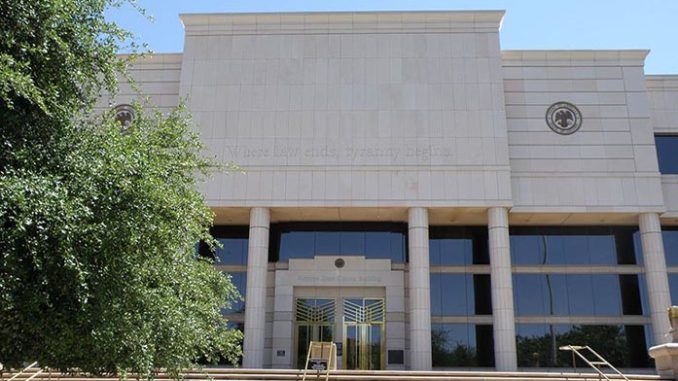
The Arizona Supreme Court has agreed to take on a case determining whether Arizona State University (ASU) can mandate diversity, equity, and inclusion (DEI) trainings for its employees.
Professor Owen Anderson sued the Arizona Board of Regents in 2024 after ASU required him to take a DEI training called “Inclusive Communities” (ASU referred to their version of DEI as “DEIB,” or “diversity, equity, inclusion, and belonging”).
ASU requires the Inclusive Communities training as a condition of employment upon hire and every two years.
The Goldwater Institute, a Phoenix-based public policy and litigation organization, filed on Anderson’s behalf. Goldwater Institute attorney Stacy Skankey said the case represented Arizonans’ right to hold government agencies accountable for violating the law.
Arizona law prohibits any mandatory trainings which impart “blame or judgment on the basis of race, ethnicity or sex.”
“No one should be forced to participate in divisive DEI training or endorse race-based ideology as a condition for holding a government job,” said Skankey. “That’s exactly why Arizona lawmakers banned mandatory trainings that teach discriminatory ideas about race, ethnicity, or sex. But a law without enforcement is no law at all.”
The Inclusive Communities training included materials which taught that white supremacy exists as a structural phenomenon, minority faculty don’t have authority or control due to structural inequalities like racism and sexism, white privilege and white fragility exist and impact communities, white people have a duty to combat their privilege, racism can be implicit even if not intended, and sexual identities yield power.
Transcript examples from the training materials were included in the Goldwater Institute’s filing within the Arizona Supreme Court.
Along with the training, ASU formerly required employees to pass an accompanying module quiz. This exam graded certain answers as correct which served to advance DEIB ideology; the Goldwater Institute argued this final test further proved the training served as an impermissible mandate for employees to accept blame or judgment on the basis of race, ethnicity, and sex.
Anderson said ASU’s mandate violated state law because the training assigned “race blame” based on skin color.
Anderson added that ASU’s training was rooted in a Marxist dichotomy reducing the world to oppressor versus oppressed, and that the training imparted impermissibly discriminatory teachings that conflicted with his religious and political beliefs. Anderson is a tenured faculty member who teaches philosophy and religious studies.
“Arizona State leaders broke the law when they forced me and every other employee to take part in an ideological training that taught that it’s okay to judge people on their race, ethnicity, religion, and sex. I simply refuse to do that,” said Anderson. “Ultimately, the question before the Arizona Supreme Court isn’t a left or right issue — it’s about whether a state employee has the right to hold their employer accountable when it violates the law.”
The Arizona Court of Appeals previously rejected Anderson’s lawsuit. The court ruled that the law doesn’t have a provision allowing individuals like Anderson to seek legal recourse.
AZ Free News is your #1 source for Arizona news and politics. You can send us news tips using this link.
Arizona State University (ASU) professor Dr. Owen Anderson has asked the Arizona Supreme Court to hear his case challenging mandatory diversity, equity, and inclusion (DEI) training after a lower court dismissed his lawsuit, according to a petition filed this week by the Goldwater Institute.
Anderson, a philosophy and religious studies professor at ASU, originally filed the lawsuit in 2024 against the Arizona Board of Regents. He argued that the university’s required “Inclusive Communities” DEI training violated an Arizona statute that prohibits public agencies from making employees participate in training that “presents any form of blame or judgment on the basis of race, ethnicity, or sex.” Arizona Senate President Warren Petersen (R-LD14) and then-House Speaker Ben Toma (R-LD27) filed an amicus brief in support of Dr. Anderson’s lawsuit.
According to the Goldwater Institute’s petition, Anderson objects to the DEI training materials, saying they include concepts about race and identity that he believes are unlawful under state statute.
“No one should be forced to participate in divisive DEI training or endorse race-based ideology as a condition for holding a government job. That’s exactly why Arizona lawmakers banned mandatory trainings that teach discriminatory ideas about race, ethnicity, or sex. But a law without enforcement is no law at all,” Goldwater attorney Stacy Skankey explained. “We’re asking the Arizona Supreme Court to correct the lower court’s error and restore Arizonans’ right to hold government agencies accountable when they violate the law.”
ASU forced a professor to take DEI training as a condition of employment.
Goldwater stated in a press release, “There’s no way around it—a law is meaningless if it can’t be enforced. If allowed to stand, the error by the Arizona Court of Appeals would eliminate an essential civil-rights safeguard for public employees and taxpayers. The ruling changes how Arizona laws are enforced by removing the ability of an ordinary Arizonan to ensure government officials obey the law.”
In its February filing, Goldwater said the Arizona Court of Appeals ruled that Anderson could not sue because it concluded the relevant law does not expressly provide an avenue for individuals to challenge such training in court.
The petition filed by the Goldwater Institute argues that allowing the Court of Appeals’ decision to stand would leave public employees without a means to enforce the statute and hold government employers accountable. It asks the Arizona Supreme Court to recognize an implied private right of action under the law, allowing employees to challenge alleged unlawful training mandates.
The case highlights a broader debate over DEI programs at public institutions. The previous lawsuit filed by the Goldwater Institute in March 2024 similarly challenged ASU’s DEI training and sought a court order preventing the Board of Regents from imposing or using public funds for the training, citing the same Arizona statute.
ASU has previously contested the Goldwater Institute’s claims, with university officials stating that its training reflects its commitment to inclusiveness and does not violate state law. However, as AZ Free News has previously covered, ASU lost 27 grants from the National Science Foundation (NSF) in 2025, worth approximately $28.5 million, in line with the NSF policy that ensures grants don’t prioritize certain groups or individuals.
Speaking of the ongoing lawsuit, Professor Anderson said in a statement, “Arizona State leaders broke the law when they forced me and every other employee to take part in an ideological training that taught that it’s okay to judge people on their race, ethnicity, religion, and sex. I simply refuse to do that. Ultimately, the question before the Arizona Supreme Court isn’t a left or right issue—it’s about whether a state employee has the right to hold their employer accountable when it violates the law.”
There is currently no set timeline for the Arizona Supreme Court to decide whether it will grant review of Anderson’s petition.