by Matthew Holloway | Feb 6, 2026 | Education, News
By Matthew Holloway |
Arizona State University (ASU) professor Dr. Owen Anderson has asked the Arizona Supreme Court to hear his case challenging mandatory diversity, equity, and inclusion (DEI) training after a lower court dismissed his lawsuit, according to a petition filed this week by the Goldwater Institute.
Anderson, a philosophy and religious studies professor at ASU, originally filed the lawsuit in 2024 against the Arizona Board of Regents. He argued that the university’s required “Inclusive Communities” DEI training violated an Arizona statute that prohibits public agencies from making employees participate in training that “presents any form of blame or judgment on the basis of race, ethnicity, or sex.” Arizona Senate President Warren Petersen (R-LD14) and then-House Speaker Ben Toma (R-LD27) filed an amicus brief in support of Dr. Anderson’s lawsuit.
According to the Goldwater Institute’s petition, Anderson objects to the DEI training materials, saying they include concepts about race and identity that he believes are unlawful under state statute.
“No one should be forced to participate in divisive DEI training or endorse race-based ideology as a condition for holding a government job. That’s exactly why Arizona lawmakers banned mandatory trainings that teach discriminatory ideas about race, ethnicity, or sex. But a law without enforcement is no law at all,” Goldwater attorney Stacy Skankey explained. “We’re asking the Arizona Supreme Court to correct the lower court’s error and restore Arizonans’ right to hold government agencies accountable when they violate the law.”
Goldwater stated in a press release, “There’s no way around it—a law is meaningless if it can’t be enforced. If allowed to stand, the error by the Arizona Court of Appeals would eliminate an essential civil-rights safeguard for public employees and taxpayers. The ruling changes how Arizona laws are enforced by removing the ability of an ordinary Arizonan to ensure government officials obey the law.”
In its February filing, Goldwater said the Arizona Court of Appeals ruled that Anderson could not sue because it concluded the relevant law does not expressly provide an avenue for individuals to challenge such training in court.
The petition filed by the Goldwater Institute argues that allowing the Court of Appeals’ decision to stand would leave public employees without a means to enforce the statute and hold government employers accountable. It asks the Arizona Supreme Court to recognize an implied private right of action under the law, allowing employees to challenge alleged unlawful training mandates.
The case highlights a broader debate over DEI programs at public institutions. The previous lawsuit filed by the Goldwater Institute in March 2024 similarly challenged ASU’s DEI training and sought a court order preventing the Board of Regents from imposing or using public funds for the training, citing the same Arizona statute.
ASU has previously contested the Goldwater Institute’s claims, with university officials stating that its training reflects its commitment to inclusiveness and does not violate state law. However, as AZ Free News has previously covered, ASU lost 27 grants from the National Science Foundation (NSF) in 2025, worth approximately $28.5 million, in line with the NSF policy that ensures grants don’t prioritize certain groups or individuals.
Speaking of the ongoing lawsuit, Professor Anderson said in a statement, “Arizona State leaders broke the law when they forced me and every other employee to take part in an ideological training that taught that it’s okay to judge people on their race, ethnicity, religion, and sex. I simply refuse to do that. Ultimately, the question before the Arizona Supreme Court isn’t a left or right issue—it’s about whether a state employee has the right to hold their employer accountable when it violates the law.”
There is currently no set timeline for the Arizona Supreme Court to decide whether it will grant review of Anderson’s petition.
Matthew Holloway is a senior reporter for AZ Free News. Follow him on X for his latest stories, or email tips to Matthew@azfreenews.com.
by Matthew Holloway | Dec 8, 2025 | Education, News
By Matthew Holloway |
University of Arizona (UA) English professor Dr. Matthew Abraham has filed a federal lawsuit alleging he was blacklisted from key faculty-governance committees after raising concerns about DEI-driven hiring practices within his department. The complaint, filed Nov. 25 in the U.S. District Court for Arizona, names the Arizona Board of Regents (ABOR) as the sole defendant and alleges retaliation in violation of Title VII of the Civil Rights Act.
Abraham, a tenured faculty member, argues that the university systematically excluded him from participation in faculty oversight bodies, including the Committee on Academic Freedom and Tenure (CAFT) and the English Department’s Academic Program Review Committee (APR), after he questioned policies, which he believed to be rooted in racial preferences, through legally protected internal and administrative channels.
According to filings and documentation released by the Liberty Justice Center, Abraham’s concerns date back several years, culminating in multiple internal grievances, public records requests, and a 2022 complaint filed with the U.S. Equal Employment Opportunity Commission (EEOC). The EEOC initially dismissed the complaint but later issued a right-to-sue letter in August 2025, clearing the way for the federal lawsuit.
In the lawsuit, Dr. Abraham alleges that UA administrators and faculty leaders applied “confidential” criteria when selecting committee members, criteria he argues were influenced by DEI ideology and were used to sideline dissenting faculty.
Slides and internal correspondence referenced in the lawsuit reportedly categorized certain faculty members as “problematic,” “not appropriate,” or otherwise unfavored for committee roles. Abraham says those labels stemmed directly from his vocal opposition to using race as a factor in hiring or governance.
“University officials cannot blacklist a professor because he dared to question race-based hiring practices,” said Ángel J. Valencia, senior counsel at the Liberty Justice Center, in a press release. “Retaliation for speaking out about unlawful discrimination is itself illegal. We seek to restore lawful, transparent standards for committee service, to remove the stigma the University has placed on Dr. Abraham, and to hold the University accountable for their unlawful actions.”
Abraham’s lawsuit seeks several remedies, according to the Liberty Justice Center, including:
- Removal of “stigmatizing” labels placed in faculty records
- Clear, viewpoint-neutral criteria for determining eligibility for governance committees
- An injunction barring ABOR and UA from using race-based or DEI-based selection practices in committee assignments
- Restoration of Abraham’s participation rights within faculty governance
The University of Arizona declined comment, citing “what is an active legal matter,” according to The Center Square.
Dr. Abraham’s lawsuit comes as public universities nationwide face increasing scrutiny over the role of DEI in hiring, admissions, and internal governance. Arizona’s public higher-education system has been under heightened legal and political pressure in the past year, as previously reported by AZ Free News.
If Abraham prevails, even just by forcing broader disclosure of committee-selection records, the case could become a significant test of how DEI principles intersect with federal civil rights protections and the speech rights of public employees.
The Board of Regents has not yet filed a response in federal court as of this report.
Matthew Holloway is a senior reporter for AZ Free News. Follow him on X for his latest stories, or email tips to Matthew@azfreenews.com.
by Ethan Faverino | Dec 4, 2025 | Education, News
By Ethan Faverino |
Eight Arizona state lawmakers have joined Superintendent of Public Instruction Tom Horne in demanding immediate action to revise the Structured English Immersion (SEI) framework, warning that the current language, loaded with Diversity, Equity, and Inclusion (DEI) ideology, violates state law, undermines classroom neutrality, and jeopardizes $866 million in federal education funds.
In a November 25 letter to the State Board of Education, Representatives Michele Peña (LD-23), David Marshall (LD-7), Michael Carbone (LD-25, Majority Leader), James Taylor (LD-29), Leo Biasiucci (LD-30), Lisa Fink (LD-27), and Senators Hildy Angius (LD-30) and Tim Dunn (LD-25), threw their full support behind the Arizona Department of Education’s (ADE) proposed revision.
The legislators accused universities and institutions of exploiting “vague and permissive language” to inject “ideological, divisive, and race-based content” into mandatory SEI coursework—material that has no place in research-based English language instruction.
The lawmakers cited constituent complaints that SEI courses, intended solely for neutral English acquisition methods under A.R.S. § 15-756.01, have instead become vessels for racialized theories that divide classrooms, distract educators, and shift instructional time away from statutory requirements.
The letter also highlighted a direct threat to federal funding. President Trump’s recent Executive Order explicitly prohibits the use of federal dollars for DEI programming. The existing SEI Endorsement Course Framework is not compliant, and keeping it as-is exposes Arizona to unnecessary and avoidable risk, the legislators warned, urging the Board to authorize ADE to open the rulemaking process immediately.
Superintendent Horne echoed the urgency in a statement released December 2, praising the legislative coalition. “I am very thankful to the eight lawmakers who sent a letter calling on the Board to start the process to revise Arizona’s teaching standards and remove DEI language,” Horne said. “This is essential not just because DEI language improperly emphasizes race over individual merit, but it threatens $866 million in federal education funds under the President’s recent Executive Order.”
He added, “Removing DEI terms from state teaching standards is the right thing to do. We must rid race-based ideology from the classroom and ensure teachers spend their time teaching math, science, language, history, and the arts. The support of these legislators is especially helpful to convey the importance and urgency of this task, and I urge my fellow board members not to further delay this process.”
The lawmakers criticized the Board’s decision to table the issue at its October 27 meeting and form a study committee, calling the move a delay tactic designed to slow or obstruct needed reforms. They insisted that the question before the Board was never about voting on specific changes but simply whether to begin the public stakeholder process to restore instructional neutrality and legal compliance.
ADE has prepared to launch the month-long rulemaking process covering teacher standards at Arizona’s three public universities. The State Board of Education is scheduled to revisit the proposal at its December 8, 2025, meeting.
Ethan Faverino is a reporter for AZ Free News. You can send him news tips using this link.
by Matthew Holloway | Nov 29, 2025 | Education, News
By Matthew Holloway |
Arizona lawmakers are urging the State Board of Education to fix the state’s Structured English Immersion (SEI) Endorsement Course Framework at its December 1st meeting, according to a letter from Rep. Michele Peña (R-LD23).
A group of State Representatives and Senators cosigned the letter from Peña, warning that existing rules risk placing Arizona out of compliance with federal funding mandates and allow the insertion of politics and racial rhetoric into courses designed to prepare educators, in violation of state law.
“Parents expect English-language instruction to focus on English-language instruction,” Peña said in a statement. “Instead, they’re finding courses with ideological material that has nothing to do with helping students learn English. The Board can’t ignore federal requirements, and it shouldn’t look the other way while universities inject political content into SEI training. The framework needs to be corrected now, and delays only create further problems for students, teachers, and the state.”
Peña warned the board that the present rule set “is harming instructional quality and undermining classroom integrity statewide.”
As noted by Peña, A.R.S. § 15-756.01 requires that the Board of Education “shall adopt and approve research-based models of structured English immersion.” In the letter, Rep. Peña adds, “SEI is intended to be a model focused only on research-based English language acquisition. That is all.”
She continued:
“The insertion of DEI-aligned language, political ideology, or racialized theories is not only outside the scope of the statute, but it also actively undermines the purpose of SEI by introducing content that divides classrooms, distracts educators, and shifts instructional time away from what the law actually requires. Arizona’s students deserve better than to have their language instruction diluted by ideological philosophies and turned into a political debate…
… We expect the Board not to delay corrective action or hide behind process barriers that were never required when these controversial provisions were inserted. Our students, teachers, and districts deserve a framework grounded in objective, research-based instruction, not ideological experimentation.”
The legislators who cosigned the letter include State Representatives David Marshall (R-LD07), James Taylor (R-LD29), Leo Biasiucci(R-LD30), Lisa Fink (R-LD27), and House Majority Leader Michael Carbone (R-LD25), as well as Senators Hildy Angius (R-LD30) and Tim Dunn (R-LD29).
As previously reported by AZ Free News, Arizona Superintendent of Public Instruction Tom Horne issued a similar statement in October, calling upon the Board to strip Diversity, Equity, and Inclusion (DEI) language from Arizona’s teaching standards.
Note: As of this report, the State Board’s public calendar shows the meeting scheduled for Dec. 1, 2025, as a meeting of the Accountability Technical Advisory Committee, while the regular State Board of Education meeting is scheduled for December 8th; this conflicts with the December 1st date provided in Rep. Peña’s statement.
Matthew Holloway is a senior reporter for AZ Free News. Follow him on X for his latest stories, or email tips to Matthew@azfreenews.com.
by Staff Reporter | Nov 2, 2025 | News
By Staff Reporter |
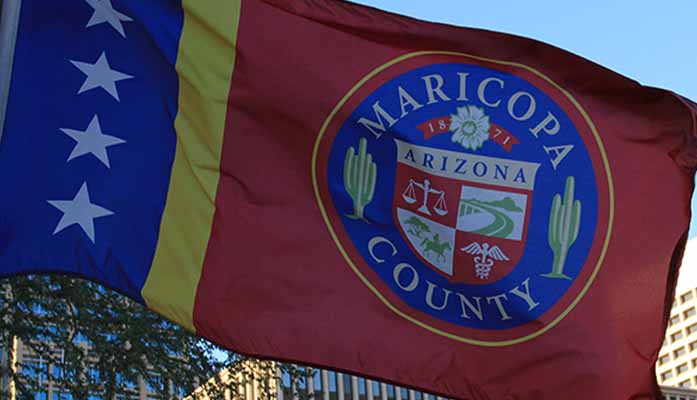
Maricopa County continues to house a diversity and inclusion initiative page.
According to the dedicated page for the diversity and inclusion initiative, Maricopa County continues to align the county’s workforce to complement constituent demographics. The county page declares that diversity yields net benefits culturally, socially, and economically.
“Maricopa County’s diversity and inclusion strategies are focused on creating an engaged workforce representative of the citizens we serve and reflective of the changing demography of our communities,” states the initiative page. “The significant cultural, social and economic dividends arising from our diverse employee base will ensure in the future our ability to provide sound government to the residents of Maricopa County.”
The page also credits differences among employees in terms of cultures, backgrounds, beliefs, and abilities as points of strength.
“Diversity and inclusion are global visions in today’s marketplace and Maricopa County realizes that by understanding, respecting and using creatively the differences of our employees, we will continue to meet the needs of the citizens we serve,” stated the initiative page.
Per the county, supporting diversity and inclusion among its workforce also consists of recognizing, rewarding, and compensating employees — specifically, based on the merits.
“The foundation of our diversity and inclusion strategies are to clearly articulate to both our employees and the general public our intention to create a culture that enhances our ability to hire, retain, develop, manage and promote a diverse, engaged workforce,” added the initiative page.
According to the page, the diversity and inclusion initiative is housed within the county’s Human Resources Department, and falls under the county’s “Government Operations” strategic priority: one of five within the 2023-2026 fiscal year strategic goals and performance measures.
This strategic priority focuses on improving infrastructure to improve government services and the county workforce.
However, on the performance dashboard page for the “Government Operations” strategic goal, the policy initiative of diversity and inclusion is not mentioned. The page mentions only three goals within the overarching strategic goal: optimizing technology by creating and launching a governance committee with the Office of Enterprise Technology; building trust by developing an online county data and services portal for residents; and developing a performance dashboard.
Nowhere else in the county’s current strategic plan is there mention of diversity and inclusion, or diversity or inclusion.
With the page remaining active as a seemingly standalone initiative, it is unclear the role diversity and inclusion plays within county governance — especially since the strategic plan it purportedly exists within doesn’t mention it at all.
Available archived versions of the diversity and inclusion page date back to 2017. The 2019-2022 fiscal year strategic goals and performance measures did not mention diversity and inclusion, and neither did the 2015-2018 version.
Earlier this year following President Donald Trump’s crackdown on diversity, equity, and inclusion (DEI) within the public sector, Maricopa County Community College District dropped its DEI policies and moved to repurpose or offload entirely individuals or groups previously dedicated to DEI.
In addition to the expected removal of its diversity page online, the district disbanded Equality Maricopa, its largest identity-based group (LGBTQ+ individuals), and advised the removal of specific identity-based groups across its campuses, like the Black Student Union.
Maricopa County School Superintendent Shelli Boggs also put the K-12 schools on notice to drop their DEI policies.
AZ Free News is your #1 source for Arizona news and politics. You can send us news tips using this link.