Editor’s Note: A Higley Unified School District spokesperson has denied that the Quran was taught to Pre-K students. The spokesperson has claimed that that social media post (see below) was due to an autocorrect error that changed Qatar to Quran. AZ Free News attempted to recreate the autocorrect error with no success. A search of Google AI indicates that “Qatar” is not likely to autocorrect to “Quran.”
An East Valley school is coming under fire from parents for teaching the Quran to pre-kindergarten students.
Children involved in the PreK THINK! Highly Gifted Academy at the Sossaman Early Childhood Development Center within the Higley Unified School District (HUSD) got an impromptu lesson on the Islamic religion this week.
A teacher for gifted students, Janet Williams, allowed the father of one student to teach the class about the Quran. In a picture posted by Williams to a forum frequented by parents, a father wearing Islamic garb offers the children to inspect his clothing.
“We celebrated [a student’s] birthday and his dad told us all about Quran,” said Williams.
Peggy McClain, who runs the Not in Our Schools website, questioned the legality and fairness of the school allowing a lesson on the Islamic religion.
“Where is the separation of church and state we are always lectured about?” asked McClain. “Look what happened in a Pre-K in a Higley District school, they discussed the Quran.”
A parent asked whether HUSD would allow their daughter to teach the Mormon religion to students next.
“Since you’re allowing members of the community to come in and share their religion, my daughter is a missionary for the LDS church and would love to stop by with treats and a quick message about Jesus Christ,” said the parent. “My Catholic and Jewish friends want their turn, too.”
Schools may not compel religious action, such as prayer. Coercion violates the separation of church and state, according to the advocacy group Secular Arizona. Schools may also not distribute religious materials, or present religious content as true or false, or present religious doctrines or beliefs as factual.
“It is easy for a teacher to give students the impression that submitting to an unwanted religious exercise is required, expected, or preferred, even if you don’t mean to do that,” stated Secular Arizona. “Students have an absolute right to be free from that pressure.”
Arizona’s chief executive and legal officer are vocally opposed to religious influence in public education. Both women have consistently maintained that religion in the classroom violates the “separation of church and state” — not an exact phrase enumerated in the U.S. Constitution but a concept derived from the First Amendment’s Establishment and Free Exercise clauses.
The Establishment Clause prohibits Congress from making laws establishing religion, while the Free Exercise Clause stops Congress from making laws prohibiting the free exercise of religion.
Last year, Governor Katie Hobbs vetoed a bill approved by the legislature to allow schools to post the Ten Commandments in classrooms.
Hobbs asserted in her veto letter that the display of the Christian religious text was not only not essential for education but likely unconstitutional.
“Not only do I have serious concerns about the constitutionality of this legislation, it is also unnecessary,” said Hobbs.
Last month, Attorney General Kris Mayes joined 17 attorneys general in a legal fight before the U.S. Supreme Court against the creation of the nation’s first publicly funded religious charter school.
“Charter schools are not private schools – they are public schools,” said Attorney General Mayes. “Allowing religious charter schools would force states to choose between violating the Constitution or dismantling their public charter systems.”
In 2023, HUSD again irked parents when it relaxed its dress code policy to allow for clothing which expose the chest, abdomen, and midriff.
AZ Free News is your #1 source for Arizona news and politics. You can send us news tips using this link.
The vice president of the Higley Unified School Board, Anna Van Hoek, received a package with an apparent threat of violence from a leftist parent.
The package, sent from Amazon, contained a rope and a book containing sexually explicit content, “Homegoing.” Following a report from Van Hoek, Gilbert Police submitted a warrant to Amazon and identified the sender as Queen Creek mother Lindzie Head.
Lindzie Head sent a copy of “Homegoing” along with a rope to Higley school board member Anna Van Hoek.
Head is a medical technologist (clinical lab scientist) at Mercy Gilbert Medical Center who serves on the Queen Creek Parks and Recreation Advisory Board. She previously held leadership roles with the PTO for Cortina Elementary School and Sossaman Middle School.
Van Hoek has taken stances on issues such as removing dirty books from classrooms and barring boys (identifying as transgender girls) from girls’ sports, in alliance with organizations such as Arizona Women of Action.
The package came after a high school English teacher, Brittany O’Neill, came under investigation for assigning the very book Head sent to Van Hoek, “Homegoing.” The book is a historical fiction addressing slavery that contains a number of passages depicting sex and rape, as well as abuse and drug use.
State law prevents the provision of sexually explicit books unless the materials are deemed educational, and parents give their consent. The Gilbert Police Department notified the district that it was investigating O’Neill over the assignment last month.
In that controversy, Van Hoek sided with the aggrieved parents who believe the book shouldn’t have been assigned to minors due to its content.
Van Hoek said in a statement that Head and her husband, Kyle Head, indicated to police that they have retained legal counsel.
In her statement, Van Hoek also said that she would not tolerate this threatening behavior. Van Hoek advised that she had previously endured an attack on her property: her tire was slashed during a board meeting last October.
“I want to make it unequivocally clear that I will not tolerate this kind of harassment and threats directed not only at myself but also at our district parents,” said Van Hoek. “Everyone has a right to express their concerns and speak out without fear of intimidation.”
Van Hoek also advised that another district parent had received the same sexually explicit book in an anonymous package from Head (confirmed by Gilbert Police) with the following message:
“Read the book and maybe you’ll learn something,” said Head’s message.
The same district parent who received Head’s package reported having his identifying information doxed on social media.
Van Hoek said that no additional information about the incidents could be provided due to an ongoing investigation.
These unwelcome packages appear to be the latest efforts by Head to become more civically involved.
Last May, Head participated in and graduated from the town of Queen Creek’s Citizen Leadership Institute. It was several months after this graduation that she applied for (and was given) the board member role for the Queen Creek Parks and Recreation Board.
Last October, Head wrote an opinion piece for the Daily Independent asking Congress to work in a bipartisan manner and pass the budget.
Head’s Instagram bio reads, “You can sit with me. Here to be unreasonable. Uninformed and relying on hearsay.”
AZ Free News is your #1 source for Arizona news and politics. You can send us news tips using this link.
The Higley Unified School District (HUSD) will now allow for students to wear more revealing clothing, which parents have criticized as risque.
The district’s new dress code removed previous policy language prohibiting attire which “immodestly exposes the chest, abdomen, midriff, genital area, or buttocks.” The new policy prohibits exposure of undergarments or “undergarment areas” in relation to exposure.
Live in a small, suburban, conservative school district and you think it's fine?
You HAVE to watch this school board meeting to believe it.
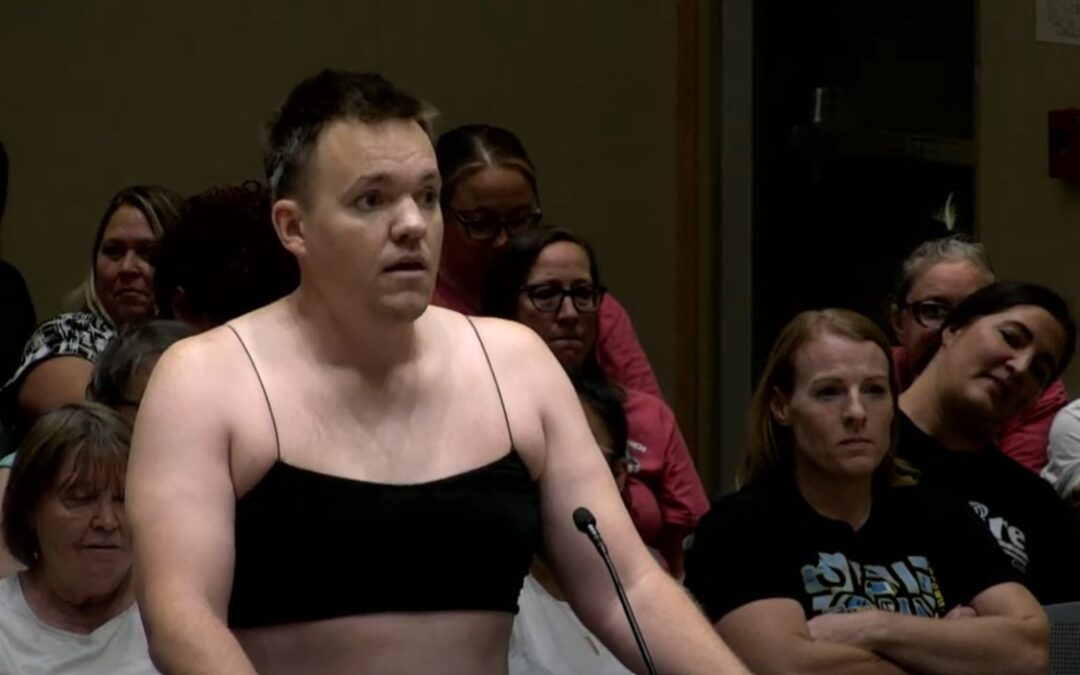
One father, Ira Latham, wore a black sports bra with spaghetti straps as an “object lesson,” or visual example, of permitted attire under the new dress code as a criticism of the district’s judgment. Latham said that anyone who took issue with his attire for a board meeting should question among themselves whether it was appropriate for a classroom. Members of the audience appeared amused or visibly uncomfortable with the display.
“Now if you ask me it’s inappropriate for a board meeting,” said Latham. “If you have a dress code policy that allows this in a classroom it does not promote a safe classroom environment as well as limits the amount of distractions in the classroom. I can’t think of any place of work where I can walk in and be taken seriously in something like this.”
Board members Kristina Reese, Tiffany Shultz, and Amanda Wade voted for the policy.
Board members Michelle Anderson and Anna Van Hoek voted against the new policy.
Anderson pointed out that grievances brought up by the community about spaghetti straps and clothing measuring didn’t exist in the now-discarded policy. Anderson also shared that she surveyed “not conservative” or “less conservative” students, namely females, about whether that policy made them feel like their bodies were disrespected or sexualized; reportedly, those surveyed felt the opposite.
“I specifically asked the less conservative females if they felt like having a dress code with our current policy’s expectations — to cover the midriff, the chest, the buttocks — if it made them feel like their body was not okay. Unanimously, they were like, ‘No,’” said Anderson. “It’s important to know that not all females feel a dress code like ours makes them feel shameful or bad about their body.”
Anderson disclosed that some of the female respondents felt like pop culture, not dress codes, marketed the sexualization of females. She also pointed out that modest apparel is a standard outside of schools in nearly all jobs available.
“We are not saying skin is not professional. We are saying that there is a professional and respectable disposition that can show skin in moderation. We are a school district in which students are mandated to attend, we are not a parks and rec entity,” said Anderson. “In school, just like in jobs, there is a time and place for certain dress. Not all places of employment have the same expectations for dress, but the majority of different career fields in jobs available have dress codes that expect employees to cover their midriff, their bust, and their buttocks for decency, for the representation of the business, for safety, for camaraderie and professionalism.”
Anderson also read aloud from the dress codes upheld by the top-10 performing schools in the nation, which had modesty provisions in their policies.
Reese contended that the dress code policy change was a non-issue because students on most campuses were already violating the policy to some extent, namely girls wearing tops that show a little bit of midriff.
In a May board meeting discussing the policy, Shultz and Wade said that nixing the immodesty provision and allowing girls to expose more of their body would lead to less sexualization.
“It makes a female feel bad about their body, and that we’re saying that they need to cover up because of the way it might make someone else feel,” said Wade.
Wade said that the modesty provisions sexualizes kids, and implied that community members concerned with expansive sexual education and LGBTQ+ ideologies ought to be more against modesty-focused dress codes.
“I find the message that we are expressing to our children to look at their bodies in a sexualized nature, we routinely have people in the community come up and talk about how they’re concerned with our efforts to sexualize kids and, in my opinion, that’s what this [dress code policy] does, completely,” said Wade.
Here's more video of the Higley board meeting. Just to be clear, when this school board member refers to sexualizing children, she's saying NOT ALLOWING girls to expose their midriffs is sexualizing them. pic.twitter.com/k90VAJAx5H
— Arizona Women of Action (@azwomenofaction) May 19, 2023
Corinne Murdock is a reporter for AZ Free News. Follow her latest on Twitter, or email tips to corinne@azfreenews.com.