by Staff Reporter | Jun 15, 2026 | News
By Staff Reporter |
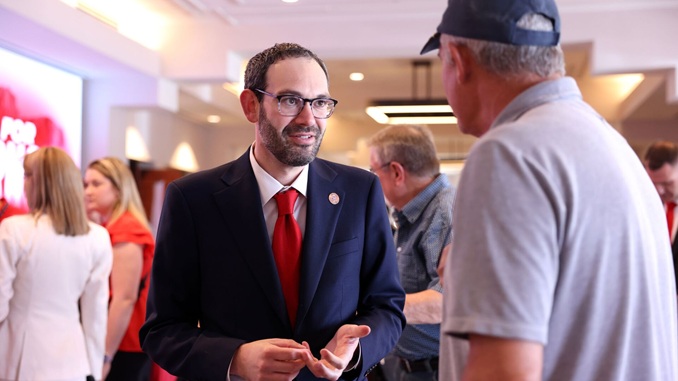
Republican State Rep. Alex Kolodin (LD3) is one of two contenders vying to unseat incumbent Secretary of State Adrian Fontes.
Kolodin, a longtime election lawyer, has been in the Arizona legislature since 2023.
Kolodin has previously defeated Fontes under different circumstances.
In 2020, Kolodin won an Arizona Supreme Court case against Fontes which determined the latter, while Maricopa County Recorder, had wrongly told mail voters that crossing out votes wouldn’t spoil their ballots. That ruling allowed Arizonans to further challenge election officials on unlawful actions.
In 2024, Kolodin again defeated Fontes in court, securing a requirement for the latter to comply with duties under the National Voter Registration Act.
Earlier this year, Kolodin successfully passed an election integrity bill (HB 2022) to ensure Arizona’s election timeline aligned with federal requirements and protected military members overseas from disenfranchisement.
Kolodin also led on HCR 2001, the Arizona Secure Elections Act, which promises to strengthen voter ID requirements through an amendment to the Arizona Constitution. The measure passed the Arizona Legislature and is now headed to the statewide ballot. If approved by voters, the amendment would mandate voter ID, declare citizenship as a mandatory qualification for registering and voting in elections, ban foreign funding in elections, and limit ballot acceptance times to Election Day.
Facing off against Kolodin in the primary is former Arizona Republican Party Chair Gina Swoboda.
Kolodin and Swoboda debated last month, with PBS moderating. Both said voters desire more reasons to trust their elections: competence, transparency, reliability, and experience.
Swoboda acknowledged that many voters believe elections have been rigged in recent years, but that the state has addressed issues with the administration, Elections Procedures Manual (EPM), and equipment through legislation and court challenges.
“The way I say it is, when people say, ‘Was it stolen?’, they were stolen fair and square,” said Swoboda.
Swoboda said issues with the EPM would always exist, but that the only issues that matter are those that affect the outcome of the election.
“We just won everything that was winnable in [20]24,” said Swoboda.
Kolodin disagreed with Swoboda’s view that the issues with the elections system, namely the EPM, have been resolved. He pointed to the Pima County GOP lawsuit against Fontes which alleges that Fontes’ EPM threatens voters’ free speech.
“The voters of Arizona are ready to move forward and have an elections system that we can be proud of,” said Kolodin.
Kolodin also questioned why Swoboda continues to defend the exclusion of political party observers in the EPM. Swoboda said she was merely backing what the law was at the time.
Swoboda criticized Kolodin for his 2023 admonishment by the State Bar of Arizona. Kolodin was punished for participating in lawsuits challenging the 2020 election.
Kolodin defended mail-in voting as the right of Arizona voters, and said that his efforts in the legislature have been to make that voting method more secure.
“Arizonans love our mail-in voting. Most Arizonans use mail-in voting, and nobody is coming to take that away,” said Kolodin.
Similarly, Swoboda said that Arizona has used mail-in voting for a while and does it well, and indicated that Arizona has further to go to secure the voting method against potential fraud.
The two contended whether the ballot referral under HCR2001 would “crush” mail-in voting. Kolodin claimed Swoboda was “misleading” voters on the referral, which he said was measures to improve the security of mail-in voting. Swoboda claimed the county recorders stand opposed to the referral.
“The voters of Arizona are the only stakeholders that I care about,” replied Kolodin.
Kolodin said it was “extremely important” to boost voter participation, especially in rural areas. However, Swoboda said it wouldn’t be her job as the secretary of state to ensure voter turnout was high.
In closing statements, Kolodin said his focus was on restoring public perception of integrity in Arizona’s elections.
“What the voters have been waiting for is elections that we can be proud of again,” said Kolodin.
AZ Free News is your #1 source for Arizona news and politics. You can send us news tips using this link.
by Ethan Faverino | Feb 7, 2026 | News
By Ethan Faverino |
On Friday, Arizona Governor Katie Hobbs signed a Republican bill passed on a bipartisan vote by the Arizona Legislature to change the date of the 2026 primary and permanently move Arizona primaries to the second to last Tuesday in July.
The legislation permanently shifts the primary election date earlier, ensures timely ballot access for military voters overseas, and mandates clearer guidelines for political party observers at polling sites, marking a significant step toward greater election integrity and consistency ahead of the 2026 election cycle.
HB 2022 addresses longstanding issues with Arizona’s election calendar by moving the primary from August 4 to the second-to-last Tuesday in July – specifically July 21 for 2026.
This two-week adjustment resolves conflicts with federal requirements under the Uniformed and Overseas Citizens Absentee Voting Act (UOCAVA), which mandates that ballots be sent to military and overseas voters at least 45 days before an election. Previously, Arizona’s timeline risked delays, potentially disenfranchising service members.
By advancing the date, the bill ensures that ballots are mailed on time, giving voters abroad ample time to receive, complete, and return them.
The measure also enhances transparency and oversight by explicitly requiring authorized political party observers to be permitted at all voting locations, including early voting centers and emergency voting sites.
The bill was sponosored by Rep. Alexander Kolodin (R-LD3) with a mirrored bill (SB 1425) sponsored in the Arizona Senate by Sen. Wendy Rogers (R-LD7).
“Arizona law has always intended to protect the integrity of our elections, including for military voters and at ALL voting locations,” said Rep. Kolodin. “I am delighted that Governor Hobbs agreed with me that this commonsense reform and legislation is necessary.”
“This was a unified Republican effort leading the way from start to finish,” Senator Rogers added. “By working together across chambers, we delivered a commonsense election bill that protects military voters, brings clarity to our election calendar, and strengthens transparency for Arizona voters. This is how the process should work.”
New voter deadlines are as follows:
- Voter Registration Deadline: June 22, 2026
- Ballots are mailed to voters on the Active Early Voter List and In-Person Early Voting Begins: June 24, 2026
- Primary Election Day: July 21, 2026
The Primary date change also impacts filing deadlines for candidates running for office.
Filing Dates:
- Partisan Primary Candidate Filing: Feb. 21, 2026 – March 23, 2026
- Precinct Committeemen Write-In Deadline: April 6, 2026
- Write-In Candidate Filing Deadline: May 22, 2026
The measure had the full support of the Arizona Freedom Caucus (AFC). In a statement, AFC Chairman Senator Jake Hoffman (R-LD15) said, “Governor Hobbs signing Representative Kolodin’s HB 2022 is a huge win for election integirty in Arizona. While Adrian Fontes is making radical and unserious legislative proposals, like expanding unaccountable, sprawling voting centers and reinstating a permanent early voter list, Representative Kolodin is leading with bipartisan supermajorities.”
Ethan Faverino is a reporter for AZ Free News. You can send him news tips using this link.
by Matthew Holloway | Feb 5, 2026 | News
By Matthew Holloway |
The Arizona House of Representatives approved bipartisan election integrity legislation on Monday intended to enhance voting oversight and protect the rights of military and overseas voters.
The measure, House Bill 2022, sponsored by State Representative Alexander Kolodin (R-LD3), cleared the full House after receiving bipartisan support. The bill’s passage comes amid ongoing discussions nationwide about election security and voter access.
According to the AZ House GOP, the legislation aims to protect Arizona’s military voters by ensuring election procedures account for service members and other Arizonans living or serving outside the state. Specific provisions in the bill address the handling and timely delivery of ballots for individuals covered under the Uniformed and Overseas Citizens Absentee Voting Act (UOCAVA), a federal law that safeguards absentee voting rights for military and overseas voters.
Specifically, the bill moves the Arizona primary election date to the second-to-last Tuesday in July, to better align with the federal election timeline adopted by the U.S. Congress and prevent military UOCAVA ballots from going uncounted.
In a statement announcing the bill’s passage, Representative Kolodin said, “This bill exists for one reason: to make sure Arizona voters, especially our men and women serving overseas in uniform, are not disenfranchised because Congress changed the rules and failed to check the calendar. HB 2022 locks in the fix that worked in 2024. Military ballots went out on time, and our men and women serving in uniform were able to exercise their right to vote as citizens of the United States. There is no excuse to walk away from something we know works.”
HB 2022 also includes a series of measures intended to strengthen election oversight and transparency, including requirements for updated reporting and procedural reviews by election officials, according to the bill summary.
The following changes will also be made:
- Modifying the deadline for ballot curing in elections that include a federal office to five calendar days, from the previous five business days.
- Broadening the type of locations that may be observed or challenged by party representatives, including ballot replacement locations, voting centers, in-person early voting locations, and emergency voting locations.
- And allowing permitting nomination and local initiative petition forms circulated under the previous law to be considered valid for the July 2026 primary.
State Representative Kolodin chairs the House Ad Hoc Committee on Election Integrity and Florida-style Voting Systems with Co-Chair Rep. John Gillette (R-LD30). The panel was formed to study election procedures and propose electoral reforms. This committee has previously advanced legislation to improve voter identification requirements, tighten security around mail-in and absentee ballots, and restrict certain external influences on Arizona elections.
HB 2022 will now move to the Arizona Senate for further consideration.
Matthew Holloway is a senior reporter for AZ Free News. Follow him on X for his latest stories, or email tips to Matthew@azfreenews.com.
by Daniel Stefanski | May 22, 2023 | News
By Daniel Stefanksi |
A water-related measure is clearing its final hurdles in the Arizona Legislature.
On Monday, the Arizona Senate passed HB 2022, sponsored by Representative Tim Dunn, which deals with reports on water fees and levees.
HB 2022 is “an emergency measure that extends the date, from July 1 to August 15, for the Director of the Arizona Department of Water Resources (ADWR) to annually provide a report of the ADWR’s operations to the Governor and the Legislature.” The bill also “outlines ADWR fee maximums for applications,” and it “requires the Water Infrastructure Finance Authority of Arizona (WIFA) to distribute monies to Navajo County for the Little Colorado River Levee budget line item.”
The proposal cleared the Senate with a 28-0 vote (with two members not voting) and was transmitted to the House for concurrence. Earlier in the session, the House approved of the bill by a 58-2 tally.
In the Senate’s Committee of the Whole session this week, Senator Sine Kerr amended the bill, which earned applause by Democrat Senator Priya Sundareshan, who highlighted the efforts to reduce ADWR application fees and exempt ADWR from rulemaking requirements. Senator Sundareshan stated, “We need to support better groundwater management and help our rural areas.”
When HB 2022 was considered before the Senate Natural Resources, Energy and Water Committee, Ben Alteneder, the Legislative Liaison for the Arizona Department of Water Resources, briefly testified before the members, informing the panel that ADWR was neutral on the bill and had no issues with it. In February, a representative for the Western Growers Association signaled support for the legislation.
Daniel Stefanski is a reporter for AZ Free News. You can send him news tips using this link.