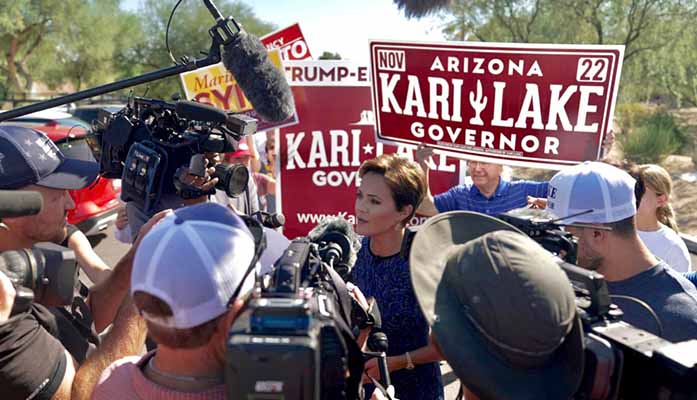
Editor’s Note: Since our story published, search results for Kari Lake now show her campaign website on Google’s first page.
Google appears to be skewing search results of Arizona’s gubernatorial candidates to favor the Democratic candidates over the Republicans. AZ Free News monitored search results over the past week and discovered indications of a consistent bias for Democratic gubernatorial candidate Katie Hobbs and secretary of state candidate Adrian Fontes, over their respective Republican opponents Kari Lake and Mark Finchem.
It’s likely the latest in Google’s history of attempting to sway election outcomes. The Big Tech giant historically referred to their technique of manipulating search results as “ephemeral experiences.” Google has admitted to manufacturing this information in order to change people’s attitudes and behavior concerning politics.
A search of “Katie Hobbs” brings up Hobbs’ website as the first result, followed by top news portraying Hobbs favorably. A sample of articles featured over the weekend: an MSNBC interview that she’s the sane candidate, a Fox News report that she has “Republicans” campaigning for her, a KTAR report that former President Barack Obama will stump for her and Senator Mark Kelly, and an Insider report on Fox News mistakenly screening mock election results of a Hobbs victory.
After those articles, it’s Hobbs’ secretary of state website, her Twitter feed, her Wikipedia page, an endorsement by pro-abortion group Emily’s List, her Ballotpedia, her Facebook, and various coverage of the burglary of her campaign office.
Then there’s the results of a search on “Kari Lake.” Her campaign website doesn’t appear on any of the first 11 search result pages, and doesn’t appear even when omitted results are included. Lake’s website appears sporadically via ads, alongside which there are usually ads asking voters to donate to Hobbs.
Search results for Lake yield a Wikipedia page first, followed by top news portraying Lake unfavorably. Here were some of the articles featured over the weekend: multiple outlets’ coverage of “Saturday Night Live” mocking Lake and other Trump-backed candidates, multiple outlets’ reports on former congresswoman Liz Cheney’s millions and latest ad to defeat Lake, an Arizona Republic report detailing Attorney General Mark Brnovich accusing Lake of running a “giant grift,” and a Politico report on Lake using “MAGA star power.” After those articles, it’s Lake’s Ballotpedia, her Twitter feed, several YouTube videos, a Washington Post article, her Instagram feed, and her Facebook page.
Something similar occurs when voters look up the secretary of state candidates. A search for “Mark Finchem” yields his state legislator profile first, not his website, followed by his Wikipedia page and a collection of “top stories” characterizing Finchem as an “election denier” and target of Cheney’s PAC. Whereas a search for “Adrian Fontes” yields his campaign website first, followed by his Ballotpedia profile, endorsements, social media profiles, and two individual links to news coverage detailing Fontes’ campaign platform. Absent from the first page of results are “top stories” portraying Fontes in any negative light.
The same can’t be said for other races. Google search results for attorney general candidates Abraham Hamadeh (R) and Kris Mayes (D) yield their websites first, followed by Ballotpedia and social media accounts — no top news stories aggregated near the top.
The same is true for the search results for Maricopa County attorney, superintendent, treasurer, and state legislative candidates. U.S. House and Senate races don’t reflect that bias, either.
Google has a history of political favoritism of the left. Evidence of their role in elections became evident following the 2016 presidential election.
In last Thursday’s episode of Fox News “Tucker Carlson Today,” acclaimed psychologist and researcher Robert Epstein said that Google modifies its search results to influence voters. That’s in addition to the fact that Google is one of the top surveillance entities in the world.
Epstein, a Biden voter, said that his research confirmed whistleblower testimonies of Google’s election influence. Throughout the 2016 election, Epstein monitored Google activity using 1,735 voters across four swing states. In all, Epstein gleaned around 1.5 million ephemeral experiences across not only Google, but Bing, YouTube, and Facebook.
Epstein asserted that the biggest issue in elections wasn’t fraud but the Big Tech companies’ unchecked influence.
“I was nauseated that our data were [sic] telling us that this election was in the hands of private companies, Google in particular. Literally, that there is no more democracy, there is no more free and fair election, it’s just an illusion,” stated Epstein.
Epstein said that Google and YouTube influenced search results to favor far-left ideology. He estimated that Google’s influence in search results affected around 6 million votes in 2020.
“What we found was extreme liberal bias on Google — which is the only real search engine that counts — and hardly any bias on Bing and Yahoo,” said Epstein.
Arizona doesn’t appear to be the top priority for the Big Tech giant this year, despite evidence of their handiwork in the gubernatorial and secretary of state races. According to Epstein’s research, Google’s current primary focus is Wisconsin.
Earlier this month, the Republican National Committee (RNC) sued Google over claims of censorship. The RNC provided research indicating that the Big Tech giant sends its campaign emails to spam folders automatically to suppress its fundraising and get-out-the-vote messages.
Corinne Murdock is a reporter for AZ Free News. Follow her latest on Twitter, or email tips to corinne@azfreenews.com.
On Tuesday, the state of Arizona reached an $85 million settlement with Google over profiting on a deceptive acquisition of users’ location data. It is the most per capita that Google has paid out for this type of lawsuit.
In a press release announcing the settlement, Attorney General Mark Brnovich shared that the legal battle constituted one of the biggest consumer fraud lawsuits in state history.
“When I was elected attorney general, I promised Arizonans I would fight for them and hold everyone, including corporations like Google, accountable,” said Brnovich. “I am proud of this historic settlement that proves no entity, not even big tech companies, is above the law.”
I’m proud to announce our historic $85 million settlement against Google for deceptive and unfair practices used to obtain users’ location data. When I was elected attorney general, I promised Arizonans I would fight for them and hold everyone accountable. https://t.co/fHpN7j8BM5
Brnovich launched a two-year investigation into the Big Tech giant in 2018 after the Associated Press reported that users were misled and deceived about the collection and use of their Android smartphone’s location data — even if the user disabled their location history. The Big Tech giant would collect location data through other phone settings without consent in order to sell ads.
hunting: searching “pumpkin spice latte near me” gathering: picking up said “pumpkin spice latte near me”
Brnovich stressed these facts when he sued Google in 2020. In all, the investigation and litigation took about four years.
“While Google users are led to believe they can opt-out of location tracking, the company exploits other avenues to invade personal privacy,” said Brnovich. “It’s nearly impossible to stop Google from tracking your movements without your knowledge or consent. This is contrary to the Arizona Consumer Fraud Act and even the most innovative companies must operate within the law.”
Over 80 percent of Google’s revenues were generated through advertising.
While Google misled users on how it would collect and profit off of their personal location data, they would purport to err on the side of transparency through initiatives like their “Transparency Report.” The company continues to raise concern about how governments and other corporations engage with individuals’ data.
They also used to publish an annual report, “Android Security Year in Review,” which discussed their efforts to protect Android users’ data. The last report of that kind was issued in March 2019, about 7 months after the AP report.
Google petitioned the courts to seal Brnovich’s complaint and exhibits in the case, prompting widespread backlash from transparency advocates. Some aspects of the documents are unredacted, though the remainder are redacted.
Most of the $85 million will go to the state’s general fund, with $5 million set aside for attorney general education programs.
Joseph Kanefield, Brunn Roysden, and Michael Catlett handled the case for the attorney general’s office. Outside counsel included Kevin Neal and Ken Ralston of Gallagher & Kennedy, and Guy Ruttenberg and Mike Eshaghian of Ruttenberg IP Law.
Corinne Murdock is a reporter for AZ Free News. Follow her latest on Twitter, or email tips to corinne@azfreenews.com.
This week, Google made its driverless vehicles available to the East Valley public through its ride-hailing company, Waymo One. The artificial intelligence taxi service is available in Chandler, Gilbert, Mesa, and Tempe.
Phoenix Mayor Kate Gallego was one of the driverless car’s first passengers.
In a promotional video, Gallego said she appreciated that the vehicles are electric, and expressed hope that it would make the city more inclusive.
“There are many people in this community who can’t drive or choose not to,” said Gallego.
This isn’t the East Valley’s first experience with these driverless cars. Google has tested them over the past five years in the area.
One of those test runs went viral last year after the car stalled in a Chandler intersection, blocked three lanes of traffic, and attempted to escape company handlers. The car became confused and stopped because it needed to take a right turn and construction closed off the turn lane with cones. At one point, the car began to back up into oncoming traffic.
The passenger noted that he’d been stranded multiple times before in Waymo’s driverless cars.
Downtown Phoenix will also have driverless cars, but only for Waymo employees and “Trusted Testers,” which are select individuals participating in approved test drives. Unlike the East Valley, the downtown driverless cars will have a Waymo “autonomous specialist” in the front seat.
Waymo is also developing driverless freight transportation through its other initiative, Waymo Via.
Google isn’t the only company testing driverless cars and trucks in Arizona. The Arizona Department of Transportation (ADOT) has approved multiple driverless trucking test runs for the company TuSimple, which has ties to the Chinese government.
According to the American Trucking Associations (ATA), there are about 3.6 million professional truck drivers in the country. Government estimates report about 8 million people involved in the entire trucking industry. Globally, the industry is worth $4 trillion, and truckers make up about 40 percent of operating costs.
Corinne Murdock is a reporter for AZ Free News. Follow her latest on Twitter, or email tips to corinne@azfreenews.com.
The largest newspaper in Arizona hired two new reporters with the help of a group funded by some of the country’s most powerful Big Tech corporations and liberal companies.
The new Arizona Republic reporters came from Report for America, a program launched by the Big Tech and liberal-funded GroundTruth Project to place their hand-selected journalists in newsrooms across the world. The not-for-profit receives millions from the likes of Facebook, Google, Microsoft, and the Ford Foundation for its mission to “restore journalism.”
The program offers a major financial incentive for news outlets to take on its reporters. Report for America pays 50 percent of their reporter’s salary the first year with a cap of $25,000 for reporters with less than eight years experience or $30,000 for reporters with eight or more years of experience, then 33 percent of the salary the second year and 20 percent the third year with no cap.
Outlets don’t even have to worry about paying for the entire remainder of those reporters’ salaries. The program pledged to help fundraise half or more of the remainder of each salary. High turnover wouldn’t be an issue, either — the program requires reporters to commit to working at least two years in the newsroom to which they are assigned.
News outlets must relinquish some of their freedom when it comes to hiring the program’s reporters, however. Outlets don’t get to choose from all of the program’s reporters. Report for America hand-selects three to five candidates from which the outlets may choose.
The owner of the Arizona Republic, the mass media holding company Gannett, has given thousands to the program: an undisclosed sum ranging from $5,000 to $50,000.
In addition to the Arizona Republic, Report for America journalists are working for Arizona Center for Investigative Reporting and Tucson Sentinel.
Republic adds 2 journalists to cover rural Arizona, with support by Report for America https://t.co/S7CzJ7kqOE
Report for America claimed that its reporters are committed to non-partisan, non-ideological local reporting. Over 200 news outlets across each of the 50 states house at least one of the over 300 Report for America journalists. Two-thirds of those reporters are women, and nearly half are “journalists of color” according to the program.
GroundTruth’s editorial partners include The Washington Post, Time, The Atlantic, The New York Times, The Guardian, USA Today, PBS, NPR, NewsWeek, TeenVogue, CNN, Cosmopolitan, ABC News, and USA Today.
Corinne Murdock is a reporter for AZ Free News. Follow her latest on Twitter, or email tips to corinne@azfreenews.com.
Arizona, as part of a coalition of states is suing Google in an antitrust case challenging the company’s control over its Android app store.
Google is facing a series of major antitrust cases, including a suit that the Justice Department and 14 states filed in October, focused on Google’s efforts to dominate the mobile search market; one from 38 states and territories filed in December, also focused on search; and a third suit by 15 states and territories related to Google’s power over the advertising technology.
As Big Tech continues to flex its monopolistic powers regulators have attempted to rein in the search giant in Arizona. State Rep. Regina Cobb had hoped to help consumers save money and innovators compete in the tech market this past legislative session. Rep. Biasiucci had thrown his support behind Cobb’s bill, which would have allowed app developers to avoid what the two lawmakers call “devastating” fees imposed by big tech monopolies.
That bill died an untimely death.
The heart of the lawsuit centers on Google’s exclusionary conduct which substantially shuts out competing app distribution channels. Google requires that app developers, that offer their apps through the Google Play Store, use Google Billing as a middleman. This arrangement forces app consumers to pay Google’s commission— up to 30 percent— on in-app purchases of digital content. This commission is much higher than what consumers would pay if they could choose from one of Google‘s competitors instead. The lawsuit alleges that Google works to discourage or prevent competition, violating federal and state antitrust laws.
When Google launched its Android OS, it originally promised to keep it an “open source” platform. The lawsuit alleges Google did not keep that promise. By promising to keep Android open, Google successfully enticed manufacturers (such as Samsung) and operators (such as Verizon) to adopt Android, and more importantly, to forgo competing with Google’s Play Store at that time. Google then shut down the Android ecosystem and relevant Android App Distribution Market as soon as it was feasible to do so, effectively trapping consumers and app developers in that ecosystem and removing any effective competition by (among other things) requiring manufacturers and operators to enter into various contractual and other restraints.
Arizona also alleges that Google engaged in conduct in violation of consumer protection laws by falsely representing that it would keep Android “open” and by issuing misleading warnings to consumers– that directly downloading an app would lead to disastrous consequences for the user and their device which also enhanced and protected Google’s monopoly position.
The complaint was filed in the U.S. District Court for the Northern District of California.