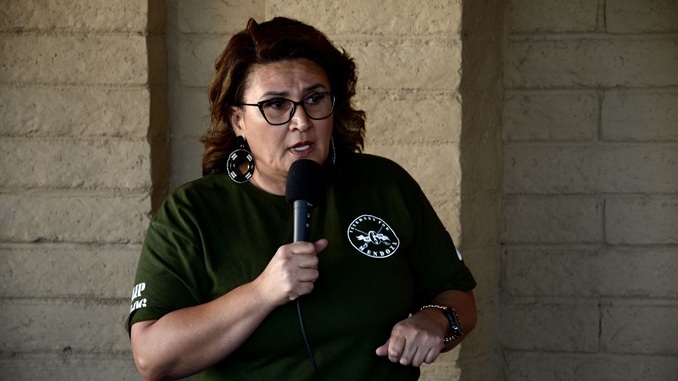
Arizona Democrat’s nominee for the 6th Congressional District refused to elaborate this week on why she opposes a measure that would prevent males from entering female-only spaces and sports.
JoAnna Mendoza ignored public questioning when asked about her opposition to Proposition 318, a ballot initiative that would require schools and athletic associations to restrict individuals to private spaces and sports teams designated for their biological sex.
The proposition, titled “Require Schools and Athletic Associations to Restrict Use of Restrooms, Locker Rooms, and Other Privates Spaces Based on Sex,” would also define sex as the biological status as male or female recorded at birth on the original birth certificate.
Yesterday, YES on Prop. 318 – Protect Girls Sports released a new video entitled "Pretending.” Please watch and share.
The opposition's website copies the YES on Prop. 318 website- violating Arizona election law, as well as, consumer protection and copyright laws.
Mendoza indicated in a statement to American Journal News last month that she opposed the proposition. Mendoza implied that the question shouldn’t be decided by a ballot vote but should instead be decided by parents, coaches, and sports associations.
“As a mom, I know that parents just want to protect their kids on the playing fields and across Arizona,” said Mendoza. “Rules about keeping sports fair and safe for young people should be made by the people who know the most — parents, coaches, and sports associations — not politicians.”
Mendoza is running for the 6th Congressional District to unseat its Republican incumbent, Rep. Juan Ciscomani.
Mendoza had previously stated during the 2020 campaign for the state legislature that legislation requiring strict biological gender adherence for sports teams was “toxic” and non-inclusive. In deleted interview footage, Mendoza said public schools and sports needed to be inclusive of transgenderism.
“And I believe that we need to ensure that our students from all backgrounds from the LGBTQ community should feel accepted and safe in their environments and at school,” said Mendoza.
The National Republican Congressional Committee spokesperson Ben Petersen said Mendoza was a “far-left lobbyist” that has strategically toned down her rhetoric on these politicized issues.
“Lobbyist Mendoza called concerned parents ‘toxic’ for wanting to protect girls’ sports, and now she won’t even explain why she opposes this common sense ballot initiative,” said Petersen.
It was also during her 2020 campaign that Mendoza advocated for legalizing prostitution, especially for transgender women of color and other communities she characterized as marginalized.
Mendoza has received backing from major Democratic donors.
Mendoza raised more than $7.3 million. Some of her biggest single contributors have been the House Victory Project 2026, JStreetPAC, New Politics Next Mission Fund, Dem Rising 2026, Emily’s List, Invest to Elect Illinois Battleground Support 2026, and VoteVets Hellcat Victory.
Mendoza also received funding from the Soros family via George Soros’ son Jonathan Soros.
In recent weeks, Mendoza has faced questions over her campaign salary and financial disclosures changes. In her 2026 candidate financial disclosure filed last month, Mendoza reported receiving a salary of more than $35,000. Other campaign finance filings reflecting regular payroll payments to Mendoza indicated that she was compensated much higher: approximately $102,000 annually before taxes.
OpenPolitical’s federal campaign finance data reflected that Mendoza’s campaign reported nearly $300,000 in payroll-related expenditures.
Ciscomani has raised more than $6.1 million. His biggest single contributors so far have been the Ciscomani Victory Fund, Grow the Majority, Defend Our Majority, and Emmer Majority Builders.
AZ Free News is your #1 source for Arizona news and politics. You can send us news tips using this link.
The campaign supporting Proposition 318 filed a campaign finance complaint with Arizona Secretary of State Adrian Fontes on Monday, alleging an opposition website copied its name and visual presentation while failing to disclose who paid for the site.
The two-page complaint accuses the unidentified operators of ProtectGirlsSportsAZ.vote of violating Arizona campaign disclosure requirements and attempting to mislead voters about the November ballot measure.
The complaint compares the opposition site with the Yes campaign’s ProtectGirlsSportsInAZ.vote, including screenshots showing similar turquoise, pink, black, and white branding and versions of the phrase “Protect Girls’ Sports in Arizona.” La Sota alleged the opposition site copied the Yes campaign’s “trade dress” and selected a web address closely resembling the campaign’s own domain.
“In addition, the website address itself is meant to mislead,” La Sota wrote in the complaint.
According to the complaint, the opposition site uses ProtectGirlsSportsAZ.vote, while ProtectGirlsSportsAZ.com redirects visitors to the same website. The Yes campaign operates ProtectGirlsSportsInAZ.vote.
“The group I chair has existed since June,” La Sota wrote. “What these fraudsters obviously did was go to our website and copy our trade dress and even our name, and intentionally found a website address that was as close to ours as possible.”
The complaint alleges that the opposition website does not identify a person or organization that paid for it.
Under A.R.S. § 16-925, a person other than an individual who makes an expenditure for an advertisement or fundraising solicitation must include the words “paid for by” followed by the name of the person making the expenditure. Electronically delivered advertisements are required to make the disclosure clearly readable.
Arizona campaign finance law defines an “advertisement” as information or materials, excluding nonpaid social media messages, that are published, displayed or otherwise placed in a communication medium for the purpose of influencing an election. A “ballot measure expenditure” is an expenditure that expressly advocates support for or opposition to an identified ballot measure.
“The only conceivable way that there would be no disclosure requirement would be if a single individual person was behind this shameful effort,” La Sota wrote. He added that publicly available registration information did not reveal the identity of the person who registered the domain.
Whether the website violates state campaign finance law has not been determined. The identity of its operator and the amount spent to create or maintain the site were not established in the complaint.
La Sota also cited A.R.S. § 16-905, writing that registration and campaign finance reporting requirements could apply depending on how much money has been spent on the effort.
Arizona law requires an entity to register as a political action committee when its primary purpose is influencing an election, and it crosses the applicable contribution or expenditure threshold. The Secretary of State lists the adjusted threshold for the 2025-2026 election cycle at $1,500.
The complaint also cites A.R.S. § 16-1006, which makes it unlawful to use specified corrupt means to influence an elector and prohibits deceiving an elector into voting for a different measure than the voter intended. A violation is a class 5 felony.
La Sota acknowledged in the complaint that the Secretary of State does not have criminal enforcement authority and cautioned against broad application of the statute because of its potential effect on protected political speech.
“Obviously this statute must be used with the utmost caution because it could easily be turned into a weapon against protected speech,” La Sota wrote. “But this is about as compelling a case under this statute as I have seen given the obvious attempt to defraud voters.”
The Yes campaign separately said it is asking Attorney General Kris Mayes to investigate whether the opposition website violates state consumer protection laws. The campaign did not include a separate Attorney General complaint among the materials provided to AZ Free News. Its Monday press release described the campaign finance complaint as filed with the Secretary of State and said the campaign was “asking the Attorney General to investigate.”
The campaign announced the complaint during an event at the Arizona State Capitol, where it also named Christine Jones and former Arizona State Treasurer Jeff DeWit as honorary co-chairs of the Yes on 318 campaign. State Senate President and Republican Attorney General nominee Warren Petersen, Republican gubernatorial nominee Rep. Andy Biggs, and Republican Secretary of State nominee state Rep. Alex Kolodin also voiced support for the measure in the campaign announcement.
“Arizona parents should not have to wonder whether a political website is deliberately deceiving them or who is hiding behind it,” Petersen said. “Attorney General Kris Mayes must immediately investigate these allegations and determine whether Arizona’s campaign finance and consumer protection laws were violated.”
The campaign also released a 39-second advertisement titled “Pretending”, which places screenshots of the Yes and No websites side by side and draws a comparison between the dispute over the opposition site and the campaign’s arguments concerning transgender participation in female sports. The advertisement ends with a disclosure stating that it was paid for by Protect Girls Sports in Arizona, received zero percent of its funding from out-of-state contributors and was not authorized by any candidate or candidate committee.
Glad to see my bill to protect girls’ sports and female spaces has been given a title and is now known as Prop 318. But now seeing a disgraceful trick by the opponents to copy our official website – Protect Girls’ Sports in Arizona. With look-alike graphics and no “Paid for”… pic.twitter.com/zHqIGDiZty
Proposition 318, referred to voters by the Legislature as HCR 2003, would amend Arizona law governing student athletics.
According to the Secretary of State’s official ballot language, the measure would require public schools, private schools and athletic associations to designate athletic teams as male, female, or coed based on biological sex as recorded at birth and would prohibit males from participating on female teams. It would also prohibit schools and athletic associations from authorizing individuals to use private spaces, including restrooms, that are not designated for that individual’s sex.
Current Arizona law applies the athletic-team designation requirements to public schools and private schools whose teams compete against public schools. Proposition 318 would broaden the statute to additional schools and athletic associations and expressly add restrictions governing restrooms, locker rooms, shower rooms, and other private athletic spaces.
A “yes” vote would enact those changes beginning Jan. 1, 2027, while a “no” vote would maintain current Arizona student-athletics law, according to the Secretary of State.
“Today we celebrate sports for all, as we begin the campaign to protect both girls’ sports and the right for everyone to participate,” Jones said Monday. “Prop 318, the Protect Girls Sports in Arizona Act will designate sports Male – Female – Co-Ed, ensuring fairness for females, and the opportunity for everyone to play.”
The complaint urges Fontes to take action on the alleged disclosure violations and ensure transparency surrounding the opposition website. La Sota asked the secretary to give the matter his “utmost attention,” writing that voters should not “unwittingly lose their vote on this ballot measure.” As of publication, no determination that a campaign finance violation occurred had been announced.
Arizona’s “Save Women’s Sports Act” no longer faces a court challenge following a Supreme Court ruling.
Last month, the U.S. Supreme Court ruled in West Virginia v. B.P.J. (inclusive of Little v. Hecox) that states have a constitutional right to enact laws restricting single-sex sports participation on biological sex. The court ruling affirmed that biology, not gender identity, defines sex when considering federal regulations on sex-based discrimination.
The Save Women’s Sports Act went into effect in 2022 under SB 1165. The law requires K-12 students to play on sports teams aligning with their biological sex.
The following spring, the families of two boys who identify as transgender girls sued State Superintendent of Public Instruction Tom Horne in Doe v. Horne. The boys who filed were, at the time, an 11-year-old middle schooler in Maricopa County identified as “Jane Doe” and a 15-year-old high schooler in Pima County identified as “Megan Roe.”
Roe, now identified as Grey Picciano, dropped out of the case upon graduating high school, and until this week only Doe remained in the case.
The two youths had alleged the law was unconstitutional under the Fourteenth Amendment’s Equal Protection Clause, Title IX, the Americans with Disabilities Act, and the Rehabilitation Act since they had either not undergone puberty or were taking puberty blockers.
The Tucson division of the Arizona District Court blocked the state law in July 2023, and the Ninth Circuit Court of Appeals upheld that ruling in 2024.
Horne celebrated the lawsuit’s dismissal in a press release announcement, bringing to close a three-year court battle in which Horne ultimately held the line on Arizona’s law.
“There had been numerous articles about girls who worked hard on their sports, hoping to make the team, or even get a college scholarship or compete for the Olympics. Then they had to compete with a biological boy who was bigger, stronger and faster from birth,” said Horne. “They could not compete. Their dreams were shattered and they were devastated. They no longer need to fear those outcomes.”
Horne also pointed out that, of all those named as defendants in the original lawsuit, only his office remained three years later. Attorney General Kris Mayes reportedly declined to represent Horne in the case. Horne contracted the services of Wilenchik Law Firm to represent him.
An attorney behind the lawsuit to stop Arizona’s law, Rachel Berg, senior staff attorney with the National Center for LGBTQ Rights (NCLR), told Capitol Media Services that it was Doe’s decision to dismiss the lawsuit.
“[O]ur client has decided for personal reasons that she does not want to continue with the litigation,” said Berg.
In a statement last week responding to the Supreme Court ruling, Berg claimed state laws restricting participation in single-sex sports based on biological sex would lead to institutions checking the gender of participants should they appear to be physically above average.
“Blanket bans on transgender girls playing school sports invite anyone to call for a ‘gender check’ on any girl who wants to play sports if they think she is ‘too tall’ or ‘too strong,’” said Berg. “Local schools and sports associations should be handling this issue, not politicians.”
Including the dismissed case, NCLR has filed five cases challenging Arizona laws and policies which allegedly impose unlawful discriminations against individuals who identify as transgender.
AZ Free News is your #1 source for Arizona news and politics. You can send us news tips using this link.
On Tuesday, the U.S. Supreme Court upheld state laws barring males from competing in female sports, even if they identify as female. The ruling drew praise from Arizona’s Republican leaders.
In its opinion in West Virginia v. B.P.J. (inclusive of Little v. Hecox), the high court declared that biology defines sex, not gender identity, when considering federal regulations on sex-based discrimination.
“The term ‘sex’ […] cannot plausibly be interpreted to refer to anything other than biological sex,” stated the ruling.
Arizona participated in the lawsuit through its leaders in the Republican-led state legislature: Arizona Senate President Warren Petersen (LD14) and Arizona House Speaker Steve Montenegro (LD29). The pair filed an amicus brief last September.
Petersen hailed the Supreme Court decision as a “landmark ruling.” In a press release responding to Tuesday’s ruling, Petersen said the ruling represented a win in both the intellectual and moral sense, calling it common sense justice for women and girls.
“Every young woman deserves the opportunity to compete on a level playing field and earn a roster spot, a championship, a record, or a scholarship based on her hard work. Girls shouldn’t have to lose those opportunities because adults are afraid to acknowledge biological reality. That’s not fairness, and it’s not what Title IX was created to do,” said Petersen. “Arizona has been leading on this issue for years, and we were proud to stand with West Virginia and Idaho before the U.S. Supreme Court to defend girls’ sports. Today’s decision makes it clear that states can continue protecting the integrity of women’s athletics and the opportunities generations of women fought so hard to secure. This is a victory for every girl who dreams big, works hard, and deserves the chance to compete fairly.”
Arizona Superintendent of Schools Tom Horne — the lone elected leader to defend in court Arizona’s law prohibiting biological males from participating in female-only sports — declared the ruling a victory for female success and safety in competition. Attorney General Kris Mayes refused to defend the law in court (Jane Doe v. Warren Petersen).
“The news has been full of stories about girls who worked hard on their sports, hoping to make the team, or even earn a college scholarship or qualify for the Olympics. But then they had to compete against biological boys and their advantages in birth in size, speed and strength. The girls’ dreams were shattered and they were devastated,” said Horne. “Girls have also been injured, including a brain injury, from having to compete against larger and stronger males. I am committed to making sure that Arizona schools follow state law protecting girls’ sports.”
Former Gov. Doug Ducey, a Republican, passed the “Save Women’s Sports Act” under the Republican-led state legislature in 2022. In a letter approving the legislation, Ducey called it fair and common sense.
“This legislation simply ensures that the girls and young women who have dedicated themselves to their sport do not miss out on hard-earned opportunities including their titles, standings and scholarships due to unfair competition,” stated Ducey. “This bill strikes the right balance of respecting all students while still acknowledging that there are inherent biological distinctions that merit separate categories to ensure fairness for all.”
AZ Free News is your #1 source for Arizona news and politics. You can send us news tips using this link.
Earlier this spring, the International Olympic Committee (IOC) released a new policy on protecting women’s sports in future Games. The Committee concluded that “for all disciplines on the Sports Programme of an IOC Event, including individual and team sports, eligibility for any Female Category is limited to Biological Females.”
The IOC’s rationale was very thorough and scientific. The Committee found that “to protect fairness in sports and events that rely on strength, power, and/or endurance, as well as safety particularly in contact sports, it is necessary and adequate to base eligibility for competition on biological sex.” The IOC’s new policy should be applauded, yet it came on the backs of decisive and unapologetic leadership from President Donald J. Trump, former female athlete Riley Gaines, and so many others.
For the vast majority of Americans, this finding was celebrated. Most people still believe in science and common sense to drive their thoughts about everyday life, including the line between men’s and women’s sports. A 2025 NBC News Stay Tuned Poll showed that 75% of respondents disagreed with biological male athletes competing in female sports. In a January 2025 Iposos survey, 94% of Republicans, 67% of Democrats, and 64% of Independents also indicated their preference for protecting the integrity of women’s sports.
While the IOC and the majority of the American public may agree on the scientific facts behind biological men and women and the necessities of safeguarding women’s sports, many elected Democrats around the nation, including in Arizona, do not. It was unfortunate to see that while only a minority of national Democrats think boys should be able to play in girls’ sports, one hundred percent of Arizona’s out-of-touch liberal legislators voted to allow boys in girls’ sports. These Democrats are holding on to crazy, unscientific, and dangerous fantasies about opening women’s sports for any and all comers. They would rather jeopardize the safety of girls and women to protect the feelings of men pretending to be women.
The issue transcends women’s sports, as it has included a malicious desire to allow men into women’s private spaces, such as bathrooms, showers, and locker rooms. Across the country, Democrats have continually blurred the lines between men and women and what we have historically held sacred in this country (for very good reasons). Again, most reasonable people do not believe that a biological man should be allowed to walk into a woman’s restricted area. Yet this has been happening for years and celebrated by the left.
The ultimate gaslighting is telling a boy that he is a girl or that he can invade girls’ private spaces and arenas. I can’t wake up one day and decide I want to identify as a cat – no matter how much I match my appearance to our feline friends. If I did so, then people would rightly think I’ve lost my mind. This is what has been happening, though, around America. People are showing their insanity by working to bend the rules of biology.
That’s why as Senate President, I’ve refused to capitulate to the crazy and dangerous ideas of the left – and I’ve actually gone on the offensive for what’s right. I’ve led the charge on safeguarding girls’ bathrooms, locker rooms, and sports. I’ve even spearheaded the defense of Arizona’s commonsense law protecting the integrity of women’s sports, taking our case (Jane Doe v. Warren Petersen) all the way to the Supreme Court of the United States (SCOTUS). Currently, SCOTUS is considering two of these women’s sports cases (from West Virginia and Idaho), and the forthcoming opinion will decide the fate of other laws being held up in federal litigation, including Arizona’s. In fact, I was sitting in the Supreme Court next to Attorneys General McCuskey and Labrador during the oral arguments for this case at the beginning of the year. It was sadly unsurprising to hear that some of the Justices didn’t know the biological definition of a woman. Fortunately, though, for the rest of real America, most of the Justices did know the biological definition of a woman – and I believe we will receive a 6-3 ruling in favor of science and common sense.
Unfortunately, for Arizonans – especially the girls and women depending on their government officials to protect their safety and decency in public spaces – our state has a Democrat governor and attorney general who are both unwilling to listen to the majority of reasonable people and stand for the integrity of women’s sports or the decency of privacy in bathrooms, showers, and locker rooms. Governor Katie Hobbs vetoed several reasonable attempts by the Republican-led Arizona Legislature to protect females in these arenas and spaces, while Attorney General Kris Mayes has been absent throughout the process to defend Arizona’s Save Women’s Sports Act.
As the IOC found in creating its new policy for future Olympic Games, “biological sex, which is divided into categories (Male and Female, based on their reproductive biology, including their sex chromosomes, gonads and hormones, is distinct from gender identity, which is a person’s sense of themselves as a woman or a man or neither/non-binary.” This finding didn’t used to be controversial at all, and it still isn’t in most American circles. The problem is that we’ve allowed a few (though growing number of) radicals to influence our policies across our states, nation, and world, leading to chaos and insanity about these unalterable scientific laws.
Though this debate has been raging now for several years, we are still relatively in the early stages of the war over women’s sports and private spaces. We cannot lose this battle or allow future generations of Americans to grow up in a new normal, where boys and men are allowed unfettered access to girls’ and women’s restricted areas or sports. That’s why I’m fighting every day to protect women’s sports and private spaces.