by Matthew Holloway | Jan 22, 2026 | News
By Matthew Holloway |
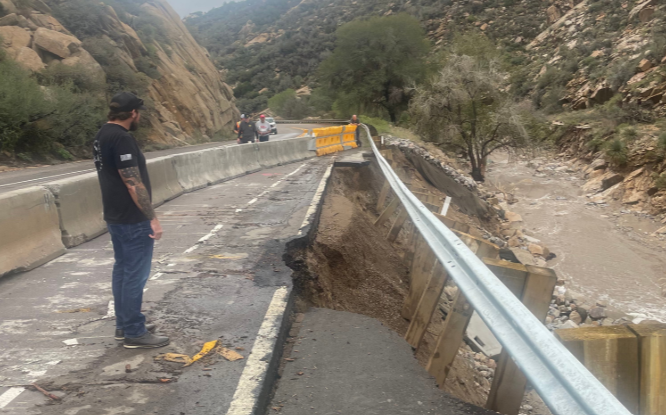
In the aftermath of historic flooding across Gila County in September 2025, Arizona communities are still wrestling with the long road toward recovery, and the federal government’s initial refusal to provide disaster relief has only added to the frustration.
On Thursday, U.S. Rep. Eli Crane (R-AZ02) took action, sending a letter to President Donald Trump and FEMA Region IX Administrator Robert Fenton uring them to intervene in Arizona’s appeal of FEMA’s denial of a Major Disaster Declaration. He was joined by Reps. Andy Biggs (R-AZ05), Juan Ciscomani (R-AZ06), and David Schweikert (R-AZ01).
The disaster declaration, would unlock vital federal funds and resources under the Robert T. Stafford Disaster Relief and Emergency Assistance Act to help communities like Globe, Miami, and other rural areas rebuild infrastructure, support residents, and mitigate future flood risks.
The appeal follows FEMA’s December 20, 2025, denial, a decision that came despite the state and local officials’ reassessment estimating damages well above $100 million.
“The new figures reflect substantial and unanticipated financial burdens placed on local jurisdictions, which were required to undertake immediate emergency protective measures, restore essential services, and address damage to roads, utilities, and public facilities,” Crane wrote in the letter.
He added, “When viewed in the aggregate, these impacts demonstrate a level of strain that exceeds the reasonable capacity of affected communities to manage without federal support.” Crane has engaged directly with FEMA officials in Washington, D.C., and invited them to visit Gila County to see conditions firsthand.
“With this more accurate assessment,” Crane said, “FEMA will now have a better sense of the damage to these storied communities. While many democrat elected officials were quick to point fingers and score cheap points, we worked behind the scenes to strengthen our efforts and believe the State of Arizona’s updated figures present a far stronger case for federal assistance. We applaud President Trump’s ongoing commitment to Arizona and look forward to continuing our work with his team at FEMA as they consider this appeal, which would deliver much-needed assistance to residents in rural Arizona.”
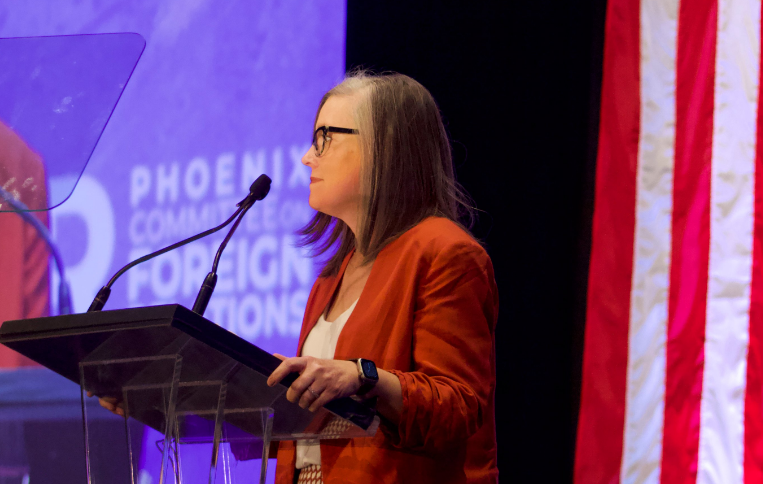
The original denial has drawn bipartisan criticism, including from Democrat Gov. Katie Hobbs, who argued the decision left families and local governments to shoulder rebuilding without critical federal support.
As federal officials weigh the appeal, residents and local leaders in Gila County continue working to recover from floods that overwhelmed watersheds, washed out infrastructure, and left lasting damage to homes and businesses.
Matthew Holloway is a senior reporter for AZ Free News. Follow him on X for his latest stories, or email tips to Matthew@azfreenews.com.
by Ethan Faverino | Dec 30, 2025 | News
By Ethan Faverino |
Arizona Governor Katie Hobbs strongly condemned the Federal Emergency Management Agency’s (FEMA) decision to deny the state’s request for a Major Disaster Declaration following the devastating floods that struck Gila and Mohave Counties from September 25-27, 2025.
Governor Hobbs announced plans to appeal the decision, emphasizing the urgent need for federal support to rebuild infrastructure, homes, and lives in these rural areas.
“The people of Gila and Mohave County were devastated by flooding from severe monsoon storms this September,” said Governor Katie Hobbs. “Now, they’ve been denied support from the federal government with little explanation. By denying much-needed relief, this administration is leaving Arizonans out on their own after their homes, businesses, roads, and bridges were decimated by historic storms. I will appeal this reckless decision and continue doing everything in my power to ensure Arizona communities don’t pay the price for the federal government’s senseless policies.”
The floods, triggered by a stalled monsoonal moisture system that dumped six to ten inches of rain in just 48 hours, overwhelmed local watersheds, including Pinal Creek, Miami Wash, Russell Gulch, and Keller Canyon.
Rapid runoff led to flash floods, debris flows, and widespread destruction across Globe, Miami, Claypool, Hayden, Winkelman, and other communities, including nearby Tribal nations.
Preliminary damage assessments revealed severe impacts: 312 homes were affected, with 64 destroyed, 89 suffering major damage, and 159 with minor to affected-level damage. More than 180 residents required emergency sheltering, and approximately 74 households lacked flood insurance.
Public infrastructure bore the brunt of the disaster with major damage to roads, bridges, utilities, and wastewater systems, including the loss of Globe’s city-owned wastewater system.
Total estimated losses stand at $33,579,081, broken down as follows:
- Residential: $4,100,000 for 312 damaged homes.
- Public Infrastructure: $23,306,284 for roads, bridges, and utilities in Globe, Miami, and rural areas of Gila and Mohave Counties.
- Emergency Protective Measures: $4,721,112 for search and rescue, debris clearance, sheltering, and Emergency Operations Center (EOC) activities.
- Debris Removal: $1,451,685 for 175,000 tons of mixed debris.
Hobbs was slow to declare a State of Emergency following the catastrophic flooding, eventually doing so on September 27, 2025, prompted by local declarations from Gila County, Mohave County, the San Carlos Apache Tribe, the Town of Miami, the City of Globe, and others.
State resources, including the Arizona Division of Emergency Management (DEMA), were fully mobilized, activating the EOC, deploying the incident management team, and coordinating evacuations, shelters, and rescues.
Local leaders echoed the Governor’s call for reversal:
Gila County Board of Supervisors District One Supervisor and Chairman Steve Christensen: “Devastation from our recent and profound flooding in southern Gila County has left many in financial ruin, homes destroyed, infrastructure destroyed or badly damaged, as well as loss of life. Gila County is left with significant challenges that we can never meet standing alone. Assistance from FEMA is vital, without which we will not recover to any level of the restoration needed. Please approve funding immediately for the work we MUST do in Gila County.”
Globe Mayor Al Gameros: “I want to thank Governor Hobbs, as well as the strong bipartisan support from our congressional delegation, for requesting a FEMA Major Disaster Declaration in response to the devastating floods that resulted in the death of three residents, and destroyed parts of our historic downtown, critical infrastructure such as bridges and roads, as well as numerous community assets. These floods caused historic and unprecedented damage and have forever transformed our small, tight-knit rural communities. Our community is extremely disappointed by FEMA’s short-sighted decision to deny the State’s Major Disaster Declaration, and we respectfully request that it reexamines its methodology and determines that this devastating flood event meets the critical criteria. I strongly urge FEMA to reverse course and immediately issue an approved Major Disaster Declaration.”
Miami Mayor Gil Madrid: “Miami is a strong and resilient community, and I know we can build back from this devastation, but this is a frustrating setback that will have a real impact on our families and businesses. I will continue working with state and local partners to ensure we get the support we need from the federal government to support our community. I urge the U.S. Department of Homeland Security to reconsider their decision and deliver this important relief to my city after we were struck by historic flooding.”
Ethan Faverino is a reporter for AZ Free News. You can send him news tips using this link.
by Matthew Holloway | Nov 18, 2025 | News
By Matthew Holloway |
The Arizona Department of Homeland Security (AZDHS) has joined a lawsuit brought by 12 states that challenges the terms set by the Trump administration and FEMA for two federal grants that impact the prevention and response to terrorist attacks, securing the southern border, and bolstering emergency management capabilities.
The lawsuit, filed on November 4th was touted by Democrat Attorney General Kris Mayes as “the 30th lawsuit the Attorney General of Arizona has joined to stop the Trump administration’s federal overreach.” It argues that the grant terms in the Emergency Management Performance Grant (EMPG) and Homeland Security Grant Program (HSPG) depart from past practices, essentially making it more difficult for state, local, and Tribal partners to obtain and use the federal grant funds.
Mayes complained at the time, “The Trump administration is trying to claw back money we use to protect the border, including for protective equipment and vehicles for law enforcement on the ground, and to support emergency preparedness and terrorism response preparation. They are also trying to withhold 50% of the funds we use to respond to emergencies in Arizona.”
“Local, state, and Tribal public safety agencies rely on funding from the Homeland Security Grant Program to effectively protect Arizonans from vulnerabilities bad actors may wish to exploit,” AZDHS Director, Dr. Kim O’Connor said in a statement. “This funding is absolutely essential in keeping our citizens and communities safe.”
The lawsuit points to two of the imposed terms as “at issue”:
- “A hold on EMPG funding until the State provides FEMA with ‘a certification of the recipient state’s population as of September 30, 2025,’ including an explanation of ‘the methodology it used to determine its population and certify that its reported population does not include individuals that have been removed from the State pursuant to the immigration laws of the United States.’”
- “A reduction of the period of performance, i.e., the period in which grant recipients must complete all activities to be reimbursed, from three years to one year.”
The state attorney’s general argue that the accurate determination of a state’s population of lawful inhabitants “exceeds” the federal government’s “statutory authority, as no statute permits Defendants to impose such a hold,” “is contrary to law because 13 U.S.C. § 183 requires federal agencies to use U.S. Census Bureau data to allocate federal grant funding,” and “is arbitrary and capricious in violation of the Administrative Procedure Act (“APA”) because it is unexplained, does not reflect reasoned decision making, and ignores the States’ reliance interests on receipt of the EMPG funds unimpeded.” Finally, they argue that the action was issued without following procedural requirements.
Reasoning for these requirements is, however, provided in the FY 2025 DHS Standard Terms and Conditions, which states “compliance with this term is material to the Government’s decision to make or continue with this award and that the Department of Homeland Security may terminate this grant, or take any other allowable enforcement action.”
Mayes also appears aware of another facet of the administration’s reasoning, as stated in her November 4th statement: “the Trump administration has attempted to reduce FEMA’s role and shift the burden of emergency management to the States.”
President Trump noted during a June announcement in the Oval Office that his administration “want(s) to wean off of FEMA and we want to bring it down to the state level.” He added that states should be equipped to handle disasters directly, noting that he wants to “give out less money,” and to “give it out directly,” according to the Associated Press. He further placed the onus for disaster response onto state governors saying, “The governor should be able to handle it and frankly if they can’t handle the aftermath, then maybe they shouldn’t be governor.”
Matthew Holloway is a senior reporter for AZ Free News. Follow him on X for his latest stories, or email tips to Matthew@azfreenews.com.
by Corinne Murdock | Jul 28, 2023 | News
By Corinne Murdock |
The Arizona desert’s classic dry heat should now qualify as an “extreme heat,” according to Democratic lawmakers and leadership.
Rep. Ruben Gallego (D-AZ-03) is lobbying for more federal funding to counter the desert heat. Democrats at all levels have recharacterized summer temperatures as “extreme heat” in an attempt to pull more funding for a variety of progressive initiatives ranging from climate change to social justice. Trending usage of the word “extreme heat” has increased dramatically over the past 20 years, spiking with increased regularity every summer.
In a press release, Gallego commended President Joe Biden for increasing heat-related worker protections on Thursday. As part of the changes, Biden met with Phoenix Mayor Kate Gallego, the congressman’s ex-wife, and San Antonio, Texas Mayor Ron Nirenberg. Yet, those changes fell short of Rep. Gallego’s ultimate goal: he urged the Biden administration to go one step further by classifying heat as an emergency.
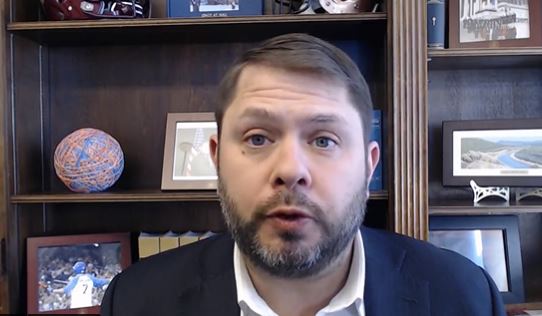
“Far too many people are dying or falling ill from these extreme temperatures,” said Rep. Gallego. “[M]ore must be done. We need a swift, immediate deployment of resources, and that requires FEMA declaring extreme heat as an emergency. I will continue pushing the administration and Congress to get that done.”
Both Gallegos have worked together to lobby the federal government to declare summer heat as an emergency.
During her annual state of the city address in April, Mayor Gallego petitioned the Federal Emergency Management Agency (FEMA) to qualify extreme heat as a disaster by adding the regular seasonal occurrence to its national emergency declarations categorization.
A FEMA recognition would bring in more federal funding. The city has a number of heat mitigation projects that would likely benefit from such funding, like the manufactured shade and drinking water access areas known as “cool corridors,” which are determined on an equity basis, and the special sunlight reflective streets known as “cool pavement.” (Which, as AZ Free News reported, actually makes people hotter). Those initiatives were unique creations under Mayor Gallego’s administration.
Mayor Gallego was also responsible for the creation of one of the first heat mitigation offices within city government: the Office of Heat Response and Mitigation (OHRM). The city established the office with $2.8 million in 2021, with the explicit attempt to combat urban heat: the theory that urbanization causes higher temperatures.
Presently, the OHRM doles out COVID-19 relief federal funding provided by the American Rescue Plan Act (ARPA) for annual heat relief grants. These grants are earmarked for nonprofit, charitable, small business, and faith-based organizations existing within the city-recognized Maricopa Association of Governments Heat Relief Network that claim negative impacts from the COVID-19 pandemic. OHRM will give out a maximum of $450,000 total, with each recipient receiving anywhere from $10,000 to $25,000.
A major focus of the OHRM is providing heat respite for the homeless. The latest update from OHRM, issued last summer, announced initiatives costing millions to increase the comfort of the homeless residing within the infamous mass homeless encampment known as the Zone: the creation of seven new shade structures; distribution of insulated and reusable water bottles, hats, sunscreen, personal misters, towels, ice chests with water; and 475 shelter beds for 24/7 heat respite.
The first and current OHRM director is Arizona State University (ASU) professor David Hondula, who teaches within the Global Institute of Sustainability. ASU worked with the city of Phoenix on the trial run and report ahead of the full launch of the cool pavement program.
After the mayor, Rep. Gallego introduced the Extreme Heat Emergency Act last month. Rep. Gallego said that extreme cold weather warrants federal disaster relief and contended that the same should be the case for the opposite of extreme heat.
“If you’re in Chicago and you have two weeks of extreme cold weather and snow and 400 people die, and Chicago calls the federal government, they will get money from the federal government,” said Gallego.
As AZ Free News reported this week, a majority of heat deaths in Maricopa County last year were due to meth.
Rep. Gallego also introduced similar legislation last year alongside Rep. Bonnie Watson Coleman (D-NJ-12). Last year’s version, the Excess Urban Heat Mitigation Act of 2022, would establish a grant program through the Department of Housing and Urban Development. It never made it past introduction.
In this latest announcement from Biden on Thursday, the president directed the Department of Labor (DOL) to issue a Hazard Alert for heat and ramp up workplace heat-safety violation enforcement, allocated $7 million in Inflation Reduction Act (IRA) funding to the National Oceanic and Atmospheric Administration (NOAA) for weather prediction improvements, and allocated $152 million in Bipartisan Infrastructure Law (BIL) funding to expand water storage and equity-based climate resilience efforts in California, Colorado, and Washington.
The Biden administration has invested over $50 billion so far to address climate issues like heat waves. They have also established a website providing information on federal funding opportunities to mitigate health risks from heat, the #SummerReady awareness campaign, established the new Office of Climate Change and Health Equity, funded 10 community groups and localities for equitable heat relief, and launched heat mapping campaigns in 154 communities across 14 states.
Earlier this month, the Biden administration announced other heat mitigation initiatives: $5 million to NOAA for two virtual research centers providing technical assistance and information to historically marginalized and underserved communities, a National Heat Strategy focused on equity and environmental justice developed by the White House Interagency Working Group (IWG) on Extreme Heat, meetings with local and tribal leadership to offer federal support for summer heat, and affordable housing opportunities using IRA and BIL funding.
Corinne Murdock is a reporter for AZ Free News. Follow her latest on Twitter, or email tips to corinne@azfreenews.com.
Page 1 of 11