by Terri Jo Neff | Aug 14, 2022 | News
By Terri Jo Neff |
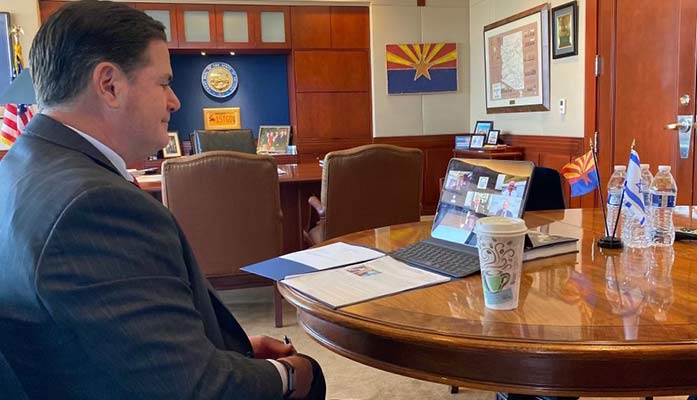
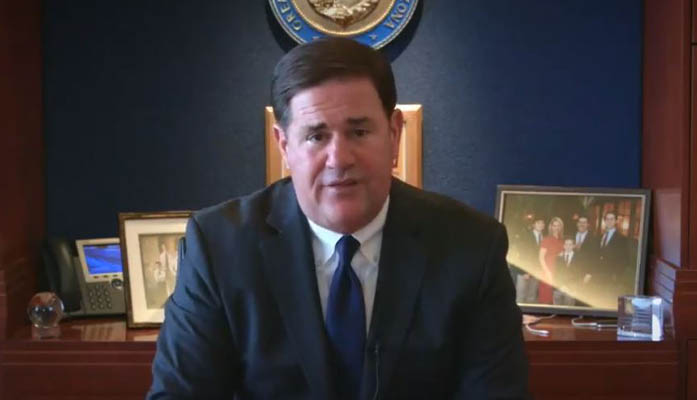
Gov. Doug Ducey signed an Executive Order on Friday for the immediate fortification of a gap in the U.S. – Mexico border in Yuma, just hours before a U.S. Consulate issued a “shelter in place” advisory for Americans living and working in Tijuana south of the border from San Diego.
“For the last two years, Arizona has made every attempt to work with Washington to address the crisis on our border,” Ducey said. “Time and time again we’ve stepped in to clean up their mess. Arizonans can’t wait any longer for the federal government to deliver on their delayed promises.”
The executive order was issued by Ducey a mere two weeks after the White House announced it would address the unsecured border in Yuma once various reviews and studies were completed. However, there was no estimate provided as to when that may be.
Ducey’s decision to authorize immediate placement of 60 double-stacked, state-owned shipping containers to fill in a 1,000-foot gap long complained about by law enforcement officials will increase national security by ensuring border security, according to Jonathan Lines, Yuma County Supervisor.
“Border communities like Yuma bear the burden of a broken border while narcotics poison our youth, human smuggling rises and mass amounts of migrants wear on our nonprofits,” said Lines, adding that Ducey was coordinating with state and local resources “to do what the federal government won’t: secure the border.”
The project overseen by state contractor Ashbritt will utilize a 25-person team of heavy equipment operators and support personnel to link together and weld shut the containers, each of which weigh more than four tons. When completed on Monday, the new barrier wall will reach about 22 feet and be topped with concertina wire.
The move to close the large gap in Yuma also came just days after President Joe Biden lifted the Remain in Mexico immigration policy which has been providing one of the few immigration controls at the border.
The U.S. Border Patrol’s Yuma Sector under the leadership of Chief Patrol Agent Chris Clum experienced more than 235,000 migrant encounters from Oct. 1, 2021 to June 30, 2022. The governor’s office called it “an ominous acceleration” for the Yuma Sector, which had the highest annual increase in encounters of all USBP sectors for the fiscal year ending Sept. 30, 2021.
Nonprofits and shelters in Yuma County set up to assist migrants have been operating for months at overcapacity. In addition, law enforcement, first responders, and local medical facilities have been overwhelmed by the influx, which includes extremely high quantities of fentanyl coming across the border Arizona lawmakers made a $335 million investment in the Arizona Border Security Fund to construct and maintain a border fence, of which $6 million will be used put the new barrier in place in Yuma.
“Republicans in the Legislature made border security a priority in this year’s budget, and I’m thankful to Governor Ducey for wasting no time in putting those funds to good use,” said Rep. Ben Toma. “Improvements to the border wall will make our communities safer by combating human trafficking and stemming the flow of fentanyl into the state.”
Just hours after Ducey signed Executive Order 2022-04 on Friday, the U.S. Consulate in Tijuana, Mexico warned of cartel violence in several Mexican cities along the border with California, including Tijuana, Mexicali, Tecate, Rosarito, and Ensenada.
The Consulate warning called on U.S. citizens already in those areas to seek secure shelter and remain aware of their surroundings. The warning also advised Americans on the Mexico side of the border to monitor local media for updates and “notify friends and family of your safety.”
The violence, which is due to internal strife within the Sinaloa Cartel as well as pressure from other cartels, is not limited to border communities near California.
Last Thursday, several killings occurred in Ciudad Juarez, a city of 1.5 million across the border from El Paso. The violence started with a deadly fight at a Mexican prison between factions of the Sinaloa Cartel. Within hours, several fires and frequent gunfire was reported throughout Ciudad Juarez, often targeting non-cartel interests.
A statement by Mexican President Andres Manuel Lopez Obrador on Friday confirmed that “innocent civilians were attacked as a kind of retaliation” in connection with the prison fight.
by AZ Free News | Jul 3, 2021 | News
On Friday, Gov. Doug Ducey rescinded a series of executive orders issued during the coronavirus pandemic. The governor said the orders were no longer needed because the Legislature put them into law.
The governor said some of the orders would remain in place until legislation takes effect in 90 days. Those include orders preventing cities, towns and counties from issuing orders for businesses that are more stringent than those Ducey issues. Other orders ending after new legislation takes effect are ones barring universities from requiring COVID-19 vaccines or masks for unvaccinated students.
The governor ordered:
Effective July 1, 2021, the following Executive Orders related to the public health emergency will be rescinded:
- Executive Order 2020-17 deferred requirements to renew state agency and board licenses that had an expiration date between March 1, 2020 and September 1, 2020 by six months from the expiration date, unless those requirements could be completed online. The timeframe for the deferrals lapsed on March 1, 2021.
- Executive Order 2020-28 was enacted to address critical demand for nursing home and long-term care facility staff, allowing caregiver trainees to utilize on-the-job training to meet a certification program. This policy was codified through legislation in 2020.
- Executive Order 2020-58 ensured cost-sharing requirements, such as co-pays and co-insurance, for the COVID-19 vaccine are waived. This policy was codified by congress through the CARES Act.
- Executive Order 2021-04 required schools to return in-person, teacher-led instruction by March 15, 2020. In-person, teacher led instruction will continue to be required beyond the March 15, 2020 deadline.
Effective July 9, 2021, the following Executive Orders related to the public health emergency will be rescinded:
- Executive Orders 2020-08 & 2020-53 extended standard driver licenses that originally expired between March 1, 2020 and December 31, 2020, in an effort to limit visits to the state Motor Vehicle division. An expiration deferral issued as a result of this order remains valid and in effect.
- Executive Order 2020-20 allowed pharmacists to dispense emergency refills of maintenance medications for up to 180 days, minimizing unnecessary trips to the doctor. With legislation expanding availability of telemedicine, obtaining refills is now more accessible.
- Executive Order 2020-25 allowed struggling Arizona restaurants to repackage and sell grocery items they have on hand, including items not normally packaged and labeled for resale. Arizona restaurants can now fully resume operations.
Effective September 29, 2021, the following Executive Orders related to the public health emergency will be rescinded upon enactment of legislation to codify the policies:
- Executive Order 2020-12 was a proactive and administrative measure to ensure consistent mitigation guidance across the state, and prohibited any county, city or town to issue an order, rule or regulation that restricts or prohibits any essential service.
- Executive Order 2021-05 lifted occupancy limits that were implemented due to COVID-19.
- Executive Order 2021-06 transitioned COVID-19 mitigation requirements for businesses to recommendations.
- Executive Order 2021-09 banned “vaccine passports” and prevented state and local governments from requiring Arizonans to provide their COVID-19 vaccination status to receive service or enter an area.
- Executive Order 2021-10 rescinded orders related to K-12 health guidance.
- Executive Order 2021-15 ensured students of public higher education institutions cannot be mandated to take the COVID-19 vaccine or submit COVID-19 vaccination documents, and prohibited mandatory testing and mask usage for students.
The following will be repealed on a date determined by the Arizona Department of Health Services:
- Executive Orders 2020-13, 2020-23, 2020-30, 2020-37, 2020-48, 2020-54, 2020-56, 2020-57, 2021-01, 2021-07, 2021-14, identified as Enhanced Surveillance Advisory Orders. The State Legislature provided authority to the Arizona Department of Health Services to continue requiring hospitals, testing laboratories and other health facilities to provide detailed information and data related to COVID-19.
by Terri Jo Neff | Jun 24, 2021 | News
By Terri Jo Neff |
In what could be a major rebalancing of powers between the executive and legislative branches, the State Senate passed legislation earlier this week to rein in a governor’s state of emergency powers.
Lawmakers have tried since January to pass legislation to ensure a governor confers with the legislature in certain instances once a public health emergency has been declared. The intent was to ensure a governor cannot issue unending emergency executive orders which impact business offerings, public health decisions, school functions, and whether families can see loved ones in nursing homes.
Many Arizonans do not realize the state remains under a declared emergency even though Gov. Doug Ducey has lifted many of his COVID-19 executive orders. Sen. Michelle Ugenti-Rita introduced a bill, SB1084, in an attempt to reassert the legislature’s power. Her bill was heard in the House and Senate but stalled in April due to concerns by some within the Republican caucus which holds a majority in both chambers.
Fast forward to the Senate’s marathon consideration of the 11-bill budget package on Tuesday and Wednesday. Ugenti-Rita proposed the text of her bill as a floor amendment to a budget reconciliation bill, SB1819. Her amendment passed on a 16 to 14 party line vote, as did SB1819 itself.
It is now up to House Speaker Rusty Bowers to secure 31 votes in his chamber to get the legislation to Ducey’s desk.
Current state law allows lawmakers to void a public health state of emergency based on a general majority vote in both chambers. However, if the legislature is not in session then two-thirds of lawmakers would have to authorize a special session, or the governor would have to call a special session.
According to the amendment language, a governor’s initial state of emergency
proclamation with respect to a public health emergency will be capped at 30 days beginning Jan. 2, 2023. It allows a governor to extend the public health state of emergency up to 120 days, but any single extension could not be for more than 30 days.
Once the 120 day period is up, the state of emergency will terminate unless extended in whole or in part by a concurrent resolution of the legislature. Lawmakers could vote to extend the state of emergency as many times as necessary in periods of not more than 30 days at a time.
Another key provision of the legislation prohibits a governor from proclaiming a new state of emergency upon termination of a state of emergency based on the same conditions unless there is passage of a concurrent resolution of the legislature consenting to the new state of emergency.
Another amendment which passed with SB1819 makes it clear what emergency powers cities, towns, and counties will have -and won’t have- in the future. It includes a ban on curfews, business closures, and other public health declarations such as mask mandates which run counter to a governor’s orders.
by Terri Jo Neff | Apr 20, 2021 | Education, News
By Terri Jo Neff |
An effort by the Arizona Legislature to craft permanent legislation to prevent a person from being denied access to businesses, government facilities, and even their child’s school unless they showed proof of being vaccination for COVID-19 was pushed aside Monday when Gov. Doug Ducey issued an executive order about the issue.
Under Executive Order 21-09, most private businesses in Arizona will be free to refuse service to “a customer” who does not provide proof of COVID-19 vaccination. Only companies which receive state funding to provide services to the public are banned from inquiring about someone’s status, although Ducey’s order does not protect those citizens who cannot receive a vaccine for a medical reason
“While we strongly recommend all Arizonans get the COVID-19 vaccine, it’s not mandated in our state — and it never will be,” Ducey said in announcing his latest COVID related executive order. “Vaccination is up to each individual, not the government.”
Daycares, schools, colleges, and universities would still be able to ask about a student’s vaccination record as already allowed by law, but parents could not be asked about their own vaccination status if the educational program receives any state funding.
In addition, hospitals and other healthcare facilities can inquire about the vaccination status of patients, prospective patients, vendors, visitors, and staff, even if the organization receives state funds.
There was initially some confusion Monday morning about what EO 2021-09 encompassed, as Ducey’s official Twitter account read “I’ve issued an Executive Order banning ‘vaccine passports’ and preventing state and local governments from requiring Arizonans to provide their #COVID19 vaccination status to receive service or enter an area.”
Many took the first sentence to mean businesses could not impose a vaccine requirement on customers. However, that misinterpretation was quickly corrected by the rest of the governor’s comments.
Ducey noted in the executive order that no person should be compelled to disclose their private health information -including their vaccination record- to a government entity as a condition of receiving services, obtaining a license or permit, or entrance to a public facility unless state law already requires proof of vaccination.
He added that federal and state laws allow individuals to refuse to be vaccinated, and that “it is not and will not be mandated in the State of Arizona.”
EO 2021-09 also prohibits any other state subdivision -including cities towns, counties, and state agencies- from adopting a policy or ordinance that contradicts the governor’s order. This ensures cities, towns, and counties cannot demand proof of vaccinations for people to use public parks and other public recreational and entertainment amenities.
Rep. Bret Roberts (R-LD11) first introduced legislation to ban such “vaccine passports” in Arizona. His effort was taken up by Sen. Kelly Townsend on March 28 in the form of HB2190, which would have protected Arizonans from having to divulge their vaccination record to shop, dine, or do most everyday activities.
HB2190 hit a snag in early April over concerns that it did not allow healthcare providers nor business owners to inquire about vaccination status of their employees. Negotiations have been underway all month on possible amendments to Townsend’s bill.
For his part, Roberts announced his support for EO 2021-09, noting Ducey’s “reasons for doing so are sound.” But he went on to note that many of those sounds reasons “also apply to the private sector.”
“No one should be required to give up their medical history to participate in commerce,” Roberts tweeted Monday morning. “When all businesses require it the individuals choice is lost. Allowing private business to do this amounts to segregation.”
Roberts also expressed concern that executive orders are intended to be temporary. After the governor’s announcement, Rep. Leo Biasiucci (R-LD4) said SB2190 should be voted on in the coming days as it “solves the issue with businesses requiring vaccine mandates.”
Also on Monday, Ducey rescinded a section of his EO 2020-51 which had directed K-12 schools to require masks.
“We will continue to work with public health professionals and Arizona’s schools as more students return to the classroom and our state moves forward,” the governor said.
by Terri Jo Neff | Mar 25, 2021 | News
By Terri Jo Neff |
The attorney for more than 100 bars and saloons across Arizona is declaring victory in a decision issued Wednesday by the Arizona Supreme Court that a recent executive order by Gov. Doug Ducey resolved a dispute about restrictions placed on some liquor license holders which shuttered many businesses for months.
The March 24 order dismissed an appeal filed by attorney Ilan Wurman on behalf of his clients who own Series 6 and Series 7 liquor licenses who alleged Ducey’s executive orders, specifically EO 2020-43 were unlawful. The lawsuit had also challenged operational guidelines issued Aug. 10 by the Arizona Department of Health Service (ADHS).
Most Series 6 & 7 licenses are used to operate smaller, family owned bars which were disproportionally impacted by Ducey’s executive orders last year. EO 2020-43 kept many closed while other liquor-serving establishments were allowed to remain open.
The supreme court’s order notes Ducey issued a EO 2021-05 on March 5, rescinding capacity or occupancy limits in place under a previous executive order. However, EO 2021-05 did not come right out and say all other executive orders related to operation of liquor-related businesses, such as EO 2020-43, were obsolete.
The supreme court took care of that, Wurman says, in its order finding that the bar owners’ appeal of a legal challenge against Ducey is now moot because EO 2021-05 will govern in the event of conflict with other executive orders and removes any distinctions between how Series 6 & 7 licensees and other businesses can operate.
According to Wurman, the supreme court’s order is “a huge win” for his clients.
“A case is moot if the Plaintiffs have obtained all the relief they seek,” he said. “The Court’s ruling is that the new EO (2021-05) rescinds any contrary guidelines that limit capacity. Further, they interpret it to prohibit discrimination against series 6s. Therefore, bars can now open and operate on the same terms as anyone else.”
As a result, Wurman is advising his clients that they can “open up 100 percent.”
“That is the only interpretation of the Supreme Court’s order that would actually render this case moot,” he said, adding that if Ducey, ADHS, or the Arizona Department of Liquor Licenses & Control disagrees with how the Supreme Court evaluated EO 2021-05, “it is incumbent upon them promptly to issue new guidance clarifying what restrictions still apply specifically to bars.”