Russia has banned Arizona State University (ASU) President Michael Crow for his CIA connections.
Last week, Russia banned Crow and about 500 other Americans from coming into their country. In listing Crow among hundreds banned, the country identified Crow as the chairman of the board of trustees to the CIA venture capital firm specializing in intelligence agency technology, In-Q-Tel Corporation, but not in his capacity as ASU President.
Crow remarked on his ban on Tuesday in a brief, tongue-in-cheek tweet.
“I will miss those cards and flowers from Putin,” wrote Crow.
So, I’ve been added to the list of people banned from Russia.
In-Q-Tel was launched in 1999 by the former CEO of government defense weapons giant Lockheed Martin. It was the first government-sponsored venture capital firm, created with the intention of expanding CIA research and development into the private sector. In-Q-Tel relies on CIA funding to invest in startups developing intelligence technologies.
Crow had plans to launch an ASU extension in Ukraine, American University Kyiv (AUK), up until the Russian invasion. As AZ Free News reported last February, those behind AUK harbored deep ties to the Clintons and the Bidens.
Crow wasn’t the only In-Q-Tel leadership banned: others included Stephen Bowsher, the president; Megan Anderson, executive vice president; Christopher Darby, the executive director; executive vice president for political affairs, Sarah Sewall; executive vice president George Hoyem; Safra Ada Catz, Michael Glenn Mullen, Judith Miscik, George John Tenet, William Ballard Hurd, and Ted Schlein, board of trustees members.
As Arizona Daily Independent noted, Tenet was a former CIA director and Hurd was a former CIA operative.
The remainder of the 500 added to Russia’s ban list included other high-profile figures in global affairs. Among the list of the names of congressmen (49 members), attorneys general (17), governors (8), and top leadership in the White House, federal agencies, and military branches was former President Barack Obama.
The executive vice president of Lockheed Martin Corporation, Tim Cahill, was also banned. Another executive for another defense corporation giant, senior vice president Jeffrey Shockey of Raytheon Technologies, was banned.
Multiple executives from George Soros’ Open Society Foundations were also banned: the CFO, Maija Arbolino, and the executive vice president, Leonard Benardo.
Several organizations had many individuals named to Russia’s ban list. This included over 80 members of the Rand Research Corporation; nearly 30 members of the Brookings Institution; nearly 60 members of the Carnegie Endowment; and 15 members of General Dynamics.
Also named to the ban list were 21 members of the National Security Council; 34 members of the NGO Atlantic Council; 11 members of the NGO Center for a New American Security; 23 members of the NGO Center for Naval Analysis; two journalists, Matthew Continetti with National Review and Jeffrey Scott Shapiro with The Washington Times; and three commentators, Joe Scarborough with MSNBC, Erin Burnett with CNN, and Rachel Maddow with MSNBC.
Military-wise, bans included the deputy secretary, secretary, and chief of staff for the Air Force; the secretary and the general of the Army; and the minister of the Navy.
There were several bans of interest, due to their apparent disconnect with global affairs: Michael Byrd, the U.S. Capitol police officer responsible for fatally shooting Ashley Babbitt during the January 6 incident; and Georgia’s Brad Raffensperger, the only secretary of state listed.
Another ban of interest was Nina Jankowicz, selected last April by the Biden administration to lead a newly created, highly controversial, and quickly scrapped Disinformation Governance Board within the Department of Homeland Security. In September, Jankowicz registered as a foreign agent to embark on a similar disinformation initiative with the United Kingdom-based Centre for Information Resilience (CIR).
I’ve been sanctioned by Russia today.
One of the proudest moments of my career, honestly.
I’ll continue standing up against Putin’s authoritarianism for as long as it is necessary. pic.twitter.com/OqrRMo5I1D
The ASU president wasn’t the only high-profile Arizonan to make Russia’s most recent list of banned persons. Both Rep. Eli Crane (R-AZ-02) and Gov. Katie Hobbs also made the cut.
— Eli Crane for Congress (@EliCraneAZ) May 22, 2023
Hobbs wrote that she would continue to support Ukraine in light of this ban.
I'm proud to be banned from Russia by dictator Vladimir Putin.
Arizona will continue to support Ukraine, including training Ukrainian fighter pilots right here in Tucson. I will always stand up for democracy at home and abroad. pic.twitter.com/jmRfQHbME1
— Governor Katie Hobbs (@GovernorHobbs) May 24, 2023
Corinne Murdock is a reporter for AZ Free News. Follow her latest on Twitter, or email tips to corinne@azfreenews.com.
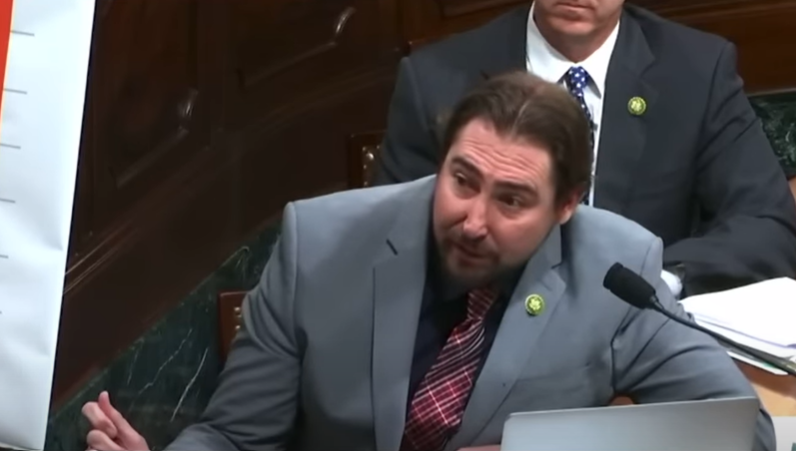
As the issues at America’s southern border continue to mount, one Arizona Congressman took advantage of a face-to-face encounter with the Secretary of the U.S. Department of Homeland Security (DHS) to let him know exactly how he felt about the official’s job performance.
On Wednesday, the U.S. House Committee on Homeland Security held a hearing to “examine the Biden administration’s Fiscal Year 2024 budget proposal for the Department of Homeland Security.” On the docket for the meeting was testimony from DHS Secretary Alejandro Mayorkas. Arizona Freshman Representative Eli Crane sat on this committee and had a chance to question Mayorkas.
Representative Crane didn’t mince words and he didn’t leave anyone in doubt as to his true feelings about the Biden Administration’s policies at the border. Directing the full weight of his comments to Secretary Mayorkas, who was sitting directly in front of the dais in the committee room, Crane said, “Sir, you said in your opening statements that you’re attacking cartels and smugglers in an unequivocal way. You most certainly are not, sir. As a matter of fact, if they were in this room right now, the heads of these cartels, you know what they’d tell us? They’d say, ‘hey, reelect these guys again and by all means keep that guy right in his seat because he’s our MVP. He’s making it so easy for us to smuggle drugs, smuggle people, get gangs into this country, distract our Border Patrol agents, and at the same time, destroy the U.S. economy.’ So you’re not doing a good job, sir.”
Secretary Mayorkas is the MVP for the Mexican cartels.
As long as he's the head of DHS, the cartels have an easy time smuggling drugs, engaging in sex trafficking, emboldening gangs, distracting U.S. Border Patrol agents, and destroying our economy. https://t.co/i4PPpBF1rX
Crane then used this scathing, yet respectful and measured, lecture to reiterate his support for Articles of Impeachment against the DHS Secretary, which so far have been drafted by fellow Arizona Congressman Andy Biggs. Earlier this year, Congressman Biggs re-filed the Articles after first introducing the action in August 2021. In a press release announcing his re-introduction of the Articles, Biggs said, “It’s clear Secretary Mayorkas has committed high crimes and misdemeanors. His conduct is willful and intention. He is not enforcing the law and is violating his oath of office. For these reasons, Secretary Mayorkas should be impeached.”
Biggs and Crane aren’t the only Members of Congress on the track towards tougher action against Mayorkas. Back in November 2022, Kevin McCarthy, now the Speaker of the United States House of Representatives, stated, “His actions have produced the great wave of illegal immigration in recorded history. That is why today I am calling on the secretary to resign. He cannot and must not remain in that position. If Secretary Mayorkas does not resign, House Republicans will investigate every order, every action and every failure to determine whether we can begin an impeachment inquiry.”
Just six months into Fiscal Year 2023, border officials have apprehended 1,223,067 illegal aliens at the southern border, including 191,899 in March (the most-recent month of information) – a little over half the numbers for the entirety of Fiscal Year 2022 (2,378,944). These apprehensions also do not take into account the number of ‘gotaways,’ which is a term for illegal aliens who escape detection by border officials and fade into countless American communities.
In February, Congressman Crane visited the southern border in El Paso, Texas, with members of the House Homeland Security Committee. Crane’s office publicized that the congressional delegation “witnessed a drug bust in real time, highlighting the severe drug trafficking issue plaguing our nation and the failure of the Biden Administration to disincentivize smugglers.” Crane said that the Biden Administration’s abandonment of the American people at the border was “a dereliction of duty” and “a betrayal of the American people they swore to protect.”
Daniel Stefanski is a reporter for AZ Free News. You can send him news tips using this link.
The most highly-contested races tightened overnight after Election Day votes were counted, leaving a substantial number of early ballots left to process.
In eight of these 13 races, Democrats lead Republicans. Total ballots processed numbered over 1.8 million, or 44 percent of total registered voters (over 4.1 million). Voter turnout in the 2018 midterms was over 2.4 million ballots cast (nearly 65 percent of the 3.7 million total registered voters).
In the Senate race, incumbent Democrat Mark Kelly leads Republican Blake Masters by nearly 90,000 votes, 51 to 46 percent.
In the gubernatorial race, Democrat Katie Hobbs leads Republican Kari Lake by over 11,700 votes, 50 to 49 percent.
In the secretary of state race, Democrat Adrian Fontes leads Republican Mark Finchem by over 84,500 votes, 52 to 47 percent.
In the attorney general race, Democrat Kris Mayes leads Republican Abraham Hamadeh by 4,000 votes, both sharing about 50 percent.
In the state treasurer race, incumbent Republican Kimberly Yee leads Democrat Martín Quezada by 201,200 votes, 55 to 44 percent.
In the superintendent race, Republican Tom Horne leads incumbent Democrat Kathy Hoffman by nearly 7,700 votes, both sharing about 50 percent.
In the first congressional district, Democrat Jevin Hodge leads incumbent Republican David Schweikert by 4,400 votes, 51 to 49 percent.
In the second congressional district, Republican Eli Crane leads incumbent Democrat Tom O’Halleran by 18,700 votes, 53 percent to 46 percent.
In the third congressional district, incumbent Democrat Ruben Gallego leads Republican Jeff Nelson Zink by 47,300 votes, 76 to 24 percent.
In the fourth congressional district, incumbent Democrat Greg Stanton leads Republican Kelly Kooper by 24,400 votes, 57 percent to 43 percent.
In the fifth congressional district, incumbent Republican Andy Biggs leads by 38,200 votes, 56 to 38 percent.
In the sixth congressional district, Republican Juan Ciscomani leads Democrat Kirsten Engel by 2,400 votes, 50 to 49 percent.
In the seventh congressional district, incumbent Democrat Raúl Grijalva leads Republican Luis Pozzolo by nearly 34,000 votes, 64 to 36 percent.
Incumbents Debbie Lesko (R-AZ-08) and Paul Gosar (R-AZ-09) were unchallenged.
Corinne Murdock is a reporter for AZ Free News. Follow her latest on Twitter, or email tips to corinne@azfreenews.com.
Republican Blake Masters accrued over 256,000 votes, pulling ahead of contenders Jim Lamon (187,714 votes), Attorney General Mark Brnovich (119,232 votes), Mick McGuire (57,895 votes), and Justin Olson (33,307). Former President Donald Trump endorsed Masters.
Discussing the unfortunate state of our schools with some concerned parents. We’re gonna put parents back in charge pic.twitter.com/Enryuh6r9Q
The Libertarian Party candidate, Marc Victor, ran uncontested as well. He earned just under 2,600 votes.
PRESS RELEASE! It’s Official: Marc J. Victor Will Offer Arizonans an Independent Option for the U.S. Senate The Libertarian Party’s nominee for the U.S. Senate, Marc J. Victor, says he is looking forward to offering voters a “credible, serious, and independent” choice #ussenatepic.twitter.com/vxOHiaxMKZ
Democrat Jevin Hodge bested Adam Metzendorf, over 39,200 votes to over 24,600 votes.
Our sights are set on November, we’re going to work tirelessly to defeat Shady Schweikert pic.twitter.com/OG9rl2eDVR
— Jevin D. Hodge for Congress (@JevinHodge) August 4, 2022
Incumbent David Schweikert (R-AZ-06), who had Trump’s endorsement, accrued over 42,000 votes, achieving 10 percent more of the vote than runner-up Elijah Norton and 20 percent more of the vote than Josh Barnett.
The District 1 Republican primary was one of the more contested ones. Schweikert and Norton lobbed accusations at one another over ethics, either concerning campaign signs or finances. The Federal Election Commission (FEC) fined Schweikert $125,000 for 11 ethics violations.
Congress, District 2: Crane v. O’Halleran
Republican Eli Crane beat out State Representative Walt Blackman (R-Snowflake), earning just under 28,400 votes over Blackman’s over 20,400 votes. The remainder of the heavily-contested primary split the vote five different ways: Mark DeLuzio, under 14,800 votes; John Moore, over 6,000 votes; Andy Yates, just under 6,000 votes; Steven Krystofiak, just over 4,700 votes; and Ron Watkins in last, with just over 3,100 votes.
Gallego pledged to “make an example” of Republican candidate Jeff Zink, who ran uncontested and earned over 11,500 votes. Zink’s son, Texas resident Ryan Zink, was arrested over his presence at the January 6, 2021 riot at the Capitol. The elder Zink attended the rally, but didn’t participate in the riot.
If you would like to know what is really happening in Arizona then come and learn the truth https://t.co/TKf90gKKMe
— RealJeffZinkForCongress (@realJeffZink) July 27, 2022
Congress, District 4: Cooper v. Stanton
Republican Kelly Cooper (just under 16,700 votes) edged out a narrow victory over opponents Tanya Wheeless (over 13,900 votes), Dave Giles (nearly 11,000), Rene Lopez (over 8,000 votes), Rene Lopez (over 8,000), and Jerone Davison (over 7,000).
This is the reality of our border crisis. The Democrats' policies have welcomed felons to illegally enter our Nation and integrate themselves into our once secure Arizona communities. Meanwhile, Greg Stanton has done absolutely nothing! https://t.co/OTXHHXDo1a
Democratic incumbent Greg Stanton (D-AZ-09) ran uncontested, earning over 51,700 votes.
Domestic violence survivors are often forced to repeat their trauma through revictimization—it's wrong that my friend and colleague @DebbieLesko was forced to endure it today. https://t.co/QxvFVsBMmY
Incumbent Republican Andy Biggs (R-AZ-05) ran uncontested, earning over 73,300 votes.
Biggs will face off against Democrat Javier Ramos, who ran uncontested and pulled over 41,500 votes.
It's exciting when Congress actually works together to get things done. Adding #Finland and #Sweden to #NATO will make us stronger against #China and #Russia and anyone who voted "yea" can be proud to be a part of that.https://t.co/IJ8nvkRlDz
Republican Juan Ciscomani won a crowded race, beating out four other opponents with over 43,800 votes. Brandon Martin earned over 12,200 votes, Kathleen Winn earned over 17,200 votes, Young Mayberry earned over 7,900 votes, and Lucretia Free earned over 4,400 votes.
🚨FIRST AD LAUNCHED🚨
I am running for the U.S. Congress to fight to secure our border and preserve the #AmericanDream. 🇺🇸 #AZ06
In a slightly-less crowded race, Democrat and former state legislator Kirsten Engel (over 49,800 votes) beat out State Representative Daniel Hernandez (D-Tucson), who earned over 28,600 votes, and Avery Anderson, who earned over 5,000 votes.
Congress, District 7: Grijalva v. Pozzolo
Incumbent Democrat Raúl Grijalva (D-AZ-03) ran uncontested, pulling over 56,000 votes.
As climate change causes temperatures to soar, it's critical that we protect our workers from the heat.
That's why Congress needs to pass the Asuncion Valdivia Heat Illness and Fatality Prevention Act to ensure the safety and health of workers who work in extreme conditions. https://t.co/UHDByQpQUX
Grijalva will face off against Republican candidate Luis Pozzolo, who earned over 17,500 votes compared to his opponent, Nina Becker, with over 8,000 votes.
— Luis Pozzolo 4 Congress (@Luis4Congress) August 4, 2022
Congress, District 8: Lesko
Incumbent Republican Debbie Lesko (R-AZ-08) ran uncontested, and faces no opponents in the general election.
Congress, District 9: Gosar
Incumbent Republican Paul Gosar (R-AZ-04) emerged victorious in a crowded primary with over 58,200 votes. He beat out three opponents: Randy Kutz, over 11,500 votes; Adam Morgan, nearly 11,100 votes; and Sandra Dowling, over 8,100 votes.
Corinne Murdock is a reporter for AZ Free News. Follow her latest on Twitter, or email tips to corinne@azfreenews.com.