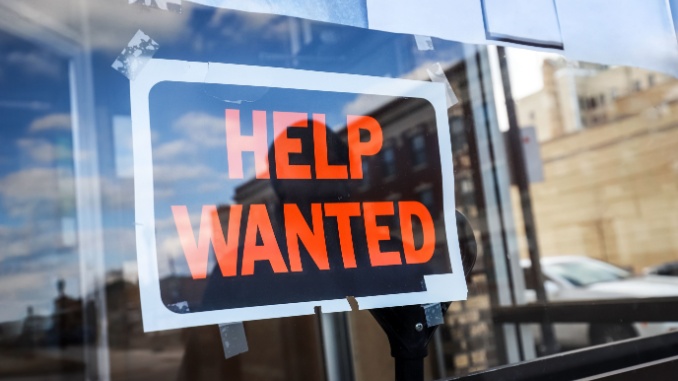
The U.S. labor market continued to expand in June, but at a significantly slower pace than economists expected, as hiring cooled and fewer Americans participated in the workforce, according to the latest Monthly Employment Update released last week by the Joint Economic Committee.
The economy added 57,000 non-farm payroll jobs in June, including 49,000 private-sector jobs and 8,000 government positions. While the national employment rate edged down from 4.3% to 4.2%, the improvement coincided with a 0.3 percentage-point decline in the labor force participation rate to 61.5%, indicating fewer Americans were either working or actively seeking employment.
The broader U-6 unemployment rate, which includes underemployment workers and those marginally attached to the labor force, also declined from 8.1% to 7.9%.
The June report follows downward revisions to previous employment data. The Bureau of Labor Statistics revised May’s job growth downward by 43,000 jobs, reducing the month’s gain from 172,000 to 129,000 jobs. April’s final revision, meanwhile, increased payroll growth by 33,000 jobs to a total gain of 148,000.
Among industries, private education and health services led monthly hiring with 69,000 new jobs, followed by professional and business services, which added 36,000 positions. Leisure and hospitality posted the largest decline, shedding 61,000 jobs, while the information sector lost 9,000 positions.
Over the past year, private education and health services has remained the nation’s strongest-performing sector, adding 648,000 jobs, followed by leisure and hospitality with 114,000.
Federal government employment experienced the steepest annual decline, falling by 258,000 jobs, while financial activities lost 100,000 positions.
Despite slower hiring, wages continued to outpace inflation. Average weekly earnings for all private-sector employees increased 3.82% over the past year, while average hourly earnings rose 3.52%.
Production and nonsupervisory workers saw annual increases of 3.73% in weekly earnings and 3.42% in hourly earnings.
Job Openings Hold Steady Despite Cooling Labor Market
Separate data from the Job Openings and Labor Turnover Survey showed labor demand remained relatively stable. Total job openings increased by 9,000 in May to 7.59 million nationwide, with the job openings rate holding steady at 4.6%
Leisure and hospitality recorded the largest increase in available positions, followed by trade, transportation, and utilities, while private education and health services posted the largest decline in openings.
State-level employment data reflected a mixed picture across the country. Unemployment rates declined in 20 states during May, increased in nine states, and remained unchanged in 22 states and the District of Columbia.
The District of Columbia recorded the nation’s highest unemployment rate at 6.1% while South Dakota posted the lowest at 2.1%
Payroll employment increased in 38 states and fell in 13 states during May. West Virginia recorded the nation’s largest percentage increase in payroll employment at 1.4% while Montana experienced the largest decline at 0.5%.
Arizona continued to rank among the nation’s stronger performing states for job growth despite signs of a slowing labor market.
The state added 2,000 net payroll jobs in May after adding 8,100 jobs in April. Over the past 12 months, Arizona has added 21,200 payroll jobs, tying for the 10th nationally in percentage growth of non-farm employment.
Arizona’s private sector added 22,900 jobs over the past year, ranking tied for ninth nationally in private-sector payroll growth.
Arizona’s unemployment rate increased slightly to 4.8% in May up from 4.7% the previous month and 4.3% one year earlier. Employment in the state declined by 16,293 during the month and has fallen by more than 66,000 over the past year.
The state’s labor force participation rate also weakened, falling from 61% to 60.7% in May, placing Arizona 37th nationally.
Nationally, labor force participation remained at 61.8% during May before declining to 61.5% in June.
Arizona’s strongest monthly employment gain came in construction, which added 1,300 jobs, and financial activities, which added 700 jobs. State and local government employment declined by 1,000 positions, while professional and business services lost 300 jobs.
Over the past year, Arizona’s private education and health services sector led all industries with 16,600 new jobs, followed by professional and business services with 8,100.
Financial activities experienced the largest annual decline, losing 4,000 jobs, while federal government employment fell by 3,200 positions.
Ethan Faverino is a reporter for AZ Free News. You can send him news tips using this link.
Arizona’s unemployment rate has now hit a new high following the COVID-19 pandemic.
The state’s unemployment rate neared 5% according to a new data analysis report from the Common Sense Institute of Arizona (CSI). Based on this newly calculated rate, Arizona has the 12th-highest unemployment rate in the nation.
Unemployment hit 4.8% in May, with CSI saying broader data indicators have revealed the state’s labor market to be cooling despite job growth.
The addition of 2,000 non-farm jobs in May put Arizona at 30th for national job growth. Overall, the nation experienced growth with the addition of 172,000 jobs.
As for job growth year-over-year, Arizona added over 21,200 jobs. That qualified the state as the 10th best in the nation for job growth year-over-year.
Mining jobs increased by about 1,300 over the past year. CSI attributed this growth to the increased demand for copper by electric vehicles, artificial intelligence technology, and data centers.
Manufacturing jobs also increased by 500 over the past year. Trade, transportation, and utility jobs declined by 1,600 over the past year.
Arizona’s labor participation also hit a post-pandemic milestone. The state’s labor force participation rate fell just below 61 percent: the lowest level seen since 2020. Last May, the labor force participation rate was over 62 percent.
Along with rising unemployment and compressed labor participation, Arizona’s private-sector wages increased by over three percent over the year to $35.78. However, that total lags behind the national average of $37.53.
Arizonans may have felt these changes to Arizona’s employment climate more acutely due to major year-over-year changes with state spending.
CSI attributed the state’s budget shortfall to overspending.
Another recent analysis released earlier this month by CSI found that the state budget has experienced rapid growth over the past decade.
In just 10 years, the state budget doubled and now amounts to more than 10% of the state’s gross domestic product.
Per CSI, spending pressures have remained elevated despite normalized revenue growth.
Some items that CSI said to blame were the disparities between Arizona Health Care Cost Containment System (AHCCCS) enrollment and member costs, elevated demands from the Development Disabilities Program (DDP), and federal payment error rates impacting Supplemental Nutrition Assistance Program (SNAP) obligations.
AHCCCS enrollment fell by about 10% (over 200,000 people) but average per-member costs increased by 14%.
DDP was projected to require an additional $400 million in state spending by next year.
And the state may have to cover $300 million in annual SNAP cost-sharing obligations should federal payment error rates fail to be reduced in the near future.
Total state spending reached over $70 billion in the 2026 fiscal year, and estimates projected spending to approach $75 billion in the 2027 fiscal year. Of the 2026 fiscal year total state spending, close to $50 billion is expected to come from non-appropriated funds.
CSI found that spending not subject to regular legislative appropriations has grown by more than 150% over the past decade, though appropriated spending grew by about 100%.
AZ Free News is your #1 source for Arizona news and politics. You can send us news tips using this link.
U.S. Rep. David Schweikert (R-AZ01), chairman of the Joint Economic Committee (JEC), warned that the United States faces growing fiscal risk unless Congress acts sooner to stabilize the federal debt-to-GDP ratio.
Schweikert sent the committee’s latest Views and Estimates letter to House Budget Committee Chairman Jodey Arrington in a letter earlier this month.
“There is great uncertainty about when and how the debt will switch from sustainable, business as-usual, to an unsustainable, market-unraveling nightmare,” Schweikert wrote. “Every year we wait to change course increases leverage, and the higher the debt-to-GDP ratio the easier it is for bad headwinds—such as crisis spending or interest rate fragility—to lock us into a debt spiral. In short, allowing the debt burden to increase is a levered bet, and the downside risks are already enormous.”
JEC Chairman @RepDavid sent @HouseBudgetGOP Chairman @RepArrington the latest Views & Estimates. “There is great uncertainty about when & how the debt will switch from sustainable, business as-usual, to an unsustainable, market-unraveling nightmare. https://t.co/pPMp4K17EP
— Joint Economic Committee Republicans (@JECRepublicans) June 8, 2026
The committee’s Republican staff found that rising federal debt is structurally unsustainable and that stabilizing the debt-to-GDP ratio will require large early policy changes. The letter states that delaying action materially increases the risk of severe economic and financial consequences.
According to the letter, federal debt has recently reached 100 percent of gross domestic product, meaning the federal debt is now roughly the size of the economy’s total annual output. The Congressional Budget Office projects debt held by the public will reach 118 percent of GDP by 2035, 142 percent by 2045, and 172 percent by 2055. Treasury projections cited in the letter are higher, estimating 129 percent by 2035, 183 percent by 2045, and 245 percent by 2055.
The JEC letter describes the current debt path as a “levered bet on stability” that depends on avoiding major crises requiring substantial fiscal headroom and on future interest rates remaining favorable relative to economic growth. The letter warns that the damage to the nation’s fiscal position and status as a world power could be “catastrophic and irreversible” if those conditions deteriorate.
The committee cited estimates from the Committee for a Responsible Federal Budget indicating that a fiscal adjustment of about $9.5 trillion over ten years would be needed to stabilize the debt-to-GDP ratio at about 100 percent. The JEC letter used a similar ballpark estimate of about $9.2 trillion to close the primary deficit over a ten-year window, while noting that the exact adjustment would depend on interest rates, economic growth, the timing of policy changes, and the path of the primary deficit.
“In any case, these are magnitudes of adjustment virtually absent from current policy debates,” the letter states.
The letter recommended reforms in Medicare, international taxation, and immigration that it estimated would produce about $3.6 trillion in deficit reduction over ten years, or roughly 40 percent of the adjustment identified as necessary to stabilize the debt-to-GDP ratio.
The largest proposed savings would come from Medicare Advantage reform. The letter states that Medicare Advantage now covers 55 percent of all Medicare beneficiaries and that flawed payment policies, excessive coding practices, insufficient enforcement, and federal inaction have driven up costs. According to the JEC, Medicare Advantage beneficiaries are now estimated to cost roughly 14 percent more than they would under traditional Medicare, amounting to an estimated $76 billion in excess federal spending in 2025.
The letter cites H.R. 3467, the Better Medicare Act, as a proposal to realign Medicare Advantage incentives. The JEC estimated the legislation would reduce federal spending by approximately $1.8 trillion over ten years.
In a Fox Business appearance posted to X by Schweikert’s office, Schweikert described what he called “institutional design fraud,” citing his team’s investigations into New York and California “where they’re exploiting part of the Medicaid system for billions and billions and billions of dollars.”
Federal prosecutors say a $30 million Medicaid scheme meant for children’s mental health services helped pay for a fleet of luxury vehicles. That is bad actor fraud.
But the real bleeding is coming from New York and California exploiting parts of Medicaid for billions and… pic.twitter.com/jFyGJr3JAC
“If New York actually had the same cost in their Medicaid system,” he continued, “it would be a $50 billion savings a year if they had the same costs as other states. That’s actually where the tremendous amount of money is, because remember, we’re borrowing about a million dollars every 15 seconds. So, the scale is what’s just so hard to get your head around.”
The committee also recommended a border adjustment tax policy, which would tax business income based on where products are sold rather than where they are produced. Under the proposal, export receipts would be excluded from the tax base and import deductions would be disallowed. The JEC estimated the policy could raise approximately $1.5 trillion over ten years.
On immigration, the committee recommended shifting employment-based admissions toward higher-producing applicants through a points-based, industry-targeted framework. The letter states that an aging population and a shrinking pool of younger workers are reducing the labor force needed to grow the economy and service the debt. The JEC estimated that such a reform could produce a net fiscal benefit of $335 billion over ten years and $1.34 trillion over twenty years, assuming annual immigration remains at current levels.
Schweikert has raised the alarm regarding demographic decline as a driver of fiscal collapse, citing three unassailable facts: “debt, deficits and demographics,” in March 2025.
The letter also credited H.R. 1, commonly known as the One Big Beautiful Bill Act, with pro-growth tax provisions. The JEC said policymakers should redirect their focus toward “transparently pro-growth reforms” and cited federal land sales, reforms of the Jones Act, and policy related to port automation as examples of areas that could support growth.
Schweikert’s letter concluded that growth alone should not be counted on to resolve the federal government’s fiscal problems.
“I have highlighted fiscal reforms that would bring us about 40 percent of the way to stability of the debt-to-GDP ratio,” Schweikert concluded in the letter. “While there is strong potential for increasing economic growth as a partial solution, we should not count on growth alone to address our fiscal problems.”
Small business job openings declined sharply in May while concerns over rising labor costs reached the highest level in the survey’s history, according to the National Federation of Independent Business (NFIB) May Jobs Report released Friday.
The NFIB Small Business Employment Index remained essentially flat in May, standing at 100.3 after 100.4 in April. This marks the third consecutive monthly decline. The index now sits below the 2025 average of 101.2, though it remains slightly above the long-term historical average of 100.
In May, 29% of small business owners reported job openings they could not fill, a 5-point drop from April and the lowest reading since May 2020. Openings for skilled workers fell 2 points to 27%, while openings for unskilled positions dropped 4 points to 9%.
“Concerns about rising labor costs increased significantly to the highest reading in the survey’s history,” stated Chief Economist Bill Dunkelberg. “Small business owners are facing mounting pressure to retain workers, and many firms are navigating costly new state mandates. While current conditions restrict Main Street’s already-thin profit margins, compensation measures remain steady for now.”
Arizona-specific concerns added to the unease. “Arizona small businesses are growing increasingly uneasy as labor costs climb and uncertainty around state tax policy remains unresolved,” NFIB State Director Chad Heinrich added. “Failure to conform with the business provisions Congress made permanent at the federal level will result in a tax hike on Main Street Arizonans. Small businesses need certainty to plan, invest, and create jobs, and time is running short for lawmakers to deliver.”
Looking ahead, hiring plans weakened further. A seasonally adjusted net 9% of owners plan to create new jobs in the next three months, down 4 points from April and the lowest level since May 2020. This falls below the historical average of a net 11%.
Overall, 55% of owners reported hiring or trying to hire in May, up slightly from April. However, 46% of all owners (representing 84% of those actively hiring or trying to hire) reported few or no qualified applicants for open positions.
Labor quality, the most important business problem eased to 13%, the lowest since December 2016. In contrast, labor costs surged in importance, cited by 14% of owners as their top problem — a 5 point increase from April and the highest reading on record.
Despite softening demand for new hires, compensation pressures persisted. A net 31% of owners reported rising worker compensation in May, up 1 point from April. Plans to raise compensation in the coming three months held steady at 18%.
Ethan Faverino is a reporter for AZ Free News. You can send him news tips using this link.
Retail sales increased for the seventh consecutive month in April, highlighting the resilience of American consumers despite rising gas prices and elevated inflation.
According to the CNBC/NRF Retail Monitor, total retail sales excluding automobile dealers and gas stations increased 0.34% seasonally adjusted from March and rose 5.73% unadjusted from April of 2025. That follows gains of 0.4% month-over-month and 6.59% year-over-year in March.
“Retail sales continued to grow in April despite higher gas prices driven by the ongoing conflict in Iran, cautious consumer sentiment and the persistent concerns about sustained inflation,” stated NRF President and CEO Matthew Shay.
Core retail sales, which also exclude restaurants, posted a smilier 0.34% month-over-month gain and climbed 5.53% year-over-year. For the first four months of 2026, total sales were up 6.07% year-over-year, while core sales rose 5.99%.
Sales growth was broad-based, rising in eight of nine major categories on a yearly basis and in all but one category on a monthly basis. Clothing and accessories stores led the way with a 0.59% month-over-month increase and a strong 9.75% year-over-year gain.
Sporting goods, hobby, music and book stores advanced 0.12% month-over-month and 8.55% year-over-year, while health and personal care stores rose 0.45% and 8.42% respectively. Digital products, including electronic books and games, posted the strongest monthly gain at 1.11% and climbed 8.09% annually.
Other categories showing positive momentum included general merchandise stores (up 0.15% month-over-month and 6.19% year-over-year), electronics and appliance stores (up 0.16% and 4.03%), and grocery and beverage stores (up 0.36% and 3.21%).
Furniture and homes furnishings stores saw a slight 0.06% monthly decline but still posted a 2.58% annual increase. Building and garden supply stores edged up 0.009% for the month but were down 2.74% from the prior year.
“Spending on household priorities remains solid, supported by a steady labor market, wage growth and a significant influx of cash from tax refunds,” added Shay. “While consumers are mindful on costs, retailers are working hard to keep everyday goods affordable for American families.”
Ethan Faverino is a reporter for AZ Free News. You can send him news tips using this link.