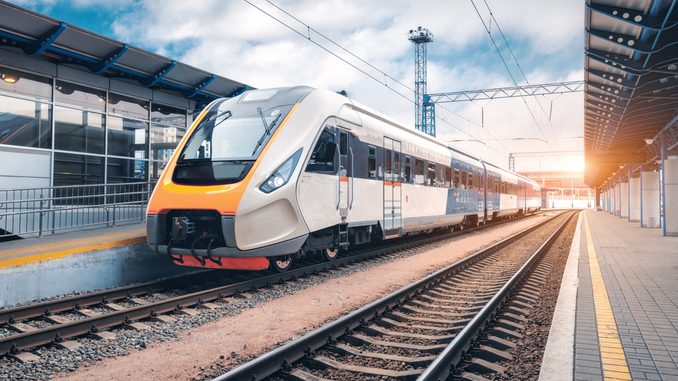
Arizona State Senator David Farnsworth (R-LD10), chairman of both the Senate Appropriations and Transportation committees, is pushing to bring private-sector innovation to Arizona’s public transportation system.
In a recent meeting with Uber policy officials, Farnsworth called for new partnerships that harness technology and market-based solutions to make transit in the East Valley more efficient, cost-effective, and responsive to residents’ needs.
The meeting focused on exploring how companies like Uber could play a larger role in shaping Arizona’s transportation future — particularly through autonomous vehicle technology. Farnsworth highlighted the success of similar programs by Waymo and urged Uber to consider developing comparable systems that could supplement or even replace traditional fixed-route bus services.
“We have a responsibility to find effective solutions for the people of Arizona, rather than simply maintaining inefficient systems that waste taxpayer funds,” Farnsworth said. “Meeting with companies like Uber highlights a significant opportunity to let innovation take the lead.”
Farnsworth emphasized that current bus routes often operate with minimal ridership, resulting in high operational costs with limited public benefit. By contrast, autonomous ride-share models could provide flexible, on-demand transit available around the clock — reducing taxpayer burden while improving reliability and safety.
The senator framed his proposal as part of a broader effort to prioritize fiscal responsibility and smart governance. “Autonomous vehicles can provide safer and more efficient transportation, and I will keep working to ensure that Arizona remains at the forefront of realistic and sustainable travel options for the future,” he added.
Farnsworth’s initiative reflects a growing movement among Arizona lawmakers to integrate private-sector innovation into state infrastructure systems. As the East Valley continues to grow, policymakers are looking toward new ways to connect residents to jobs, schools, and local businesses — without expanding costly and underused public transit routes.
If discussions progress, Farnsworth’s collaboration with Uber could mark a turning point for Arizona’s approach to public transportation, signaling a shift toward efficiency, adaptability, and technology-driven mobility.
Jonathan Eberle is a reporter for AZ Free News. You can send him news tips using this link.
Just two years after voters approved a $161 million bond in 2023, the Kyrene Elementary School District has unveiled a deeply unpopular, albeit long overdue, austerity plan to shutter nine of its 25 schools. Final decisions on which campuses will close remain in flux until December.
This should alarm not only Kyrene residents but also taxpayers in neighboring East Valley districts such as Chandler, Gilbert, and Mesa, which have likewise postponed needed consolidations despite data showing the urgency for school districts to “rightsize” to avoid future financial shocks.
Kyrene’s predicament shows what happens when district leaders, aided by special-interest boosters, ignore demographic realities and lean too heavily on bonds and overrides to prop up aging, half-empty facilities. Beyond the loss of schools and public trust, Kyrene’s crisis is a cautionary case study in how long districts can keep kicking the can on closures and restructuring before the math catches up.
For decades Kyrene ESD has fiercely defended its autonomy, resisting consolidation with Tempe Elementary School District, most notably in 2008, when Tempe voters approved a merger that Kyrene voters rejected by a 2-to-1 margin. The district has also resisted unifying with Tempe Union High School District, which serves most Tempe and Kyrene graduates. The result: three separate, duplicative bureaucracies servicing the same boundary zones of attendance.
That independence once seemed justified. By the 1980s and 1990s, Kyrene’s fortunes soared with population growth and rising property values following Phoenix’s annexation of Ahwatukee. A building boom beginning in the 1970s relieved Kyrene’s historic reliance on drawing students from outside its boundaries. That same appetite in housing translated to Kyrene’s expansion of schools, fueled by voter-approved bonds and overrides. Like many East Valley districts, Kyrene’s bond and override measures have passed easily, and typically without organized opposition.
Those glory days are long gone. Enrollment has fallen from 20,000 students in 2001 to roughly 12,000 today. That represents a 40 percent drop while the district continues operating 26 schools, a daunting figure considering it only serves grades K-8. Demographers project another 1,000-student decline within five years, equating to roughly $7 million less in state funding. Eight Kyrene campuses are less than half full, and three others are barely above that mark, culminating in the present restructuring effort.
Although Kyrene does have an override measure on the ballot for 2025, it remains to be seen if the drastic restructuring plan will have any impact on voter sentiment in the area for future bond requests. Given that Kyrene has spent millions from the recent bond request on schools now marked for closure, governing board members would be hard-pressed to make their case to residents for additional funding. Taxpayers who were told in 2023 by Superintendent Laura Toenjes that the bond would be “one more example of Kyrene’s commitment to fiscal responsibility” are right to demand answers about the gap between two decades of declining enrollment and the district’s continued inaction.
Kyrene is hardly alone. Large systems such as Chandler Unified remain locked in a perpetual bond-and-override cycle, masking structural enrollment declines with new debt and vague promises of an enrollment recovery effort that grows less plausible each year.
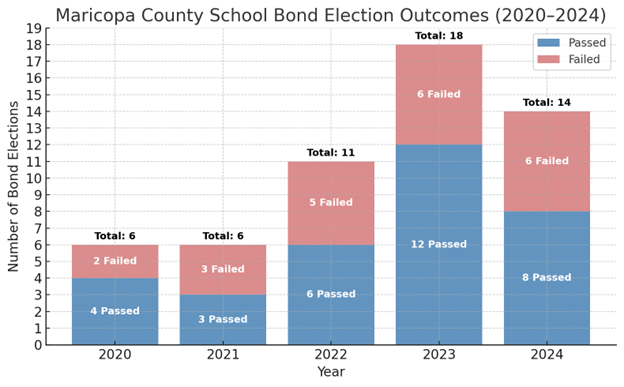
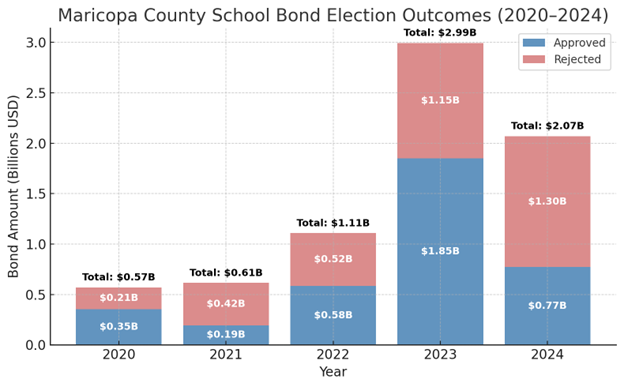
As seen in the chart below between 2020 and 2024, bond requests across Maricopa County have ballooned as pandemic stimulus dollars expired and districts turned back to property-tax financing. The pace of school bond elections far exceeds municipal ones, and the total amounts sought have surged as seen in the 2nd chart below. Inflation alone doesn’t explain the escalation, though it is often erroneously cited as the root cause of this growth.
The lesson isn’t that districts should never seek voter support, but that leaders must confront an uncomfortable truth: demand for traditional district schools is shrinking. Some causes, like rising housing costs and lower birth rates, are beyond their control. Others, like families choosing charters or ESAs, are the direct result of competition and consumer preference. Pretending otherwise guarantees more sudden, painful closures down the road, along with wasted opportunities adding up to hundreds of millions in taxpayer funds.
Kyrene’s crisis is neither the first nor the last domino of overbuilt school districts. Every district that keeps chasing bonds to prop up half-empty schools is writing the same ending. The can has been kicked far enough. It’s time to stop borrowing from tomorrow to preserve yesterday’s mistakes.
Arman Sidhu is a lifelong Arizona resident and educator who has served as a teacher and principal in both traditional public and charter schools. He is a doctoral student in education at Arizona State University’s Mary Lou Fulton Teachers College. His opinions are entirely his own.
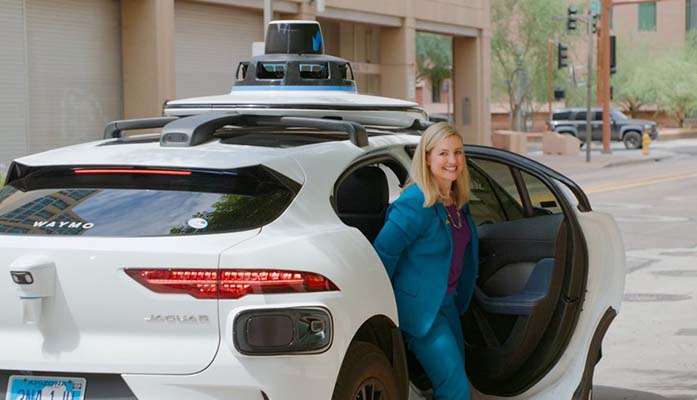
This week, Google made its driverless vehicles available to the East Valley public through its ride-hailing company, Waymo One. The artificial intelligence taxi service is available in Chandler, Gilbert, Mesa, and Tempe.
Phoenix Mayor Kate Gallego was one of the driverless car’s first passengers.
In a promotional video, Gallego said she appreciated that the vehicles are electric, and expressed hope that it would make the city more inclusive.
“There are many people in this community who can’t drive or choose not to,” said Gallego.
This isn’t the East Valley’s first experience with these driverless cars. Google has tested them over the past five years in the area.
One of those test runs went viral last year after the car stalled in a Chandler intersection, blocked three lanes of traffic, and attempted to escape company handlers. The car became confused and stopped because it needed to take a right turn and construction closed off the turn lane with cones. At one point, the car began to back up into oncoming traffic.
The passenger noted that he’d been stranded multiple times before in Waymo’s driverless cars.
Downtown Phoenix will also have driverless cars, but only for Waymo employees and “Trusted Testers,” which are select individuals participating in approved test drives. Unlike the East Valley, the downtown driverless cars will have a Waymo “autonomous specialist” in the front seat.
Waymo is also developing driverless freight transportation through its other initiative, Waymo Via.
Google isn’t the only company testing driverless cars and trucks in Arizona. The Arizona Department of Transportation (ADOT) has approved multiple driverless trucking test runs for the company TuSimple, which has ties to the Chinese government.
According to the American Trucking Associations (ATA), there are about 3.6 million professional truck drivers in the country. Government estimates report about 8 million people involved in the entire trucking industry. Globally, the industry is worth $4 trillion, and truckers make up about 40 percent of operating costs.
Corinne Murdock is a reporter for AZ Free News. Follow her latest on Twitter, or email tips to corinne@azfreenews.com.
If there’s one entity that specializes in giving people something they don’t need—or aren’t even asking for—it’s the government. So, naturally, while the country faces sky-high inflation and Arizonans make sacrifices in their family budgets, the Town of Gilbert saw fit to discuss a potential…commuter rail.
That’s right. At the end of April, the Gilbert Town Council announced that it’s considering a $289,000 consulting contract for a feasibility study on establishing a commuter rail. What this would accomplish—and why anyone thinks this would be good for Gilbert—remains a mystery.
Even before COVID, public transit usage has been on the decline. And that’s only worsened since…