Scottsdale Unified School District (SUSD) parents are attempting to reverse the relaxation of the district’s dress code.
SUSD surveyed Scottsdale Parent Council (SPC) members about the district’s dress code, which parents criticized for failure to indicate a requirement for students to cover their midriffs.
The survey, shared by Scottsdale Unites For Educational Integrity (SUFEI), only included “genitals, buttocks, chest, and nipples” in its description of “private body parts” in a question to parents about appropriate student clothing.
SUFEI urged parents to respond to the survey in opposition to the question of appropriate student clothing and to leave a comment explaining their support for qualifying the midriff as a private body part.
Current SUSD dress code does not require students to cover their midriffs. However, the dress code does prohibit students from wearing anything deemed “hate speech,” along with any clothing depicting profanity, nudity, or pornography.
In 2022 emails reported by the Arizona Daily Independent last fall, the governing board’s then-vice president Libby Hart-Wells reportedly pressured SUSD administration to override the district’s Code of Conduct to allow girls to wear clothing that exposed the midriff.
SUSD Residents- help 🛑 the sexualization of Scottsdale Unified students!
— Arizona Women of Action (@azwomenofaction) April 22, 2025
Hart-Wells, who presided over the board last year, no longer serves on the board.
Most other districts around the Valley do not allow midriffs and have maintained the traditional set of dress codes, but several have begun to loosen their dress codes as well.
In 2023, Higley Unified School District (HUSD) removed policy language prohibiting clothes which “immodestly exposes the chest, abdomen, midriff, genital area, or buttocks,” instead reducing the prohibition to clothing exposing “undergarments [or] undergarment areas.”
Last year, Tucson Unified School District revised its policy citing concerns of sexism and equity, effectively allowing students to expose most of their breasts along with their entire torsos and buttocks.
Scottsdale parents concerned with the relaxed dress code are also coming off of other, more significant concerns with the district. Last year, the governing board approved a bonus to Superintendent Scott Menzel despite lower test scores. Menzel earned the bonus based on meeting several nonacademic achievement goals over the course of a year, not any of the academic ones: increased attendance rate, increased student extracurricular and cocurricular activity participation, increased certified staff retention, an established baseline for work-based learning opportunities and hours, and the production of a decision making matrix and proposal.
Under Menzel’s leadership for the past four years, SUSD enrollment dropped by over 1,500 students and science scores dropped 24 percent. Less than 50 percent of 8th grade SUSD students were proficient in math, despite 94 percent of students graduating.
Menzel has been a proponent of more progressive ideologies, such as those behind critical race theory and LGBTQ+ lifestyles. Menzel has defended the inclusion of sexualized discourses and subject matter on campuses as protected under Civil Rights law.
Menzel came to SUSD in July 2020 amid the racial reckoning sweeping the nation following George Floyd’s death in police custody. The year before, while still a superintendent in Michigan, Menzel gave an interview calling the white race “problematic” and meritocracy “a lie.”
“[White people] should feel really, really uncomfortable, because we perpetuate a system by ignoring the realities in front of us, and living in a mythological reality,” said Menzel. “In this country it’s about meritocracy. ‘Pull up yourself by your bootstraps, everybody has the same opportunity.’ And it’s a lie.”
The discovery of these past remarks prompted Scottsdale lawmakers to advocate for Menzel’s removal.
Arizona Superintendent of Public Instruction Tom Horne also advocated against Menzel’s contract renewal last fall.
AZ Free News is your #1 source for Arizona news and politics. You can send us news tips using this link.
Scottsdale Unified Board Member Libby Hart-Wells appears to have used her position to bypass the Code of Conduct Committee, pressing top district administrators to remove ‘navel’ from the list of body parts that students must cover at school.
Due to Hart-Wells’ actions, Scottsdale’s Chaparral High School began the 2024-2025 school year by featuring on social media a female student wearing a bra top and low-cut jeans, with her entire torso exposed.
Although Hart-Wells’ actions occurred in 2022, parents are only now becoming aware of them due to newly obtained public records. These records reveal Hart-Wells’ growing frustration when staff did not promptly comply with her request to permit midriff shirts. In fact, SUSD staff members told Hart-Wells that they wished to honor the work of the Code of Conduct Committee, however, that message did little to sway Hart-Wells from pursuing her personal agenda.
None of Hart-Wells’ emails indicated that she consulted parents, committee members, or her fellow board members about her plans to modify the policy on students’ acceptable dress.
“It’s clear that board member Hart-Wells does not respect the district or parents or have our students’ best interest in mind. We need school board members who prioritize academics and respect parents’ involvement in their kids’ lives. We need family-friendly school board candidates Gretchen Jacobs, Jeanne Beasley and Drew Hassler,” stated a concerned SUSD parent.
🧵 Newly received documents indicate that Scottsdale Board Member Libby Hart-Wells badgered SUSD staff via email regarding a dress code policy change that she personally desired.
— Scottsdale Unites for Educational Integrity (@ScottsdaleUnite) August 22, 2024
The district emails reveal that, without providing evidence, Hart-Wells asserted, “I did get some student feedback.”
“Please know I press this issue not for myself or as any slight to the committee’s work, but for the students and the learning environment,” wrote Hart Wells. In yet another email, she stated, “I have requested your reconsideration more than once but remain without a substantive response” after the district didn’t acquiesce to her demands.
District emails also show that Assistant Superintendent Milissa Sackos and Director of Support Services Shannon Cronn pushed back on the change internally, and that the district’s cabinet concluded that the modification should not be made. Sackos decried Hart-Wells’ request as “contrary to the committee recommendations after including, without limitation, a discussion with cabinet and school-level administrators.”
Ultimately, Superintendent Menzel instructed staff, “I agree we should do this and hopefully include it on the October 18th consent agenda.” A private memo to governing board members dated October 14, 2022, states “this request was discussed with several stakeholder groups.” Public records show the “stakeholder groups” were only Hart-Wells.
At the October 18, 2022, board meeting, without any public discussion to indicate that the code of conduct had been modified, board members Zach Lindsay, Julie Cieniawski, Libby Hart-Wells, and Patty Beckman approved the revised 80-page Code of Conduct, which was now lacking the word ‘navel.’
That’s what you’re getting from your school board members, Scottsdale. It’s time for a change this November.
The Higley Unified School District (HUSD) will now allow for students to wear more revealing clothing, which parents have criticized as risque.
The district’s new dress code removed previous policy language prohibiting attire which “immodestly exposes the chest, abdomen, midriff, genital area, or buttocks.” The new policy prohibits exposure of undergarments or “undergarment areas” in relation to exposure.
Live in a small, suburban, conservative school district and you think it's fine?
You HAVE to watch this school board meeting to believe it.
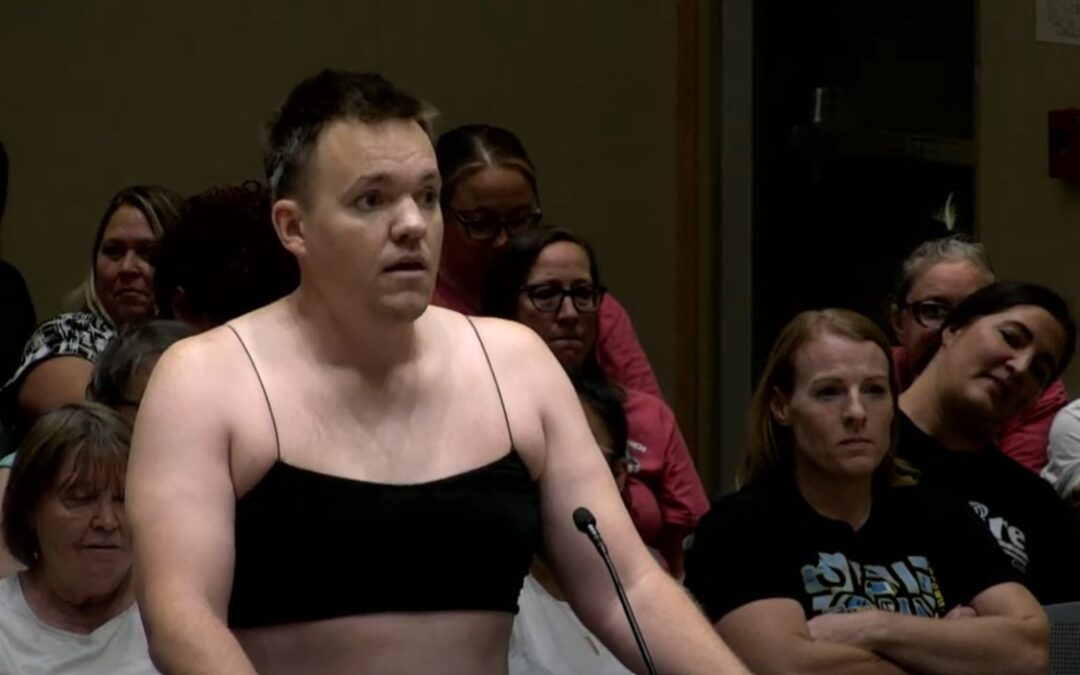
One father, Ira Latham, wore a black sports bra with spaghetti straps as an “object lesson,” or visual example, of permitted attire under the new dress code as a criticism of the district’s judgment. Latham said that anyone who took issue with his attire for a board meeting should question among themselves whether it was appropriate for a classroom. Members of the audience appeared amused or visibly uncomfortable with the display.
“Now if you ask me it’s inappropriate for a board meeting,” said Latham. “If you have a dress code policy that allows this in a classroom it does not promote a safe classroom environment as well as limits the amount of distractions in the classroom. I can’t think of any place of work where I can walk in and be taken seriously in something like this.”
Board members Kristina Reese, Tiffany Shultz, and Amanda Wade voted for the policy.
Board members Michelle Anderson and Anna Van Hoek voted against the new policy.
Anderson pointed out that grievances brought up by the community about spaghetti straps and clothing measuring didn’t exist in the now-discarded policy. Anderson also shared that she surveyed “not conservative” or “less conservative” students, namely females, about whether that policy made them feel like their bodies were disrespected or sexualized; reportedly, those surveyed felt the opposite.
“I specifically asked the less conservative females if they felt like having a dress code with our current policy’s expectations — to cover the midriff, the chest, the buttocks — if it made them feel like their body was not okay. Unanimously, they were like, ‘No,’” said Anderson. “It’s important to know that not all females feel a dress code like ours makes them feel shameful or bad about their body.”
Anderson disclosed that some of the female respondents felt like pop culture, not dress codes, marketed the sexualization of females. She also pointed out that modest apparel is a standard outside of schools in nearly all jobs available.
“We are not saying skin is not professional. We are saying that there is a professional and respectable disposition that can show skin in moderation. We are a school district in which students are mandated to attend, we are not a parks and rec entity,” said Anderson. “In school, just like in jobs, there is a time and place for certain dress. Not all places of employment have the same expectations for dress, but the majority of different career fields in jobs available have dress codes that expect employees to cover their midriff, their bust, and their buttocks for decency, for the representation of the business, for safety, for camaraderie and professionalism.”
Anderson also read aloud from the dress codes upheld by the top-10 performing schools in the nation, which had modesty provisions in their policies.
Reese contended that the dress code policy change was a non-issue because students on most campuses were already violating the policy to some extent, namely girls wearing tops that show a little bit of midriff.
In a May board meeting discussing the policy, Shultz and Wade said that nixing the immodesty provision and allowing girls to expose more of their body would lead to less sexualization.
“It makes a female feel bad about their body, and that we’re saying that they need to cover up because of the way it might make someone else feel,” said Wade.
Wade said that the modesty provisions sexualizes kids, and implied that community members concerned with expansive sexual education and LGBTQ+ ideologies ought to be more against modesty-focused dress codes.
“I find the message that we are expressing to our children to look at their bodies in a sexualized nature, we routinely have people in the community come up and talk about how they’re concerned with our efforts to sexualize kids and, in my opinion, that’s what this [dress code policy] does, completely,” said Wade.
Here's more video of the Higley board meeting. Just to be clear, when this school board member refers to sexualizing children, she's saying NOT ALLOWING girls to expose their midriffs is sexualizing them. pic.twitter.com/k90VAJAx5H
— Arizona Women of Action (@azwomenofaction) May 19, 2023
Corinne Murdock is a reporter for AZ Free News. Follow her latest on Twitter, or email tips to corinne@azfreenews.com.