Hours before a scheduled appearance on Monday with former Vice President Mike Pence, Governor Doug Ducey’s office announced that he’d tested positive for COVID-19. Ducey’s communications director, C.J. Karamargin, toldKTAR News that the governor was asymptomatic and “feeling well.”
From Day One, Vice President @Mike_Pence has worked closely with states to secure the border. Grateful to have him at Arizona’s southern border today to get an update on the ground. https://t.co/3uaEyLk0BN
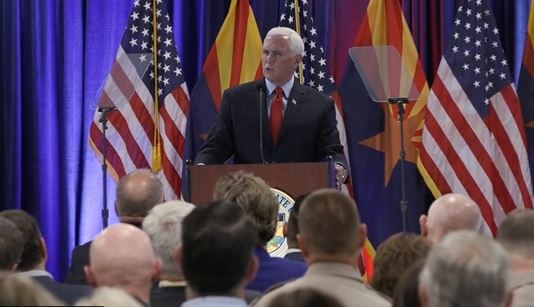
Originally, Ducey was to accompany Pence on a tour of the southern border, followed by attendance at a border security speech by the former vice president at the Arizona Commerce Authority in Phoenix.
During his speech, Pence argued that the Biden administration was exacerbating the border crisis.
“[This border crisis] can be ended almost overnight, if President Biden will just put back the policies the Trump-Pence administration put into effect that reduced illegal immigration by 90 percent,” said Pence.
Pence also lauded Ducey for his leadership and wished him a speedy recovery from COVID-19. In April, the governor coordinated with half of the country’s governors to launch a strike force modeled after his 2015 state-level initiative to address the border crisis.
“Let me say: how fortunate the people of Arizona are to have a leader so principled and devoted to securing the border and keeping our families and our neighborhoods safe,” said Pence.
Among those that met with Pence on Monday were Cochise County Sheriff Mark Dannels and his department, along with Arizona Department of Homeland Security Director Tim Roemer.
We are here today to say with one voice: President Joe Biden must do his duty and Secure Our Southern Border NOW! pic.twitter.com/mnz9ALUZyK
According to the latest Customs and Border Patrol (CBP) data, there have been nearly 1.3 million border encounters since last October.
The Biden administration’s attempt to rescind Title 42, policy under former President Donald Trump to expedite expulsion of illegal immigrants, failed last month. The program was slated to end on May 23, but a federal court in Louisiana issued a temporary restraining order preventing the Biden administration from ending the policy.
HUGE. The Court keeps Title 42 in place. We're going to keep fighting – and winning – because Arizonans' lives are on the line. https://t.co/wXqGHegTGC
Ducey credited the senior advisor on the pandemic and lead for statewide vaccination efforts, Dr. Richard Carmona, for ensuring that the vaccine was the best tool to fight COVID-19. As AZ Free News reported, Carmona serves on the board of directors for a major distributor of the COVID-19 vaccine, McKesson.
Dr. Carmona is an incredible source of information in Arizona's response to the pandemic. Received a briefing from him today and we agree: the vaccine is the best tool we have to fight the pandemic. 2/ pic.twitter.com/LhwLCOaRD0
Favorability polls conducted last week through YouGov, Politico, and Harris indicated that voters largely had an unfavorable view of the former vice president. The latestpolling for 2024 presidential picks reflected that Pence falls behind Florida Governor Ron DeSantis with or without former President Donald Trump in the running.
Corinne Murdock is a reporter for AZ Free News. Follow her latest on Twitter, or email tips to corinne@azfreenews.com.
On Wednesday, the Arizona Senate passed HB2008, which reforms the state’s high school learning standards to cast a positive light on America’s founding principles while exploring the dangers of other governing ideologies. The bill now heads to the House for review before submission to Governor Doug Ducey for final approval.
Under the bill, the State Board of Education (SBE) must update high school social studies standards to incorporate a comparative discussion of political ideologies. Communism and totalitarianism will be juxtaposed with American ideology, such as its founding principles of freedom and democracy.
“The academic standards prescribed by the state board in social studies shall include personal finance, American civics education, and a comparative discussion of political ideologies, such as communism and totalitarianism, that conflict with the principles of freedom and democracy that are essential to the founding principles of the United States,” states the bill. (emphasis added to reflect the new legislative language)
Specifically, HB2008 requires the learning standards to rely on source texts, oral histories from victims of ideologies like communism and totalitarianism. The SBE would develop resources from the Arizona State University (ASU) School of Civic and Economic Thought and Leadership, the University of Arizona (UArizona) Center for Philosophy of Freedom, and the Sandra Day O’Connor Institute for American Democracy.
The SBE would have until this New Year’s Eve to establish a list of “portraits in patriotism” oral history resources supplementing the civic education and social studies standards.
The bill almost didn’t make it out of the Senate. It failed just the day before, on Tuesday, when Majority Leader Rick Gray (R-Sun City) joined Senate Democrats in opposing it since State Senators Kelly Townsend (R-Mesa) and Michelle Ugenti-Rita (R-Scottsdale) weren’t able to vote. However, all Republican senators offered unified support for the bill the next day.
HB2008 passed in the House along party lines, with unanimous opposition from Democrats and unanimous support from Republicans.
Democrats have pushed back against efforts to portray communism in a negative light. Some, like State Representative and congressional candidate Daniel Hernandez (D-Tucson), have argued that ideologies like white nationalism pose a bigger threat than communism.
HB2008’s sponsor, State Representative Quang Nguyen (R-Prescott Valley), was a victim of communism himself. At 12 years old, Nguyen fled from the Communist Party of Vietnam a week before the Fall of Saigon in April 1975.
HB2008 was Nguyen making good on his promise late last year to ensure students learn about the evils of what he and others, such as House Majority Leader Ben Toma (R-Peoria), had suffered. Toma was nine years old when he emigrated from Romania in the 1980s, ruled at the time by communist dictator Nicolae Ceaușescu.
Corinne Murdock is a reporter for AZ Free News. Follow her latest on Twitter, or email tips to corinne@azfreenews.com.
Over Memorial Day weekend, Governor Doug Ducey traveled to Israel, in part, to visit a desalination plant holding a proposed solution to Arizona’s ongoing drought.
Desalination removes minerals from water, making water sources like seawater into a potable resource.
Toured an extensive desalination plant in Israel. Innovations like these are part of the solution to secure our water future. In January’s state of the state, we said desalination made Israel the world’s superpower – and it’s clear to see here. pic.twitter.com/RmXRD5CdDU
The Israel trip marked a continuation of Ducey’s proposed plan mentioned in his State of the State Address last summer. At that time, Ducey introduced the idea of a $1 billion investment into Mexico for desalination. The governor has his eye on the Sea of Cortez, or the Gulf of California, bordered by the west coast of Mexico and the Baja California peninsula.
Israel’s desalination plants not only reversed their drought — they created a water surplus. Their Sorek desalination plant alone provides enough drinking water for 1.2 million people a day.
Although, it would likely be years before Arizona reaps the benefits of desalinated water. Arizona Department of Water Resources Director Tom Buschatzke predicted to KTAR that it would be another decade before the state relied on desalinated water.
Arizona has been in a long-term drought for nearly 30 years. The National Ocean and Atmospheric Administration (NOAA) estimates that about 90 percent of Arizonans are impacted by drought, or 6.4 million people. The NOAA added that 2022 marked the state’s sixth driest year in its history.
The ongoing drought was exacerbated recently by the reclassification of the Colorado River, Arizona’s largest renewable water supply, to Tier One drought status. The federal government’s reclassification reduced Arizona’s water allotment.
Cities have adapted to heed the drought. In January, the city of Scottsdale asked residents to reduce their water usage by five percent. Resident compliance may not remain voluntary: city officials communicated that their next step would make water restrictions mandatory.
During his visit, Ducey also visited with Israel Prime Minister Naftali Bennett and toured their border wall as part of the other two focuses of his trip: trade and border security.
Good to sit down with the Prime Minister of Israel Naftali Bennett to discuss how to continue to bring Arizona and Israel’s relationship to new heights. Arizona stands with Israel. @naftalibennett@IsraeliPMpic.twitter.com/0o8J0ieoC6
In his first veto of the 2022 legislative session, Gov. Doug Ducey unexpectedly shot down an election integrity bill introduced by Rep. Joseph Chaplik (R-Scottsdale) with overwhelming support of the House Republican caucus.
House Bill 2617 dealt with the removal of voters from each county’s voter rolls, focused on non-U.S. citizens and non-Arizona residents. But Ducey announced his veto in a letter to Senate President Karen Fann and House Speaker Rusty Bowers. on Friday.
“Our lawfully registered voters deserve to know that their right to vote will not be disturbed without sufficient due process,” Ducey wrote. “This provision leaves our election system vulnerable to bad actors who could seek to falsely allege a voter is not a qualified elector.”
Chaplik’s HB2617 mandated county recorders to remove voters from their rolls based on a “reason to believe” the voter is not a U.S. citizen or a resident of the county. Such removal could not occur until the end of a detailed process which ensured the voter in question had 90 days to present satisfactory evidence that the person is in fact qualified to vote in their registered county.
The bill also included new reporting requirements for all jury commissioners and the Arizona Department of Transportation to help identify people who may no longer be eligible to vote in a specific county or were never eligible to vote in Arizona.
However, Ducey’s veto letter pointed to several concerns with the legislation, including the level of proof threshold.
“The subjectivity of this provision, as well as a lack of guardrails against false claims, included in H.B. 2617 leaves voter registration susceptible to being canceled based on fiction rather than fact,” Ducey wrote to Fann and Bowers.
But Ducey’s criticisms did not sit well with supporters who saw Chaplik’s bill as a much needed and long overdue opportunity to establish confidence in the legitimacy of Arizona’s voter rolls.
AZGOP chair Kelli Ward called Ducey’s move “unAmerican” while Rep. Jacqueline Parker (R-Mesa) tweeted that the governor “apparently wants dead people to be able to vote again.”
Sam Stone, former Phoenix city staffer and current city council candidate, was “hugely disappointed” in Ducey’s veto and questioned the governor’s motives.
“Cleaning up our voter rolls is essential to secure elections,” Stone tweeted. “There is not one legitimate reason to leave people who have died or moved on our voter rolls, especially with automatic vote-by-mail.
Stone further suggested “the only reason to leave people who have died or moved on our voter rolls” is to commit voter fraud.
Ducey’s veto brought forth a more detailed rebuke from the Arizona Free Enterprise Club (AFEC).
“Contrary to what is stated in the veto letter, #HB2617 provides ample safeguards to ensure eligible voters do not have their registrations improperly cancelled,” AFEC tweeted after the veto was announced. “In fact, the bill stipulates that counties must confirm that the voter is ineligible, then requires the county to send a notice to the voter.”
It is only after the registered voter fails to respond to the notice within 90 days that the registration would be cancelled, AFEC pointed out.
“A broad coalition of local and national election integrity leaders signed onto a letter urging Governor Ducey to sign HB2617, and explained in great detail the need for the enhanced voter roll maintenance requirements and the safeguards contained in the measure,” AFEC further tweeted.
The letter referred to by in the tweet was signed by AFEC President Scot Mussi along with representatives of Heritage Action for America, America First Policy Institute, Election Transparency Initiative, Honest Elections Project Action, FreedomWorks, Amax ACTION, and the Foundation for Government Accountability.
Ducey noted he would consider signing a new voter roll bill with revised language if Chaplik and the rest of the Legislature wants to consider his feedback.
FreedomWorks activist Merissa Hamilton is among those hopeful Chaplik will consider the governor’s criticisms and reintroduce a new version of HB2617 this session. She said a path to clean voter rolls is “needed to secure our Arizona elections.”
Over the weekend, leaders from across the world convened in Sedona for an annual event dedicated to collectively solving global issues: the McCain Institute’s Sedona Forum. Among them was Governor Doug Ducey.
A recap of the event focused on the word “democracy.” Featured speakers insisted on white supremacy’s hold on U.S. institutions, argued that the significance of 9/11 ended with January 6, lamented distrust in mainstream media, and proposed tactics for increasing aggression against Russia for invading Ukraine.
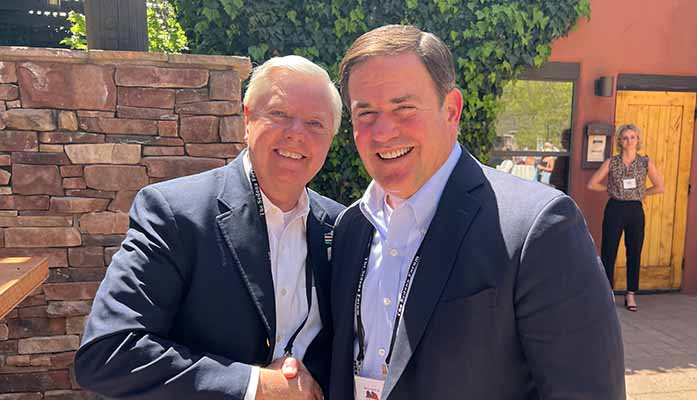
While at the event, Ducey published a series of tweets declaring that Russia was attacking democracy and freedom by invading Ukraine. He commended the late senator, John McCain, for warning Americans about Russia and Vladimir Putin. Ducey didn’t mention NATO’s role in instigating the war. However, he did post a candid photo of his conversation with former NATO and Ukraine ambassador Kurt Volker.
Though Volker only served as NATO ambassador for one year, 2008 to 2009, he worked on NATO-related assignments beginning in 1998. Volker’s U.S.-Ukraine Business Council (USUBC) Ambassador position incited controversy due to former President Donald Trump’s investigatory attempts into President Joe Biden and Hunter Biden’s business dealings in China and Ukraine.
Volker helped create Arizona State University’s (ASU) Ukrainian campus, American University Kyiv, which stalled at the end of February due to the Russian invasion.
Senator McCain had been sounding the alarm about Russia and Putin. Russia’s unprovoked attack on Ukraine is an attack on democracy and freedom. Arizona stands with the men and women of Ukraine putting up an incredible fight – from President Zelensky to everyday citizens. 2/
ASU President Michael Crow was also in attendance at the Sedona Forum. He co-hosted a panel with Congressman Adam Kinzinger (R-IL-16) and The New Yorker writer Sue Halpern to discuss cybersecurity.
Senator Mark Kelly (D-AZ) was also present at the Sedona Forum.
I'm excited to be opening the @McCainInstitute’s Sedona Forum on strategic competition, a topic where we miss Senator McCain’s voice and leadership as much as ever.
The event had moderators and reporter coverage provided by its “media partner,” The Washington Post — the very publication that doxxed the woman behind “Libs of TikTok,” the popular social media account relied on by parents and politicians for showcasing leftist ideologies and political trends.