Less than 24 hours after the Joint Legislative Budget Committee published the proposed budget report late Monday, infighting broke out among Arizona’s House and Senate Republicans.
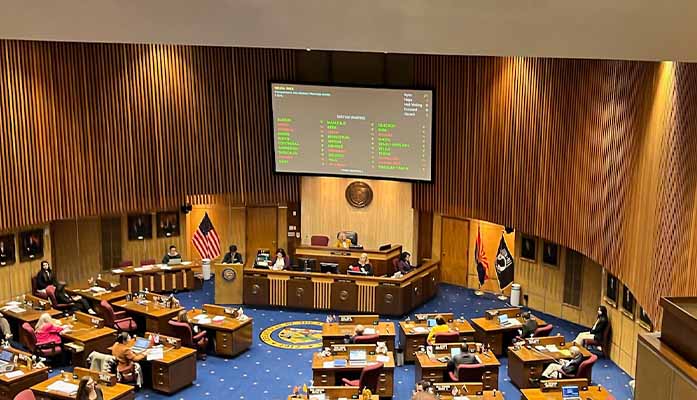
Tuesday marked lengthy budget discussions in the House Appropriations Committee, but in the Senate discussions were cut off abruptly with an indefinite recess of the Senate Appropriations Committee. Effectively, public budget talks ended before they started in half of the State Capitol.
State Senator David Gowan (R-Sierra Vista) said that the House didn’t honor its agreements to pass some bills; one of those significant ones being the Arizona Board of Regents (ABOR) continuation.
“The House has decided that they will not honor the deals we created together and move things forward. I know there’s some media out there, social stuff going on, that they’re trying to pin us and maybe leverage us. But the point is here, they blew the deal,” said Gowan.
Gowan added that he wasn’t willing to call the committee together later on in the day, either. It appears that House legislators reneged on some serious closed-door talks — enough to upset him.
“It would be pretty hard for me to want to come back and help people who wish not to honor deals. In that effort, it’s just not appropriate in what just occurred, so I want that out to the world,” said Gowan.
After moving 3 budget bills this morning, the Senate Appropriations Committee has recessed indefinitely due to House Leadership Members going back on a promise to push forward some important Senate budget bills, including the continuation of @AZRegents. @DavidGowanAZ explains⬇️ pic.twitter.com/93zaM20NfH
However, State Representative Travis Grantham (R-Gilbert) contended that he’d never heard of these deals as the House Rules Committee Chairman. He criticized Gowan’s preferences as “special interest” legislation that was “fat, bloated, […] unconstitutional,” and adverse to Republican interests. Gowan didn’t reply.
“I have never discussed a deal, agreed to a deal or been part of some secretive deal to move certain Senator’s special interest bills that are fat, bloated and in some instances likely unconstitutional,” wrote Grantham. “And further, why would we invite and pay an industry, with taxpayer dollars to come into our great state when they will ban, boycott and take away major meetings, corporations and events because of our Republican majorities and sound policies? #BadIdea”
This is interesting 🤨. I serve as the Chairman of the House Rules Committee. I have never discussed a deal, agreed to a deal or been part of some secretive deal to move certain Senator’s special interest bills that are fat, bloated and in some instances likely unconstitutional.
Those weren’t the only serious breaks from presenting a unified Republican front on the budget. Several individual Republican legislators vocalized dissatisfaction with the budget emphatically on social media and during committee votes.
As the majority, the GOP will have to resolve those opposed within its membership if it hopes to secure the budget’s passage before the new fiscal year begins next Friday, July 1.
Among those opposed to the budget are State Senator Michelle Ugenti-Rita (R-Scottsdale). She asserted that the budget wasn’t fiscally responsible in the face of a looming recession. Ugenti-Rita scorned provisions of the bill as “pet projects” for fellow members.
I can’t think of anything more fiscally irresponsible than spending recklessly on member pet projects while Arizonans struggle to keep up with crushing inflation.
— Michelle Ugenti-RITA (@MichelleUgenti) June 21, 2022
That contradicted how State Representative Regina Cobb (R-Kingman) characterized the budget during the House Appropriations Committee on Tuesday. Cobb said that the proposed budget bills would afford the state with an 8 to 10 percent cushion — enough to “weather the storm” of a pending recession, asserting repeatedly that paying off the pension debt and rollovers would remove troublesome burdens in coming years.
“Are we going to flatline tomorrow or July 1? Absolutely not, but we’ve projected it to be fiscally conservative,” said Cobb. “I think if we’re going into a recession, we’re paying off a lot of debt that could be hanging over our heads during a recession.”
State Representative Jake Hoffman (R-Queen Creek) also opposed the budget. He declared that the budget would only worsen an impending sustained recession and current, serious economic destruction. Hoffman criticized the raises to state employees and judges of up to 15 percent. Although Hoffman was the only Republican committee member to vote against the bill, the legislator said that the budget doesn’t reflect the majority’s platform.
“Everything in [our constituents’] lives are going up, and they’re not getting raises right now. If they are, they’re under the inflation rate,” said Hoffman.
Arizona Free Enterprise Club, a free market policy and advocacy organization, asserted that extraneous funding for agendas contrary to the interests of Arizonans were sprinkled into the budget. In a statement to AZ Free News, President Scot Mussi declared that the budget largely fulfilled Democrats’ wishlist.
“The proposed budget deal includes hundreds of millions in new spending, subsidies for Hollywood liberals to make movies, tax hikes for a Green New Deal transit plan in Maricopa County and special interest pork to buy Democrat votes,” said Mussi. “We should be working toward a budget that has full Republican support, not a Build Back Broke budget supported by Democrats.”
By and large, Democrats focused their comments Tuesday on lamenting the budget’s K-12 spending. Some accused the budget’s design as a “shell game.” Several noted that they didn’t like the idea of funding more border security.
One of the most vocal opponents of the budget, State Representative Kelli Butler (D-Paradise Valley), called the ongoing revenue calculations “irresponsible” during committee. Butler also said that she and a majority of Arizona voters wanted $1 billion for K-12 education. Butler accused the budget of shell games related to taxation that made education funding more vulnerable.
Despite the ongoing economic turmoil and near-universal expectation of a recession, Butler asserted that the economy was “thriving.” Butler also took issue with the fact that she was still getting briefings by midnight and memos from staff at one am early Tuesday, arguing that no legislators had time to figure out what’s all in the budget.
⚠️There may be an #azleg House Appropriations special committee tomorrow at 8am. Bills have not been made public or provided to Democrats yet, but the GOP passed a floor motion for the Approps committee to hear measures “relating to revenues and expenditures.” 🤷♀️ Stay tuned. pic.twitter.com/dSYJY9xBc9
Present at the State Capitol were educator activists with the Arizona Education Association (AEA) rallying for more teacher pay using the $5.3 billion surplus.
Those for the budget praised it for getting more things right to address the state’s current needs. One Democrat, State Representative Cesár Chávez (D-Maryvale) signaled support for the budget, pointing out during committee that the legislature had a little over a week before its deadline for the budget hits. He concurred with his Democratic peers that K-12 education needed a “true, historic investment,” but that he had a responsibility to make the budget work ahead of the deadline.
State Representative Michelle Udall (R-Mesa) offered a list of positives within the budget solving statewide problems: over $1 billion to solve water supply problems; over $1.6 billion overall increase in K12 spending, which meted out to $750 per pupil or a $23,000 increase per classroom; over $1 billion in debt payoff in unfunded liabilities and pensions; over $1 billion increase in public safety (police, fires, courts); and over $500 million to increase health care like in diabetes management training and postpartum care.
Corinne Murdock is a reporter for AZ Free News. Follow her latest on Twitter, or email tips to corinne@azfreenews.com.
A last minute bill which could give voters the chance to significantly increase the pay for Arizona’s 90 lawmakers and double the length of terms for state senators is set to be heard Monday.
The Arizona Legislature is in session at least 100 days each year starting in early January. Under current law, voters have the final say in setting the annual salary for the state’s 30 senators and 60 representatives.
That rate is $24,000 a year which has not changed for nearly 25 years.
However, Sen. David Gowan and Rep. Regina Cobb are supporting legislation under Senate Bill 1180 which would ask voters in November to set legislators’ pay at 60 percent of the governor’s salary. The governor’s annual pay is currently $95,000, meaning lawmakers would be paid $57,000 a year starting in January 2023.
But it is not only pay that would double for a state senator like Gowan, who represents all of Cochise and Greenlee counties, as well as southern Graham County and a portion of Pima County.
SB1180 includes language asking voters to change the length of Senate terms from two years to four years. And although state representatives would still serve two-year terms, all lawmakers would be allowed to serve up to 12 years in each chamber, for a total of 24 years if a lawmakers runs between the two chambers.
The current limit is eight years in each chamber, or 16 years total as a lawmaker.
To get the bill heard at this point in the session, Cobb has introduced an amendment to strike all the language of Gowan’s current SB1180, which was a COVID-19 expenditure reporting bill already passed by the Senate. The “strike everything amendment” is 25 pages that if cleared by the Legislature would put the provisions in front of voters in November as Senate Concurrent Resolution 1018.
Among the provisions is an overhaul the reporting system for lobbyists who make campaign contributions or expenditure on behalf of a state lawmaker.
According to SB1180, the current quarterly reporting of such expenditures would be replaced with a new mandate that those expenditures be reported within five business days. It also significantly increases the type of gifts to a state officer or employee or a member of the officer’s or employee’s householdwhich would have to be publicly reported.
Currently there is a long list of exemptions to the gift rule, allowing some public officials and employees or their families to accept travel, lodging, and speaking engagement fees without the “gift” ever being reported to the public.
The new transparency rules related to lobbyist activity would also require a new web-based digital platform application to allow for real-time entry of information and public accessibility. SB1180 would allocate $10 million to the Arizona Secretary of State to cover that cost.
On Monday, Cobb’s House Appropriations Committee will hear SB1180’s strike everything amendment. If it passes, the new version of the bill would go back to the Senate for approval because the language varies from what the Senate passed last month.
Gowan has been a strong advocate for ensuring more Arizonans can afford to run for the Legislature, particularly those who live hours away from Phoenix.
In the 2021 legislative session, he spearheaded a bill to change the per diem rates for lawmakers from outside Maricopa County. Those rates -which had equaled $60 a day for housing and food since 1984- were raised to $207 a day for the first 120 days of session.
Future rates will be adjusted based on the federal winter per diem rates set annually by the U.S. General Services Administration. Per diems are separate from pay or travel reimbursement.
The per diem bill became law when Ducey utilized a rare procedural maneuver to allow the legislation to take effect without a governor’s signature.
In a rare split, nine Republican Senators voted Wednesday against a bill sponsored by a member of their own caucus, with one senator calling on Gov. Doug Ducey to veto the bill if it hits his desk.
Voters approved the one-half cent sales tax for transportation funding back in the early 1980s and again in 2004 as Proposition 400. It is set to expire at the end of 2025 unless voters approve an extension that will general billions over the course of the proposed new extension.
To understand the money at play, the Joint Legislative Budget Committee projects the current Maricopa County transportation tax will generate in $754 million in annual revenue in 2025 alone.
Senate Bill 1356 was introduced in January by Sen. Tyler Pace as the vehicle to get the choice in front of voters. It contains an emergency clause, so if signed into law by Gov. Doug Ducey then the extension option will appear on the 2020 General Election ballot.
Voters in Maricopa County would then have a chance to say aye or nay to another extension. They will also have a good idea for how the tax revenue would be spent during the next two decades thanks to a draft spending plan from the Maricopa Association of Government.
But it appears the rush to get the matter on the ballot this year was more of an objection to those senators voting against the bill than the extension itself.
For Sen. Michelle Ugenti-Rita, putting the matter before voters in 2022 does not make sense considering the sales tax extension can go on the 2024 ballot.
“We have some members that are requesting that we suspend the 18 cents gas tax,” she said in explaining her no vote. “We’re sending mixed messages. There’s no reason we need to do it now. We can do this in 2024.”
Ugenti-Rita pointed out that Republicans have been touting tax cuts the last several years and are now asking voters in Maricopa County to approve a tax increase that cannot be undone for 25 years.
“Coming up on an election, this is the worst thing Republicans can do, is mandate a historic tax increase be placed on the ballot,” she added while calling on Ducey to veto the bill if it gets that far.
Joining Ugenti-Rita in voting against SB1356 were Senators Nancy Barto, Sonny Borrelli, David Gowan, Vince Leach, JD Mesnard, Warren Petersen, Wendy Rogers, and Kelly Townsend.
For Mesnard, the inclusion of funding for “intolerable” light rail projects was the primary reason for his no vote even though he applauded Pace for the effort put into the legislation.
“The thing that I have just wrestled over is when I look now down 25 yeas in the future, what is transportation going to look like?” Mesnard said on the floor. “And so I have been uncomfortable with the idea that we would spend what I think is hundreds of millions, billions of dollars, on light rail.”
SB1356 also makes several changes to the distribution of the tax revenues, while modifying the budgeting process for the Maricopa Association of Governments which will have to create a Transportation Tax Plan. And it increases the tax period from 20 to 25 years.
Gowan explained his no vote is also tied to the inclusion of so much money for light rail projects, saying he thought the money would be better spent on the construction of freeways and maintenance of existing highways and streets.
“I think it is a better fit for those dollars that we would get for light rail to actually go into the roads…the highways that we all travel,” Gowan said Wednesday. “I do believe, no pun intended, it’s a bridge too far to go with the light rail. And that is why you see me voting no today, Madame President.”
SB1359 still passed out of the Senate on a 21 to 9 vote, securing the two-thirds votes required of an emergency clause. It has been transmitted to the House where its passage is not assured due to the two-thirds requirement of the 60 representatives.
Arizona lawmakers are currently living in “La La Land.” No, really. They want to dole out $150 million of your dollars to sign checks to woke Hollywood producers to literally California our Arizona.
SB1708, sponsored by Senator David Gowan, passed out of the Senate last week by a vote of 21-7. It provides a tax credit for a percentage of movie production costs: 15% for productions up to $10 million, 17.5% for productions between $10 and $35 million, 20% for productions over $35 million, and the opportunity for an extra 2.5% on top for positions held by Arizona residents, if the production is filmed in a qualified facility or primarily on location, or if it was produced in association with a long-term tenant in a qualified production facility.
The worst part—it’s refundable. This means that if Hollywood producers wipe out their tax liability to zero, the remaining tax credits come as a check from you, the taxpayer.
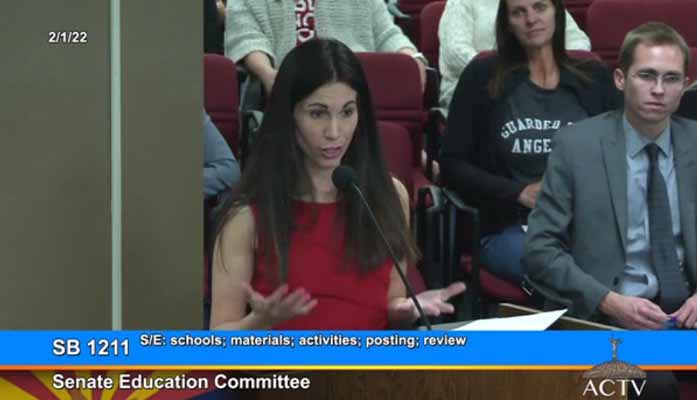
The Arizona Senate Education Committee passed a bill to ensure K-12 schools afford greater transparency to parents concerning the content and adoption procedures for curriculum and all other learning materials. The bill, SB1211, passed 5-3 along party lines. 20 states have introduced similar legislation; the Wisconsin legislature passed a similar bill last year but their governor vetoed it; most recently, the Indiana House moved another similar bill forward. However, no other state has the same legislative language as SB1211.
Specifically, the 14-page bill would require schools to post online in a searchable manner all learning material adoption procedures as well as the content organized by subject, grade, and teacher. The specified learning material covered requires readings, videos, audio, digital materials, websites, instructional handouts, worksheets, apps, assemblies, guest lectures, civics assignments or projects, and service learning projects. Any educational materials concerning nondiscrimination, diversity, equity, inclusion, race, ethnicity, sex, gender, bias, action-oriented civics, service learning, or social and emotional competencies must be referenced in full online at least 72 hours before implementation. Materials outside that scope must be posted online within a week of their implementation and remain accessible on the site for two years. The bill also would require schools to allow all throughout the school day as well as a half an hour before and after school hours for textbook review prior to adoption.
Parents could seek redress for violations of this bill by first submitting a complaint to the school principal. If the principal doesn’t investigate and respond within 15 days, or the response doesn’t solve the issue satisfactorily, parents could submit a complaint to their school board. If the board doesn’t respond adequately or at all within 25 days, then parents may take legal action against the school’s governing body. No teachers would be subject to punishment.
State Senator Nancy Barto (R-Phoenix) insisted all she was introducing was a “simple […] common-sense transparency bill.” Barto clarified that the bill would allow parents a heads-up about what their children would learn.
“So many parents are so frustrated at not having access to what their children are learning in schools. There are so many things that are accessible online now, and curriculum needs to be one of them,” said Barto.
Parent after parent highlighted personal and local incidents concerning willful lack of transparency from their schools and districts. In addition to parents, the Arizona Coalition of School Board Members and Heritage Action for America showed up to support the bill. A handful of teachers, most of them masked, and the Arizona Education Association (AEA) spoke out against the bill. They argued that the bill would create an undue burden on teachers and districts, foster distrust and malcontent between parents and teachers, and even further reduce educational quality. The Arizona Charter School Association (ACSA) was also reportedly against the bill, according to State Senator Gonzales, but none of their representatives gave testimony before the committee on Tuesday.
The first to provide public commentary on the bill was none other than Nicole Solas — the Rhode Island parent sued by her state’s teacher’s union, the National Education Association of Rhode Island (NEARI) for her public record requests and represented by the Goldwater Institute, the Phoenix-based conservative public policy and litigative think tank.
Solas told the committee that her story was a cautionary tale of what occurs when a state doesn’t have academic transparency. Her story began when she requested information about the education her daughter would receive, and learned that the school taught about gender at every grade level in “age-appropriate ways,” as well as teaching five-year-olds on the first day of Thanksgiving what could’ve been done differently during the pilgrim’s Thanksgiving. When Solas attempted to ask more questions about the curriculum, her school told her to submit public records requests. After doing so, the school board of her district put her name on the agenda of a public meeting with a threat to sue her for her records requests.
Solas recalled how the five hour meeting was filled with public harassment and open debates on her moral character and motivations by the board members. Solas shared further that her district then hired a public relations firm to defame her in the national media. The local teacher’s union then decided to sue Solas for filing those records requests. Even after enduring all of that eight months later, Solas said her original requests have gone unanswered. All she received was outdated curriculum; the district told her she hadn’t asked specifically for the current curriculum.
“What they did to me was government abuse of power just because I wanted to know what was being taught,” said Solas. “This is a kafkaesque, bureaucratic problem with a very easy academic solution.”
It wasn’t just the blame from the district that presented a problem to Solas — it was the cost of the records requested. Solas insisted that the cost to districts to fulfill public records requests was unnecessary, and that public schools needed to be protected from squandering their education dollars.
“Pass this bill for public schools and you can save them from themselves. We need our education dollars to be spent on students, not on a petty stand-off between schools and parents,” said Solas. “These are the games they play with public records requests. Our children’s education is not a game.”
Majority Leader Rick Gray (R-Sun City) said Solas’ story was heartbreaking to hear, and expressed condolences for the plight of New Jersey’s children.
“They wanted to send a message that if you want transparency […] they will retaliate against you and punish you for asking for transparency,” relayed Solas.
State Senator Christine Marsh (D-Phoenix) asked Solas if New Jersey had a parental bill of rights similar to Arizona’s. She added that she didn’t understand what Solas’ issue had to do with Arizona schools. Solas said they don’t have anything like that in her state, and informed Marsh that the Phoenix-based Goldwater Institute is representing her for the lawsuit.
Goldwater Institute Director of Education Policy Matt Beienburg offered insight from Arizona teachers in support of the bill. He read a letter from Jessica, an English teacher, who described how she covered over 70 absences in one week and insisted on the bill because it provided an “easy safeguard” for creating a “workshop” between families and schools.
“This bill is pro-student, pro-parent, and pro-teacher,” asserted Beienburg.
State Senator Tyler Pace (R-) asked what a pragmatic solution would be, instead of this bill. Thomas said the best solutions would be at the local level. He said parents already had “a lot of tools” to get the transparency they need.
“The unintended consequence of this is that kids are going to suffer in that their interests aren’t going to be explored at any given instance during the day,” asserted Marsh.
Gray pressed AEA President Joe Thomas, who insisted that better answers were to be had, to give them a tangible solution. Thomas couldn’t. Instead he repeated that parents had the tools to investigate the curriculum themselves. Gray insisted that wasn’t enough of an answer.
“When we see this as a legislative body and this is brought to us, it is our responsibility to see what we can do to solve this problem. Ideally we would never get this problem here because the schools would take care of it,” responded Gray. “We don’t have any solutions from the education industry, but we clearly have problems from the parents.”
In closing public remarks, Beienburg cited how an AEA spokeswoman last year reported that she submitted curriculum materials regularly to her district officials for review.
“That’s indicative of the fact that this is doable,” said Beienburg.
Curriculum Transparency!@NancyBarto's SB1211 bill will be heard on Tuesday at 2PM!
SB1211 would make the curriculum materials available online for parents to view.
Give it a ? on RTS Come testify and support Contact the Senate Education Committee to encourage a YES vote