by Terri Jo Neff | Jan 13, 2022 | News
By Terri Jo Neff |
With the introduction of legislation this week in the Arizona House of Representatives to prohibit many public entities from using public funds to pay for ransomware attacks, AZ Free News recently spoke with Sen. David Gowan about the security of the Legislature’s own computer systems.
Gowan says that the dedicated IT staff of the Arizona Legislature have ensured that its system protections are up to date and meet or exceed industry standards. This would allow the legislative session to continue with little impact if hit with the type of ransomware attack suffered by the Virginia Legislature last month.
“Nothing is 100 percent guaranteed, but we try to figure it out before a hacker can,” he said. “And we have the ability to move forward and maneuver, even if we have to do some things on paper.”
The Dec. 10 ransomware attack on servers used by Virginia lawmakers led to the disabling of the legislature’s voicemail system, its budgeting portal, and the platform used to draft bills. Even access to the Virginia Constitution and state code normally accessible online had to be taken down after the attack, which one state official blamed on an “extremely sophisticated malware.”
For a short time the website serving Virginia’s Division of Capitol Police was also down but there was no report of impacts to critical functions.
Whoever hacked the Virginia Legislature’s system left a ransom note, although it did not include a ransom price nor due date, according to a senior staff member. It is the first reported cyber security attack on a state legislature, although at dozens of public entities across the country were hit in 2021.
Gowan is pleased that Arizona’s legislative staff has safeguards in place which will allow lawmakers to “quickly move forward with our work” if hit by an attack like Virginia experienced. He credits the fact that the legislature’s IT personnel conduct refresher training for lawmakers and staff about suspicious emails, which is the easiest way for a cyber attacker to get into a system.
There is also frequent spot checks of the legislature’s systems. And it helps, Gowan noted, that Arizona has one of the nation’s premiere cybersecurity programs, with the Arizona Department of Homeland Security, the Arizona Department of Public Safety, and the Department of Emergency and Military Affairs all major players, along with local and federal agencies.
Two controversial bills recently introduced by a state representative would make significant changes to Arizona’s laws related to cyberattacks. One would tie the hands of public officials in responding to a ransomware attack, while the other seeks to require anyone who does business in Arizona to report a computer security breach or face a civil penalty from the Arizona Attorney General’s Office.
HB2145 would bar the State and any political subdivision of the state (such as a county, city, town, or school district) from making ransomware payments to secure the release of data. It would also require immediate notification of such an attack to the Director of the Arizona Department of Homeland Security.
Meanwhile, HB2146 would mandate anyone who “conducts business in this state and that owns, maintains or licenses unencrypted and unredacted computerized personal information” to report any security system breach to the Director of the Arizona Department of Homeland Security within 45 days.
A willful violation of the notification statute could lead to a civil penalty of up to $500,000, according to the bill.
by AZ Free News | Jun 19, 2021 | News
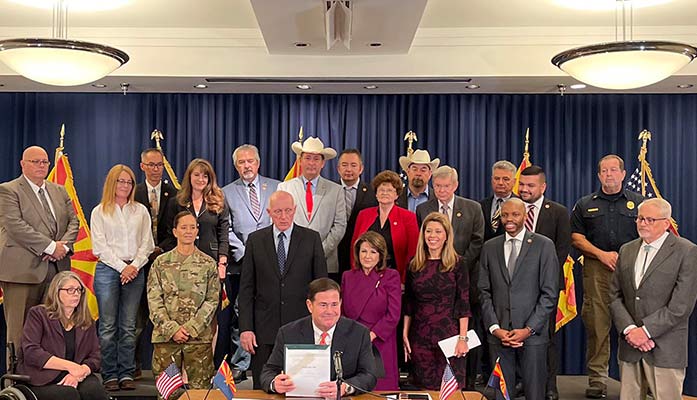
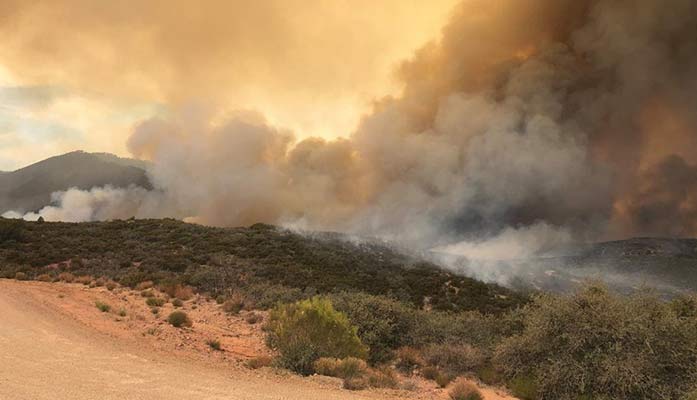
Governor Doug Ducey today signed a bipartisan relief package to support firefighters and safety officials as they battle wildfires, ensure Arizona communities have the resources necessary for post-fire disasters such as flooding and reduce the risk from future wildfires.
The $100 million package passed with strong bipartisan support during a legislative special session called by the Governor after a visit to the Telegraph and Mescal Fires last week.
“We are in the midst of another catastrophic wildfire season, and it’s clear that we need to do more to fight these wildfires,” said Governor Ducey. “Many Arizona communities have already felt the impacts of this year’s wildfire season — people and pets have been displaced, homes have burned down, swaths of land have been decimated. I’m grateful that we were able to quickly come together in a bipartisan manner for the safety and protection of our communities. My thanks goes to our first responders working tirelessly to combat these fires, local and state agency leaders for their leadership during this time, and the legislators who worked across the aisle to get this bill passed.”
The wildfire relief package was led by a bipartisan group of legislators representing both rural and urban Arizona, including House Speaker Rusty Bowers, Representative Gail Griffin, Representative David Cook, House Minority Leader Reginald Bolding, Senate President Karen Fann, Senate President Pro Tem Vince Leach, Senator Sine Kerr and Senate Minority Leader Rebecca Rios.
House Bill 2001 includes:
- $24.6 million for a partnership between the Department of Forest and Fire Management and the Arizona Department of Corrections, Rehabilitation and Reentry to reduce wildfire risk to Arizona communities by removing fire-prone vegetation; and
- $75 million for fire suppression efforts, recovery efforts including post-fire floods, economic assistance for those displaced, and assistance to landowners for emergency repairs to infrastructure damaged by wildfires.
“Thank you, Governor, for allowing us to work together, and thank you, Minority Leader Bolding and Leader Rios, for your help on an issue where we can come together for a common goal,” House Speaker Rusty Bowers said. “People who aren’t Republicans or Democrats – they’re just our friends and people.”
“I look forward to partnering with my colleagues on continuing bipartisan success because wildfires don’t care which party you belong to,” said Senator Sine Kerr, who introduced House Bill 2001’s mirror legislation in the Senate.
Arizona is currently in the midst of fire season, having already experienced 918 wildfires burning over 245,000 acres this year. The Telegraph Fire visited by the Governor last week is currently the sixth-largest wildfire in state history.
“There is no question that there was an enormous need to dedicate as many resources as possible to fight the currently active wildfires as well as to prevent future ones from occurring,” Senate Minority Leader Rebecca Rios said. “I applaud the governor for calling a special session to address this extraordinary wildfire season. This was clearly a major issue that needed immediate attention, and I’m grateful for Governor Ducey’s action in bringing bipartisan leadership to work together to address this critical need.”
“We must do what we are doing today to react to this emergency, but we must also do everything in our power to mitigate the crisis for future generations – and we must do that together,” House Minority Leader Reginald Bolding said. “Thank you again, Governor Ducey. My colleagues in both the Republican caucus and our caucus stand ready to work together and ready to move forward.”
The Governor was also joined by Department of Forestry and Fire Management Director David Tenney, Department of Emergency and Military Affairs Director and Adjutant General Kerry Muehlenbeck and Gila County Supervisor Steve Christensen.
“I’d like to thank the Governor for calling this special session on behalf of Gila County and rural Arizona,” said Gila County Supervisor Steve Christensen. “The leadership in Gila County says thank you for being an advocate for Arizona. I’d like to extend my thanks to the Legislature and their willingness to work in a bipartisan way.”
On June 9, the Governor issued two Declarations of Emergency in response to the Telegraph and Mescal Fires in Pinal and Gila Counties. The orders made up to $400,000 available for response efforts, and followed a request to the Federal Emergency Management Agency (FEMA) for a Fire Management Assistance Grant on June 6.
In March, the Governor signed Senate Bill 1442 to prevent wildfires by allowing for additional partnerships to employ Arizona inmates to clear forests of debris. The legislation aligns with the Arizona Healthy Forest Initiative proposed in the Governor’s budget which builds on proven methods to protect communities, while engaging individuals in state correctional facilities to equip them with new skills and reduce recidivism.
by Terri Jo Neff | Jun 17, 2021 | News
By Terri Jo Neff |
After a mini-Wildfire 101 course from the Arizona State Forester, 18 of the 19 members of legislature’s Joint Committee on Natural Resources, Energy, and Water voted in favor of Gov. Doug Ducey’s proposed $100 million fire suppression and mitigation legislation.
Next up for the bill during this Special Session is a quick trip through two Rules Committees on Thursday morning. That should be followed by the House and Senate convening to consider amendments to the two identical bills, SB1001 and HB2001, which are tracking in both chambers.
Wednesday’s hours-long meeting featured a questions and answers session with David Tenney, director of Arizona’s Department of Forestry and Fire Management (DFFM) on the same day that two ongoing destructive wildfires near Globe -the Telegraph and the Mescal- merged with nearly 150,000 acres burned.
Ducey called the Special Session for the sole purpose to pass a wildfire-related supplemental appropriations bill. The joint committee discussed many of the bill’s targeted investments for wildfire preparedness, response, and recovery, including $76 million toward fire suppression efforts, recovery efforts, mitigation of post-fire floods, economic assistance for those displaced by fires or post-fire floods, and assistance to landowners for emergency repairs from wildfire-related infrastructure damage.
There is also nearly $25 million appropriated in the bill for DFFM and the Arizona Department of Corrections (ADC) to partner on wildfire mitigation efforts such as removing hazardous vegetation and fire fuels. The funds include hiring 720 ADC inmates, working in 72 teams of 10 inmates, to target DFFM-designated areas across the state where mitigation is needed. The goal, said Tenney, is for the crews to cover 20,000 acres annually.
Among the questions Tenney was asked was whether Arizona should own a fleet of firefighting aircraft instead of contracting with providers. Tenney was also asked whether DFFM should purchase a handful of $500,000 firetrucks designed for off-road wilderness access that could be “borrowed” to smaller fire departments.
Tenney also noted that as of this week, Arizona’s 2021 fire season will have impacted nearly 300,000 acres. That puts the state of track for its worst fire season in history due to the combination of excessive heat in all 15 counties as well as drought conditions.
Some committee members tried to get Tenney to discuss whether Arizona’s increasingly larger wildfires are the result of climate change, but the director stuck to the purpose of the legislation -and the Special Session- which is to ensure funding for activities which can have an immediate affect on reducing fires or limiting the damage from fires.
The climate change comments received pushback from Sen. David Gowan (LD-14), who said no one is disputing there is climate change.
“Climate change happens every decade, happens every century, millennium, we have climate change,” he said.
Some Democrats questioned whether the Ducey-backed appropriations bill goes far enough as they preferred legislation addressing more than the immediate critical need. However, committee chairs Rep. Gail Griffin (R-LD14) and Sen. Sine Kerr (R-LD13) guided the discussion back onto the purpose of the legislation – to address the wildfire and post-fire flooding crisis facing Arizona now.
The only no vote was cast by Sen. Juan Mendez (D-LD26).
by Terri Jo Neff | Mar 4, 2021 | News
Terri Jo Neff |
Two pieces of state legislation aimed at protecting gunowners’ rights made it out of the Senate on Wednesday, and it is now up to House Speaker Rusty Bowers to assign the bills to House committees.
SB1382 deems stores which sell firearms, ammunition, or components of either as “an essential business” during a state of emergency. The bill cleared the Senate Judiciary and Senate Rules committees in early February and passed on the Senate Floor by a 16 to 14 vote along party lines.
The bill impacts ARS § 26-303 under Military Affairs and Emergency Management, which currently guarantees emergency powers shall not allow the imposition of additional restrictions on the lawful possession, transfer, sale, transportation, carrying, storage, display or use of firearms or ammunition or firearms or ammunition components.
Under SB1382, the statute would be amended to add one sentence that specifies stores that sells firearms, ammunition, or components of such are essential businesses “and there may not be any restrictions imposed on the store’s normal operations” during a state of emergency.
The legislation would not require a store’s primary source of revenue to come from gun or ammunition sales, thus allowing businesses which sell other retail items in addition to firearms to remain open. One such business that would benefit from the legislation is Lilly’s Tombstone Memories, a specialty gift store on historic Allen Street in Tombstone.
If SB1382 had been the law when COVID-19 first hit, owners Lillian and Bob Hritz would have been able to remain open without fear of retribution against their business license. They, like a number of gun store owners, saw an increased customer demand starting last March but due to Gov. Doug Ducey’s executive orders many had to close.
Among those supporting the bill are the Republican Liberty Caucus of Arizona and the Arizona Citizens Defense League.
Another gun rights bill passed out of the Senate on Wednesday, this one by a 17 to 13 vote.
SB1328 -known by its working title of the Second Amendment Firearm Freedom Act- would declare any federal act, law, treaty, order, rule, or regulation to be null and unenforceable in Arizona if the action violates the right to bear arms as provided by the Second Amendment of the U.S. Constitution or by the Arizona Constitution.
The bill sponsored by Sen. David Gowan (R-LD14) would also prohibit the State and any of its political subdivisions from using personnel or financial resources to enforce, administer or cooperate with any federal act, law, treaty, order, rule, or regulation deemed in violation of the U.S. or Arizona Constitutions.
But unlike many bills, SB1328 as currently written includes a provision putting teeth into the new law by making the impairment of a citizen’s right to bear arms a Class 1 misdemeanor for the first offense. Each subsequent offense would be a Class 6 felony, and a judge would be required to impose the maximum fine and sentence allowed by law for anyone convicted of such conduct.
The bill also contains a provision allowing citizens to sue any “entity, agency, bureau, employee or official of Arizona or a political subdivision of Arizona” that engages in such infringement for judicial relief, damages, and attorney fees. However, it excludes persons working under the authority or orders of a government entity, agency, bureau, employee or official from the outlined prohibitions.