by Corinne Murdock | Feb 4, 2022 | News
By Corinne Murdock |
As the government continues to struggle retaining a totalitarian grasp on all things related to the pandemic, including Americans’ health care options, Arizonans should be aware that their skin color will determine their ability to access life-saving treatment. One Phoenix man shared with AZ Free News how his decision to identify himself as “white” because of his skin tone, rather than Hispanic, nearly cost him his life, in the hopes that his experience will spread awareness and serve as a cautionary tale to fellow Arizonans.
Michael Myers explained that he made the mistake of marking his race as “white” on medical intake paperwork rather than “Hispanic” — in part due to his complexion, mixed with the fact that he was raised to not think of himself as Hispanic.
“Had I put that I was Hispanic they probably would’ve gave [the monoclonal antibodies] to me,” said Myers. “I lost four days [of treatment] getting sicker and sicker. I put down ‘white’ even though I was sicker than a dog.”
Even though race doesn’t weigh heavily on Myers’ mind, it does for the government. AZ Free News inquired with the health system that treated Myers, HonorHealth, about their adherence to any federal or state guidelines that limit or prohibit COVID-19 treatments based on high-risk categories that factor race or ethnicity. They explained that they “follow CDC guidelines when it comes to COVID-19 treatments.” The CDC cites the FDA as the reference for guidelines on treatments for individuals with “high risk of disease progression.”
In supplemental information on their emergency use authorization (EUA) of monoclonal antibodies, the FDA acknowledged that race and ethnicity “may also place individual patients at high risk for progression to severe COVID-19,” therefore rendering them valid determinations of eligibility for monoclonal antibody treatments. That’s a conclusion that the state of Minnesota drew explicitly in their “Ethical Framework for Allocation of Monoclonal Antibodies during the COVID-19 Pandemic” published last month.
Last summer, the Department of Health and Human Services (DHHS) lauded Michigan and Maryland for incorporating equity in their decisions to administer monoclonal antibody treatments.
Also last month, the CDC published a report suggesting that “equitable” use of treatments factoring race was critical in combating the disproportionate numbers of certain races being adversely affected by COVID-19. The CDC also has a page which argues for equitable approaches to health care because COVID-19 impacts minorities disproportionately.
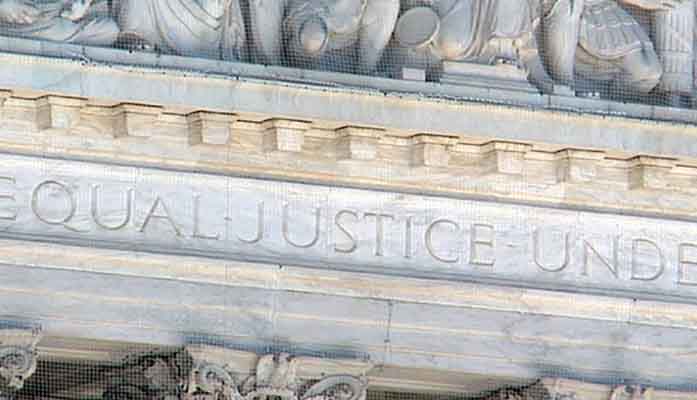
Equity looked like health care providers ignoring the entirety of Myers’ condition and focusing on one characteristic: his reported race.
Myers was diagnosed with COVID-19 exactly two weeks before Christmas Day. Based on Myers’ condition, his health care providers at HonorHealth gave him the option to either receive monoclonal antibodies at their FastPace emergency room nearby or wait for their Scottsdale infusion center’s next available appointment. Myers told AZ Free News that he was so sick that he opted for the emergency room.
After waiting over two and a half hours, Myers was admitted to a room. Just as the IV was placed in Myers’ arm, a pharmacist intervened. The pharmacist informed Myers that he “didn’t qualify” for the monoclonal antibody treatment because he wasn’t “high-risk” enough. Confused and upset, Myers left.
He said he was shocked when, on Monday morning, HonorHealth called him for his appointment to receive monoclonal antibodies. When Myers informed the nurse that he’d been disqualified by their FastPace center, the nurse was dismayed and insisted that he receive the treatment based on his deteriorating condition. By that point, Myers had begun to cough up blood. The infusion center’s earliest available appointment was on Wednesday; Myers said he barely made the drive from Glendale to Scottsdale safely because his coughing had worsened and he nearly didn’t have the strength to steer the wheel.
“Within 24 hours I felt I was getting better. It took me a week and a half to get back to some normal,” said Myers.
Weeks later, Myers told AZ Free News that he received a $1,500 bill from FastPace — even though they refused to treat him. Myers said his entire ordeal was entirely unnecessary, relaying frustrations at how he believed politics got in the way of his health care.
“It’s political b******t really. I got sicker when I could’ve recovered faster, and it cost me thousands of dollars in medical bills and me being off of work,” said Myers.
Corinne Murdock is a reporter for AZ Free News. Follow her latest on Twitter, or email tips to corinne@azfreenews.com.
by Corinne Murdock | Feb 3, 2022 | News
By Corinne Murdock |
The House Government and Elections Committee passed two bills prohibiting government entities from requiring masks or COVID-19 vaccines. The first bill, HB2498, prohibits governments from mandating COVID-19 vaccinations for any Arizonan; The second bill, HB2453, would eliminate all governmental authority to require masks or face coverings on their premises, with an exception carved out for areas with workplace safety and infection control measures unrelated to COVID-19. For both bills, “government entities” are defined as those who receive and use tax revenues.
Both bills were introduced by Queen Creek Republicans: State Representatives Jake Hoffman and Neal Carter, respectively. HB2498 passed 7-5 along party lines, with State Representative Alma Hernandez (D-Tucson) abstaining her vote. HB2453 passed more narrowly, 7-6 along party lines.
State Representative Sarah Liguori (D-Phoenix) argued during Wednesday’s committee that the vaccine prevents individuals from spreading COVID-19; Hoffman, the vice chairman, rebutted that simply wasn’t the case. Liguori argued, based on a definition from ushistory.org, that governments provide everyday behavior parameters, well-being, and happiness for citizens. Hoffman responded that the definition wasn’t at all aligned with the U.S. Constitution.
“I honestly don’t give a rat’s ass what ushistory.org says,” said Hoffman. “We exist to protect the rights of our citizens. One of their own rights is to choose their own bodily decisions. It’s their right to choose whether or not a vaccine is injected into them.”
A male legislator chimed in to say Hoffman’s argument aligned with pro-abortion arguments; Hoffman rebutted that wasn’t true because a baby’s life was at stake.
Minority Leader Reginald Bolding (D-Laveen) insisted that the fact that vaccines don’t prevent individuals from catching or spreading COVID-19 was “unfounded.” He then characterized the bill as an overreach preventing individuals from obtaining the protections of a vaccine, though he didn’t clarify how this bill had any bearing on individuals choosing to get vaccinated voluntarily.
“If we have the ability to have a vaccine that would prevent individuals from becoming severely ill or losing their life, we should not be standing in the way of that. I believe this bill is an additional overreach,” said Bolding.
Hoffman reiterated that the American system of government doesn’t have a right to force its citizens to take a vaccine they don’t want to have.
“Our overture to the world on what sets this people apart from everywhere else: ‘We hold these truths to be self evident: that all men are created equal, that they are endowed by their Creator with certain unalienable rights. That among these are life, liberty, and the pursuit of happiness. That to secure these rights, governments are instituted among men, deriving their just powers from the consent of the governed,” said Hoffman. “The choice of the governed. It is not in the American system that a government can tell them what to do, can force them to take a vaccine.”
As AZ Free News reported, Carter asserted that his bill, HB2453, would curb further exacerbations of the current hiring and employee shortages in addition to respecting the right of individuals to make their own health decisions.
During the committee meeting, Bolding called the bill “misplaced policy” by not allowing local governments to protect their citizens by requiring masks. State Representative John Fillmore (R-Apache Junction) responded that he feels bad that any individual would die from an infectious disease, but it saddened him greatly too that a whole society allowed the government to assume complete control over their lives.
“I was appalled that the churches did not rise in opposition when [the government] said that people could not go and pray to the gods of their choice and live out their lives, like they did during the Revolutionary War which sparked freedom in America the way that it did,” said Fillmore.
Liguori insisted that “the science” proved mask wearing prevented spread of COVID-19, and that masks weren’t a partisan issue.
Corinne Murdock is a reporter for AZ Free News. Follow her latest on Twitter, or email tips to corinne@azfreenews.com.
by AZ Free Enterprise Club | Jan 15, 2022 | Opinion
By the Arizona Free Enterprise Club |
Democrats love to talk about the need of establishing a “universal” health care system that provides everyone with the same quality of care. That was the major theme pushed by the left and the media when Obamacare was signed into law in 2010.
We always knew that it was propaganda and that a government-run healthcare system would result in worse care for everyone. What we didn’t know is that the left doesn’t even support this claim. They do like the idea of providing different care to different people, so long as it promotes their radical, race-based social justice agenda.
Rationing COVID treatments based on race
To kick off the new year, health officials in Democrat-run New York made the call to prioritize non-whites as part of their criteria to decide who is eligible to receive monoclonal antibodies. And while white people can still receive the treatments, they’ll have to show that they have medical conditions that increase their risk for severe illness. Non-white patients, however, are automatically eligible.
>>> CONTINUE READING >>>
by Corinne Murdock | Jan 10, 2022 | News
By Corinne Murdock |
Last month, State Senator Kelly Townsend (R-Mesa) requested Attorney General Mark Brnovich investigate Pima County for denying reasonable accommodations for religious beliefs conflicting with their COVID-19 vaccination requirement. At this point in the investigation, Townsend has requested Pima County employees to file complaints to the civil rights division of the attorney general’s office.
The county requires current and future employees to get vaccinated. However, the county must abide by A.R.S. § 23-206 which requires reasonable accommodations for religious beliefs.
“If an employer receives notice from an employee that the employee’s sincerely held religious beliefs, practices or observances prevent the employee from taking the COVID-19 vaccination, the employer shall provide a reasonable accommodation unless the accommodation would pose an undue hardship and more than a de minimus cost to the operation of the employer’s business,” read the statute.
Pima County contended that the law poses an undue hardship. In a statement released Thursday, Townsend asserted that Pima County’s allegations of undue hardship conflicted with their previous two years of mitigations without a vaccine.
“[T]he County alleges that it cannot provide reasonable accommodations in certain situations due to the hardship it would cause them, even though employers have successfully adjusted to accommodate COVID-19 in the workplace for nearly two years,” stated Townsend. “I am confident the attorney general will continue to investigate, and where appropriate prosecute, instances of personal freedom infringement across Arizona, including in Pima County.
Townsend promised further that she would continue to fight for individuals to make their own medical decisions.
Late last month, Brnovich responded to another request from Townsend concerning another COVID-19 topic: forced quaratines of K-12 students. Brnovich issued an opinion declaring that students had a right to legal counsel in the event that their school required them to quarantine for COVID-19 exposure.
In September, another one of Townsend’s inquiries to Brnovich on the legality of COVID-19 response measures prompted action from the city of Tucson. After Brnovich opined that the city acted unlawfully when it handed down five days unpaid suspension to unvaccinated employees, the city halted its vaccine mandate.
Within a week, the CDC changed its guidelines to halve the quarantining recommendation from 10 days to five. As AZ Free News reported, the changes came after a request letter to the CDC from Delta Airlines CEO Ed Bastian.
Corinne Murdock is a reporter for AZ Free News. Follow her latest on Twitter, or email tips to corinne@azfreenews.com.
by Terri Jo Neff | Jan 10, 2022 | News
By Terri Jo Neff |
Employers who mandate COVID-19 vaccinations as a prerequisite to employment or continued employment could be held liable for damages if an employee is denied a religious exemption and then suffers significant injury due to the vaccine, according to legislation introduced Friday by State Rep. Quang Nguyen.
“The reality is COVID-19 is going to be with us for a long time,” Nguyen said of his motivation for the bill. “If businesses and employers are intent on mandating vaccinations as a condition of employment, they should be held accountable if their employees face serious harm or illness.”
Some COVID-19 vaccines have been granted liability protection from the federal government, which limits the options for affected individuals who are injured in connection to a vaccination. Current state law only provides for an affected employee to seek recourse via the workers’ compensation system.
Nguyen, a Republican, serves Legislative District 1 which includes Prescott and portions of Yavapai and Maricopa counties. His HB2043 creates a separate pathway for an employee to seek recourse if they are significantly injured due to a mandated vaccine after being denied a religious exemption.
“This is one of the most important bills I’m introducing this coming session,” Nguyen said. “Public and private health mandates are not a good solution and could instead cause harm in some cases.”
According to the current bill language, anaffected employee who prevails in state court could be entitled to at least $500,000 in actual damages. Punitive damages could also be sought in cases where egregious or malicious conduct is alleged.
Another 11 representatives have signed on to HB2043 as co-sponsors.