The city of Phoenix plans to send hundreds of unclaimed guns to Ukraine, around 500 to 600 guns, over the next two years.
The Phoenix City Council approved the measure during last week’s formal meeting. The city will give the guns to a private company headquartered in Pennsylvania, D.T. Gruelle, who will then transport them to the National Police of Ukraine. The city will expend nothing for the transfer.
The approximately $200,000 in firearms given to Ukraine will only be 9mm, 45mm, 39mm, and 12 gauge. The firearms transfer agreement is binding for two years: June 28 of this year to June 28, 2025.
However, the gun donation may be unlawful.
Arizona House Judiciary Committee leaders immediately contacted Phoenix Mayor Kate Gallego over the arrangement. In a letter, the committee members warned that the gun donation violates state law.
Reps. Quang Nguyen (R-LD01) and Selina Bliss (R-LD01), chair and vice-chair of the committee, urged Gallego to repeal the ordinance.
The lawmakers noted that state law prohibits political subdivisions from enacting any ordinance concerning the possession, sale, transfer, purchase, acquisition, or use of firearms.
The lawmakers also noted that state law doesn’t permit cities or other local governments from disposing of their firearms through donations. Rather, statute permits local governments to either trade the unclaimed firearms to a federal firearms licensed business in exchange for items like ammunition or weapons, or sell the unclaimed firearms to an authorized business who will then sell those firearms to the public.
The pair reminded Gallego of Brnovich v. City of Tucson, in which the Arizona Supreme Court ruled that the city of Tucson’s ordinance ordering the destruction of unclaimed firearms conflicted with state law.
It appears that Phoenix’s donated guns may not only go to the National Police of Ukraine, but the citizens themselves.
The company contracted to take the unclaimed guns, D.T. Gruelle, has close ties to the Ukrainian government. Their managing director, Marco Gruelle, sits on the board of Ukrainian Arsenal of Liberty (UAL): a group created by Ukrainian Parliament members for the purpose of arming citizens. Parliament member Maryan Zablotskyy sits on UAL’s board.
Also on UAL’s board are Oleksandr Markushyn, mayor of the city of Irpin, and Ivan Slobodyanyk, chair of the Union of Local Communities and Farmers Union of Ukraine as well as a fighter in the Territorial Defense Force.
According to UAL’s donation brief, they utilized donated and unused guns obtained by American states’ police forces. Unclaimed guns are held by the Phoenix Police Department; as the Arizona Daily Independent first reported, the donation plan didn’t mention tracking measures for the guns once donated.
The company first engaged in the Russian-Ukrainian conflict last February. D.T. Gruelle has provided “critical aid transport” to various conflict zones since 2019.
That same year that D.T. Gruelle began providing conflict zone assistance, it established its 501(c)(3) nonprofit, D.T. Care, which currently provides emergency relief to Ukraine. Marco Gruelle also serves as president of D.T. Care. In its last annual report, issued in 2021, D.T. Care distributed over $361,000 in relief to South Africa, Panama, Lebanon, Bosnia, and Herzegovina, respectively.
D.T. Gruelle was founded in 1982 by Durard Timothy Gruelle, an Army veteran of the Vietnam War who continues to preside over the company today.
Corinne Murdock is a reporter for AZ Free News. Follow her latest on Twitter, or email tips to corinne@azfreenews.com.
Democrats like to believe they are the party of compassion and kindness, but the reality in most blue cities says otherwise. For years, homeless encampments have been springing up in liberal-run cities like Seattle, Portland, San Francisco, and Los Angeles. And in recent years, this trend made its way into Phoenix.
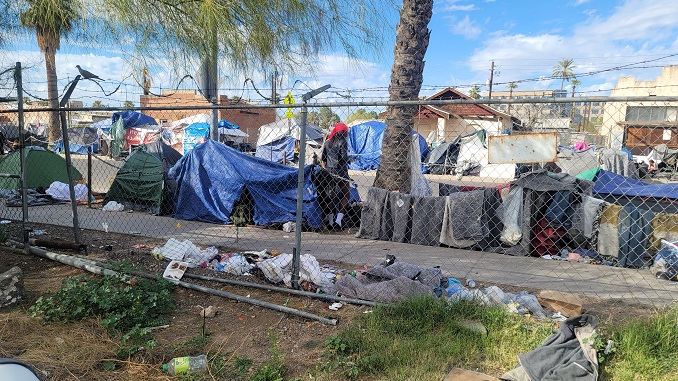
Just blocks from the state capitol, amidst what was once a thriving business district, a sprawling encampment of around 1,000 homeless has come to be known as “The Zone.” It’s a place where drug use, drug deals, defecation, urination, sexual acts, assaults, rape, and murder are frequently committed out in the open—often with little to no consequences. The problem has even gotten so bad that the Phoenix Fire Department won’t respond to calls inside The Zone without assistance from the Phoenix Police Department and assurance that the scene of the incident is secure.
But crime within The Zone is only one part of the problem…
Downtown Phoenix’s residents experienced a glimmer of hope in the ongoing homeless crisis last month after a court declared the city to blame. If the city doesn’t appeal the court’s order, it may be the end of the massive encampment known as “The Zone.”
The decision flies in the face of the precedent set by other cities: plans and spending that yield no favorable results, ultimately forcing the residents to learn to live with the crime and squalor. Yet, Phoenix may no longer be resigned to the same fate borne by most other major cities. Downtown property and business owners were vindicated in their belief: city officials’ plans, spending, and promises alone don’t qualify as results.
Requiring results of the city could mean The Zone may cease to exist in the near future — restoring a square mile of the current wasteland of city-sanctioned slums into a healthy business district — but only if the city of Phoenix decides to follow through on the court-ordered action to resolve the homeless crisis. Cleaning up The Zone would mean finding shelter and services for around 800 homeless residing in the area, according to a census conducted by the Human Services Campus late last month.
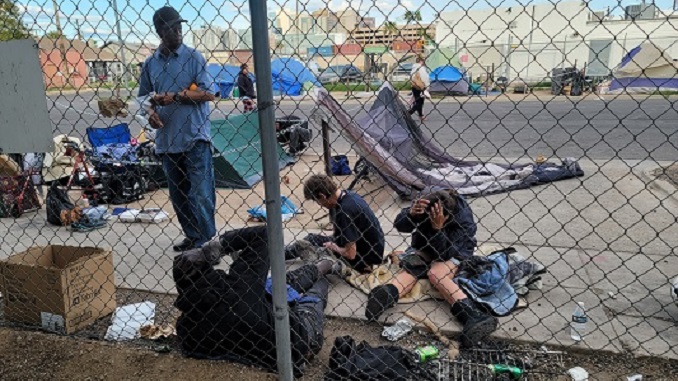
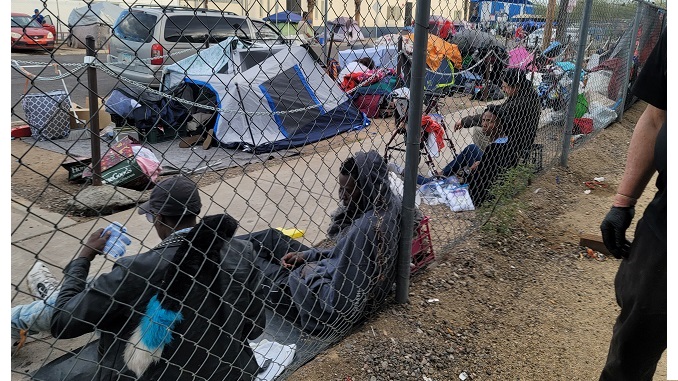
Homeless sit outside a business in The Zone.
The first bout of legal relief came for The Zone’s residents and business owners after the Maricopa County Superior Court ruled last month that the city of Phoenix was at fault for The Zone. The court ordered the city to show that it’s taking “meaningful steps” toward fixing The Zone. They have until July 10 to do so, with a trial date scheduled for June.
The ruling came days after the city of Phoenix promised to finally meet to fix The Zone, a promise prompted by back-to-back murders in the encampment.
Vice President for Legal Affairs at the Goldwater Institute, Timothy Sandefur, who submitted an amicus brief in the case, told AZ Free News that this ruling was a good first step toward remedying The Zone — but that the city has a ways to go.
“I think this is a first step and a very important one,” said Sandefur.
Sandefur said that the superior court indicated the best next steps for the city would be to build structured campgrounds and establish treatment programs, rather than continue with their current “housing first” approach.
However, notice of a settlement in a separate, federal case issued recently may complicate matters in finally getting the city of Phoenix to fix The Zone.
In the Arizona District Court case, the ACLU and the city held mediation about three weeks ago.
Details of the settlement weren’t made public. The Phoenix City Council plans to convene April 18 in an executive session — a meeting not open to the public — to discuss the terms of the settlement. At some point after, the Phoenix City Council will announce the settlement terms during a public meeting.
Of note, the city attempted to dismiss the superior court case — but not the federal case. The city also spent just shy of $100,000 fighting the superior court case.
Ilan Wurman, another lawyer on the lawsuit against the city, told AZ Free News that the court’s order to fix The Zone was thorough to the point where he imagined it would be difficult for the city to fight it.
“The court’s ruling is such a thorough victory for the business and property owners that it will be very hard for the city to overcome it at a full trial on the merits,” said Wurman. “We hope the city does the right thing and considers a settlement or simply follows through on the court’s instructions — that will save a lot of expense to taxpayers and it will be better for the unsheltered community as well.”
In remarks to the press, the city stresses that it has allocated around $140 million to solve the homeless crisis. However, there’s a difference between commitment and spending. Of the $120 million in COVID-19 relief funds received to address the homeless crisis, the city has only spent about 10 percent.
Of what little the city has spent for the homeless crisis, the Maricopa County Superior Court assessed that none of this spending has actually mitigated the crisis.
Homeless use drugs inside Phoenix’s sprawling encampment known as The Zone.
“With few exceptions, the action items about which city representatives testified centered around the creation of more bureaucracy, additional staff positions, and obtaining additional funding for programs to vaguely address homelessness in general,” stated Judge Scott Blaney. “The Court received very little evidence — if any — that the City intends to take immediate, meaningful action to protect its constituent business owners, their employees, and residents from the lawlessness and chaos in the Zone.”
However, in a recent interview, Mayor Kate Gallego indicated that the city was attempting to follow through on a “housing first” approach, and claimed that the city was “working very hard” to fix the homeless crisis.
As AZ Free News previously reported, “housing first” — also referred to as “permanent supportive” or “affordable” housing — holds the theory that the homeless will choose to seek employment, become financially responsible, and receive mental health care and/or substance abuse treatment if food and housing are provided. The theory also posits that enabling the homeless to choose their housing and support services will make them more likely to remain in that housing and stick with self-improvement initiatives.
Gallego shared that the city was working on launching seven new shelter options in partnership with various organizations, and that the city is hoping to receive additional help from both the state and federal government. She mentioned that she would meet with the Maricopa County Board of Supervisors.
Gallego disclosed that she recently spoke with Gov. Katie Hobbs about the homeless crisis — a conversation that had last occurred during Hobbs’ inauguration week in January. The mayor said that Hobbs was looking for additional resources to provide the city.
“Residents should feel confident that they’re going to see changes,” said Gallego. “The message we want to send to the public is that we recognize it’s a problem and we want to solve it.”
When questioned, Gallego didn’t directly deny that the city wouldn’t appeal the superior court’s decision.
In another interview, Gallego claimed that adequate law enforcement was taking place in The Zone. Gallego’s claim conflicted with the various investigative reports and witness accounts that depicted minimal law enforcement in The Zone.
“We treat every member of our community the same when they commit a crime. We want to be consistent and to enforce breaking the law,” said Gallego. “If you commit a crime, it is the same regardless of your housing status.”
However, the “Gaydos and Chad Show” testified to witnessing a myriad of criminal activity during a recent excursion in The Zone — including drug use, public defecation and urination, and prostitution — but not seeing any police presence. In response, Gallego claimed the city’s police were “too aggressive” when handling the homeless. The mayor cited the Arizona District Court case against the city as justification for her claim. However, that lawsuit concerned whether the city could enforce camping and sleeping bans, as well as whether the city had a right to seize or throw away items from homeless encampments as part of cleanup efforts. The lawsuit does not address police response to criminal activity.
Watch: The Zone – Homelessness and Crime Rampant in Phoenix
Corinne Murdock is a reporter for AZ Free News. Follow her latest on Twitter, or email tips to corinne@azfreenews.com.
The suffocating stench of urine and feces. Rotting garbage. The occasional whiffs of fentanyl, or the synthetic drug Spice clouding the air. Dead bodies. No, it’s not a Third World nation—it’s a lawless encampment of over 1,000 homeless people in downtown Phoenix, where crime is rampant, and the city does virtually nothing about it.
The city’s inaction provoked a lawsuit by business owners in the Zone who are suffering the consequences of the unchecked homelessness crisis. This week, a Maricopa County judge issued a preliminary ruling, finding that the city has “intentionally stopped—or at least materially decreased—enforcement of criminal, health, and other quality of life statutes and ordinances in [T]he Zone,” effectively making it “off-limits to [law] enforcement.” That’s good news for the business owners, but the decision is just a first step in the long process of solving the problem.
Karl Freund — who was leasing a building in The Zone and is suing the city over the homeless crisis — described to AZ Free News a state of apathy toward improvement for both the homeless and those assigned to handle it.
“You see trash everywhere. These people just don’t give a flip anymore, you know?” said Freund. “I see these people smoking meth wide out in the open. I’ll go over to them and tell them to leave. Then they’ll just go to another corner.”
The apathy has turned the once-thriving residential and business district into a depressed wasteland of death and depravity. Freund had plans to run a real estate business in the building he’d leased. Destruction to his property and the undesirability of the area caused by the homeless encampments has made that impossible; per AZ Free News’ initial report, he spent hundreds of thousands to fight for the property before having to find another to sublet it.
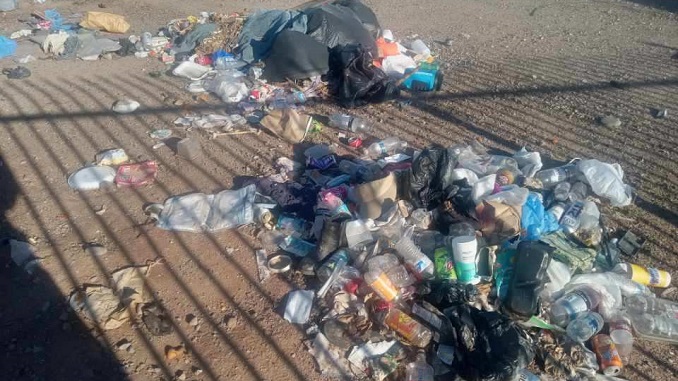
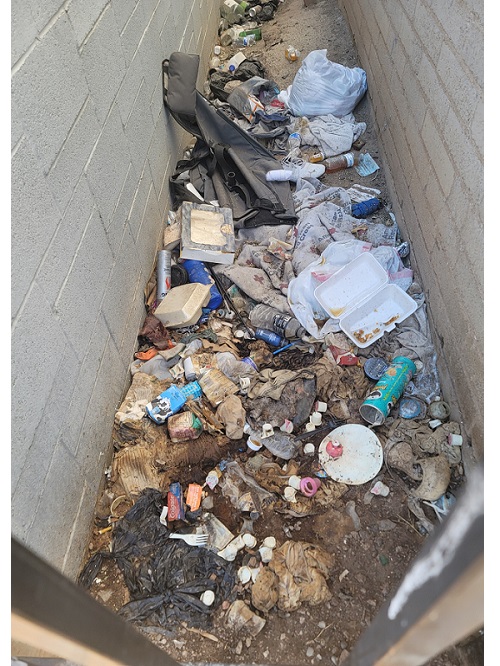
Human waste, garbage, and drug use overwhelm The Zone.
Sanitation is a far-off dream in The Zone — not only for the homeless, but also for those residents and business owners stuck there. These biohazardous slums are also affecting the rest of the state. Photographic evidence submitted in court filings reveals that unmanaged sewage and trash end up in storm drains. Drains which discharge into rivers, washes, and retention bases. The Zone is polluting Arizonans’ water on a daily basis, uninhibited.
AZ Free News spoke with a lawyer on the lawsuit against the city alleging a failure to take care of The Zone, Ilan Wurman, about the environmental hazards that The Zone poses (Brown v. Phoenix). Wurman confirmed that the constant deluge of waste ending up in our waterways violates state law.
“Their trash and waste goes into the storm drains and ends up in the waterways. That’s illegal discharge,” said Wurman.
The human waste and garbage that doesn’t end up in waterways creates other problems. Namely, they attract rodents and flies: a breeding ground for disease.
It was rats that resurrected a “medieval” disease in Los Angeles, California’s homeless population over the last decade: the bubonic plague. That accompanied the resurgence of other diseases rarely seen in this modern age, typhus and typhoid fever, alongside the persistent problem of hepatitis A and staph outbreaks. Around 1,000 were infected by hepatitis A from 2017 to 2019 in Southern California — even before the surge in the number of homeless that occurred during the pandemic — leaving just under two dozen dead. Typhus increased by thirteen-fold over the course of a decade in the area, from just over a dozen to just under 200 cases.
AZ Free News was unable to locate data from either Maricopa County or the state on communicable disease outbreaks other than COVID-19 in recent years.
Both court precedent and statute indicate that the city has a legal duty to not allow these hazards. Wurman referred AZ Free News to the justifications made for this argument in their recent motion for summary judgment issued in March.
“[A]ny person who knowingly maintains or commits a public nuisance or who knowingly fails or refuses to perform any legal duty relating to the removal of a public nuisance is guilty of a class 2 misdemeanor.” — A.R.S. Section 13-2917(D)
The city admits per court filings and testimony that conditions in The Zone are a “biohazard” due to the human waste, drug paraphernalia, and trash. Gina Montes, deputy city manager, said The Zone created “sanitation issues”; Scott Hall, deputy director of the Office of Homeless Solutions, admitted that the cleanups require “sanitation chemicals.”
“Their cleanup crews come in with hazmat gear. They expect us to accept those conditions in their neighborhood when they themselves have to wear those suits,” said Wurman.
The results of cleanup efforts only last a day at most, per testimony given by plaintiffs in court and by residents in interviews with AZ Free News. Cleanup crews also require police escorts due to the risk of violence they face, per city testimony. Yet residents and business owners must face The Zone on their own every day.
Up until last January, the city conducted cleanups three times a week: Mondays, Wednesdays, and Fridays. Items that couldn’t be moved were trashed. That was part of what prompted the DOJ to begin investigating the Phoenix Police Department in August 2021, reflecting tensions between a community desperate for better sanitary conditions and an unwavering political belief in protecting property rights for the homeless. Office of Homeless Solutions director Scott Hall claimed to reporters last November that the city wasn’t aware of property being thrown away.
The city resumed cleanups last December. However, the effects of these cleanups were only temporary since crews conducted these cleanups on a block-by-block basis. By the time crews reached the next block, the previous block they’d just cleaned had returned to its original state. City workers also offered services to the homeless while cleanups were underway; only 33 accepted, with the rest electing to return to a life on the streets.
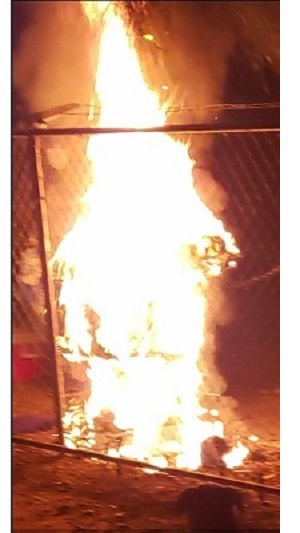
A fire burns in The Zone.
Cities that have dealt with a homeless crisis for far longer have experienced serious environmental dangers from mass encampments. Seattle, Washington has struggled to mitigate its homeless for decades, with reports highlighting 2005 as the first year that city officials first introduced a plan to tackle the problem. Thornton Creek Alliance (TCA), an environmental nonprofit focused on restoring Seattle’s waterways, has spoken out for years about the serious negative consequences of homeless encampments on the environment.
“The impact of homeless camps on nature is a concentrated version of the usual impacts of human settlement on nature: impervious packed soils, concentrations of human body waste, food waste, packaging waste, abandoned equipment and shelter materials, contamination by household and drug chemicals, destruction of existing wildlife and plants, pollution of watercourses and possibly water sources,” explained TCA board member Dass Adams in a statement to AZ Free News. “We have seen these effects here and we take care to discourage encampments in parks and natural areas that exist for healthful benefits for our citizens.”
In other reports, TCA warned that specific public health threats posed by homeless encampments included E. coli fecal coliform bacterial contamination of waterways. Such contaminated waterways usually indicate the presence of other waterborne pathogenic diseases such as typhoid fever, hepatitis A, and dysentery.
AZ Free News spoke with Mike Godbehere, one of the residents suing the city over alleged failure to maintain The Zone. His family’s auto supply company was located within The Zone — it had long predated it but didn’t outlast it.
Godbehere’s grandfather started the family business in 1947, after World War II ended and his service was concluded.
“My grandfather was an auto painter. When he came out of the war, WWII, he began selling services like matching color and pinstriping for body shops. One of the paint companies needed a paint distributor in our town,” said Godbehere. “Our family, four generations, have worked there including cousins and aunts and uncles. It was a business that supported our family through that length of time.”
Four generations interrupted by The Zone. Godbehere still owns the property, but leasing remains an issue. Those who most recently contracted to lease the place left before their lease was up — they opted to pay the remaining 24 months of rent rather than remain.
Godbehere said the smell of the human feces and urine saturating the ground just outside the building overwhelms him. Yet, he shared that the Maricopa County Health Department told him that since his complaint concerned property just inside the sidewalk that it was his responsibility.
Then, there’s the fires. One building on Godbehere’s property is older, with wooden double doors dating back to the business’ beginning. It comes close to going up in flames often, due to the homeless starting fires within several feet of it. Godbehere attempted to communicate with the homeless to dissuade them from starting these fires, then contacted police for assistance, but to no avail. One woman behind most of the recent fires refused city services; under current protocols, the city won’t forcibly remove the homeless from their chosen spots.
“Each day that passes I’m wondering when I’m going to get the phone call that my place will be on fire,” said Godbehere.
Joel Coplin has his art gallery in The Zone. Over the years, he observed that the sanitation issues follow the individuals under housing-first approaches — leading him to oppose it. He said he could only imagine that kind of approach working with supervision. He expressed appreciation for Gov. Katie Hobbs’ proposal to install repurposed shipping containers as supervised housing.
“I’ve taken them to their apartments, and I’m astounded at the rents these people are receiving for this. The tenant has to pay a third or a quarter for it, but the place gets immediately trashed,” said Coplin. “If you look at the tents and how there’s all this garbage, that goes in the apartment. It winds up being a junkyard with a pathway through it from the door to the bathroom and the bed. You have to have supervision otherwise it gets trashed.”
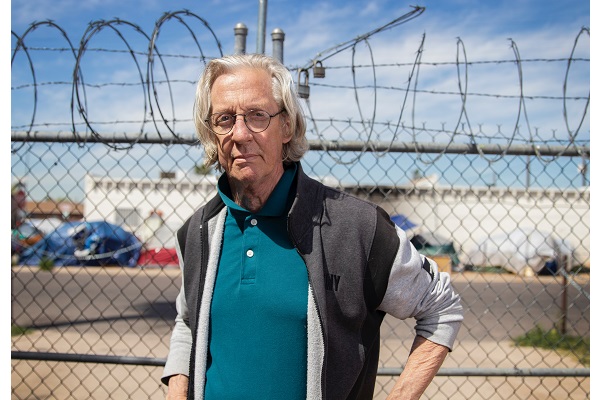
Joel Coplin has his art gallery in The Zone and has witnessed one of the many death that occur there. (Image courtesy of Blake Wilson)
Coplin compared The Zone to one of the seedier boroughs of New York.
“It’s like being in Brownsville, Brooklyn, except there’s no corner store to hang out at, so they all just hang out by their tents,” said Coplin. “I open my door and you can hear them, doing their drugs, playing their music, and having a great time. It’s a beautiful life: free rent, all the drugs you want, all the sex you want — if you have the drugs. The only problem is someone might beat you up for all the drugs.”
About a month ago, Coplin witnessed one of the many deaths that occur in The Zone. A homeless man he’d come to know on a first-name basis, Lamar, was shot and killed. Coplin explained that the homeless have tribe-like groups that fight one another.
Total deaths in The Zone have increased at an exponential rate over the last few years. The Maricopa County Medical Examiner Office reported just over 200 deaths in 2018, a year before the homeless crisis picked up. Last year, there were over 700.
Despite the squalor worsening all around him, Coplin said he’s determined to stick around, hopeful he’ll witness a revival in the area. He and other artists migrated there decades ago because it was affordable: a common backstory for those establishing a historic arts community.
“I want to see it through. I want to see our dream come true and try to put some gas on it. I want these people off the street, in some place better for them so they don’t have to crap on the sidewalk and pour my pee on the plants,” said Coplin.
Corinne Murdock is a reporter for AZ Free News. Follow her latest on Twitter, or email tips to corinne@azfreenews.com.
On Monday, the Maricopa County Superior Court ruled that the city of Phoenix is at fault for the homeless crisis, most evident in the massive encampment downtown known as “The Zone.”
Judge Scott Blaney ruled that city officials had done nothing to improve The Zone, declaring it a public nuisance. Rather, Blaney declared that the city had created and maintained The Zone. Blaney added that the actions undertaken by the city, allegedly to address the homeless crisis, had served only to grow its bureaucracy and throw money into government and nonprofit programs that haven’t yielded any discernible results.
“With few exceptions, the action items about which city representatives testified centered around the creation of more bureaucracy, additional staff positions, and obtaining additional funding for programs to vaguely address homelessness in general,” stated Blaney. “The Court received very little evidence — if any — that the City intends to take immediate, meaningful action to protect its constituent business owners, their employees, and residents from the lawlessness and chaos in the Zone.”
Blaney ordered the city to abate The Zone by permanently removing the encampments in public rights of way; cleaning up the biohazardous materials including human feces and urine, drug paraphernalia, and other trash; and removing individuals committing offenses against the public order. Effectively, the judge ordered the city to enforce existing laws.
The city has until July 10 to achieve material results toward compliance with the court’s ruling.
In the 23-page ruling, Blaney agreed with arguments posed by the plaintiffs, made up of residents and business owners in The Zone: that the city stopped enforcing laws within The Zone, resulting in increased violent crime, property crime, prostitution, public indecency, public drug use, a blocks-long biohazard, fire hazards, and environmental destruction.
Notably, Blaney agreed that the owners of Maker Kitchens had the right to install the dinosaur statues on the right of way adjacent to its building to discourage the homeless from re-establishing their encampments after the city did a cleanup to do gas line work. Blaney ruled that the city had arbitrarily enforced its laws so as to ignore violations by the homeless on that land and yet demand removal of the statues.
Blaney ruled that the city couldn’t force the restaurant to remove the dinosaur statues until it cleaned up The Zone or the court issued a further order.
Blaney ruled that the city had “abused its discretion through the arbitrary application of the law and provision of taxpayer funded security in The Zone.” He also ruled that the residents and business owners who filed the lawsuit had a strong possibility of receiving damages on the basis of irreparable injury, should the city not provide relief by mitigating The Zone.
🦕These mysterious dinosaur statues will likely face extinction after the City of Phoenix and nearby homeless population want them removed from ‘The Zone’. They popped up earlier this week along 9th Ave in the public right of way. More tonight @FOX10Phoenixpic.twitter.com/LxfNRZzpwg
Blaney agreed that city leaders erroneously applied the Ninth Circuit Court of Appeals’ ruling in Martin v. City of Boise, which determined that municipalities couldn’t enforce public camping laws against the homeless when no adequate temporary shelter options existed.
The judge further noted that the city had wholly ignored the residents’ and business owners’ proposals to resolve the homeless crisis, an outdoor shelter space, presented in January 2020 — just before the crisis “really got out of hand.” However, the city ignored all proposed plans to mitigate the crisis until one month before the plaintiffs filed their lawsuit, last October. That’s when the city approved the construction of a “sprung structure” containing 200 additional shelter beds.
Yet, Blaney stated that the city’s proposed shelter options were either designed as temporary, being seasonal, or as speciality situations, being intended for domestic violence survivors or COVID-19 response.
At one point in his ruling, Blaney surmised that violent, organized crime had taken root in The Zone. AZ Free News reported that gangs run The Zone, assaulting and charging encampment space rent to the homeless.
“The evidence also strongly suggests that the City created and maintained the dire situation that currently exists in The Zone through its failure, and in some cases refusal, to enforce criminal and quality of life laws in The Zone,” said Blaney. “The City’s refusal to meaningfully enforce statutes and ordinances in The Zone has created a classic ‘siren song’ to certain individuals that are enticed at their peril by The Zone’s drugs, sex, and lack of societal rules.”
The court’s ruling comes days after the city promised it would arrange some kind of meeting on the issue at some point following back-to-back murders in The Zone.
Corinne Murdock is a reporter for AZ Free News. Follow her latest on Twitter, or email tips to corinne@azfreenews.com.