by Staff Reporter | Dec 13, 2025 | News
By Staff Reporter |
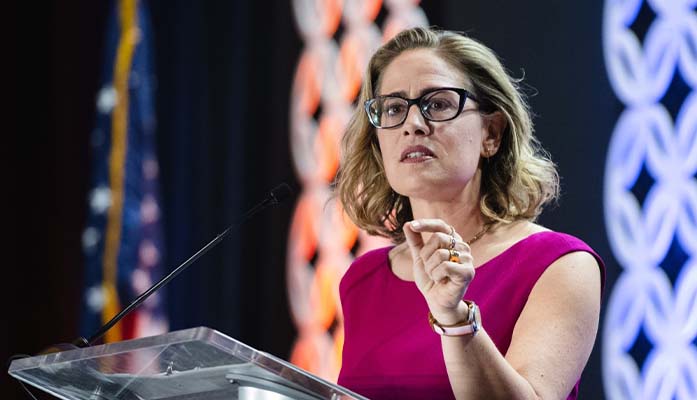
Former Senator Kyrsten Sinema claims she’s not a lobbyist, but her emails tell a different story.
Emails uncovered by FOIAzona revealed Sinema’s lobbying for a major new AI data center in Chandler.
When Sinema joined Hogan Lovells, global law and lobbying firm, as senior counsel back in March, she told reporters she wasn’t registering as a lobbyist. Sinema is also an advisory council member for Coinbase Global, a cryptocurrency company; and president and CEO of Arizona Business Roundtable.
Federal law requiring a “cooling off” period for former representatives and senators doesn’t apply to lobbying at local levels — only lobbying in Congress.
The federal lobbyist system doesn’t have Sinema registered. However it does have the registration of Hogan Lovell’s policy advisor: her former congressional aide, Daniel Winkler.
Emails revealed that Sinema met with Chandler council members in mid-June to discuss the data center. Following that meeting, Sinema used her Hogan Lovells email to push plan proposals for the data center to six city officials: a development agreement and a white paper advocating for AI data centers as an economic boon. Her emails to city officials were consistent thereafter.
“Single User – We demo the property and leave the front part open to attract the single use that [City Manager] Micah [Miranda] envisions. We build only the data center and the north building at the same time. R&D buildings along Dobson – We commence construction of these two eastern buildings within 18 months of C of O of data center. This gives Micah the time to attract a single user, but we still will process plans for these two buildings in the meantime to hit the 18 month mark. This leave the middle portion open to still attract a single user and build to suit. Full buildout – We commence spec construction of the middle building within 36 months of C of O of data center. This gives Micah the time to attract a single user, or a middle user but we still will process plans for all the buildings to hit the 36 month mark.”
Councilmember Matt Orlando then met with Sinema and Winkler in early August.
About a week later, Sinema was attempting to get the ear of another member of the council, Jennifer Hawkins.
In the days that followed, Orlando advised the city manager and economic development director that councilmembers were receiving constant communications about AI, and directed the pair to reach out to Sinema for possible development sites.
“We should not only look at the old Northrop Grumman site, but at the airport and other areas of our community for many AI clusters,” said Orlando. “We need to look at the economic model of such complexes. Please get with Kirsten [sic] Sinema, our existing companies and others in the industry and get us some ideas for a truly strategic plan to position our city for the future.”
The city’s economic development director advised in September that there wasn’t “any definitive cause relationship” between AI data centers and the desired location site for companies.
Then came the widely reported day in mid-October when Sinema argued for the data center at the Chandler Planning and Zoning Commission meeting.
It was there that Sinema threatened to use the power of the Trump administration against the city should they not approve the data center.
“[My coalition] works hand-in-glove with the Trump administration as we prepare for AI American dominance,” said Sinema. “We all know that the innovation campus has been vacant for over seven years. What I’d like you to know today is this: if we choose not to move forward with this development, the land will continue to sit vacant until federal preemption occurs.”
Sinema argued on behalf of the data center developer Active Infrastructure. She presented herself as the founder and co-chair of the AI Infrastructure Coalition (AIC), which formally launched with a swanky D.C. party last month.
AIC members include Andreeseen Horowitz, Cisco, ExxonMobil, Google, Lumen, Meta, Microsoft, and Pinnacle West. AIC’s executive director, Brian Walsh, formerly led the Congressional Leadership Fund and America First Action.
The Chandler City Council voted 7-0 against the data center in their meeting on December 11.
AZ Free News is your #1 source for Arizona news and politics. You can send us news tips using this link.
by AZ Free Enterprise Club | Oct 15, 2025 | Opinion
By the Arizona Free Enterprise Club |
What’s most likely to get your local officials fired up to fight for you? Lower utility rates? Wrong. Removing sexually explicit material from our libraries? Nope. How about just filling potholes in our roads? You’d think so. But what really gets the local officials in Chandler going is making sure they can sit on city council or as mayor longer.
Proposition 410, a local ballot measure, seeks to amend the city charter’s term limit section to extend the term for how long councilmembers and the mayor can serve. The measure is particularly problematic because it directly benefits a sitting councilmember, Matt Orlando, allowing him to run for mayor in 2026 without interruption after finishing his second consecutive council term. This proposition is not about reigning in political power; it’s about conveniently clearing the path for one councilmember to extend his political career. If it doesn’t pass in November, Orlando will face issues being elected mayor after his stint on the council, and clearly, he can’t have that.
The current city charter provision essentially says that one person can serve no more than two consecutive terms as councilmember, mayor, or a combination of both, and must wait four years before running again for either office. Therefore, someone can only serve two consecutive terms total.
However, some argue this language is ambiguous, allowing for another interpretation, one that allows a person to serve up to sixteen consecutive years: eight as a councilmember and eight as mayor. This interpretation has been the practice in Chandler for the past three mayors. Kevin Hartke, Boyd Dunn, and Jay Tibshraeny each served eight years as councilmembers and eight years as mayor – sixteen consecutive years.
The proposed language change on the ballot effectively attempts to legitimize the last three mayors by expanding the term limits in the city’s charter. It now states that a person can serve up to two consecutive terms as councilmember and two consecutive terms as mayor, sixteen years total. After reaching either limit, or a combined sixteen consecutive years in both offices, they must wait four years before running again for either position.
Why the rush for a change?
>>> CONTINUE READING >>>
by Charlotte Golla | Oct 10, 2025 | Opinion
By Charlotte Golla |
Chandler, Arizona, has a special election coming up on November 4, 2025. If you’re a resident, keep an eye on your mailbox. Ballots were mailed to voters on Wednesday, October 8, 2025.
One matter on this year’s special election ballot seems rather innocuous—Proposition 410—Charter Amendment Clarification of Term Limits for Councilmembers and Mayor.
At first glance, this appears to be a simple clarification of murky language in an outdated city charter. The current city charter states: “No person shall be eligible to be elected to the office of councilmember for more than two consecutive terms, or to the office of mayor for more than two consecutive terms or to more than a consecutive combination of the same.”
Simply put, candidates can hold office for two consecutive terms and then must sit out four years before running again. This language, however, poses a major problem. The past three Chandler mayors all served 8 years (two terms) on city council and then served 8 years (two terms) as mayor. This is in violation of the charter as it is currently written.
This all came to light in May of this year. Matt Orlando, a current 2-term Chandler city councilmember who filed a statement of interest to run for mayor in 2026, was quoted as saying, “It’s all how we interpret the charter – Bottom line is this: there is some clarity that is needed to fix the charter language.”
There was some debate at the subsequent city council meetings about whether this should be fast tracked to the November 4th special election ballot or tabled for community discussion and then voted on in 2026. The council ultimately voted 6-1 in favor of clarifying the charter language to, in essence, EXTEND the term limits from 8 years in office at city level to 16 years in office at city level. As currently written, an individual could not run for mayor after two terms on city council without a legitimate legal challenge.
This all sounds pretty boring, right? I certainly thought so. The last three Chandler mayors all served 16 years—8 on council and 8 as mayor. And Chandler is one of the best run, most financially solvent cities in Arizona. So, who cares?
Then I started seeing the signs—VOTE YES ON PROP 410 – KEEP CHANDLER TERM LIMITS (emphasis added).
Wait…am I confused? Isn’t a yes vote intended to get rid of the current term limits and extend them to 16 consecutive years at city level—8 on council and 8 as mayor?
After seeing the signs, I went home and did some research. And I was right. A yes vote most certainly does NOT keep term limits as written. It extends them. So, then I made some phone calls, specifically asking if it is legal to lie on campaign signs. And guess what? IT IS LEGAL TO LIE ON CAMPAIGN SIGNS. Whoa. I just went from a whole level of not caring to being very perturbed.
Why the lies? What is going on? And who is behind the YES ON PROP 410 campaign? If we are being outright lied to on campaign signs up all over the city, these are questions we should be asking. And I am asking them.
I’m not sure who is behind it, but I do know that Councilmember Matt Orlando, who plans to run for mayor in 2026, has made it clear that he fully endorses the Yes on 410 messaging. And interestingly enough, he would be the one who would benefit the most from its passage.
Do we really want a city leader who knowingly misleads his constituents for personal gain?
I know I don’t.
Charlotte Golla is Chandler resident of 20 years, wife and mother of four children, fundraising consultant, and concerned citizen.
by Staff Reporter | Sep 25, 2025 | News
By Staff Reporter |
New campaign signs appearing in the Chandler area are claiming a ballot amendment would keep term limits — but it actually rolls them back.
The signs advocate for the passage of Proposition 410 this November with phrasing that includes “Keep Term Limits.” In reality, the passage of Proposition 410 would amend the city of Chandler’s charter to expand term limits.
Under the proposition, individuals may serve 16 consecutive years — eight years as a council member, eight years as the mayor — before triggering a four-year waiting period.
The proposition seeks to clear away confusion resulting from myriad interpretations of current term limits within the city charter, namely one interpretation which declares that the present charter’s provision for two consecutive term limits on the council applies to the council members and the mayor together.
Additionally, the proposition clarifies that individuals elected to be mayor or elected to the council would be limited to two consecutive terms with a waiting period of four years after those terms. Again, nonconsecutive terms wouldn’t trigger the four-year waiting period.
The four-year waiting period can be waived, however, by the council to fill any vacancies on the council including for the office of the mayor.
The city charter amendment on the November ballot stands to benefit at least one council member: Councilman Matt Orlando, who filed a statement of interest to run for mayor in next year’s election. Orlando is serving his second consecutive term on the council. Under the one interpretation of the current charter, Orlando would not be eligible to run for mayor in 2026.
The council introduced the proposition following challenges to the interpretation of term limits within the current language of the charter, which puts limits on a “consecutive combination” of terms served as mayor and on the council.
“No person shall be eligible to be elected to the office of councilmember for more than two consecutive terms, or to the office of mayor for more than two consecutive terms or to more than a consecutive combination of the same,” states the current charter. “A person elected to two consecutive terms as a councilmember or two consecutive terms as mayor or a combination of the same as above set forth shall not be eligible to hold either office again until four years have elapsed.”
A lawsuit over the current charter language prompted Mayor Kevin Hartke to cease his 2026 campaign for a council seat.
“The City Council desires to propose amendments to the City Charter to clarify certain ambiguities in the Charter regarding the term limits for councilmembers and mayor,” stated the resolution passed earlier this year.
Hartke faced a lawsuit from a former opponent, Ruth Jones, who ran against him in 2022. Jones contended in her lawsuit, filed in May, that the city charter’s term limits invalidated Hartke’s election in 2022. Hartke served on the city council for nine years, twice as vice mayor. Under the one interpretation mentioned above, Hartke would not have qualified to serve as mayor.
AZ Free News is your #1 source for Arizona news and politics. You can send us news tips using this link.
by Matthew Holloway | Sep 8, 2025 | News
By Matthew Holloway |
The Chandler City Council has placed an amendment to the city charter on the November ballot, which, if enacted, would directly benefit at least one member of the Council: Councilmember Matt Orlando. The proposed amendment would roll back term limits, allowing Orlando to run for Mayor in 2026 and opening the door to future campaigns from Councilmembers OD Harris and Christine Ellis as well.
The proposal, Prop. 410, would amend the current term limit provision in the Chandler city charter, affecting the offices of council members and mayor.
Under the existing provision, current Mayor Kevin Hartke opted to abandon his plans to run for city council in 2026 after an examination of the provision led to a lawsuit that could have unseated him. The term limits could also bar Councilmembers Matt Orlando, OD Harris, and Christine Ellis from running for Mayor in 2026.
As reported by the Arizona Republic, the push to amend the city’s term limits comes from the uncertainty of the existing city charter language, which presently limits the mayor and council to one term in each role or a total of two consecutive terms. Mayor Hartke has served in office for a total of 16 years, leading to a legal challenge to his 2022 election. Before Hartke’s term, two prior mayors, Boyd Dunn and Jay Tibshraeny, also served 16 years consecutively as councilmembers and mayor.
Dunn told the outlet, “This has been the language essentially that, or at least a concept, that the city has worked with for over 40 years. There’s been no controversy, no questions, and really, a clear operation over decades.”
The existing provision of the city charter states:
“Limitation of terms. No person shall be eligible to be elected to the office of councilmember for more than two (2) consecutive terms, or to the office of mayor for more than two (2) consecutive terms or to more than a consecutive combination of same. A person elected to two (2) consecutive terms as a councilmember or two (2) consecutive terms as mayor or a combination of same as above set forth shall not be eligible to hold either office again until four (4) years have elapsed.”
According to the City of Chandler’s website, the proposed amendment to the charter in Prop. 410 would update Article II, Section 2.01 in the following ways:
- “No person shall be eligible to be elected to the office of councilmember for more than two (2) consecutive terms. A person who is elected to two (2) consecutive terms as a councilmember shall not be eligible to hold the office of councilmember again until four (4) years have elapsed since the end of the last term served as a councilmember, except as provided in subsection 2.06(c).
- No person shall be eligible to be elected to the office of mayor for more than two (2) consecutive terms. A person who is elected to two (2) consecutive terms as mayor shall not be eligible to hold the office of mayor again until four (4) years have elapsed since the end of the last term served as mayor, except as provided in subsection 2.06(c).
- No person shall be eligible to be elected to the office of councilmember or mayor after serving sixteen (16) consecutive years of combined service in those offices until four (4) years have elapsed since the end of the last term served, except as provided in subsection 2.06(c).
- No person who has served two (2) four-year terms as councilmember followed by a break in service of two years or less and two (2) four-year terms as mayor shall be eligible to hold the office of mayor or councilmember until at least four (4) years have elapsed since the end of the last term served, except as provided in subsection 2.06(c).
- Councilmembers who resign for any reason other than to run for mayor as required under State Law and this Charter and mayors who resign shall not be eligible for re-election or appointment until the second succeeding city election following the date of tender of their written resignation except as provided in subsection 2.06 (c).
- Elected or appointed terms of less than four (4) years as councilmember or mayor shall not be counted in the above time limitations.”
As reported by Axios Phoenix, Orlando’s campaign appears to hinge on the outcome of the special election. If the new language is approved, a potential challenge to his candidacy would be eliminated. Under the existing Charter provision, he will undoubtedly be exposed to legal action.
Matthew Holloway is a senior reporter for AZ Free News. Follow him on X for his latest stories, or email tips to Matthew@azfreenews.com.