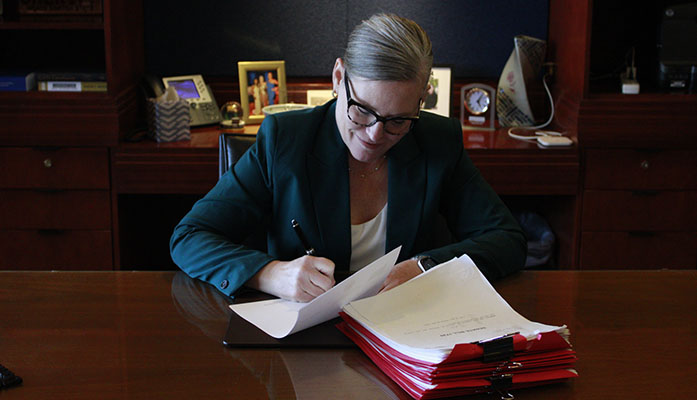
Governor Katie Hobbs, who bedecked the Ninth Floor of the Arizona Executive Tower with the Progress Pride Flag to mark Pride Month, has chosen to also mark the month by vetoing SB 1511. The bill would have required fair treatment for one of the most marginalized groups of all: those who suffer from gender transitions and now seek to reverse the damage, known as ‘de-transitioners.’
Arizona Senator and Vice Chair of the Senate Health and Human Services Committee Janae Shamp (R-Surprise) proposed the “Detransitioner Bill of Rights” in February, which would guarantee an equality of care and medical coverage for those seeking to reverse so-called ‘gender affirming’ care. On February 22, it was passed by the Senate, and on June 12 was sent to Hobbs after passage in the House. The governor issued her veto six days later with the comment: “This bill is unnecessary and would create a privacy risk for patients,” and no further explanation.
According to Greg Scott, the Vice President of Policy at the Center for Arizona Policy, the bill was a “simple ‘good faith’ bill that levels the health care playing field for a vulnerable population of Arizonans and takes the politics out of medicine and insurance coverage.” In an Op-Ed for the AZ Capitol Times, Scott added, “The purpose of SB 1511 is not to pronounce judgment about the merits or the dangers of gender transition. And it doesn’t. Rather, it does what a law is supposed to do – solve a real problem affecting real people.”
Responding to the veto from Hobbs, Sen. Shamp wrote in a press release, “If doctors are going to block the natural puberty process of children and surgically alter the genitalia of people struggling with gender dysphoria, they must be prepared to undo the damage – as much as possible.”
“And if insurers are going to pay for gender-altering drugs and surgeries, they must also pay for any effort to regain the victim’s God-given identity. My heart goes out to the growing number of people, especially children, who are struggling with their identity and are being pushed into physically altering their bodies as a solution, instead of receiving the mental healthcare they deserve. Shame on Governor Hobbs for sending a message that the institutions tasked with protecting their health and wellbeing have turned their backs on them.”
🚨 FOR IMMEDIATE RELEASE: Hobbs Marks "Pride Month" by Denying Necessary Medical Treatment for Growing Number of Detransitioners
Shamp added, “I’m fighting for equal treatment for people like Chloe Cole, who traveled to the Capitol from out of state to share her heartbreaking experience of the irreversible damage and regret from attempting to transition into the opposite sex,” said Senator Shamp. “As a child who was confused with her gender identity, she was given puberty blockers and underwent a double mastectomy. She has since detransitioned and struggles with the severe damage left behind. It’s unfathomable that we consider mutilating an undeveloped child’s body as “healthcare,” but what’s even more horrifying is the fact that we deny them access to care when they go on to suffer the mental and physical consequences.”
WATCH:
Speaking to a press conference on February 1, Cole told reporters, “Everything that I went through did nothing to address the underlying mental health issues I had. My doctors, with their gender theories, thought all my troubles would go away as soon as I was transformed into something that vaguely resembled a boy. Their theories were wrong. I now have two giant scars across my chest that remind me every day that I was butchered by the institutions that we all thought we could trust. The drugs and surgeries changed my body, but they did not and could not change the undeniable reality that I am, and forever will be, a female.”
According to the release, SB 1511 would have “required insurers and providers of gender-altering drugs and surgeries to also provide and cover detransition procedures. This bill would have held health care providers and insurance companies accountable for the damage they cause by prescribing off-label drugs and experimenting on children and adults with irreversible surgeries.”
When asked by AZ Free News if she intends to reintroduce SB 1511 or another bill like it, Shamp said, “Absolutely. This legislation will continue until there is coverage for detransitioners.”
“Will it be run again?” she continued. “Absolutely. It might actually get more robust to include more informed consent with patients who are transitioning. Patients need to know that insurance companies will not cover detransition.”
On its last day of the term, the U.S. Supreme Court gave a major victory for the First Amendment, leading to mixed reactions from Arizona elected officials and advocates.
In a 6-3 opinion authored by Justice Neil Gorsuch, the U.S. Supreme Court ruled for 303 Creative LLC in the case 303 Creative LLC v. Elenis. The case centered on a Colorado businesswoman, Ms. Lorie Smith, who “filed a lawsuit seeking an injunction to prevent the State from forcing her to create websites celebrating marriages that defy her belief that marriage should be reserved to unions between one man and one woman.” The majority coalition in the Court held that “the First Amendment prohibits Colorado from forcing a website designer to create expressive designs speaking messages with which the designer disagrees.”
As part of his prevailing opinion, Justice Gorsuch wrote, “But, as this Court has long held, the opportunity to think for ourselves and to express those thoughts freely is among our most cherished liberties and part of what keeps our Republic strong. Of course, abiding the Constitution’s commitment to the freedom of speech means all of us will encounter ideas we consider ‘unattractive,’ post, at 38 (opinion of SOTOMAYOR, J.), ‘misguided, or even hurtful,’ Hurley, 515 U. S., at 574. But tolerance, not coercion, is our Nation’s answer. The First Amendment envisions the United States as a rich and complex place where all persons are free to think and speak as they wish, not as the government demands. Because Colorado seeks to deny that promise, the judgment is reversed.”
The opinion sparked applause and outrage across the country – especially in Arizona. Center for Arizona Policy, one of the state’s influential pro-life and pro-family organizations, released a statement to cheer on the decision from the six justices in the majority, writing, “The ruling is a huge victory for those who do not want government telling them what to say or what messages they must create. That goes for the liberal publisher who does not want to publish a book with conservative views, as well as for the religious website designer who does not want to promote weddings that violate her religious beliefs. Today’s ruling in 303 Creative LLC v. Elenis acknowledges the difference between disagreement and discrimination by distinguishing between serving all people and promoting all messages. Lorie Smith happily designs websites for all customers but cannot create messages that run counter to her deeply held beliefs. Her decision is based on the message, not the person. Today, the Court affirms that difference.”
Democrat Attorney General Kris Mayes took the opposite view, saying, “Today, a woefully misguided majority of the United States Supreme Court has decided that businesses open to the public may, in certain circumstances, discriminate against LGBTQ+ Americans. While my office is still reviewing the decision to determine its effects, I agree with Justice Sotomayor – the idea that the Constitution gives businesses the right to discriminate is ‘profoundly wrong.’”
Mayes added that “Despite today’s ruling, Arizona law prohibits discrimination in places of public accommodation, including discrimination because of sexual orientation and gender identity. If any Arizonan believes that they have been the victim of discrimination on the basis of race, color, religion, sex (including sexual orientation and gender identity), national origin, or ancestry in a place of public accommodation, they should file a complaint with my office. I will continue to enforce Arizona’s public accommodation law to its fullest extent.”
The Arizona House Democrats Caucus also weighed in on the decision, tweeting, “This is not about weddings. This is about creating a religious right to discriminate against protected classes across a broad front of services, taking our country back to Jim Crow. And using a fake case to do it. Shameful.”
Republican Representative Travis Grantham, the Arizona House Speaker Pro Tempore, responded to the Democrats’ attack: “And the award for dumbest take ever goes to……”
The Arizona Attorney General’s position on the case’s outcome is a complete reversal of her predecessor’s, who, in 2022, co-led a coalition of states in filing an amicus brief, which urged the nation’s high court “to defend the First Amendment rights of business owners.” At that time, Mark Brnovich said, “Owners of small companies do not give up their constitutional rights as a cost of doing business. Freedoms of speech, belief, and expression are at the core of who we are as Americans, and our government is out of line to infringe on them.”
ICYMI: Our office co-led a coalition, urging the U.S. Supreme Court to defend the 1A rights of business owners.
Freedoms of speech, belief, and expression are at the core of who we are as Americans, and our government is out of line to infringe on them. https://t.co/1PTOi9oEb5
Gov. Katie Hobbs exercised her executive authority to take the enforcement of abortion law into her own hands.
On Friday — almost one year to the day that the Supreme Court overturned Roe v. Wade via Dobbs v. Jackson Women’s Health Organization — Hobbs issued an executive order rescinding county attorneys’ authority to prosecute in abortion-related cases, instead granting sole authority to Attorney General Kris Mayes. In a statement, Hobbs characterized abortion as a “fundamental right.”
“I signed an Executive Order protecting Arizonans’ reproductive freedom,” said Hobbs. “I will not allow extreme and out of touch politicians to get in the way of the fundamental rights of Arizonans.”
I signed an Executive Order protecting Arizonans’ reproductive freedom. I will not allow extreme and out of touch politicians to get in the way of the fundamental rights of Arizonans. My Executive Order does four things to the full extent of my authority: pic.twitter.com/2digbGB6EM
— Governor Katie Hobbs (@GovernorHobbs) June 23, 2023
In addition to strengthening control over abortion prosecutions, Hobbs’ executive order directed state agencies to not assist in investigations relating to those who provide, assist, seek, or obtain abortions; banned compliance with other states’ extradition requests for those who provided, assisted, sought, or received an abortion where illegal; and established an advisory council to formulate strategy on expanding abortion access.
The executive order declared that abortion restrictions and bans were inimical to equity for those who get the most abortions: non-white, disabled, and poor individuals. The order also declared abortion as a form of freedom.
“[L]imitations on access to reproductive healthcare disproportionately impact people of color, people who live in rural and tribal communities, people with low incomes, and people with disabilities,” stated the order.
In addition to abortions, the Governor’s Advisory Council on Protecting Reproductive Freedom will be charged with expanding access and implementing equitable solutions concerning sexual and reproductive health care resources. Hobbs will appoint the council chair and members. The executive order noted that the council would “reflect the diversity” of Arizona to include indigenous, rural, and LGBTQ+ members.
Planned Parenthood, an abortion provider which also offers sexual and reproductive health care items, expanded their resources over the past year to include gender transition drugs like puberty blockers and hormone replacement therapy.
Pro-life groups challenged Hobbs’ statutory authority behind the executive order immediately.
In a press release, Center for Arizona Policy claimed that state law only allows for the attorney general to aid county attorneys in their duties — not replace them.
“Arizona law, A.R.S. 41-101, Section 8 states that the governor ‘may require the attorney general to aid a county attorney in the discharge of his duties.’ Aid does not mean supplant or replace. In her zeal for abortion, Gov. Hobs has exceeded her authority as governor,” stated Herrod. “The law does not allow her to strip county attorneys of their clear enforcement authority as granted in various Arizona laws.”
Hobbs preceded the executive order with an announcement of support for the Arizona Right to Contraception Act on Thursday.
Reproductive freedoms are under threat. That’s why I was proud to join Rep. @AthenaSalman to announce my support for the Arizona Right to Contraception Act, which will ensure all Arizonans have the right to access birth control. I will never back down in the fight to protect our… pic.twitter.com/5TuG6C2icG
— Governor Katie Hobbs (@GovernorHobbs) June 22, 2023
Arizona law currently bans abortion after 15 weeks’ gestation.
Corinne Murdock is a reporter for AZ Free News. Follow her latest on Twitter, or email tips to corinne@azfreenews.com.
The pro-life group Center for Arizona Policy (CAP) has asked the Arizona Supreme Court to reverse a lower court ruling nullifying the state’s total abortion ban.
The Arizona Court of Appeals ruled in December that, because the state legislature hadn’t attempted to eliminate elective abortions following and in spite of the Roe v. Wade ruling, the state legislature wouldn’t currently support the long-dormant ban.
CAP submitted their amicus brief in the case Planned Parenthood Arizona v. Mayes on Monday. In the brief, CAP pointed out that the decades-old injunction preventing the enforcement of the state’s abortion ban was contingent on the authority of Roe as law of the land. CAP also noted that most states with abortion bans following the Roe ruling repealed their bans, yet Arizona didn’t over the last 50 years.
“Recall that the legislature had two choices under Roe: allow the abortion free-for-all that Roe created or seek to limit abortion,” wrote CAP. “Eliminating elective abortion was not an option; Arizona’s law doing precisely that was already enjoined.”
CAP argued that the legislature had expressed legislative intent to protect unborn children at all stages of gestation on multiple occasions. The organization noted that Arizona had also attempted in 2012, unsuccessfully, to prohibit most abortions after 20 weeks gestation. CAP also noted that the state legislature enacted a statute in 2021 to direct all provisions of Arizona law to “be interpreted to acknowledge the equal rights of the unborn.”
CAP pointed to the language of the bill enacted last year allowing abortions to occur up to 15 weeks’ gestation, SB1164.
“[W]ith the potential overturning of Roe on the horizon, the legislature sought to avoid any doubt that it desired § 13-3603 [the abortion ban] to become fully enforceable again,” stated CAP. “Thus, S.B. 1164 went beyond simply saying that it was not repealing any ‘applicable state law regulating or restricting abortion.’ 2022 Ariz. Sess. Laws ch. 105, § 2 (2d Reg. Sess.). Its statement of non-repeal also referenced one law specifically—§ 13-3603.”
CAP estimated that about 13,000 unborn children were killed through abortion due to the lower court’s ruling, which upheld SB1164.
“Put simply, both the legislature and various abortion supporters believed that if Roe were overturned, § 13-3603 would prohibit physicians from performing elective abortions from conception. If the legislature did not desire that outcome, it would have acted to prevent it,” said CAP. “It did not. To the contrary, the legislature declared its intent to preserve § 13-3603 even after being told that it would prohibit all elective abortions if Roe were overturned. That intent must be given effect.”
In a press release, CAP argued further that the overturning of Roe should’ve restored the state’s dormant abortion ban. CAP said the lower court ruling “wrongly assumed” that post-Roe state lawmakers that passed limitations on abortion in accordance with the Supreme Court (SCOTUS) precedent didn’t intend to protect the pre-Roe ban.
“State lawmakers passed dozens of laws protecting life while Roe forbade them from going further; they kept the pre-Roe law on the books, even as they made other adjustments to the law; they passed a requirement that Arizona laws be interpreted to value all human life, at every stage of development; and they wrote into the latest abortion law a recommitment to protect life by specifically stating that they were not repealing the pre-Roe law by passing a 15-week limitation just months before Roe was overturned,” stated CAP.
Corinne Murdock is a reporter for AZ Free News. Follow her latest on Twitter, or email tips to corinne@azfreenews.com.
In this past November’s election, Arizona voters were misled into passing Prop 211. Billed as the “Voters’ Right to Know Act” that’s supposed to “Stop Dark Money” in our state, it sounds harmless enough. But that was all a part of the clever messaging from its campaigners—like former Arizona Attorney General Terry Goddard—to scare the average person into voting “yes.”
Unfortunately, it worked. But Prop 211 is unconstitutional, and that’s why the Arizona Free Enterprise Club, in partnership with the Center for Arizona Policy and the Goldwater Institute, filed a lawsuit to stop the Act from being enforced…