Lawmakers Launch Investigation Into Alleged Censorship At ASU
By Corinne Murdock |
On Tuesday, a joint committee of the Arizona legislature launched an investigation into allegations of censorship at Arizona State University (ASU). Lawmakers issued a 60-day deadline to conduct the investigation.
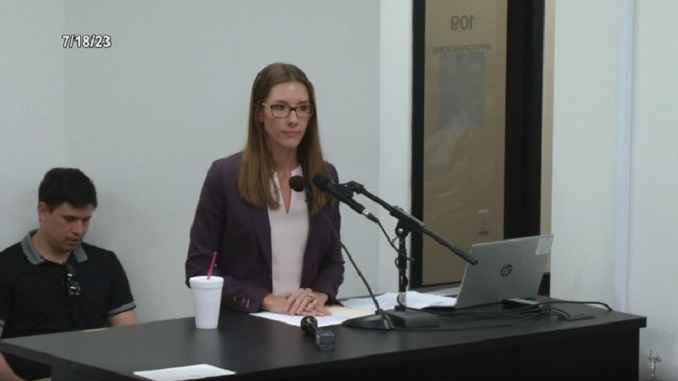
The directive arose from the Joint Legislative Ad Hoc Committee on Freedom of Expression at Arizona’s Public Universities hearing concerning the T.W. Lewis Center, shuttered this year after the revocation of $400,000 in annual funding from its namesake, Tom Lewis, who cited “left-wing hostility and activism” as his reason for defunding the program.
Lewis’ contention arose from the efforts of 37 Barrett Honors College faculty members, who launched a coordinated campaign to prevent an event featuring prominent conservative speakers Dennis Prager and Charlie Kirk. Prager testified at Tuesday’s hearing; he also published an opinion piece on the event ahead of the hearing.
State Sens. Anthony Kern, co-chair (R-LD27), Frank Carroll (R-LD28), Sally Ann Gonzales (D-LD20), Christine Marsh (D-LD04), and J.D. Mesnard (R-LD13) served on the committee, as did State Reps. Quang Nguyen (R-LD01), Lorena Austin (D-LD09), Analise Ortiz (D-LD24), Beverly Pingerelli (R-LD28), and Austin Smith (R-LD29). Kern and Nguyen served as co-chairs.
“This is to get to the bottom of a state-funded university that is not meeting its obligation to freedom of expression and freedom of speech,” said Kern.
The center relied on an annual budget of around $1 million; ASU representatives explained that the center would live on through the classes taught, though the actual center itself and the executive director at its helm, Ann Atkinson, would be gone.
ASU Vice President of Legal Affairs Kim Demarchi explained that Lewis’ funding provided for career development and education. Demarchi testified that ASU considered what programs it could continue without Lewis’ funding, and declared that they could only sustain the faculty without Lewis’ funding. Demarchi also shared that the Barrett Honors faculty weren’t punished in any way for the letter or allegations of intimidation.
“It is possible it [their letter] has a chilling effect,” said Demarchi.
However, Demarchi clarified that a professor would have to explicitly threaten a student’s grade in order to be in violation of university policy.
Atkinson went public with the closure of the Lewis Center last month. (See the response from ASU). She told AZ Free News that the university turned down alternative funding sources that would make up for the loss of Lewis’ funding necessary to keep the Lewis Center running.
Nguyen opened up the hearing by recounting his survival of Vietnam’s communist regime as a child, and comparing that regime’s hostility to free speech to the actions of Barrett Honors College faculty.
“My understanding is that there is an effort to prevent conservative voices from being heard,” said Nguyen. “I crossed 12,000 miles to look for freedom, to seek freedom.”
Nguyen expressed disappointment that none of the 37 faculty members that signed onto the letter showed up to testify in the hearing. He said if he accused someone, he would show up to testify.
Democratic members of the committee contended that the event occurred and therefore censorship hadn’t taken place. Kern said the occurrence of the event doesn’t resolve whether freedom of speech was truly permitted, citing the closure of the Lewis Center.
ASU Executive Vice Provost Pat Kenney emphasized the importance of freedom of expression as critical to a free nation. Nguyen asked whether Kenney read the Barrett letter, and agreed to it. Kenney said the letter was freedom of expression. He claimed the letter didn’t seek cancellation of the event.
“When faculty speak out on their own like that, they’re covered on the same topic we’re here about, which is free speech,” said Kenney.
ASU representatives claimed near the beginning of the hearing that Lewis and ASU President Michael Crow had discussed the withdrawal of funding. However, toward the end of the hearing Kern announced that he’d received information from a Lewis representative that the pair hadn’t discussed the funding, and accused ASU representatives of lying.
Ortiz called the anonymous complaints from students hypotheticals because no formal complaints were lodged. She also claimed that the hearing was merely an attempt to delegitimize public and higher education. Marsh claimed that lawmakers shouldn’t consider the claims of student fears of retaliation because the students should’ve gone to ASU directly.
Nguyen asked whether ASU would defend guest speakers, such as himself, if ASU faculty were to lodge claims of white nationalism. Kenney said that, in a personal capacity, ASU faculty were free to make their claims, but not if they spoke out on ASU’s behalf.
Atkinson contested with the characterization that the Barrett faculty spoke out in their personal capacity. She pointed out that Barrett faculty signed the letter in their capacity as ASU faculty, emailed her using their ASU emails, and sent communications to students about opposing the event using ASU technology.
Ortiz announced receipt of a letter from the Arizona Board of Regents (ABOR) on the outcome of the requested investigation into the incident, the results of which Kern and the rest of the committee appeared to not have been made aware, determining that no free speech violations took place at ASU.
Marsh speculated that the professors didn’t show up because they faced death threats, citing media attention and conservative speaker Charlie Kirk’s Professor Watchlist. Kern said that would be a “lame excuse.” He also pointed out that the professors launched a national campaign and initialized bringing themselves into a bigger spotlight.
“You’re making excuses where we don’t know that’s the case,” said Kern.
Atkinson said that she could provide “dozens, if not hundreds” of students that could testify to experiencing faculty intimidation. She also claimed that Williams told her to avoid booking speakers that were political.
“We allow the speaker but you have to take the consequences,” said Atkinson, reportedly quoting Williams.
Atkinson testified that TV screen ads were removed and flyers were torn down following the Barrett Honors faculty letter. She also said she shared the information for the person responsible on June 13, yet it appears ASU took no action. ASU said they weren’t aware of any advertising for the event pulled.
Additionally, Atkinson testified that Williams pressured her to postpone the event “indefinitely.” She noted that Williams interpreted ASU’s policy of not promoting political campaigns as not allowing political speech at all.
“We were in an environment telling us that this was ‘hate speech,’” said Atkinson.
Atkinson said she was directed by leadership ahead of the event to issue a preliminary warning that the event contained potentially dangerous speech.
Gonzales told Atkinson that hate speech doesn’t qualify as constitutionally protected speech. However, the rules attorney corrected her that the Supreme Court ruled hate speech as protected.
ASU professor Owen Anderson also testified. He said that he’s previously had to get the free speech rights organization Foundation for Individual Rights and Expression (FIR) involved twice due to faculty attempts to suppress free speech. Anderson also said that faculty have attempted to restrict speech by adding anti-racism and DEI to policy on class content and annual reviews of professors.
“Insults abound, but rational dialogue is rare. What we need are administrators that call these faculty to higher conduct,” said Anderson.
In closing, Kern said he doesn’t trust ASU, the University of Arizona, or ABOR. He argued that ABOR hadn’t issued a real investigation and called their report “typical government fluff [and] garbage.” Kern also called for the firing of Barrett Honors College Dean Tara Williams.
Corinne Murdock is a reporter for AZ Free News. Follow her latest on Twitter, or email tips to corinne@azfreenews.com.