by Terri Jo Neff | Jun 27, 2021 | News
By Terri Jo Neff |
When the State House voted Friday to pass HB2898, the K-12 Education budget bill, it marked the end of a grueling process that resulted in passage of a $12.8 billion budget package for Fiscal Year 2022.
A key provision of HB2898 is the establishment of new academic standards for K-12 students in the area of civics. There was also funding for a number of special programs for students and a variety of new rules for school board and school districts.
But much of the debate about the bill centered on whether more money should have been allocated.
Rep. Aaron Lieberman (D-LD28) acknowledged HB2898 includes “a lot of money,” but he argued it was not enough. Lieberman noted 2,000 classrooms across the state do not have assigned, permanent teachers, something he said could be remedied by spending one-fourth of the state’s $2 billion surplus.
“It’s clear now more than ever we need every dollar,” Lieberman said in voting against the bill.
However, Rep. Bret Roberts (R-LD11) questioned why more focus is not on the decisions of school boards who spend the billions of dollars provided each year through federal funding and from the legislature.
“Why are we not asking the school boards why they’re not giving the money that the legislature sends to the school boards to the teachers?” he asked on the floor. “Why are we not holding the school boards responsible for the money that we send them to give to the teachers? When are the teachers going to hold the school boards responsible?”
Rep. Walt Blackman (R-LD6) expressed similar frustration, noting that many of the chamber’s 24 Democrats who were present Friday complained the funding in HB2898 was too low. So they simply voted against the bill.
Blackman acknowledged K-12 funding in the bill “may not be enough” but said those representatives who vote green -yes- are demonstrating they “support education by action.” Which is why he was disturbed to see so many red -no- votes.
Democrats may give myriad reasons for what is wrong in HB2898 or what could be done differently, he said, “but if we are really dedicated to teaching our children K-12, and that is a non-partisan issue, then why do we have red votes?”
“This can’t be an issue where we are upset and we take our marbles and we go home because we don’t have enough marbles to play,” Blackman said, adding that all of the votes should be green because “nothing is perfect.”
The House K-12 Education bill will now be transmitted to the Senate, which last week passed its own education bill. There is now one significant difference between the bills which will need to be reconciled.
That difference involves a major expansion of the state’s Empowerment Scholarship Accounts (ESAs) which is currently available to about 250,000 students. The Senate’s budget bill added two eligibility criteria which would make ESAs an option to 700,000 students, including children from Title 1 schools where at least 40 percent of the families are considered low-income.
However, three Republicans in the House voted against an amendment which would have included the ESA expansion in HB2898. The amendment died without those votes and the three Republicans also voted against a later attempt to insert the failed amendment into the main bill just prior to final voting.
Sen. Paul Boyer (R-LD20) is a teacher and a major supporter of ESA legislation. He took to Twitter after the House vote to express his disappointment with the ESA decision.
“Meanwhile, minority students are 6 to 12 months behind their white counterparts. This defeat of ESAs for Title I students makes sure those same students never leave the school that’s failing them,” Boyer tweeted.
by Terri Jo Neff | Jun 22, 2021 | News
By Terri Jo Neff |
For the last three weeks the Arizona Legislature has spent more time not working on the state budget slated to start July 1 than they have spent working on it. But optimism is rising -particularly within the Republican caucus- that the impasse may be over.
Gov. Doug Ducey warned lawmakers at the end of May that he did not want to see any legislation hit his desk unless it was the 11 bills contained with the budget packet. He even vetoed 22 bills, all of which had Republican supports, to show he was serious.
On Monday, a number of people involved in the budget process signaled that compromises were being worked out to ensure 31 House and 16 Senate “aye” votes will be put forth for all 11 bills, or at least a significant number to get things moving forward.
According to Sen. Vince Leach, the proposed budget compromise provides money for education, public safety, road infrastructure, debt reduction, and “significant tax relief.” The first four of those items have been the key areas of disagreement, while the latter involves both tax cuts and a transition to a flat rate income tax.
Ducey also released a letter of support for a revised budget package which would now provide cities and towns with an 18 percent share of the state’s Urban Revenue Sharing Fund rather than 15 percent. The increased percentage is intended to cover $225 million in revenue municipalities were estimated to lose if Ducey’s proposed flat rate income tax is approved by lawmakers.
The transition to a flat tax would take place over a few years, and would limit the top rate at 4.5 percent, although Arizonans making less than $250,000 would have a rate of 2.5 percent.
Another compromise expected to be introduced would cap the amount of tax cuts next year at $1.3 billion unless certain revenue thresholds are hit. In that case, the tax cuts could go as high was $1.8 billion.
The Arizona Education Association has come out against the tax cuts and the flat tax. However, the Home Builders Association of Central Arizona threw its support behind Ducey’s efforts to reach a compromise on the budget package. According to a statement released Monday by HBACA, the budget “enhances Arizona’s economic environment, provides more resources to keep Arizona growing, and promotes housing affordability.”
The mayors who signed the letter to Ducey are from Avondale, Buckeye, Camp Verde, Chandler, El Mirage, Gila Bend, Gilbert, Glendale, Goodyear, Lake Havasu City, Kingman, Marana, Mesa, Payson, Peoria, Prescott, Sahuarita, Surprise, Winkenburg, Youngstown, and Yuma.
by Terri Jo Neff | Jun 18, 2021 | News
By Terri Jo Neff |
In a very efficient use of 72 hours, the Arizona Legislature finished a special session called by Gov. Doug Ducey to approve a $100 million supplemental appropriation bill which will fund fire suppression and fire mitigation efforts across the state.
“This will help our brave firefighters, at-risk communities and so many Arizonans,” said Ducey, who is expected to sign the HB2001 on Friday. The bill passed with bipartisan support from 24 of 30 senators and 56 of 60 house members.
Much of the funds are earmarked for the Arizona Department of Forestry and Fire Management (DFFM) but millions will also be spent for inmate and non-inmate labor related to work crews from the Arizona Department of Corrections.
The legislation addresses targeted investments toward the labor and equipment needed for wildfire prevention and preparedness, as well as response and recovery operations. Some of the funding is also earmarked for economic assistance for those displaced by fires or post-fire floods.
Only minimal amendments were made to the proposed legislation which had been sent to lawmakers earlier this week with Ducey’s blessing. One amendment changed a job title while another set a $10 million cap for funds to be used as a last resort for private landowners who experience infrastructure damage related to a fire or post-fire flooding.
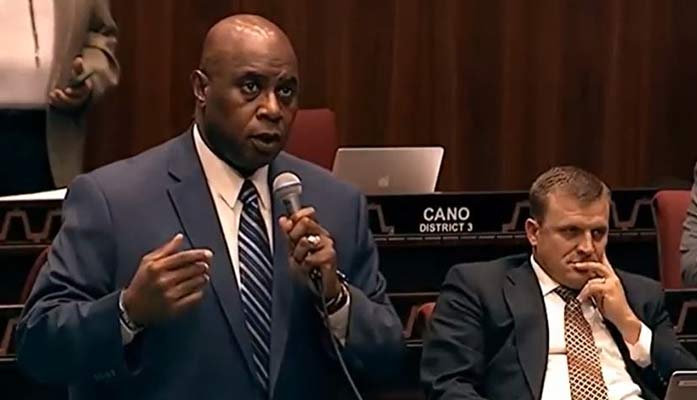
That reference to landowners triggered one of the biggest debates in the House after Rep. Andres Cano (D-LD3) sought to include $5 million dollars of “last resort” funds for small business owners, many of whom may suffer losses from wildfires but do not own the land on which their business operates.
Rep. Gail Griffin, who chairs the House Committee on Natural Resources, Energy, and Water, opposed the amendment even though she understood Cano’s concern. The problem, explained Griffin (R-LD14), is that a lot of effort was put into drafting the special session legislation and any extra items lawmakers want to fund should be addressed once back in regular session.
Cano’s amendment died on a voice vote. But he attempted to add the amendment back on via a motion once the main bill made it to the House floor. Cano’s effort failed, but it triggered a roll call vote by each representative.
It was revealed during the roll call that Rep. Travis Grantham (R-LD12) had been given permission by House Speaker Rusty Bowers to vote via text message because Grantham was in an aircraft at the time. A rules challenge was sustained which forced Bowers to disallow Grantham’s no vote on Cano’s motion. It also meant Grantham was unable to cast a vote for the fire suppression bill.
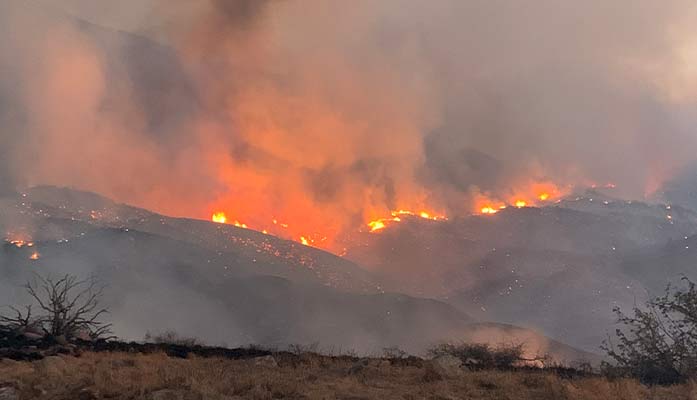
Arizona State Forester David Tenney, who is also DFFM’s director, warned lawmakers during a meeting Wednesday that the destructive Telegraph and Mescal wildfires near Globe are just a glimpse of what is expected to be a severe wildfire season in Arizona. He said last year more than 900,000 acres burned statewide; as of Thursday 300,000 acres have burned in 2021 with months of other fires expected.
One-quarter of the $100 million appropriation will serve a dual role: it will fund several ongoing fire industry positions in addition to 720 ADC inmates who will perform fire fuel or vegetation mitigation at sites throughout the state. Tenney says he hopes the crews can clear 20,000 acres annually.
In addition to Grantham, several lawmakers did not participate in the final vote on the fire bill even though remote “Zoom” voting is allowed. They were Rep. Joseph Chaplik (R-LD23) along with Sens. Lela Alston (D-LD24), Sally Ann Gonzales (D-LD3), Tyler Pace (R-LD25), and Kelly Townsend (R-LD16).
Those who voted against the bill were Sens. Michelle Ugenti-Rita (R-LD23) and Juan Mendez (D-LD26), as well as Reps. Melody Hernandez (D-LD26) and Athena Salman (D-LD26).
Up next for the legislature is trying to pass an 11-bill budget package which had the blessing from Ducey after it was announced Arizona had a nearly $2 billion surplus. The current fiscal year ends June 30 so no new budget would mean a partial state government shutdown.
There has been a stalemate in both chambers related to the three key points of the package: how much to allocate for new spending versus paying down debt, how much of the surplus to refund to taxpayers, and whether or not to transition Arizona to a flat-rate income tax.
To pass any of the 11 bills requires 31 votes in the House and 16 in the Senate. That happens to coincide with the number of Republicans in both chambers, but some members of that caucus have refused at different times to vote for the bills unless changes are made. Everyone is expected back to work Monday in hopes of resolving enough differences to secure the required votes.
Then attention will need to turn to 22 bills which Ducey vetoed when he grew frustrated with the lack of progress on the budget. The House and Senate have reintroduced all 22 bills but have not taken final action to reapprove them. There is also a chance that all or some of the governor’s vetoes could be the subject of a veto override vote.
by Terri Jo Neff | Jun 7, 2021 | News
By Terri Jo Neff |
Don’t count your chickens until they hatch. That age old adage came into play Monday for Speaker of the House Rusty Bowers when he was unable to secure a yes vote one of the 31 House Republicans, leading to the defeat of three budget bills before the speaker called it a day.
The 60-member House is now recessed until Thursday while budget negotiators are expected to regroup and figure out how to get Rep. David Cook on board with 11 budget bills which need to be passed by June 30 to avoid a state government shutdown.
Cook voted with every Democrat in the House, leading to the defeat the HB2899 and HB2900, which included a cornerstone piece of budget legislation to transition Arizona to a flat rate income tax. His no-vote also led to the defeat of HB2907, a vital transportation budget bill. All three votes died on a 30 to 30 vote.
A major concern is how to garner Cook’s support without renewing an earlier rift among nearly a dozen Republicans who last week were demanding major amendments be made to some of the budget bills. Their dissension led to an 11-day recess that only ended Monday when Bowers called everyone back to work.
It is unclear why Cook remained the only member of the House Republican Caucus to not support any of the bills or amendments put forth for vote Monday. And if Cook had a reason, he wasn’t publicly sharing it.
Others, however, had plenty to say about Cook’s votes, including the Arizona Free Enterprise Club (AFEC). In a tweet, the small business groups tweeted “Shame on Rep. David Cook” after he voted with Democrats to protect the Prop 208 tax hike on small business owners.
“If David Cook continues to carry the water for Red4Ed and the Unions, Arizona will remain one of the HIGHEST small business income tax states in the country!” the tweet read.
One longtime lobbyist quipped, “yep, not a good look to seem left of the Lefties.”
Even the Republican Liberty Caucus turned on Cook, stating he helped Democrats “block the tax cuts in the current budget proposal” even though Cook has been open for several weeks about his displeasure with the budget that came to the House and Senate with Gov. Doug Ducey’s blessing.
For AFEC’s president Scot Mussi, the original budget package included some concerning special interest tax incentives, which he described as giveaways benefiting a few select businesses and industries that were unnecessary and unpopular within the Republican majority in the House.
Yet Mussi believed those provisions would be removed via amendments on Monday so that all 31 Republicans would be on board. Instead, every amendment put forth for the three bills considered Monday were defeated, as were the bills themselves.
As Republicans attack Cook’s votes, others like Mussi are hopeful a compromise can be worked out, so that tax cuts and tax relief can get approved. That includes the plan to transition Arizona over three years to a flat rate income tax. And Mussi says don’t believe the arguments that the budget bills are simply designed for the rich, particularly with a flat rate tax plan.
It is important to note, Mussi explained, that the recent passage of Proposition 208 now has Arizona with the ninth highest small business tax rate in the country. And Arizona’s rate is higher than nearby Nevada, Utah, Colorado, New Mexico and Texas.
“The reality is that even after the tax cuts are implemented, high income earners will still be paying nearly twice as much (4.5%) as low and middle income households (2.5%),” he explained to AZ Free News. “Additionally, opponents of the tax plan leave out the fact that much of the tax relief will go to small business owners. This tax cut package makes Arizona competitive again for small business, something opponents to the plan would not like to see happen.”
by Terri Jo Neff | May 25, 2021 | News
By Terri Jo Neff |
Arizona’s forecasted budget surplus of $1.5 to $2 billion means a lot of potential massaging of the $12.8 billion budget spending plan released Monday after months in negotiations with Gov. Doug Ducey.
The surplus also means legislators will be more likely to flex their muscle in hopes of ensuring their constituents and pet projects are covered in the budget, with encouragement from Sen. TJ Shope (R-LD8), who said last week there is “plenty of money if we need to buy people off” to secure votes.
On Monday, Sen. Michelle Ugenti-Rita (R-LD23) tweeted an apparently rhetorical question about the budget plan.
“Instead of having a clean tax cut bill members could vote on, Senate leadership added to the tax bill an increase in unemployment insurance benefits, a 10 year extension of the Angel tax credit (which doesn’t expire for 3 yrs) and a $180M tax credit for low income housing. Why?” she tweeted.
Ugenti-Rita also expressed frustration Monday that some items have been included in various budget bills despite the fact the issue was previously voted down by the legislature. One such example is a storage fee increase for impounded vehicles.
“Funny thing is, a bill with this provision in it died in the Senate the other week,” she tweeted. “Wonder how many more dead bills have been resurrected in the budget..?” She also called out a “level of excessive spending” she cannot support as a fiscal conservative.
Members of the Senate Appropriations Committee will convene at 9 a.m. Tuesday, while their House counterparts are set to meet at 8 a.m. In a strategic move, Senate President Karen Fann appointed Senate Majority Leader Rick Gray (R-LD21) to Appropriations in an effort to blunt any committee opposition from Ugenti-Rita.
As to Shope, he made it known weeks ago his support for the budget would be contingent on funds to widen a dangerous section of Interstate 10 between Casa Grande and Chandler. The result was $50 million earmarked in the budget for Shope’s project.
But while Shope received what he wanted, it is unclear whether Republicans such as Sen. Paul Boyer and Rep. David Cook will have their demands sufficiently met to ensure their budget votes. Boyer (R-LD20) outlined his budget priorities last week, including concerns about Arizona’s debt, Rainy Day Fund, and insufficient funding for the state’s universities.
Cook (R-LD8) is unhappy Ducey and the legislative budget team included the increase in unemployment benefits, although whether the increase ever kicks in next year is contingent on several economic thresholds. While on the House side, Rep. Jake Hoffman (R-LD12) is leading the charge to increase the state’s spending on elections by cutting millions from other projects, including a boost in salary for state employees.
Sen. J.D. Mesnard, a Republican for LD17, has been involved in the budget process, and cautioned his fellow legislators that “a million dollars here or there” of new expenditures “adds up.” Which can put other budget features at risk, including a much-touted plan to transition Arizona to a flat-tax method for income tax.
Republicans only have a two vote majority in each chamber, giving each of the 16 Senators and 31 Representatives within the Republican caucus some leverage in budget negotiations. Normally there may be enough Democrat-friendly priorities built into the budget bills to persuade one or two to cross the aisle, but the size of proposed tax cuts -currently at $3 billion over the next three years- could slam that door shut.