by Terri Jo Neff | May 22, 2021 | News
By Terri Jo Neff |
Four members of the U.S. Congress -including two from Arizona- sent a letter this week to the U.S. Department of Justice (DOJ) criticizing one of its deputies for “unnecessarily” weighing in on the Arizona State Senate’s ongoing audit of Maricopa County’s election process.
Representatives Andy Biggs and Paul Gosar, both Republicans from Arizona, and Reps. Matt Gaetz (R-Florida) and Marjorie Taylor Greene (R-Georgia) call a May 5 letter from DOJ attorney Pamela Karlan to Senate President Karen Fann “an attempt at intimidation, with the goal of convoluting this important audit.”
Fann is one of two state senators who signed a subpoena in January which led to Maricopa County officials being required to turn over election department records, hundreds of voting machines, and the nearly 2.1 million ballots cast by Maricopa County voters in the 2020 General Election. Karlan’s letter suggested either the Senate or the auditors may be in noncompliance with federal law, and that the elections records and the ballots “are at risk of damage or loss.”
According to Biggs, Gaetz, Gosar, and Taylor Greene, many of Karlan’s comments were previously expressed by what the four representatives call “three left-leaning organizations,” suggesting the DOJ is “more concerns with your political fellow-travelers than election integrity.” The May 17 letter signed by the four representatives also told Karlan they are “confident in the integrity” of the ongoing audit which is set to run through the end of June.
“In a constitutional republic, the most important thing you can do is make sure the integrity of our election system is protected, free, transparent, and open,” their letter states.
That letter to Fann is not the first received by the senate president in connection to Karlan’s concerns about the audit. On May 7, the Public Interest Legal Foundation (PILF) sent a letter to Fann urging her to push back on Karlan’s concerns, which PILF President J. Christian Adams and PILF Litigation Counsel Maureen Riordan characterize as threats.
Adams and Riordan told Fann that Karlan “is doing the bidding of, and acting as a surrogate for, the Democratic Party, not as an objective law enforcement official and representative of the U.S. Department of Justice.” They added that Karlan “is engaging in a partisan abuse of power well outside the traditions of the Department as well as the delegation of power under federal statutes and the controlling legal authority governing those statutes.”
PIFL, a 501(c)(3) public interest law firm, urged the Senate President to resist responding to Karlan’s “inappropriate and unjustified letter” and offered to share additional insights into the DOJ’s alleged politically motivated effort if Fann is interested. As of press time Fann had not replied to the PIFL letter, according to the group’s spokesperson.
by Sergio Arellano | May 18, 2021 | Opinion
By Sergio Arellano |
Virtually since it was first announced, the effort by the Arizona State Senate to audit the results of the November general election in Arizona’s largest County has been mocked or vilified by members of the media and assorted partisan figures. There is little doubt that their initial attacks were designed to thwart an audit, and there is little doubt that most of the effort since then has been to discredit the process and its participants to the maximum degree possible. When I talk to political people, there is a consensus that this has been a deliberate sabotage in an effort to discredit any potential findings before they are disclosed. “Convince the voters in advance that the whole thing is a joke, and they won’t believe it if something real is turned up by the audit.” said one to me recently.
The entire state would be well served if everyone would take a deep breath, refrain from turning the effort into a partisan circus, and waited for any findings and supporting evidence.
In the meantime, let’s give credit where credit is due, to Senate President Karen Fann and State Senator Warren Petersen, both of whom continue to make themselves available to a media that is looking to undercut them, while providing reasoned answers in measured tones.
As someone who has dealt with a hostile media, I know how difficult it is to not get sucked into the insults and childish behavior. But that is often a tactic used by reporters who know that their own behavior will not be a part of the story, only the responses to their behavior. So they goad and wait, and too many elected officials fall for it. As a result we have the public spectacle of Republicans firing away at other Republicans in an increasingly personal way, just like the media wants.
Fann and Petersen know when to respond and how, and the points they make are generally fair and on target. The Senate has a responsibility and is acting on that responsibility. Opposition is largely partisan in origin and passionate objections to legitimate concerns come mostly from those who spent years insisting that Congress spends tens of millions of dollars investigating a Russia hoax that they got daily updates on from their MSNBC shows. Fann and Petersen recognize this hypocrisy and have kept focused on the audit itself, the need to do it right, and the importance of getting as many facts gathered as possible before conclusions are reached.
The audit will show that everything was largely done right, or it will show meaningful problems or weaknesses in systems that need to be corrected. Both outcomes are victories for Arizona voters, even though some will claim victory and insist it is a defeat for others. If all was well then that’s obviously good news. If corrections need to be made, then the fact that they were identified and can be fixed for future elections is also good news. We all benefit from a system that strives for perfection and is checked for improvements.
If you want Election Integrity, accurate and legitimate elections, and a process that every voter can largely trust, then you’re on the side of an accurate and professionally done audit that produces verifiable results. I for one, am more than willing to patiently wait for the process to work, and I’d encourage every Arizonan to do the same.
—
Sergio Arellano was born and raised in Tucson, AZ. He joined the Army at the age of 17 and served his country honorably as an Infantryman and Human Resources Specialist for a total of 10 and a half years before retiring from the military due to combat sustained injuries.
Sergio is a founding member of the Arizona International Consortium, the Santa Cruz County Elections Integrity Committee, and the first ever AZGOP Latino Coalition. Sergio is also credited with establishing Arizona’s first ever cultural exchange agreements between the Arizona Republican Party and some of Mexico’s prominent political parties.
by Terri Jo Neff | Apr 25, 2021 | News
By Terri Jo Neff |
Two judges, one from Maricopa County and the other an Associate Justice of the Arizona Supreme Court, agreed Friday that the Senate Audit of Maricopa County’s 2020 General Election can move ahead for now. Both judges also ordered the parties to submit several court filings in the coming days.
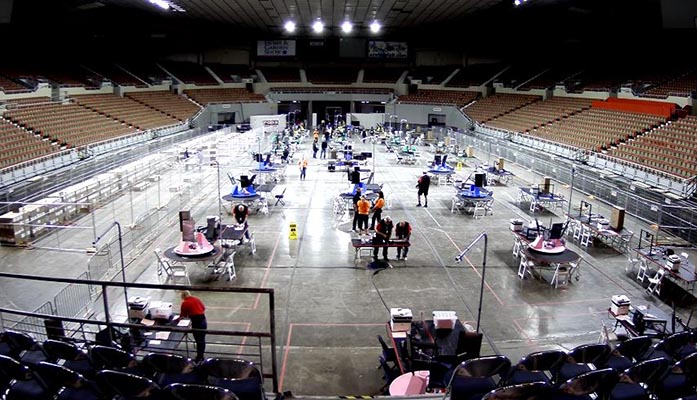
Several hundred of the nearly 2.1 million ballots cast by Maricopa County voters were audited Friday and Saturday. The volunteer counters are looking only at the race for U.S. President and the contest between Mark Kelly and then-Sen. Martha McSally.
For a short time Friday it looked like no audit activities would take place after Judge Christopher Coury of the Maricopa Superior Court agreed to issue a stay requested by the Arizona Democratic Party and Steve Gallardo, the only Democrat on Maricopa County’s five-member Board of Supervisors.
But the stay order was contingent on the plaintiffs posting a $1 million bond in the event they lost their case. AZ Dems chair Raquel Teran announced Friday afternoon that no bond would be posted, meaning the audit can continue unimpeded, for now.
Two other orders issued by Coury are currently in force: that the Senate and its contracted audit team comply with state law and that no blue or black pens can be on the floor of the Veterans Memorial Coliseum where the audit is being conducted.
Coury will be a key player in the audit this coming week, as he ordered the parties back to court Monday morning for an evidentiary hearing on the merits of the lawsuit. The judge set several deadlines for the attorneys, including an order for the audit’s written policies and procedures to be filed by the Senate and general contractor Cyber Ninjas on Sunday.
Teran and Gallardo -who says he joined the lawsuit in his personal capacity as a Maricopa County voter- must decide how far they want to push their allegations about the audit operations, given the fact Senate President Karen Fann and the other defendants have petitioned to the Arizona Supreme Court, which has also ordered a series of legal briefings in the case.
Fann and Sen. Warren Petersen of the Senate Judiciary Committee are named as defendants along with former Arizona Secretary of State Ken Bennett who is serving as the Senate’s audit liaison. The other defendant is Cyber Ninjas, the company Fann contracted with to conduct the audit with help from three subcontractor.
The Senate defendants are represented by Kory Langhofer and Thomas Bastille, who have been involved in several of the election-related lawsuits filed since Nov. 3. Florida-based Cyber Ninjas and its owner Doug Logan have retained Phoenix attorney Alex Kolodin as their Arizona legal counsel.
Another key player is Associate Justice Clink Bolick of the Arizona Supreme Court, who affirmed Coury’s earlier orders during an emergency conference Friday afternoon. Bolick set separate deadlines for the Senate’s challenge to the legality of the lawsuit, with all those filings needing to be in by the end of business April 29.
Participating in the emergency conference with the justice was attorneys for Arizona Secretary of State Katie Hobbs, who has pushed back on Fann’s previous assurances that the Senate’s audit would be “independent” and “transparent.”
Hobbs has pointed to Rep. Mark Finchem’s admitted role with the audit in light of his repeated insistence that President Joe Biden really did not win the popular vote in Arizona, and thus was not entitled to the state’s electoral votes. She also wrote to Attorney General Mark Brnovich with concerns that auditors may not be complying with Arizona’s Elections Procedures Manual (EPM).
For his part, Brnovich was the first prominent Republican to insist after the general election that there was no fraud involved in Biden’s victory. He replied to Hobbs on Friday, suggesting she notify his office when she has “credible facts and not conjecture or politics” for him to investigate.
Another player who could impact next week’s audit operations is First Amendment attorney David Bodney, who warned Fann and Bennett that the audit team’s current refusal to allow journalists to report on audit activities from the main floor of the Veterans Memorial Coliseum.
Bennett, as the audit liaison, is requiring media representatives to sign up for a six-hour shift as an observer. However, observers are prohibited from having cellphones or even pen and paper on the floor.
“Requiring journalists to become active participants in the events on which they seek to report is as unprecedented as it is untenable in a representative democracy,” Bodney wrote. “It also violates the First Amendment, which compels that members of the press be allowed access to report on these public proceedings. “
Bodney also warned that legal action could be forthcoming.
“By making the proceedings accessible to some journalists, you cannot arbitrarily deny access to others or require that others satisfy peculiar conditions not imposed upon those whom you favor,” he wrote. “In the event the audit proceeds while barring the press, we are committed to pursuing all legal remedies we deem appropriate to secure our clients’ rights under the First Amendment,” Bodney said
by Terri Jo Neff | Apr 19, 2021 | News
By Terri Jo Neff |
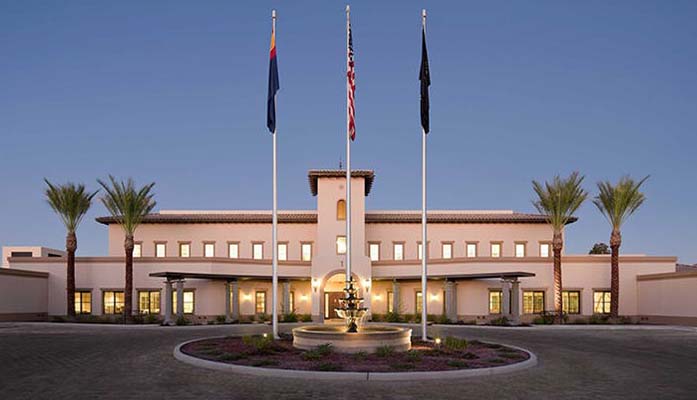
The Arizona Department of Veterans’ Services has reported 16 resident deaths among its two State Veterans’ Homes as of March 14 and has corrective deficiencies which led federal regulators to cite both homes, according to a recently issued Arizona Auditor General performance report.
The audit required by the Joint Legislative Audit Committee provides state officials and lawmakers with detailed information about operational matters with the Veterans’ Homes which provide skilled nursing and rehabilitative care for geriatric and chronically ill veterans and their dependent or surviving spouses.
Currently the Department operates a 200-bed facility in Phoenix and a 120-bed facility in Tucson. In addition, construction is underway on two 80-bed homes in Flagstaff and Yuma which could be ready to admit residents in FY2022.
Among the issues auditors reviewed was compliance with state licensing and federal certification requirements. Both the Phoenix and Tucson homes were cited by federal regulators between 2017 and 2019 for health, safety, and quality-of-care deficiencies, but corrective action was taken in response, according to the April 12 report.
“The Phoenix Home was cited for more (Centers for Medicare & Medicaid Services) health deficiencies and the Tucson Home was cited for fewer CMS health deficiencies than State and national averages,” the report states.
For FY2020, the Homes took in about $40.4 million in revenues and had nearly $37.4 million in expenditures. State law requires the facilities to be financially self-sustaining, so the Department will rely on the Homes’ Trust Fund’s current $30.3 million balance to cover the initial operating costs of the new Veterans’ Homes in Flagstaff and Yuma once those facilities open.
The U.S. Department of Veterans Affairs (VA) provided 65 percent of the construction costs for the new homes.
The audit report also addresses the ongoing discussion about adding new Homes and other long-term care options for Arizona’s veterans, and where such facilities might be located. But auditors noted VA projects Arizona’s veteran population to decline significantly in the next 25 years.
“Arizona’s population of veterans age 65 years and older is projected to decline about 47 percent from approximately 255,000 veterans in 2020 to 136,000 veterans in 2045,” the report notes.
In addition, many veterans and their families are interested in shifting toward more cost-effective, home-based or community-based services rather than centralized nursing homes in large cities.
“Research on long-term care services we reviewed indicates that older people prefer home- and community-based services, including assisted living, more than nursing home care and that nursing home use is gradually declining in the country,” the report states. “The VA has also stated its goal is to keep veterans in their homes, if that is their desire.”
Challenges brought on by the COVID-19 pandemic were also addressed in the audit report, which notes that screening procedures, restricted visitor access, and routine staff testing were implemented at both homes, as were resident vaccination protocols.
In addition to the 16 resident deaths reported, 70 of the 190 residents across the two homes and 97 of 306 staff members were reported to the Arizona Department of Health Services as COVID-19 “cases” as of March 14.
The audit also found 159 residents across the two homes received at least one vaccination dose as of March 26, while only 190 of the 306 staff members had begun the vaccination regime.
by Corinne Murdock | Apr 2, 2021 | News
By Corinne Murdock |
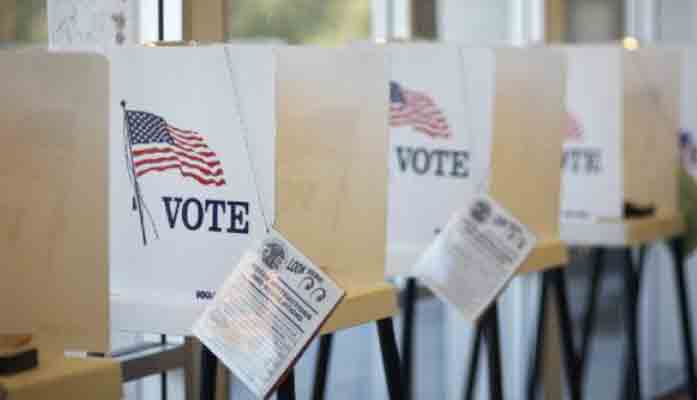
A bill proposing to strengthen election integrity was withdrawn from a Senate committee this week, after passage in the House. It was introduced by State Representative Jake Hoffman (R-Queen Creek).
The bill would have prohibited any government officials from changing election-related dates, on the threat of a class 6 felony. Specifically, no state officers or agents, political subdivisions, or agencies could modify deadlines, filing dates, submission dates, or any other statutory election dates.
Class 6 felonies are the least harsh of all felonies, and may entail a year’s prison time.
The bill passed the House in a close, party-line vote 31-29.
An amendment to the bill would provide an exception to the proposed bill if a court ruling were to come into play. However, it would prohibit election officials from agreeing to modify deadlines and other election-related dates as part of a settlement agreement.
Last year, the state saw a spike of over 52,000 voters added to the rolls after an 18-day extension for voter registration. The initiative was cut short after a federal appeals court ordered the extension to end over a week early. Even with the order, the court allowed citizens a two day grace period to continue registering.
The challenge to the extension largely arose from the additional burdens that such an extension caused to local election officials. The extension would have allowed voters to register up to a little more than one week out from Election Day. In the past, election officials had nearly a month before the election to process registrants.
Currently, the state is pending an audit for the 2020 election. The audit would focus on Maricopa County, where The Senate hired four companies to review around 2.1 million Maricopa County ballots. Last November, the Senate issued subpoenas for all county ballots and voting machines for another audit. A federal judge ruled that the county didn’t have to comply with that request, since the Senate had improperly filed it.
Once the Senate refiled, legislators and county officials engaged in a heated battle over transparency. The judge quickly ruled on the side of the Senate.
It is unclear the reason for the bill’s withdrawal. Following the 2020 election, Hoffman was banned from Twitter and Facebook.
Corinne Murdock is a contributing reporter for AZ Free News. In her free time, she works on her books and podcasts. Follow her on Twitter, @CorinneMurdock or email tips to corinnejournalist@gmail.com.