by Corinne Murdock | Feb 7, 2023 | News
By Corinne Murdock |
In a “confidential” letter issued Sunday, debtors of fallen crypto giant FTX asked for refunds from Arizona politicians, political action committees, and other beneficiaries. Arizona politicians received at least $33,200; debtors estimate total FTX donations at $93 million, however FTX executives admitted using dark money routes to finance their favored political allies.
The Arizona Democratic Party (ADP); Reps. Ruben Gallego (D-AZ-03), Eli Crane (R-AZ-02), Debbie Lesko (R-AZ-08), David Schweikert (R-AZ-01); and Sen. Mark Kelly (D-AZ) received FTX funding.
Of the $24.7 million given to Republicans, FTX co-CEO Ryan Salame donated $2,900 to Lesko, $2,900 to Schweikert, and $2,900 Crane. Of the $8.4 million given to Democrats, FTX Director of Engineering Nishad Singh donated $2,900 to Kelly. Of his $38 million, FTX CEO Samuel Bankman-Fried donated $11,600 to Gallego and $10,000 to ADP.
As of press time, only Schweikert and Gallego have responded to the FTX scandal by divesting themselves of the funds. Schweikert donated the funds to various, unnamed charitable organizations, while Gallego gave the funds to Rep. Andrea Salinas (D-OR-06) who Bankman-Fried attempted to defeat in the primary election through millions to her opponents.
In a press release, FTX Debtors stated that they have the right to take legal action if these contributions aren’t refunded voluntarily. They noted that any payments or donations to third parties, even charities, could be subject to FTX’s recovery efforts.
Gallego called for an investigation into the FTX collapse, in response to Elon Musk pointing out that Bankman-Fried primarily donated to Democrats.
“Musk knows about crypto schemes. FYI we should investigate FTX collapse,” said Gallego.
For years, Schweikert has advocated for maintaining freedom and limiting government oversight of cryptocurrency and other blockchain technologies. He’s been a longtime member of the bipartisan Congressional Blockchain Caucus, and introduced multiple bills in past years to advance crypto development.
Schweikert hasn’t issued a public comment about his FTX funding either, though he’s listed as having donated the funds.
Donations directly to campaigns weren’t the only ones influencing Arizona politics.
As AZ Free News reported last year, Bankman-Fried gave the most, $27 million, of his funding to a Phoenix-based political action committee (PAC), Protect Our Future PAC. The PAC treasurer, Dacey Montoya, is a key player in the Democratic dark money network. Montoya served as treasurer for Kelly and Gov. Katie Hobbs’ campaign committees, along with numerous other political committees and PACs across at least 16 other states. Montoya also described herself as a friend of Hobbs.
Kelly, along with Gov. Katie Hobbs, gave over $1 million to Montoya for her work.
Protect Our Future PAC shipped its millions outside of Arizona, specifically to 19 Democratic House candidates including Reps. Lucy McBath (D-GA-07), Maxwell Frost (D-FL-10), and Jasmine Crockett (D-TX-30).
Corinne Murdock is a reporter for AZ Free News. Follow her latest on Twitter, or email tips to corinne@azfreenews.com.
by Corinne Murdock | Jan 22, 2023 | News
By Corinne Murdock |
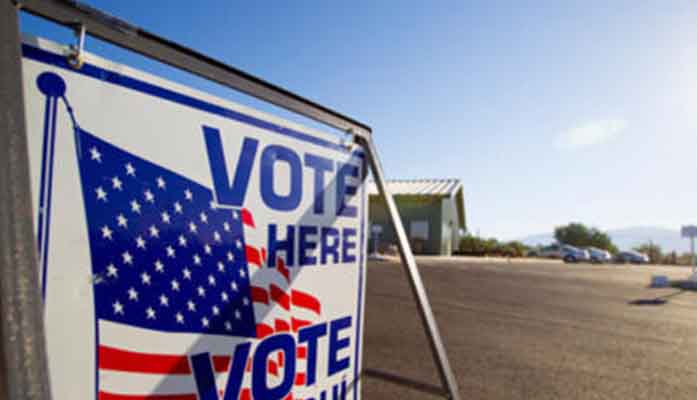
An activist group wants to overhaul elections processes with ranked-choice voting (RCV), open primaries, and a uniform signature-gathering limit.
Voter Choice Arizona (VCA) is behind the effort. During a monthly public meeting on Wednesday, VCA treasurer and founding member Richard Cook claimed RCV is nonpartisan, tried and true, and good for all parties.
“We’re not here to change an election system, we’re not here to generate support,” said Cook. “We’re here because we believe in a more effective government. We believe we can elect better leaders to lead the future of Arizona.”
In its presentation, VCA claimed that the current election system fails to eliminate the “spoiler effect” from independents and third parties, limits honest choice in the voting booth, thwarts majority rule by helping divisive candidates succeed in crowded fields, distracts from healthy-issue based campaigns, and chooses candidates in low participation primary elections. It cited low primary election participants as a reason for RCV.
RCV lets voters rank multiple candidates in order of preference, with the initial leading candidate receiving the most “first-preference votes.” However, even second, third, and so on rankings carry weight that can flip a final outcome. A candidate who originally led with the highest percentage of votes but no majority could fall behind another candidate when factoring lesser rankings.
In an example scenario: out of three candidates, none received a majority under RCV though one had the highest percentage of votes cast for them. The third-place candidate drops off, and the rankings assigned to the third-place candidate are shifted onto the first- and second-place candidates. If the second-place candidate far outranked the first-place candidate, theoretically, the second-place candidate could win.
Those elections that allow for multiple winning candidates, such as for the Arizona Corporation Commission, would need to meet a lower threshold for the majority.
VCA is partnering with several organizations: Rank the Vote, the Institute for Political Innovation, Represent Us, Unite Arizona, and Save Democracy Arizona. VCA said it planned to form a C4 organization with these organizations to fundraise and gather signatures.
In addition to its partners, VCA is endorsed by League of Women Voters Arizona, as well as a cohort of Democrat, Libertarian, independent, and moderate Republican elected officials. Members of the VCA advisory board include:
- Alison Porter: Save Our Schools founder
- Former Democratic State Rep. Sarah Liguori
- Sam Coppersmith: former Democratic Congressman; founder of a top law firm for Democrats, Coppersmith Brockelman, from which newly appointed Ninth Circuit Court of Appeals Judge Roopali Desai hailed as a partner
- Lauren Kuby: former Tempe City Councilwoman and Democratic candidate for the Arizona Corporation Commission
- Heather Carter: executive vice president of Greater Phoenix Leadership and former Republican state representative
- Art Babbott: former member of the Flagstaff City Council
VCA will attempt to file its constitutional ballot initiative for 2024 later this year. They likely need around 600,000 signatures to make the ballot, since the minimum is around 356,000. If approved, RCV would go into effect in the 2026 election.
23 other states allow RCV at varying levels: Alabama, Alaska, Arkansas, California, Colorado, Delaware, Georgia, Illinois, Louisiana, Maine, Maryland, Massachusetts, Michigan, Minnesota, Mississippi, New Mexico, New York, Oregon, South Carolina, Utah, Vermont, Virginia, and Washington.
Two states banned RCV: Tennessee and Florida.
Corinne Murdock is a reporter for AZ Free News. Follow her latest on Twitter, or email tips to corinne@azfreenews.com.
by Corinne Murdock | Jan 5, 2023 | News
By Corinne Murdock |
Governor Katie Hobbs’ first executive order prohibits gender identity discrimination in state employment and contracts.
The order directs the Department of Administration to establish procedures by April 1, 2023 regarding gender identity discrimination. The order also directed the department to launch awareness campaigns throughout state government through internal communications and trainings.
READ HOBBS’ FIRST EXECUTIVE ORDER
Hobbs’ order declared that over 40 percent of LGBTQ+ individuals nationwide report “unfair treatment” at work, such as firings, harassment, or not being hired due to their sexual orientation or gender identity. The order also noted that 83 percent of the Fortune 500 companies prohibit gender identity discrimination; those numbers came directly from a Human Rights Campaign report.
The 40 percent estimate appears to have originated from a 2021 study from a UCLA Law think tank. Their survey covered just over 900 LGBTQ+ adults about their lifetime, five-year, and past-year discrimination experiences. 46 percent of these respondents reported experiencing unfair treatment at some point in their lives, with just nine percent experiencing discrimination in 2021.
The think tank estimated that about 8 million American workers identify as LGBTQ+ — if nine percent of that estimate experienced discrimination in 2021, that would amount to just over 720,000 people. Other activist groups’ estimates place the total LGBTQ+ population at a much higher number: over 20 million.
Hobbs’ order could be viewed as a natural progression of policy initiated by a 2020 Supreme Court (SCOTUS) decision.
Former attorney general Mark Brnovich interpreted existing anti-discrimination protections to include both sexual orientation and gender identity in a 2020 filing for the case Bruer v. State of Arizona. His filing followed the SCOTUS decision in Bostock v. Clayton County which determined that employers can’t discriminate based on sexual orientation or gender identity.
Brnovich said that the state legislature would have to amend the Arizona Civil Rights Act to exclude sexual orientation and gender identity specifically if they disagreed with this interpretation.
The state already prohibited discrimination based on sexual orientation in a 2003 executive order issued by former Governor Janet Napolitano — the last Democrat elected as governor prior to Hobbs.
Corinne Murdock is a reporter for AZ Free News. Follow her latest on Twitter, or email tips to corinne@azfreenews.com.
by Corinne Murdock | Jan 4, 2023 | News
By Corinne Murdock |
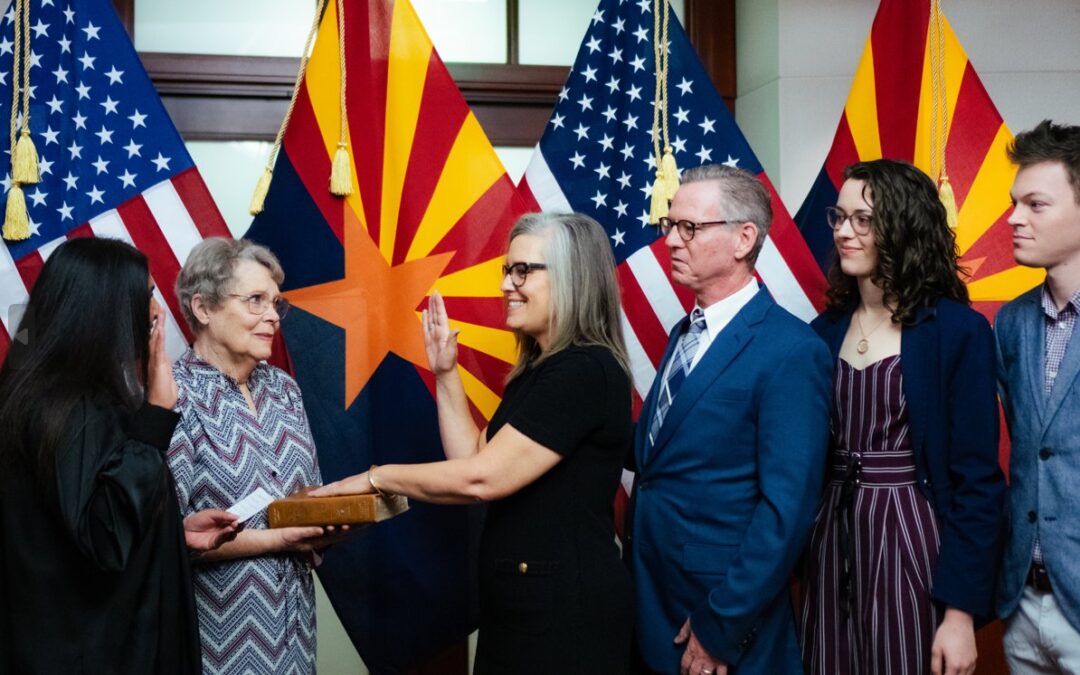
Governor Katie Hobbs laughed when asked if she would uphold the Arizona Constitution during her swearing in on Monday.
The individual to swear in Hobbs was her longtime lawyer, ally, and friend: Roopali Desai, a recent Biden appointee to the Ninth Circuit Court of Appeals. Hobbs exhibited nervous excitement: she required multiple prompts from Desai to finish taking her oath of office.
“Stop it!” exclaimed Hobbs.
Reporters weren’t welcome at the swearing-in, save for one photographer from the Associated Press. Press arrived to the cover the event. They weren’t allowed inside.
All reporters were directed to a Facebook livestream to witness Hobbs’ swearing-in.
WATCH: HOBBS SWORN IN
However, reporters will be allowed in the inauguration ceremony on Jan. 5.
After Hobbs took the oath of office, she claimed in a statement that partisanship wouldn’t define her administration. Hobbs promised to work with leaders of all political persuasions, specifically naming public school funding, water security, legalized abortion, and cost of living as initial priorities.
“Today marks a new chapter for Arizona. As we look forward to a brighter future, I pledge that the needs of Arizonans – not partisan politics – will always come first,” stated Hobbs.
The governor’s promise follows reporting that revealed Hobbs holds a different outlook on GOP leaders in private. Last month, Hobbs remarked during the Democratic Governors Association annual meeting that she wouldn’t communicate with GOP leaders due to strained relationships.
Hobbs is Arizona’s first Democratic governor elected in 16 years.
Hobbs’ first executive order prohibited state employment or contract discrimination based on gender identity. The order was issued as part of her “First 100 Days Initiative.”
One of her first moves as governor was to announce a Day of Service on Tuesday. Hobbs encouraged Arizonans to volunteer with their local nonprofits. The governor plans on volunteering with the Arizona Service Project.
Adrian Fontes (secretary of state), Kris Mayes (attorney general), Kimberly Yee (state treasurer), Tom Horne (superintendent of public instruction), and Paul Marsh (state mine inspector) were also sworn into office.
Corinne Murdock is a reporter for AZ Free News. Follow her latest on Twitter, or email tips to corinne@azfreenews.com.
by Corinne Murdock | Dec 31, 2022 | News
By Corinne Murdock |
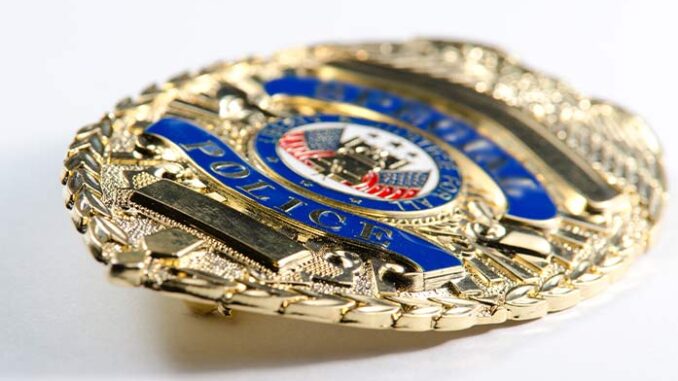
Arizona ranked second in the nation for most officers shot in 2022, falling just behind Texas and ahead of Georgia. There were over triple the number of officer shootings and deaths compared to last year.
According to the National Fraternal Order of Police’s (FOP) annual report, 21 Arizona officers were shot in the line of duty. Three were killed by gunfire:
Officer Adrian Lopez, Sr., White Mountain Apache Tribal Police Department (EOW: June 2)
Sergeant Richard Lopez, Yavapai County Sheriff’s Office (EOW: June 28)
Constable Deborah Martinez-Garibay, Pima County Constable’s Office (EOW: Aug. 25)
A Customs and Border Protection (CBP) agent with a residence in Florida as well as Cochise County, Michel O. Maceda, was killed by gunfire last month during a drug bust off the coast of Puerto Rico. Maceda’s end of watch was on Nov. 17.
Last year, Arizona had six officers shot in the line of duty, and one was killed. Drug Enforcement Administration (DEA) Special Agent Michael Garbo was killed by gunfire last October.
While Arizona’s shooting incidents and deaths more than tripled compared to last year, the national totals declined. Nationwide, 2022 marked a slight decline from 2021: this past year 323 officers were shot, and 60 died by gunfire. In 2021, 346 officers were shot, and 63 died by gunfire. In 2020, 312 were shot, 47 died by gunfire. In 2019, 319 officers were shot, and 50 died by gunfire.
There have been a total of 87 ambush-style attacks on officers this year, resulting in 124 officers shot and 31 killed.
This increase in officer shootings and deaths conflicts with the decline in the state’s crime levels. According to Arizona Department of Public Safety (AZDPS) data, violent crimes have so far declined by 35.3 percent since last year: homicides are down 36 percent (72.8 percent with firearms), aggravated assaults are down 32.2 percent (30.3 percent with firearms), robberies are down by 44.7 percent (35.3 percent with firearms), and sexual assaults are down by 37.4 percent (less than 1 percent with a firearm).
This data may change by next month after participating agencies submit their crime reports for December.
The decline follows a three-year steady increase in crime rates. Last year, violent crimes increased by 3.6 percent from 2020. Homicides were up by 16.5 percent, (69 percent committed with a firearm); aggravated assaults were up by 2.7 percent (29 percent with firearms), robberies were up by 2 percent (28.8 percent with firearms), and sexual assaults were up by 11 percent (less than 1 percent with a firearm).
AZDPS’ past annual crime reports from 2006-2020 are available here.
Corinne Murdock is a reporter for AZ Free News. Follow her latest on Twitter, or email tips to corinne@azfreenews.com.