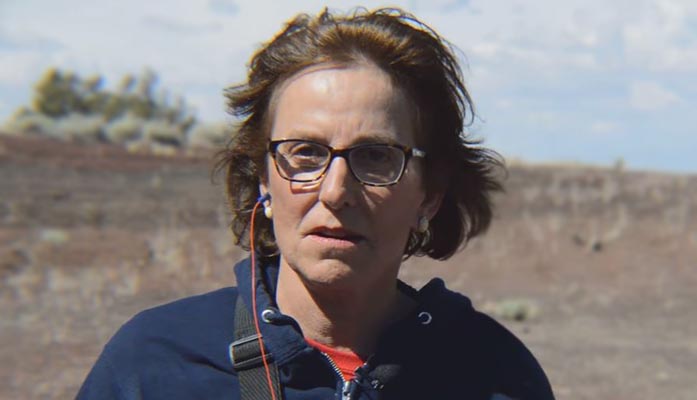
The Arizona Senate voted to censure State Senator Wendy Rogers (R-Flagstaff) for her statements concerning political opponents and fellow senators, especially those given most recently. The censure motion said that Rogers engaged in unbecoming conduct as a senator, citing specifically her hopes for “violence against and punishment of American citizens.” The Senate passed the measure 24-3.
The censure was prompted by Rogers’ remarks during and following the America First Political Action Conference (AFPAC) in Florida last weekend: a controversial gathering organized by some of the most controversial right-wing political figures in America, primarily Nick Fuentes.
During a speech for AFPAC, Rogers asserted that individuals would be right to try and convict their political opponents who worked to take away their rights these last two years.
“Capitulation is why we are being overrun by the LGBTQ movement; it’s why our border’s being overrun by illegals, and it’s why babies are dying in the womb,” said Rogers. “At this historic point it will take all of us to speak out, to defend each other for standing up for what is right. When we do take back our God-given rights, we will bring these criminals to justice. I’ve said we need to build more gallows. If we try some of these high-level criminals, convict them, and use a newly-built set of gallows, it’ll make an example of these traitors who betrayed our country. They have yet to be justly punished for the crimes they committed.”
When talk of censuring Rogers came on Monday from Senate Majority Leader Rick Gray (R-Sun City), Rogers responded that she was being threatened with punishment for being white and pledged to destroy the careers of those Republicans coming after her.
“I will not apologize for being white. Hit me all you want,” wrote Rogers. “I will personally destroy the career of any Republican who partakes in the gaslighting of me simply because of the color of my skin or opinion about a war I don’t want to send our kids to die in.”
I will personally destroy the career of any Republican who partakes in the gaslighting of me simply because of the color of my skin or opinion about a war I don’t want to send our kids to die in.
During the Senate floor discussion of her censure, Rogers was first to speak. She declared that the senate was a violation of her freedom of speech. Rogers said that her constituents supported her remarks, and that by censuring her the senate was truly censuring her constituents.
“This censure is nothing more than an attempt to limit my speech,” said Rogers. “I do not apologize, I will not back down, and I’m sorely disappointed in the leadership of this body for colluding with the Democrats in an attempt to destroy my reputation. In the end, I rejoice in knowing I do and say what is right. And I speak as a free American regardless of the actions of this corrupted process today.”
Anti-Semitic and hateful language has no place in Arizona. I have categorically condemned it in the past and condemn it now. 1/
Gray emphasized that he opposed Rogers’ rhetoric and insisted that legislators should separate policy from person.
State Senator Rebecca Rios (D-Phoenix) called Rogers’ beliefs “sickening”: that Ukraine President Volodymyr Zelenskyy was a puppet for George Soros, and that Fuentes was a patriot. State Senator Lisa Otondo (D-Yuma) said that free speech doesn’t allow for speech that bullies, slanders, or threatens.
Senate President Karen Fann (R-Prescott) said this wasn’t a measure she wanted to have to take, but freedom of speech doesn’t give senators leeway to disrespect one another by saying whatever they’d like.
“We do support the First Amendment, freedom of speech, we absolutely support it, we fight battles over it. But what we do not condone is members threatening each other, to ruin each other, to incite violence, to call us communist, we don’t do that to each other,” said Fann.
Watch the Arizona Senate discuss and vote on its censure of Rogers here:
Corinne Murdock is a reporter for AZ Free News. Follow her latest on Twitter, or email tips to corinne@azfreenews.com.
The Arizona Senate Transportation Committee devoted their entire agenda on Monday to discussing four bills advancing electric vehicle initiatives. The four bills were introduced by Minority Whip Victoria Steele (D-Tucson), with two of the bills cosponsored by State Representative Jennifer Jermaine (D-Chandler).
SB1150 would prohibit municipalities or boards of supervisors from awarding residential, single-family building permits unless the structure would have an electric vehicle charging station. Manufactured homes or residences under 1,000 square feet, without off-street parking, or with electric services that would exceed 200 ampere with an electric vehicle charging station would be exempt. Proposed changes to the bill would have the state reimburse builders up to $1,000 for the cost of electric vehicle charging outlet installation. SB1150 passed 6-3; Majority Leader Rick Gray (R-Sun City) along with State Senators Paul Boyer (R-Glendale) and Sine Kerr (R-Buckeye) voted against it while Minority Leader Rebecca Rios (D-Phoenix) and State Senators Steele, Rosanna Gabaldon (D-Tucson), Lisa Otondo (D-Yuma), Tyler Pace (R-Mesa), and T.J. Shope (R-Phoenix) voted for it. This was the only Green New Deal-esque bill that Boyer voted against.
SB1151 would direct the Arizona Department of Housing (ADOH) to conduct a two-year program funded with $500,000 from the state’s general fund. State agencies could request the department to cover any electric vehicle charging station installation costs. Steele’s bill would also make Arizona greener in more than one sense of the word. If passed, private companies could turn a profit from this endeavor — the bill would grant private entities to establish fee-based electric vehicle charging stations at the legislature, any state agency, and any Arizona Board of Regents (ABOR) university property. SB1151 passed 7-2, with Gray and Kerr voting against it, and Boyer, Gabaldon, Otondo, Rios, Steele, Shope, and Pace voting for it.
SB1152 would redefine “zero emission vehicle” (ZEV) to mean that which doesn’t emit exhaust, gas, or other pollutants, and require the Arizona Department of Transportation (ADOT) to establish interstate and intrastate zero emission vehicle corridors, and install zero emission vehicle infrastructure. ADOT would be required to submit a draft ZEV plan to the governor and the presidents of the state senate and house six months after the bill’s passage. Gray and Kerr voted against it, and Boyer, Gabaldon, Otondo, Rios, Steele, Shope, and Pace voted for it.
SB1154 would establish a “Transportation Electrification Study Committee” to review current state laws inhibiting electric transportation expansion; issue propaganda; and coordinate with local governments, electric utilities, environmental groups, the transportation industry, and the community to determine the best route for transitioning from regular to electric vehicles. If passed, the committee would submit its report by July 1, 2023 before its dissolution in September 2024. SB1154 passed 7-2, with Gray and Kerr voting against it, and Boyer, Gabaldon, Otondo, Rios, Steele, Shope, and Pace voting for it.
The bills resemble a similar policy enacted by the Tucson City Council last summer. Tucson now requires electric vehicle charging outlets on all new constructions of one- and two-family dwellings.
Corinne Murdock is a reporter for AZ Free News. Follow her latest on Twitter, or email tips to corinne@azfreenews.com.
Arizona Secretary of State Katie Hobbs is coming under attack from within her own party over her involvement in events which led a federal jury to award $2.75 million in damages this week to a former policy advisor Hobbs helped fire in 2015.
That staff member, Talonya Adams, had brought it to the attention of Democratic Senate leaders that as a Black female she was being paid significantly less than policy advisors who were White males. Adams had also documented those other staffers received pay raises while she had not, despite no negative performance reviews.
That put Adams’ claims of pay disparity on the shoulders of Hobbs, who was Senate Minority Leader in 2015, making her the top ranking Democrat in the state Senate at the time. And when Adams was terminated a short while later, there was undisputed evidence that Hobbs was intimately involved in the process.
There have been two trials in U.S. District Court stemming from Adams’ federal racial discrimination and retaliatory termination firing lawsuit. In both, juries found in favor of Adams, and this week that second jury’s award of $2.75 million far exceeded the first jury’s award of $1 million.
There was little public attention to Hobbs’ role in the Adams case during the first trial in 2019 despite Hobbs serving as Secretary of State, which puts her in line to be Governor if anything happens to Doug Ducey.
But with Hobbs seeking the Democratic nomination for Arizona Governor, her actions just a few years ago as Senate Minority Leader are coming under intense scrutiny. Even within her own party.
Especially after Hobbs allowed her gubernatorial campaign spokeswoman to issue a press release after the jury’s unanimous verdict. Not only is the statement in the words of the spokeswoman Jennah Rivera instead of Hobbs, but the statement fail to express any concern for Adams.
That statement turned Adams’ struggles into a campaign ad for Hobbs, with criticism of how diversity and wage inequity is currently handled by the Republican-controlled Legislature. Nowhere does Rivera own up to the fact Hobbs was in meetings with other Democrats in 2015 figuring out how to fire Adams just weeks after the employee complained about her pay.
And then there is the claim in Rivera’s statement about how Hobbs “voluntarily” testified. Hours later, Adams tweeted a copy of the federal subpoena which had been served on Hobbs requiring her presence in court for the trial.
In June, Hobbs explained her decision to run for governor by stating she wanted to “deliver transparency, accountability, and results for Arizonans — just like I’ve done my whole career.”
That has left one prominent Democrat calling for a sincere review of Hobbs’ actions both in 2015 and today in dealing with the Adams’ case.
“We need to have an open and honest discussion about what happened, who is accountable, and if we, as Democrats, are prepared to support a nominee for governor who behaved in this manner just a few short years ago,” said former Rep. Aaron Lieberman,
Lieberman, who is considered Hobbs’ top challenger for the Democratic nomination for governor, also says that the Democratic platform on equality and fair treatment for all needs to be more than a campaign motto.
“Being an effective Democratic leader is about more than just participating in partisan fights; it is about holding a key set of values and living those values all the time—especially when no one is watching,” said Lieberman.
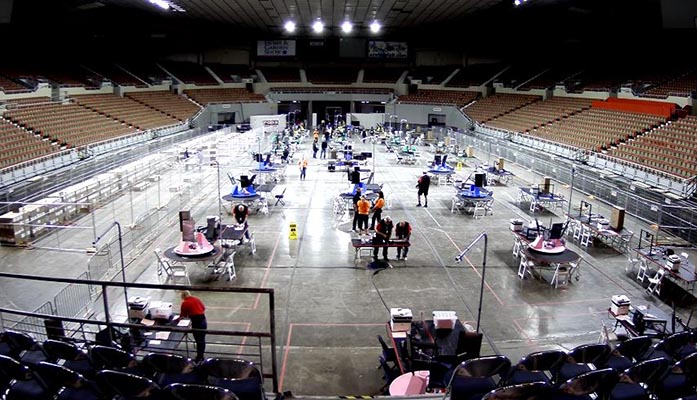
Last Friday, Maricopa County settled with the State Senate on both side’s election demands, with the Senate apparently compromising on nothing per the agreement. The county will hand over the remaining election materials subpoenaed by the Senate: routers, splunk logs, and digital images of ballot envelopes. They will also drop their demand that the legislature pay $2.8 million to replace the voting machines. Secretary of State Katie Hobbs – who told the county that she would likely decertify any election results that come from the audited machines – has yet to issue a statement on the settlement.
The Maricopa County Board of Supervisors convened on Friday to discuss this settlement. They ultimately decided that the election routers, splunk logs, and ballot envelopes weren’t worth $700 million in lost funds. In fact, the board decided securing those funds was worth an additional expenditure. The county will pay for a “Special Master”: an official to oversee acquisition of the routers and splunk logs. Former Republican Congressman John Shadegg will serve that role.
Senate Republicans tweeted the news in a statement from President Karen Fann (R-Prescott). Fann clarified that experts were sure that the audited election equipment wasn’t compromised, as the county had claimed.
“The Senate will finally get the answers to questions asked for in the subpoenas issued to the County months ago,” stated Fann. “I look forward to getting our final questions answered and wrapping up the review of the election in Maricopa County.”
Shortly after, Fann released a more personalized statement of her own. She responded to critics and skeptics with clarification that the Senate hadn’t lost out on anything they were desiring.
“HUGE win for the Az Senate today! Maricopa settlement gives us all the data needed to complete the review of the routers & splunk log to the most comprehensive election audit in history,” stated Fann. “We got everything we need and more. Maricopa County goes home with its tail between its legs.”
Maricopa County officials spun a different narrative in their announcement of the settlement. The county neglected to clarify that they were still turning over the subpoenaed election materials to the Senate for inspection. Instead, they emphasized that the auditing company, Cyber Ninjas, wouldn’t be given access to those materials.
“NEW: Board votes to approve an agreement with the AZ Senate that keeps county routers & other sensitive materials out of the hands of Cyber Ninjas. The agreement also protects taxpayers and ends a legal dispute over the Senate’s ongoing election review,” stated the county. “Per Chairman @jacksellers: ‘The Cyber Ninjas will never be able to touch the routers or access our data. An independent third party can confirm what we’ve always said: the election equipment was not connected to the internet and no vote switching occurred. And our residents, law enforcement, and courts can all rest assured that their data and equipment are protected.’ The agreement with the Senate comes with a provision that the Senate President write a letter to the Attorney General stating the County has now fully complied with the Senate’s outstanding subpoenas and that further action is not warranted.”
Cyber Ninjas’s report on Maricopa County’s 2020 election will be released on Friday. Since Cyber Ninjas isn’t privy to the election materials obtained from the Maricopa County-Senate settlement, information from those materials won’t be included.
Last month, Hobbs published a full report of the audit, asserting that Cyber Ninjas’ work was more of a partisan review than a credible audit.
The results of the Arizona Senate’s audit of Maricopa County’s 2020 election results are expected to be released next Friday at 1 pm, according to State Senate Attorney Kory Langhofer. Audit results will include a hand count total of the ballots, a machine count total of ballots to compare the auditing company’s totals against the state’s, and complete analysis of mail-in ballot signatures.
State senators will be the first to lay their eyes on the audit findings prior to a public presentation. The auditing company, Cyber Ninjas, will privately present their findings to Senate President Karen Fann (R-Prescott) and Judiciary Committee Chairman Warren Peterson (R-Gilbert). Once the other senators have reviewed the report, the judiciary committee will convene formally in a meeting open to the public to discuss the report.
As of press time, neither Fann or the Arizona Republican Party have issued an official statement about this new date for the audit results.
Langhofer revealed the new release date during a hearing on Thursday before Maricopa County Superior Court Judge Michael Kemp. The hearing was part of an ongoing lawsuit against the Senate, American Oversight v. Fann, et al., to obtain all communications and documents from Cyber Ninjas. Kemp also ordered Cyber Ninjas and the Senate to produce these records in another lawsuit, Phoenix Newspapers, Inc., v. Arizona State Senate.
Kemp originally ordered Cyber Ninjas to produce the requested records by August 31. However, Kemp granted them more time to turn over the thousands of records following their request.
Cyber Ninjas has faced several delays throughout this audit, which began in April. Most recently, progress halted after their entire team was reportedly infected by COVID-19. The company has also been waiting for Maricopa County election officials to comply with outstanding subpoenas for routers and passwords connected to the voting machines. If the county doesn’t comply by September 27, the state will withhold around $700 million in funding obtained from sales tax revenue.
Those missing items will not be part of this latest report.
Maricopa County argued that they didn’t have to comply with the Senate’s request because the legislative session ended in July. Attorney General Mark Brnovich disagreed. He determined that if the county didn’t comply by the deadline, they would lose out on their millions.
With just one week left before their deadline, the county’s board of supervisors decided to convene to discuss whether they will comply with the Senate’s subpoena. The meeting will take place on Friday.
Corinne Murdock is a reporter for AZ Free News. Follow her latest on Twitter, or email tips to corinne@azfreenews.com.