by Staff Reporter | Jun 19, 2026 | News
By Staff Reporter |
This November, voters will decide on a resolution amending the Arizona Constitution to further prevent noncitizen voting and foreign influence in elections.
House Concurrent Resolution 2001 passed the legislature along party lines last week. The Arizona Secure Elections Act, also known as the FAST Election Results Act, will appear on the general election ballot.
The resolution would amend the state constitution to repeat an existent declaration that only U.S. citizens may register and vote in Arizona elections. The resolution would also ban foreign nationals from contributing or expending money or anything of value to influence an Arizona election, and would require voters to show valid government-issued proof of identity for all voting methods prior to casting their ballot — including mail voting.
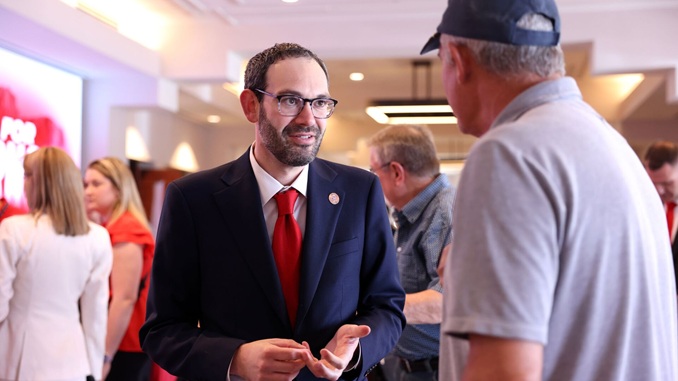
Republican State Sen. Alexander Kolodin (LD3), the resolution sponsor and secretary of state candidate, issued a press release describing the legislation as an opportunity for voters to establish better safeguards for elections by enshrining these proposed rules in the state constitution.
“For years, Arizonans have watched the same election problems repeat while trust in the system has eroded,” said Kolodin. “Election laws should be written by Arizonans, not dictated by bureaucrats, activists, or outside interests.”
Democrats and Republicans argued over the impact of the resolution during the Senate vote last Friday.
Senate Democrats criticized the legislation as redundant at best and a fatal threat to voting by mail at worst.
State Sen. Lauren Kuby (D-LD8) claimed the resolution was a “backdoor attempt” to end mail-in voting. Kuby accused Republicans of being stooges for President Donald Trump’s election policy preferences at the expense of Arizona voters.
“It’s disturbing to see the legislature put the desires of a sad, desperate man above their very own constituents,” said Kuby.
State Sen. Priya Sundareshan (D-LD18) called the bill “unnecessary” and filled with “vague” language, saying the state constitution’s present voter ID and citizenship proof requirements were enough.
State Sen. Analise Ortiz (D-LD24) said the bill was “voter suppression” and “a state-level SAVE Act.” Ortiz argued the resolution would enable lawmakers to repeal mail-in voting in the future. Ortiz claimed Trump was “plotting to meddle in the 2026 midterms.”
“The real goal of this is to make it harder for eligible voters to vote,” said Ortiz. “Our democracy is being systemically dismantled across the country.”
State Sen. Mitzi Epstein (D-LD12) said the legislation’s declaration that only citizens were eligible to vote was not only redundant and unnecessary, but that the other provisions would create an undue burden on mail-in voters.
“This bill opens the door to no more mail-in ballots,” said Epstein.
State Sen. Theresa Hatathlie (D-LD6) claimed the resolution was a template to “lay the groundwork for Project 2025.”
Republicans countered that existing voter registration requirements already require proof of citizenship, and that voters already anticipate security measures when casting ballots.
Majority Leader John Kavanagh (R-LD3) accused Democrats of “confusing the issue” and misleading voters.
“You’re only scaring people and creating a false argument,” said Kavanagh.
State Sen. David Farnsworth (R-LD10) said an increasing number of Arizonans have lost faith in their elections, and that this resolution was the means of remedying that sentiment.
“Our motive is not to make it more difficult to vote, but to make our elections more secure so that all of us can have confidence that those who vote their votes will be counted properly, and that those who win the most votes will be elected,” said Farnsworth.
State Sen. Jake Hoffman (R-LD15) argued that the “overwhelming majority” of Arizonans support these proposed provisions within the resolution.
AZ Free News is your #1 source for Arizona news and politics. You can send us news tips using this link.
by Staff Reporter | Jun 15, 2026 | News
By Staff Reporter |
Republican State Rep. Alex Kolodin (LD3) is one of two contenders vying to unseat incumbent Secretary of State Adrian Fontes.
Kolodin, a longtime election lawyer, has been in the Arizona legislature since 2023.
Kolodin has previously defeated Fontes under different circumstances.
In 2020, Kolodin won an Arizona Supreme Court case against Fontes which determined the latter, while Maricopa County Recorder, had wrongly told mail voters that crossing out votes wouldn’t spoil their ballots. That ruling allowed Arizonans to further challenge election officials on unlawful actions.
In 2024, Kolodin again defeated Fontes in court, securing a requirement for the latter to comply with duties under the National Voter Registration Act.
Earlier this year, Kolodin successfully passed an election integrity bill (HB 2022) to ensure Arizona’s election timeline aligned with federal requirements and protected military members overseas from disenfranchisement.
Kolodin also led on HCR 2001, the Arizona Secure Elections Act, which promises to strengthen voter ID requirements through an amendment to the Arizona Constitution. The measure passed the Arizona Legislature and is now headed to the statewide ballot. If approved by voters, the amendment would mandate voter ID, declare citizenship as a mandatory qualification for registering and voting in elections, ban foreign funding in elections, and limit ballot acceptance times to Election Day.
Facing off against Kolodin in the primary is former Arizona Republican Party Chair Gina Swoboda.
Kolodin and Swoboda debated last month, with PBS moderating. Both said voters desire more reasons to trust their elections: competence, transparency, reliability, and experience.
Swoboda acknowledged that many voters believe elections have been rigged in recent years, but that the state has addressed issues with the administration, Elections Procedures Manual (EPM), and equipment through legislation and court challenges.
“The way I say it is, when people say, ‘Was it stolen?’, they were stolen fair and square,” said Swoboda.
Swoboda said issues with the EPM would always exist, but that the only issues that matter are those that affect the outcome of the election.
“We just won everything that was winnable in [20]24,” said Swoboda.
Kolodin disagreed with Swoboda’s view that the issues with the elections system, namely the EPM, have been resolved. He pointed to the Pima County GOP lawsuit against Fontes which alleges that Fontes’ EPM threatens voters’ free speech.
“The voters of Arizona are ready to move forward and have an elections system that we can be proud of,” said Kolodin.
Kolodin also questioned why Swoboda continues to defend the exclusion of political party observers in the EPM. Swoboda said she was merely backing what the law was at the time.
Swoboda criticized Kolodin for his 2023 admonishment by the State Bar of Arizona. Kolodin was punished for participating in lawsuits challenging the 2020 election.
Kolodin defended mail-in voting as the right of Arizona voters, and said that his efforts in the legislature have been to make that voting method more secure.
“Arizonans love our mail-in voting. Most Arizonans use mail-in voting, and nobody is coming to take that away,” said Kolodin.
Similarly, Swoboda said that Arizona has used mail-in voting for a while and does it well, and indicated that Arizona has further to go to secure the voting method against potential fraud.
The two contended whether the ballot referral under HCR2001 would “crush” mail-in voting. Kolodin claimed Swoboda was “misleading” voters on the referral, which he said was measures to improve the security of mail-in voting. Swoboda claimed the county recorders stand opposed to the referral.
“The voters of Arizona are the only stakeholders that I care about,” replied Kolodin.
Kolodin said it was “extremely important” to boost voter participation, especially in rural areas. However, Swoboda said it wouldn’t be her job as the secretary of state to ensure voter turnout was high.
In closing statements, Kolodin said his focus was on restoring public perception of integrity in Arizona’s elections.
“What the voters have been waiting for is elections that we can be proud of again,” said Kolodin.
AZ Free News is your #1 source for Arizona news and politics. You can send us news tips using this link.
by Matthew Holloway | Jan 24, 2026 | News
By Matthew Holloway |
A proposed constitutional amendment aimed at reshaping Arizona’s election system passed its first major legislative hurdle in a hearing on Wednesday, as the Arizona House Committee on Federalism, Military Affairs & Elections (FMAE) approved Rep. Alexander Kolodin’s (R-LD3) Arizona Secure Elections Act.
The Committee advanced House Concurrent Resolution 2001 with a 4-3 vote. It now heads to the House Rules Committee. If approved by both chambers of the Arizona Legislature, the measure would be referred to voters on the November 2026 general election ballot.
Kolodin announced the committee hearing on social media ahead of the meeting.
According to supporters, HCR 2001 is intended to address concerns about voter confidence following recent election cycles. If approved by voters, the constitutional amendment would establish several requirements for statewide election administration.
Those provisions include limiting voter registration and participation to U.S. citizens, prohibiting foreign contributions to candidates or ballot initiatives, and requiring government-issued identification in order to vote.
Additional requirements would mandate that early voting concludes no later than 7:00 p.m. on the Friday preceding a Tuesday general election, prohibit the acceptance of ballots after polls close on Election Day, preserve in-person voting options at accessible polling locations, and require mail-in voters to verify their address each election cycle.
Committee Debate
During the hearing before the committee, Kolodin described HCR 2001 as an effort to overhaul Arizona’s election system by drawing comparisons to reforms adopted in Florida after the 2000 presidential election.
“This year the Arizona State Legislature will give the voters of Arizona the opportunity to transform our system of elections from a national embarrassment to a national model,” Kolodin told committee members, arguing that Florida’s reforms improved election security, sped up results, and increased voter satisfaction.
Kolodin urged lawmakers to advance the measure, saying the proposal would allow voters to address longstanding concerns about election administration.
Democrats raised concerns about voter access and election logistics. Rep. Aaron Márquez (D-LD5) argued that the proposal would effectively end the active early voting list and push large numbers of voters back into in-person voting without funding for additional polling locations, potentially creating longer lines on Election Day.
Kolodin rejected that characterization, emphasizing that HCR 2001 is a constitutional ballot referral rather than a statutory change.
“You have mistaken assumptions right off the bat,” Kolodin said. “It’s not a piece of legislation. It’s not modifying statutory law. This is a constitutional ballot referral.”
Kolodin explained that constitutional amendments are intended to establish broad governing principles, while election administration details are left to statute.
“In a statute, you want to be prescriptivist,” he said. “With a constitutional amendment, you must refrain from being overly prescriptivist,” noting that constitutional provisions are designed to endure for generations.
Addressing concerns about early voting, Kolodin said the proposal would not eliminate early or mail-in voting but would require voters to confirm their address each election cycle before automatically receiving a ballot.
Kolodin also defended the proposal’s voter identification requirements, arguing that the current signature verification system is imprecise and can result in lawful ballots being rejected.
“Our current system of signature verification, which is incredibly imprecise, leads to a large number of valid votes sometimes be[ing] rejected. It’s a very imperfect system. A more precise system, where a definite match can be obtained, where you don’t have to squint at the loops and the squiggles to try to figure out the signatures match, or if a ballot should be sent to curing, and potentially rejected, but where there’s something where it’s binary: it’s either a yes or no. There’s no matter of opinion there [that] will actually lead to fewer votes cast by lawful voters being rejected in the system,” Kolodin said.
Advocacy Groups Weigh In
The Arizona branch of the American Civil Liberties Union, represented by Katelynn Contreras, opposed the Resolution during the public comment period, stating, “HCR 2001 does not improve election integrity. Instead, it will restrict access for eligible voters to create confusion and rigid, unworkable rules in the Arizona Constitution. This resolution significantly curtails early and non-voting options that most Arizonans rely on.“ The ACLU representative cited what she described as survey data, claiming that 70 percent of Arizona voters say elections are fair and that roughly 80 percent vote by mail or early, and suggested that the ballot measure would “ban a method of voting that is widely used in the state.”
The figures cited by the ACLU couldn’t be independently verified by AZ Free News.
Asked to clarify the claim, Contreras said the measure would create “new discretionary areas that could be used to restrict mail voting for future.” Kolodin responded, “Mr. chair, I just wish to point out that that is untrue. OK, I just want to put that very clearly.”
The Arizona Freedom Caucus has promoted the proposal on its social media channels since the resolution’s prefiling in November, identifying it as a legislative priority and encouraging public engagement ahead of committee consideration. Arizona House Republican accounts have also circulated prior statements from Kolodin outlining the proposal’s intent.
Arizona Freedom Caucus Chairman Jake Hoffman (R-LD15) urged legislative leaders to advance the proposal following committee review.
“The Arizona Freedom Caucus is grateful that AFC Member Representative Alexander Kolodin has once again provided much-needed leadership in the critical mission to secure Arizona’s elections today and into the future,” Hoffman said. “Once it is heard by the FMAE Committee this week, I urge House Leadership to move it quickly to a floor vote and then send it to the Senate.”
Kolodin criticized the objections raised during the hearing, saying opponents had failed to cite provisions supporting claims that the measure would end early voting.
“We have now reached the point where the opposition to this measure has become truly silly,” Kolodin said, arguing that the proposal would expand, not restrict, voting opportunities.
He added, “It is time for the people of Arizona to have the opportunity to get their kids and their grandkids, my kids and your kids, an election system that we can be proud of, an election system that actually works, instead of inconveniencing and disenfranchising voters, and an election system that provides more opportunities for community participation by casting one’s vote at the polls or to return you ballot to the polls as you prefer. And it’s time, in other words, to take this choice out of the hands of politicians and put it in the hands of the people who actually deserve to have it: you, the voters of Arizona, and that’s where we’re sending it, despite the opposition.”
AZ Free News previously reported on Kolodin’s election integrity proposals and related legislative efforts, including the prefiling of HCR 2001 and its Senate mirror measure, SCR 1001, in November 2025. The Senate resolution, introduced by Sen. Shawnna Bolick (R-LD20), passed a hearing with the Senate Judiciary Committee 4-3 on Wednesday and will be heard next by the Senate Rules Committee.
The resolution must be approved by both the Arizona House and Senate before it can be referred to voters for consideration in 2026.
Matthew Holloway is a senior reporter for AZ Free News. Follow him on X for his latest stories, or email tips to Matthew@azfreenews.com.
by Jonathan Eberle | Nov 17, 2025 | News
By Jonathan Eberle |
The Arizona Freedom Caucus (AFC) is throwing its support behind a new election-related proposal from Rep. Alexander Kolodin, announcing its endorsement for the Arizona Secure Elections Act, a measure the group says is aimed at restoring trust and stability in the state’s voting system.
The bill outlines a series of election policy changes that AFC members argue are necessary to address ongoing concerns about administration errors, delays, and voter confidence. According to the caucus, repeated issues in recent election cycles have eroded public trust and demand a comprehensive response.
“The integrity of our elections remains a top priority,” the caucus said in its statement, pointing to what it described as persistent failures that have “made it impossible for reasonable people to trust the integrity of the process and therefore outcomes.” The AFC said its legislative agenda will continue to center on tightening election procedures and removing what it views as opportunities for error or abuse.
The Arizona Secure Elections Act would make a series of changes to election laws, including affirming the principle of “one citizen, one vote”; banning campaign or ballot-measure contributions from foreign individuals or corporations; requiring government-issued identification for all voters; ending early voting at 7 p.m. on the Friday before Election Day; prohibiting ballots from being cast or accepted after polls close on Election Day; guaranteeing access to in-person voting at local polling places; and requiring mail-in voters to confirm their mailing address every election year.
If approved by lawmakers, the measure would appear on the next general election ballot for voters to decide, setting up a statewide vote as soon as 2026. AFC Chair Sen. Jake Hoffman praised both the proposal and Kolodin’s involvement, calling the act a pivotal step toward what the caucus views as long-needed structural reforms.
“With our endorsement, we will be working to ensure that Arizonans have the opportunity to vote for this Act on the 2026 ballot,” Hoffman said, crediting Kolodin and other AFC members for advancing what he characterized as essential election security priorities.
The legislation, if passed, would bypass the governor and head directly to voters for final approval. The AFC says it intends to campaign for the measure statewide ahead of the 2026 election. The proposal is likely to draw significant attention as lawmakers continue to debate voting access, election security, and administrative reforms—issues that have dominated Arizona politics across several cycles.
Jonathan Eberle is a reporter for AZ Free News. You can send him news tips using this link.
Page 1 of 11