by Elizabeth Troutman | Mar 9, 2024 | News
By Elizabeth Troutman |
Dr. Eugene Livar will serve as Arizona’s first Chief Heat Officer, the state Department of Health announced Wednesday. The position is part of Gov. Katie Hobbs’ Extreme Heat Preparedness Plan.
“I’m excited to take on this role and this important work to make sure Arizona is prepared as possible for this upcoming heat season and beyond,” Livar said.
Hobbs, a Democrat, has named addressing extreme heat in Arizona as one of her most important initiatives. The preparedness plan will involve several state agencies along with the Governor’s Office of Resiliency.
Arizona Republicans have criticized Hobbs for wasting government funding on paying unnecessary employees.
“If Hobbs really cared about making AZ “resilient,” she would start by helping Arizonans keep more $$ in their wallets,” the American Free Enterprise Club said on Twitter. “Instead, she’s flexing her power as governor to create a multi-million-dollar program so her political friends can do phony baloney jobs.”
Livar will oversee the implementation of the plan and work to coordinate partnerships between the state, county health departments, local municipalities, communities, the private sector, and community-based organizations, according to a news release.
“ADHS is proud to play a role in meeting this moment and working to fix a complex problem facing Arizonans and we will handle this responsibility with the care it deserves and in partnership with the Governor’s Office of Resiliency Director Maren Mahoney,” said Jennie Cunico, ADHS Cabinet Executive Officer.
The health department under Hobbs also hired a heat relief coordinator to serve as the statewide point-of-contact for county coordinators and develop training for community navigators focused on improving access to human service providers.
Livar has been part of the ADHS team since 2012. He previously served as the assistant director for public health preparedness and steered the development of the ADHS heat preparedness recommendations, which contributed to the state’s heat plan.
Former legislator and current candidate for Maricopa County Board of Supervisors Michelle Ugenti-Rita said the chief heat officer position sounds like a joke.
“This is an all time level of absurdity – a “chief heat officer,” she said. “It has to be a joke…we live in the DESERT.”
Merissa Hamilton, Republican politician and executive director of Save Arizona, said Hobbs’ agenda must be rejected.
“Democrats manufacture crises for their degrowth death cult,” she tweeted. “We must firmly reject this agenda!”
Elizabeth Troutman is a reporter for AZ Free News. You can send her news tips using this link.
by Corinne Murdock | Mar 29, 2023 | News
By Corinne Murdock |
The Arizona Department of Health Services (ADHS) will give $25 gift cards to attendees of an LGBTQ+ “health equity” event on Tuesday.
Attendance was limited to 30 people, or $750 in gift cards. Attendees were required to be at least 18 years old, living in Pima County, and identifying as an LGBTQ+ community member.
ADHS partnered with the Southern Arizona AIDS Foundation (SAAF) to host the event. SAAF confirmed with AZ Free News that there would be about 12 participants. Also helping facilitate the event was Lenartz Consulting — a company owned by Tracy Lenartz, a health planning consultant for ADHS. Recordings from these in-person listening sessions are anonymized and transferred to ADHS for review before being destroyed.
According to ADHS, referencing the Centers for Disease Control and Prevention (CDC), “health equity” is defined as the fair and just opportunity for all to achieve the highest level of health. Equity is also at the center of the CDC’s 10 Essential Public Health Services framework, unchanged for 25 years until September 2020 — less than four months after the death of George Floyd, which spurred months of Black Lives Matter (BLM) riots and social justice campaigns across state and local governments.
“To achieve equity, the Essential Public Health Services actively promote policies, systems, and overall community conditions that enable optimal health for all and seek to remove systemic and structural barriers that have resulted in health inequities,” stated the CDC. “Such barriers include poverty, racism, gender discrimination, ableism, and other forms of oppression. Everyone should have a fair and just opportunity to achieve optimal health and well-being.”
ADHS adopted an “equity focus” as one of its core values, and added “advancing health equity” to their strategic map issued last year.
The map noted that “equity focused” meant that ADHS valued and respected diverse life differences. In order to understand its equity focus, ADHS suggested resources for the community such as training modules on social determinants of health and how health inequity is rooted in “powerlessness.”
The ADHS definition of social determinants of health suggests that personal behaviors and clinical care are only a minor part of what determines one’s health. The other, greater factors would be social, economic, and environmental conditions: policies, programs, systems, communities such as transportation options, segregation, housing, discrimination, crime, and poor quality of education.
The concept of powerlessness referenced by ADHS comes from institutions like the World Health Organization (WHO), which theorizes that a lack of social and institutional power inequities results in poorer health in the poor, minorities, and women. The WHO suggested that political interventions must be implemented in order to reverse negative health trends: legal reform, or changes in economic or social relationships.
ADHS also participates in an annual Arizona Health Equity Conference which tackles these issues. This year, they will be joined by Arizona State University (ASU) Southwest Interdisciplinary Research Center, Arizona Alliance For Community Health Centers, A.T. Still University, Dignity Health, Esperanca, Equality Health, FSL, Honor Health, Mayo Clinic, Mercy Care, and the University of Arizona (UArizona) Mel & Enid Zuckerman College of Public Health.
Corinne Murdock is a reporter for AZ Free News. Follow her latest on Twitter, or email tips to corinne@azfreenews.com.
by AZ Free Enterprise Club | Feb 18, 2023 | Opinion
By the Arizona Free Enterprise Club |
Katie Hobbs’ reign as governor of Arizona is off to a rough start. She was booed at the Phoenix Open this past weekend. She looked foolish in an interview before the Super Bowl with Fox News Sunday host Shannon Bream—who called out Hobbs for opposing school choice even though she attended a private school. And her pick to lead the Arizona Democratic Party, Maricopa County Supervisor Steve Gallardo, was rejected.
That’s not a good look for a governor who’s been in office just over a month. And it’s probably why, at this point, Hobbs has chosen to rule by executive action. But her latest failure may be her worst to date.
Earlier this week, Hobbs’ pick to lead the Department of Health Services (DHS), Dr. Theresa Cullen, failed miserably when the Senate rejected her nomination…
>>> CONTINUE READING >>>
by AZ Free Enterprise Club | Feb 11, 2023 | Opinion
By the Arizona Free Enterprise Club |
Katie Hobbs certainly seems to like power. That’s probably why she was so giddy with laughter and excitement during her swearing-in ceremony last month. Now, she’s gotten to work. And despite her claims that Republicans and Democrats will have an open door to her office to get to work on bipartisan compromise, her preferred method appears to be executive action.
In just over a month since beginning her reign as governor, Hobbs has already signed seven executive orders. And there’s no sign that she’ll stop there. Her first executive order, prohibiting gender identity discrimination in state employment and contracts, was particularly eye-opening. Consider it a small taste of the woke agenda Hobbs is looking to implement over the next four years. And while it’s good to see that groups like the Arizona Freedom Caucus are planning to file a lawsuit challenging the constitutionality of such an order, it will take more than that to stop Hobbs from overstepping her authority…
>>> CONTINUE READING >>>
by Corinne Murdock | Dec 4, 2022 | News
By Corinne Murdock |
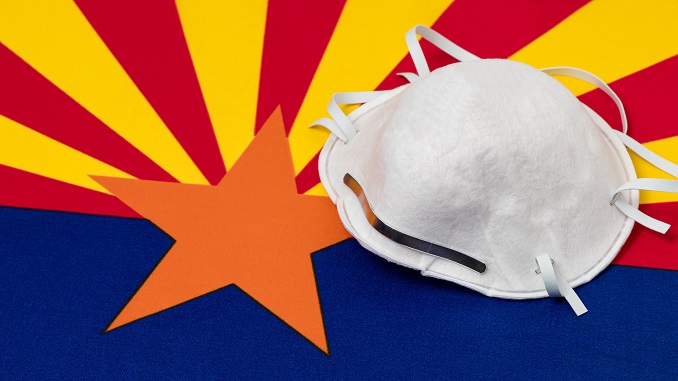
Two years and nine months after “15 days to slow the spread,” the Arizona Department of Health (AZDH) is again asking Arizonans to mask up.
On Tuesday, AZDHS issued a blog post advising indoor masking due to the high levels of COVID-19 infections in eight counties: Apache, Cochise, Gila, Greenlee, La Paz, Navajo, Pima, and Yuma counties.
AZDHS noted that the remaining seven counties have medium community levels.
The renewed guidance follows several years of scrutiny over the efficacy and safety of prolonged mask wearing.
Last April, State Senator Kelly Townsend (R-Mesa) highlighted studies expressing concern over the safety of the graphene coating present on masks. Some, but not all, masks contain graphene. The presence of the carbon atoms isn’t distinguished by any color or design on a mask, and manufacturer labels don’t always disclose its presence.
This past legislative session, lawmakers passed several bills to prohibit mask mandates. HB2616 requires schools to defer to parents when it comes to children wearing masks in schools. HB2453 prohibits government properties from requiring mask wearing on the premises.
Current COVID-19 case breakdowns are as follows: Maricopa County, over 168,000 cases; Pima County, over 41,800 cases; Pinal County, over 16,300 cases; Yavapai County, over 8,100 cases; Apache County, over 7,700 cases; Navajo County, over 7,300 cases; Mohave County, over 7,100 cases; Coconino County, over 6,300 cases; Yuma County, over 5,800 cases; Cochise County, over 5,300 cases; Gila County, 3,000 cases; Santa Cruz County, over 2,100 cases; La Paz County, over 500 cases; and Greenlee County, over 300 cases.
These case totals are less than the spikes that occurred in June and July. Weekly case totals are about 54 percent of what they were this time last year, and about 41 percent of what they were this time in 2020.
The highest number of cases week-over-week occurred throughout January earlier this year.
There have been over 31,700 deaths attributed to COVID-19 since the start of the pandemic. That’s about 962 deaths per month. The most deaths occurred between mid-December 2020 and the end of January 2021.
72 percent of all COVID-19 deaths occurred in those over the age of 65. 15 percent of deaths occurred in those between the ages of 55 and 65. Eight percent of deaths occurred in those between the ages of 45 and 54. Five percent of deaths occurred in those between the ages of 20 and 44. Approximately zero percent of deaths, a total of 73 persons, occurred in those under the age of 20.
Compared with pre-pandemic years, Arizonan deaths in 2020 and 2021 increased by an average of 10,600 both years. From 2012 to 2019, Arizona deaths increased every year by an average of over 1,600.
There were 60,100 deaths in 2019, 75,700 deaths in 2020, and over 81,400 deaths in 2021. It appears that this upward trend won’t continue this year. So far, there have been over 60,700 deaths (present data goes through October): a decline of over 5,000 compared with this same time last year. If death counts for November and December amount to the yearlong average of 6,000 deaths every month, then this year’s total deaths would amount to 72,900.
Nationally, the total number of mortalities increased by 17.6 percent in 2020 nationwide. In 2019, there were over 2.8 million deaths; in 2020, there were over 3.3 million deaths.
Deaths attributed to COVID-19 weren’t the sole cause of the spike. Of the near-504,000 difference, COVID-19 deaths accounted for over 345,000. Heart disease deaths increased by over 31,800; unintentional injury deaths increased by over 19,100; stroke deaths increased by about 9,000.
Deaths attributed to chronic lower respiratory diseases, cancer, and suicide decreased by nearly 8,700 altogether. Deaths from chronic lower respiratory diseases accounted for the greatest decline: over 5,300.
Prior to 2020, year-over-year death increases averaged over 35,500 from 2015 to 2019, or about 1.2 percent every year.
Corinne Murdock is a reporter for AZ Free News. Follow her latest on Twitter, or email tips to corinne@azfreenews.com.