by Ethan Faverino | Oct 20, 2025 | News
By Ethan Faverino |
The Arizona Corporation Commission (ACC) has announced a landmark $132.91 million settlement with Vanguard Marketing Corporation and The Vanguard Group, Inc. to address failures in supervising registered persons and disclosing potential tax consequences to investors.
The settlement follows a change in investment minimums for certain Vanguard target-date retirement funds, which resulted in significant, unanticipated capital gains taxes for investors.
The agreement is the result of a three-year, multi-state investigation led by a task force coordinated through the North American Securities Administrators Association (NASAA), in conjunction with a parallel investigation by the U.S. Securities and Exchange Commission (SEC).
In Arizona alone, 3,675 Vanguard account holders were financially impacted, with additional Arizona investors affected through non-Vanguard custodians.
The settlement ensures full restitution for all affected investors nationwide who faced unexpected tax liabilities due to Vanguard’s oversight.
The SEC has established a Fair Fund to manage the distribution of the $132.91 million settlement, which Vanguard has already paid. The Fair Fund administrator will identify eligible investors, including those in Arizona holding Vanguard funds through non-Vanguard custodians.
Officials at Vanguard have yet to admit or deny the findings of the investigations by the ACC or SEC.
The SEC will oversee the distribution process for all states, including Arizona, to ensure fair and efficient restitution.
Ethan Faverino is a reporter for AZ Free News. You can send him news tips using this link.
by Matthew Holloway | Oct 20, 2025 | News
By Matthew Holloway |
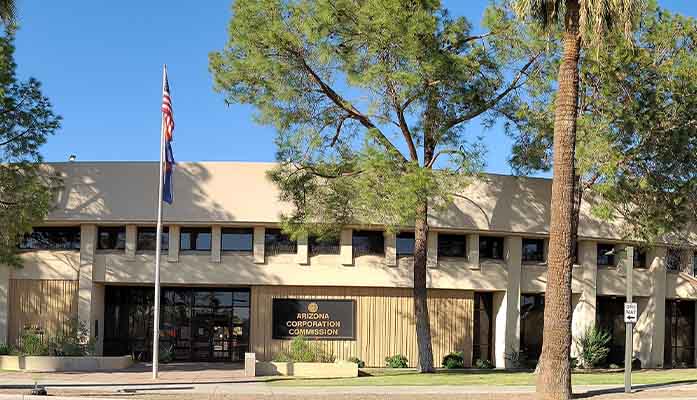
Arizona Corporation Commissioner (ACC) Rachel Walden brought an amendment during the commission’s Wednesday meeting to require detailed, extensive oversight over electrical utilities. Gaining unanimous approval in a 5-0 vote, Walden pushed to ensure Arizona’s electrical grid doesn’t become a ratepayer-funded venue for green projects.
At the October 15th open meeting, Walden pushed through an amendment demanding a more granular kind of report than the industry has provided for the past 26 years, exceeding what is required under Arizona Revised Statutes. Utilities like APS and SRP already owe the ACC their ten-year forecasts under state law, but Walden’s call for more detail: business confidential filings on line congestion, load-growth hotspots, and every grid-hardening method from reconductoring to storm-proofing—are a seismic departure from the more hands-off era that preceded.
“Finding the least cost, most reliable model includes transmission, not just electricity generation. None of the answers from our state utilities today inspired any confidence in me that these issues are a priority,” Commissioner Walden told the meeting. “I am not convinced that additional build out of renewables, while also having to add firm capacity as well as back up generation, is saving Arizonans money. I know that Arizonans are concerned with these issues, especially as we head into accelerated growth in our state. The Commissioners, as elected by the public, are faced with these questions and comments almost daily, and our actions are held accountable to the public.”
The move from Walden and the ACC seems to have been carefully timed. The Thirteenth Biennial Transmission Assessment projects a 3 percent annual growth surge through 2033, significantly faster than previous forecasts, reflecting Arizona’s population boom colliding with a deluge of intermittent ‘renewable’ sources. With solar and wind flooding the system, utilities are rerouting power across state lines, inviting operational headaches from California’s aggressive decarbonization push.
“Arizonans will not bear the costs and impacts of supporting neighboring states’ Green New Deal policies,” Walden said.
Walden’s amendment mandates confidential reports on congestion and bottlenecks, where new solar farms fail to provide a consistent load or data centers increase demand, along with projections to gauge how interconnection requests ripple through the system. Supporting Commissioner Lea Márquez-Peterson’s additions, Walden is requiring complete disclosures on enhancement efforts, ensuring the ACC can vet if utilities are truly fortifying the state’s transmission system.
With major data centers like Microsoft and Google cropping up in Maricopa County, pulling gigawatts from an already strained grid, peak demand strains are a genuine concern. The disastrous 2023 heat wave that had Texas utilities scrambling is fresh in mind. Arizona is hardly immune to such issues. As renewables providers require load balancing and battery installations, the costs are passed on to ratepayers, and Walden is questioning the utilities’ math.
“Ensuring our utilities have sufficient generation capacity to serve our customers during peak demand along with a reliable transmission grid to handle that capacity is paramount,” she said. “The Commission must ensure that any transmission or generation solutions to mitigate grid concerns, such as line congestion created by the interconnections from new generation sources, or offtakes from the grid by large customers such as data centers and hyperscalers, are borne by the creators of those grid concerns, not Arizona ratepayers.”
Walden pledged to scrutinize future Biennial Assessments and Integrated Resource Plans in a distinct pivot from the ACC’s historically more hands-off stance.
“I will be watching the Biennial Transmission Assessments and Integrated Resource Plans closely, and investigating these issues in all future rate cases,” Walden concluded.
Matthew Holloway is a senior reporter for AZ Free News. Follow him on X for his latest stories, or email tips to Matthew@azfreenews.com.
by David Winstanley | Oct 3, 2025 | Opinion
By David Winstanley |
Sandra D. Kennedy, with help and funding from Soros and company, has made it clear that she will bring the Green New Deal to SRP whether customers care or not.
You remember Sandra Kennedy, right? Kennedy tried to pass a Green New Deal regulatory mandate while serving at the Corporation Commission, but it was thankfully defeated by the other Republican Commissioners in 2022. Now, we conservatives need to pay attention again because with the SRP Board elections coming in April, there is a push to flip the board by Sandra Kennedy and her supporters.
Currently, the SRP Board is nearly split between conservatives and Green New Dealers, but the left is pushing hard to flip board members at the SRP election in April. We can’t let that happen.
It is important to understand that SRP does NOT fall under Arizona Corporation Commission jurisdiction, the entity that regulates the other Arizona electric utilities. The Salt River Project Agricultural Improvement and Power District (the District) was officially organized in 1937, formalizing its dual role in managing water resources and providing electricity. This formation was driven by a need to expand the utility’s role in power generation to support the growing population and industries of central Arizona at that time. SRP was formed according to ARS Sec: 48-2301-48-2475, which permits self-governance by a board elected from its members and elections that are completely independent from the regular elections held by city, county, and state.
The next election of Board members (a complex process) will be held April 7, 2026, and all eligible SRP voters must be registered with SRP no later than March 9, 2026. This registration and voting is completely independent of Maricopa County and the Arizona Secretary of State. Maricopa County residents can register to vote here (though you may find that many of you will not be eligible to vote).
Another important point to explore is why all Maricopa County residents who receive electricity from SRP cannot have a vote in who decides on costs of decarbonization, new power plants, and rates to fund these. I have lived in Mesa and Gilbert for the past 45 years and owned 4 houses in that time, but I could only vote in SRP elections at one of the 4 houses, why?
The answer is because the SRP District voting boundaries have never changed since it was incorporated in 1937 even though SRP has expanded service well outside the district’s original boundaries (see here).
The result is that more than 250,000 Maricopa and Pinal County residents have no say in how SRP spends its earnings or sets rates for us customers. This wide swath of Maricopa citizens cannot vote in SRP District elections, and that is just patently unfair!
It is well past time for SRP and the Arizona Legislature to update SRP Governance to include all ratepayers—or give the Corporation Commission the authority to regulate SRP. In the meantime, please do something NOW. Register to vote if you are eligible, and TALK to everyone you know about voting!
David Winstanley is a retired Director of Engineering at Honeywell Aerospace, former Chair of LD15 Republicans, and a conservative activist for local issues in the East Valley.
by Staff Reporter | Sep 29, 2025 | Economy, News
By Staff Reporter |
A series of new laws taking effect are anticipated to raise Arizona’s economic competitiveness.
The Arizona Chamber of Commerce & Industry (Arizona Chamber) highlighted six new laws as giving the state a beneficial boost in economic performance against other states.
These laws aim to make it feasible for international headquarters to build on-site workforce housing and support services (Senate Bill 1543), permit utilities to refinance infrastructure investments through securitization (House Bill 2679), allow Chase Field renovations without increasing taxes (House Bill 2704), make it feasible for advanced air mobility systems such as drone deliveries and air taxis (Senate Bill 1307), require utilities and public power entities to implement wildfire mitigation plans (House Bill 2201), and bars foreign entities from funding lawsuits while limiting outside funding to third-party litigation (Senate Bill 1215).
Dozens of states are working together to create a uniform approach to allowing advanced air mobility, along with the Federal Aviation Administration. Over 30 states are members of the Advanced Air Mobility Multistate Collaborative (AAMMC), formed in 2023 with eight to 10 member states. Arizona is member to the organization leading AAMMC, the National Association of State Aviation Officials.
In addition to raising awareness of the new laws it backs, the Arizona Chamber also releases public reports of failed bills it believed would harm the state’s economy. The chamber announced their 2025 report is forthcoming.
Arizona Chamber President and CEO Danny Seiden stated that the six featured laws would retain corporate interest in the state by implementing necessary reforms and new pathways to growth.
“As these laws take effect, Arizona employers can count on policies that reflect their priorities,” said Seiden. “From keeping vital economic drivers in Arizona, to passing commonsense energy reforms that will deliver long-term stability and affordability, to supporting global companies, these are the kinds of policies that keep Arizona competitive and attractive for investment.”
The legislature also passed other laws anticipated to boost the economy, some of which Governor Katie Hobbs also approved from the Republican-controlled legislature despite a historic veto record (nearly 200 bills this year, compared to her previous historic record of over 140 in 2023).
One such law promises to further protect Arizona from regulatory capture by monopoly-controlled utilities (House Bill 2518). The legislation prohibits Arizona Corporation Commission (ACC) members from accepting employment with the utilities under their regulation. Not all ACC members were pleased with the legislation, namely ACC Chairman Kevin Thompson.
Chair Thompson was the subject of an ethics claim filed by the Energy Policy Institute earlier this year, as first reported by the Arizona Republic. The institute alleged a conflict of interest regarding the relationship between Thompson’s consulting firm and utilities.
Another law will ensure construction crews may work in the early morning hours in the summers by prohibiting municipalities and counties from enacting or enforcing noise ordinances, rules, or regulations prohibiting general construction activities during certain summertime hours (Senate Bill 1182).
And another law requires municipalities to give affected businesses at least 60 days’ notice before voting on tax increases (House Bill 2119).
The legislature also chose to sunset the Low Income Housing Tax Credit program rather than renew. Critics of the program blame lax policies and procedures for the Department of Housing’s loss of around $2 million to a wire fraud scam in 2023.
AZ Free News is your #1 source for Arizona news and politics. You can send us news tips using this link.
by Matthew Holloway | Sep 21, 2025 | News
By Matthew Holloway |
In a key vote on Wednesday, the Arizona Corporation Commission, led by Commissioner Rachel Walden, unanimously repealed the state’s Energy Efficiency (EE) and Demand Side Management (DSM) Rules. The regulations, now 15 years old, have been expired since 2020, and according to the board, have cost Arizona ratepayers more than $1 billion in additional surcharges since inception.
Both APS and TEP have exceeded the requirements, the board noted, with Commissioner Márquez Peterson explaining, “The current standard required the accumulated savings of 22% of retail sales by 2020. We’ve had(sic) reconfirmed that as of 2024, APS is at 26.2% and TEP is currently at 28.52%. Both utilities have exceeded the standard which is out of date.”
“I cast my vote to repeal the rules because the rules were not based on any cost-effectiveness tests, nor did they contain any other ratepayer protection requirements. The mandates instead passed all program costs in support of the few on the backs of all ratepayers, especially onto those who can least afford it—our low- and fixed-income ratepayers, and our hardworking Arizona families,” Commissioner Walden said in a statement Thursday.
“I fully support the use of EE mechanisms and DSM programs, which have demonstrated energy savings, especially during peak summer heating days when our energy needs have stressed the electrical grid. What I do not support is the cost shifts and economic burdens these mandated programs have created, costing ratepayers in excess of $1.1 billion.”
Commissioner René Lopez noted during the meeting that the rules “were written over a decade ago.” He added, “We’ve had a lot of changes in technology, and a lot of changes in demand are coming, It served its purpose, everyone has met the requirements, now it’s time for them to go away.”
The commission explained that the repeal of the rules does not eliminate the EE/DSM program; instead, Arizona utilities will now be required to use All-Source Requests for Proposals when they create plans to address forecasted energy demands, with EE and DSM programs continuing as two categories of solutions that can be proposed for the utility’s consideration.
“I urge technology stakeholders to continue to propose these types of solutions to offset utility generation needs,” Walden added. “The solutions must be cost-effective, and the Commission will continue to evaluate these programs on a case-by-case basis during rate cases. I recently offered an amendment to approve a Bring Your Own Device DSM program for APS customers that did not create a cost shift, and that amendment was adopted by majority vote by this Commission.”
Commissioner Márquez Peterson added in a statement, “As a Commissioner, I will continue to communicate to utilities my support for effective EE programs in future rate cases. These programs can save ratepayers on their electricity bills and help us ensure we have reliable energy during peak times of the day.”
Matthew Holloway is a senior reporter for AZ Free News. Follow him on X for his latest stories, or email tips to Matthew@azfreenews.com.