The Arizona Chamber of Commerce announced Monica Coury, vice president of external affairs at Arizona Complete Health, as the new chair of its board of directors.
Coury officially assumed the role during a ceremonial “passing of the gavel” at the Chamber’s June 26th board meeting, succeeding Ted Geisler, president and CEO of Arizona Public Service (APS), who served as board chair for the past two years.
Monica has been a valued voice on our board, and we’re excited to have her leadership as we continue advancing policies that matter to Arizona employers.
As board chair, Coury will lead the Arizona Chamber of Commerce’s governing board and help guide its efforts to advance policies aimed at strengthening Arizona’s economy, improving the state’s business climate, and promoting long-term economic growth.
“It is an incredible honor to serve as chair of the Arizona Chamber of Commerce & Industry,” stated Coury in a press release announcing her new role. “I want to thank my fellow board members for the confidence they’ve placed in me, and I’m grateful for the opportunity to work alongside the Chamber’s outstanding team.”
“The Chamber has long been one of Arizona’s most effective and respected advocates on behalf of the state’s job creators,” Coury added, “and I look forward to building on that legacy as we continue working to make Arizona the best place in the nation to live, work, and do business.”
Coury has served on the Chamber’s board for several years, previously chairing its Public Affairs Committee before serving as chair-elect.
In her role at Arizona Complete Health, she oversees external affairs for one of the state’s largest health plans and has worked on issues related to healthcare access, workforce development, and economic competitiveness.
Arizona Chamber President and CEO Danny Seiden said Coury’s experience and leadership make her well suited to lead the organizations board.
“Monica is an exceptional leader whose collaborative approach, strategic vision, and deep commitment to Arizona make her the ideal person to lead our board,” said Seiden. “She understands that a strong economy depends on smart public policy, and she has consistently brought thoughtful leadership and sound judgment to the Chamber. I look forward to working closely with Monica as we continue advancing policies that help Arizona employers create jobs, invest, and grow.”
Seiden also recognized Geisler’s service as chairman, crediting him with helping lead the organization through a period marked by legislative successes and continued organizational growth.
“Ted has been an outstanding chairman, a trusted partner, and a friend,” Seiden added. “His steady leadership, business acumen, and unwavering commitment to Arizona’s economic future have helped position the Chamber for continued success. We are grateful for his service and look forward to his continued counsel and involvement on our board.”
Along with Coury, the Chamber also announced its new slate of board officers, including Jimmy Lindbolm of Willmeng Construction as chair-elect, Don Isaacson of Isaacson Law Firm as vice-chair of audit and finance, and Angela Creedon of Intel as vice-chair of manufacturing
Ethan Faverino is a reporter for AZ Free News. You can send him news tips using this link.
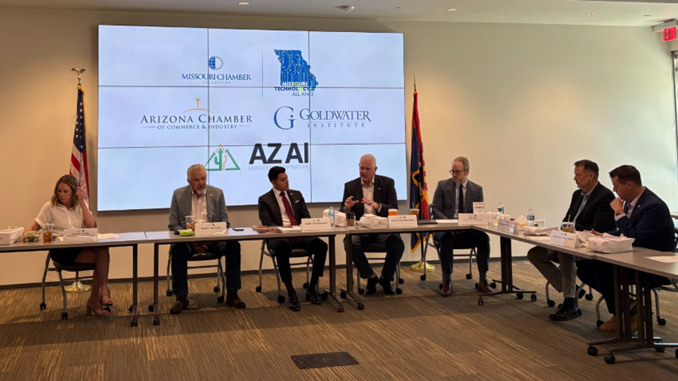
The Arizona Chamber of Commerce & Industry and the Goldwater Institute hosted a delegation of Missouri policymakers in Phoenix to discuss economic competitiveness, innovation, and pro-growth policy, according to a joint release.
The meeting focused on Arizona’s approach to building a competitive environment for emerging industries and long-term economic growth.
The discussion followed the Chamber’s recent launch of its AZ AI Leadership Initiative, which aims to strengthen Arizona’s position in emerging technologies and the broader digital economy.
Arizona has seen rapid expansion in AI and data center infrastructure, driven by growing demand for computing power and cloud services. Major investments from companies such as Taiwan Semiconductor Manufacturing Company (TSMC), which is constructing advanced semiconductor fabrication facilities in Phoenix, along with large-scale data center developments by Google and Meta Platforms in Mesa, and Amazon Web Services in Goodyear, have helped position the state as an emerging hub for both semiconductor production and AI-related computing capacity.
Participants included legislative leaders, policy experts, and representatives from the Arizona Commerce Authority, who shared insights into the state’s policy framework and economic development strategies.
A big part of the conversation: how states are thinking about AI and the broader digital economy.
“Arizona’s growth didn’t happen by accident,” said Courtney Coolidge, executive vice president of the Arizona Chamber of Commerce & Industry. “It reflects deliberate policy choices that prioritize certainty, competitiveness, and a regulatory environment where businesses can invest, innovate, and scale.”
Arizona lawmakers participating in the meeting included House Speaker Steve Montenegro (R-LD29), Majority Leader Michael Carbone (R-LD25), Rep. Jeff Weninger (R-LD13), Rep. Justin Wilmeth (R-LD2), chair of the House Artificial Intelligence and Innovation Committee, Senate President Pro Tempore T.J. Shope (R-LD16), and Senate Majority Whip Frank Carroll (R-LD28).
“Arizona has made a conscious decision to lead on innovation rather than wait for other states to set the pace,” Montenegro said. “That kind of alignment and forward-looking policy environment allows industries to grow and scale here.”
Lawmakers and policy leaders highlighted sectors including advanced manufacturing, semiconductors, aerospace, autonomous systems, and emerging technologies as areas where Arizona has seen sustained growth.
“Arizona’s success in attracting major investment is tied directly to our focus on advanced manufacturing, infrastructure, and supply chain strength,” Carbone said.
Weninger pointed to Arizona’s regulatory and tax structure as a factor in business investment.
“Companies are looking for certainty,” Weninger said. “Arizona’s predictable regulatory environment and competitive tax structure give businesses the confidence to invest and expand.”
Participants also discussed the role of infrastructure, water policy, and land use in supporting statewide growth. “We’ve been intentional about making sure economic development isn’t concentrated in one region,” Shope said.
Carroll said Arizona’s approach to economic development has positioned the state for continued expansion, particularly in emerging industries.
Wilmeth emphasized the importance of flexibility in regulating new technologies. “We’ve taken a thoughtful approach to emerging technologies by avoiding premature regulation,” he said.
Victor Riches, president and CEO of the Goldwater Institute, said policy certainty and deregulation remain key factors in supporting innovation.
“As emerging technologies continue to reshape industries, policy certainty and deregulation matter more than ever,” Riches said. “Arizona needs to ensure an environment where innovation can move forward.”
The Missouri delegation included state senators and policy advisors, including Sen. Travis Fitzwater, Sen. Maggie Nurrenbern, Sen. Karla May, Sen. Barbara Anne Washington, Sen. Jamie Burger, policy advisor to Gov. Mike Kehoe, Johnathan Shifflett, and representatives from the Missouri Chamber of Commerce, Karen Buschmann, and Jared Hankinson.
The meeting explored how elements of Arizona’s economic policy framework could be adapted in other states and how interstate collaboration could support broader economic growth.
Arizona manufacturing and business groups can claim a policy win in Washington, D.C., after the U.S. House of Representatives passed a major federal permitting reform bill they had urged Congress to advance.
On December 18, the House approved the Standardizing Permitting and Expediting Economic Development (SPEED) Act, H.R. 4776, in a 221–196 vote. The legislation is designed to streamline environmental reviews and speed federal permitting for large energy infrastructure projects, data centers, factories, and other major developments.
The bill, sponsored by House Natural Resources Committee Chairman Bruce Westerman (R–AR) and Rep. Jared Golden (D–ME), amends the National Environmental Policy Act (NEPA) to shorten review timelines, clarify when NEPA applies, and limit how long lawsuits can delay projects. A committee summary says the measure is intended to “modernize NEPA,” reduce permitting backlogs, and curb what supporters describe as “abusive litigation” that has slowed infrastructure and energy projects nationwide.
In a press release on the day of the vote, Westerman called the SPEED Act’s passage “a win for America” and urged the Senate to move quickly. The committee noted that more than 375 organizations nationwide backed the bill.
The House vote followed a coordinated push by national and Arizona manufacturing advocates in early December, when congressional leaders signaled they would take up permitting reform over a two-week stretch.
In a December 10 article, Chamber Business News reported that the National Association of Manufacturers (NAM) and Arizona business groups were urging Congress to act on what NAM branded the “12 Days of Permitting Reform.” NAM called on lawmakers to move several bills — including the PERMIT Act and the SPEED Act — to simplify federal reviews and shorten timelines for major infrastructure, energy, and industrial projects.
NAM President and CEO Jay Timmons said at the time that Congress had an opportunity “over the next 12 days to demonstrate strong, bipartisan momentum on comprehensive permitting reform,” and encouraged policymakers to make it easier and more cost-efficient for manufacturers to advance job-creating projects.
For Arizona, business leaders framed the debate as directly tied to the state’s ability to keep pace with growth in sectors such as power generation, semiconductor fabrication, aerospace and defense manufacturing, and AI-driven data centers, all of which depend on predictable federal approvals.
Arizona Chamber of Commerce & Industry President and CEO Danny Seiden said modernizing federal permitting is critical for Arizona’s economic future, arguing that “manufacturers can’t meet demand, onshore supply chains, or power new AI and data-center growth without a permitting system that works.”
“Arizona’s economy depends on major projects moving on predictable timelines. Congress should advance the PERMIT Act and the SPEED Act so companies can build the infrastructure and capacity our economy requires,” Seiden added.
Grace Appelbe, executive director of the Arizona Manufacturers Council, told Chamber Business News that long, unpredictable federal reviews create significant challenges for small and mid-sized manufacturers trying to expand, upgrade equipment, or bring new technologies online, and said reforms could lower costs and improve Arizona’s competitiveness for new investment.
The House Natural Resources Committee describes the SPEED Act as a structural update to NEPA’s review process. Key provisions include:
Shorter, defined timelines for environmental reviews on major federal actions.
Clearer triggers for NEPA, by defining “major federal action” more narrowly.
Streamlined documentation, intended to reduce the length and complexity of NEPA analysis.
Limits on litigation, including a 150-day window for filing NEPA challenges, to reduce long-running court delays.
External reporting has noted that industry groups, such as energy and infrastructure advocates, welcomed the bill as the first significant federal permitting reform effort since NEPA was enacted in 1969, while environmental organizations have urged the Senate to reject or significantly revise the measure, warning that looser standards could weaken environmental protections and public participation.
With House passage secured, the SPEED Act now moves to the U.S. Senate, where lawmakers in both parties are working on broader permitting legislation and have signaled potential changes to the House bill, Axios reports.
Arizona manufacturers and business groups, which spent early December calling for action on the SPEED Act and related measures, are expected to continue pressing for a final package that delivers the permitting certainty they say is needed for long-term investment and for meeting the state’s projected load and infrastructure demands.
The U.S. Environmental Protection Agency (EPA) has filed a motion in a federal appeals court to vacate a Biden-era rule on fine particulate matter air quality standards, which was set to affect air quality regulations in Arizona.
In the motion filed in the U.S. Court of Appeals for the D.C. Circuit, Department of Justice attorneys representing the EPA told the D.C. Circuit that the agency’s 2024 rule change on fine particulate pollution standards is both legally and scientifically flawed and must be vacated. The motion noted that the “supplement” to the EPA’s 2019 Assessment of the NAAQS, or National Ambient Air Quality Standards, for particulate matter, “did not represent [a] full multidisciplinary evaluation of evidence’ for the underlying air quality criteria.” It added that the agency “lacks statutory authority to revise standards absent a thorough review.”
The PM 2.5 rule, finalized on December 15, 2024, was purported to strengthen protections against fine particulate matter pollution, which the EPA stated was linked to respiratory and cardiovascular health risks. Implementation was set to begin in 2025, with full compliance deadlines extending to 2031. The final rule revising the NAAQS lowered the annual primary PM 2.5 standard from 12.0 micrograms per cubic meter to 9.0 micrograms per cubic meter. The rule also established a new 24-hour PM 2.5 standard of 35 micrograms per cubic meter. The rule remains in effect until the court comes to a decision.
The consolidated lawsuits involved petitioners including the Commonwealth of Kentucky, et al., the Arizona Legislature, and the Arizona Chamber of Commerce, along with 21 other states and business groups against the U.S. Environmental Protection Agency, et al. The states and business groups challenged the rule, arguing it would impose billions in compliance costs on states like Arizona, potentially halting construction projects and job growth in areas struggling to meet the stricter standards.
The petitioners contended that the new limits would classify more areas as being in a state of nonattainment, leading to economic restrictions under the Clean Air Act. Oral arguments in the case were heard on December 16, 2024.
Arizona Senate President Warren Petersen hailed the EPA’s motion on X on November 26, 2025, crediting EPA Administrator Lee Zeldin with what he called a “BIG WIN FOR ARIZONA!” He added that the EPA, “just filed a motion in federal court to throw out Biden’s unlawful PM 2.5 rule that made it nearly impossible for parts of Arizona to ever meet clean-air standards — a rule that would have crushed jobs, construction, and our economy with billions in costs. The AZ Legislature & the AZ Chamber sued the Biden admin to stop this job-killing regulation. Our lawsuit helped bring about this reversal. Thank you, President Trump, for keeping your promise to cut red tape and protect Arizona families!”
BIG WIN FOR ARIZONA!
The Trump EPA, under Secretary Zeldin, just filed a motion in federal court to throw out Biden’s unlawful PM 2.5 rule that made it nearly impossible for parts of Arizona to ever meet clean-air standards — a rule that would have crushed jobs, construction,… pic.twitter.com/pa7rIDKRVt
Adam R.F. Gustafson, Principal Deputy Assistant Attorney General, and Sarah I. Zafar, Trial Attorney in the DOJ Environment and Natural Resources Division, filed the EPA’s motion for vacatur. They wrote in part, “Implementation of the NAAQS is a complex process, which generates significant costs and reliance interests among States, local governments, and regulated parties.”
The DOJ attorneys also argued that the EPA, “should at least have considered the distinct costs associated with revising the NAAQS mid-cycle. EPA’s disregard of this relevant factor was arbitrary and capricious because it was unreasonable for EPA to read an exercise of discretionary authority as an invitation to ignore a relevant factor like cost.”
The case remains ongoing in the U.S. Court of Appeals for the D.C. Circuit.
A series of new laws taking effect are anticipated to raise Arizona’s economic competitiveness.
The Arizona Chamber of Commerce & Industry (Arizona Chamber) highlighted six new laws as giving the state a beneficial boost in economic performance against other states.
These laws aim to make it feasible for international headquarters to build on-site workforce housing and support services (Senate Bill 1543), permit utilities to refinance infrastructure investments through securitization (House Bill 2679), allow Chase Field renovations without increasing taxes (House Bill 2704), make it feasible for advanced air mobility systems such as drone deliveries and air taxis (Senate Bill 1307), require utilities and public power entities to implement wildfire mitigation plans (House Bill 2201), and bars foreign entities from funding lawsuits while limiting outside funding to third-party litigation (Senate Bill 1215).
Dozens of states are working together to create a uniform approach to allowing advanced air mobility, along with the Federal Aviation Administration. Over 30 states are members of the Advanced Air Mobility Multistate Collaborative (AAMMC), formed in 2023 with eight to 10 member states. Arizona is member to the organization leading AAMMC, the National Association of State Aviation Officials.
In addition to raising awareness of the new laws it backs, the Arizona Chamber also releases public reports of failed bills it believed would harm the state’s economy. The chamber announced their 2025 report is forthcoming.
Arizona Chamber President and CEO Danny Seiden stated that the six featured laws would retain corporate interest in the state by implementing necessary reforms and new pathways to growth.
“As these laws take effect, Arizona employers can count on policies that reflect their priorities,” said Seiden. “From keeping vital economic drivers in Arizona, to passing commonsense energy reforms that will deliver long-term stability and affordability, to supporting global companies, these are the kinds of policies that keep Arizona competitive and attractive for investment.”
The legislature also passed other laws anticipated to boost the economy, some of which Governor Katie Hobbs also approved from the Republican-controlled legislature despite a historic veto record (nearly 200 bills this year, compared to her previous historic record of over 140 in 2023).
One such law promises to further protect Arizona from regulatory capture by monopoly-controlled utilities (House Bill 2518). The legislation prohibits Arizona Corporation Commission (ACC) members from accepting employment with the utilities under their regulation. Not all ACC members were pleased with the legislation, namely ACC Chairman Kevin Thompson.
TOTALLY UNCALLED FOR
AZ Corporation Commission member Kevin Thompson’s personal attacks against Rep. Justin Olson are totally unprofessional
Arizonans have become accustomed to childish meltdowns like this from Katie Hobbs
Chair Thompson was the subject of an ethics claim filed by the Energy Policy Institute earlier this year, as first reported by the Arizona Republic. The institute alleged a conflict of interest regarding the relationship between Thompson’s consulting firm and utilities.
Another law will ensure construction crews may work in the early morning hours in the summers by prohibiting municipalities and counties from enacting or enforcing noise ordinances, rules, or regulations prohibiting general construction activities during certain summertime hours (Senate Bill 1182).
And another law requires municipalities to give affected businesses at least 60 days’ notice before voting on tax increases (House Bill 2119).
The legislature also chose to sunset the Low Income Housing Tax Credit program rather than renew. Critics of the program blame lax policies and procedures for the Department of Housing’s loss of around $2 million to a wire fraud scam in 2023.
AZ Free News is your #1 source for Arizona news and politics. You can send us news tips using this link.