by Matthew Holloway | Aug 15, 2025 | News
By Matthew Holloway |
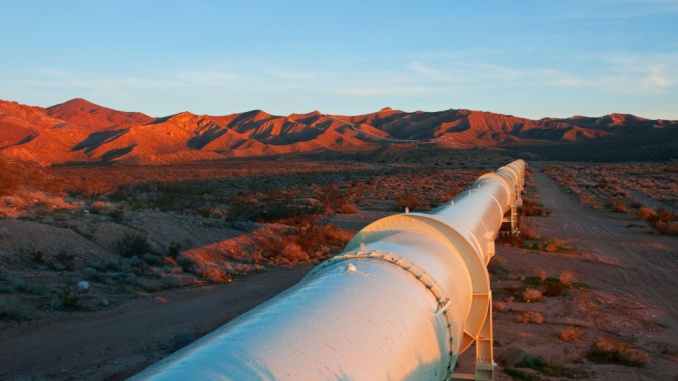
A coalition of Arizona businesses from across the state released a statement expressing strong support for a newly announced project by Energy Transfer LP. The project will bring an interstate natural gas pipeline into the state from West Texas, constructed, owned, and operated by Transwestern Pipeline Company. It will power Arizona Public Service (APS), Salt River Project (SRP), Tucson Electric Power (TEP), Unisource Energy Services, and other utilities that supply energy to Arizona’s homes and businesses.
The new 42-inch pipeline, kept pressurized by nine compression stations, will span 516 miles across Texas, New Mexico, and Arizona. It will carry 1.5 billion cubic feet per day of natural gas. It is expected to come online in 2029.
AZBigMedia reported that the project is expected to cost approximately $5.3 billion, including about $600 million of Allowance for Funds Used During Construction (AFUDC)
“With this new natural gas pipeline, Arizona will be well positioned to have reliable baseload power to meet the growing demands of our economy,” said Arizona Corporation Commissioner Rachel Walden in a statement. “I’m pleased to see that the City of Mesa is participating in this project, serving as an example of Arizona’s ability to attract new commerce with affordable power while innovating in water conservation.”
In a post to X, Commissioner Nick Myers noted that this annoucement came alongside the recent accouncement that APS is rolling back its Biden-era zero-carbon goals. He said, “On the same day it was announced that APS is backing off their Green New Deal style policies, further proof that this commission has not been friendly to those policies, it was announced that Transwestern will be putting in another natural gas pipeline into Arizona. Energy dominance at its best!”
According to the Arizona Chamber of Commerce and Industry, “The project will help ensure that Arizona remains competitive with other high-growth states by providing the reliable, cost-effective energy necessary for economic development and job creation, particularly as energy demand is projected to soar.”
The Chamber added in a press release, “Natural gas is a cornerstone of Arizona’s energy system, generating 45% of the state’s electricity. It plays a critical role in supporting Arizona’s modern electricity grid, helping utilities meet peak demand during extreme summer weather and enabling the deployment of renewable energy resources like solar and wind year-round. Additionally, more than 1.4 million residential, commercial, and industrial customers count on the natural gas distribution system for their home comfort and business needs, including in sectors like semiconductors, EV batteries, and other advanced manufacturing.”
APS director of Resource Integration and Fuels Jill Freret told KJZZ, “This expansion for APS and for some of our peer utilities really allows us to bring in more natural gas to fuel existing facilities with growing demand and position us to have additional gas on our system out into the future.” Freret observed that the energy demand of APS is expected to increase by over 60% in the next 13 years.
The benefits of the project are not limited to the energy industry, however. Patrick Bray, Executive Vice President of Arizona Farm and Ranch Group, explained, “Access to natural gas supply is essential for our farmers and ranchers to power critical operations. This pipeline is a smart investment that will ensure the continued success and competitiveness of Arizona’s agriculture industry, allowing us to produce the food that sustains our communities and contributes significantly to our economy.”
In addition to dozens of Chambers of Commerce across the state, from Flagstaff to Sahuarita, industry organizations including the Arizona Cattle Feeders Association, Arizona Lodging & Tourism Association, Arizona Manufacturers Council, Arizona Multi-housing Association, Arizona Restaurant Association, Arizona Rock Product Association, Arizona Small Business Association, Arizona Trucking Association, and the United Dairymen of Arizona, all expressed support for the pipeline.
Matthew Holloway is a senior reporter for AZ Free News. Follow him on X for his latest stories, or email tips to Matthew@azfreenews.com.
by Daniel Stefanski | Nov 23, 2024 | News
By Daniel Stefanski |
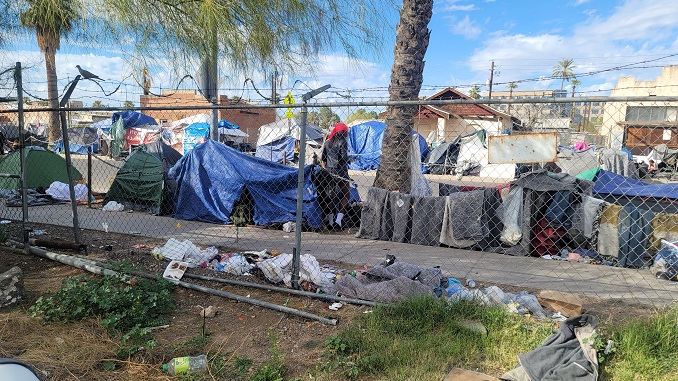
A ballot measure to protect Arizonans from the rise of unabated homelessness in communities was overwhelmingly passed by voters in the General Election.
Earlier this month, Proposition 312 received almost 60% of the vote, cruising to a smooth victory on Election Night. The measure, which was referred to the ballot from the Arizona Legislature, stipulates that “property owners may apply for a tax refund for expenses incurred due to a governing authority’s failure to enforce certain public nuisance laws on or near the owner’s real property.”
The legislative vehicle for the measure, HCR 2023, was sponsored by House Speaker Ben Toma. It passed both chambers in the Arizona Legislature with bipartisan support and was transmitted to the Secretary of State’s Office in March of this year.
In a statement after the successful passage of the bill out of his chamber, Senate President Warren Petersen said, “There are instances where local governments routinely and repeatedly fail their citizens by not enforcing laws. An example of this would be the City of Phoenix’s handling of the former homeless encampment known as ‘The Zone.’ This area was not only a public safety and public health disaster for those who camped there, but it was also a detriment to the livelihoods of small business owners who set up their shops in the area.”
Petersen added, “Money talks, and as a way to encourage municipalities to enforce the law, Speaker Toma and I teamed up to sponsor HCR 2023/SCR 1006. This measure is a ballot referral that would protect law-abiding citizens. If approved by voters, property owners would be allowed to request a refund for expenses incurred to mitigate the problem, up to the amount of their property tax liability. The funds would be deducted from the local government’s state shared revenue.”
Speaker Toma also had said, “Business owners and residents alike are having their property stolen, vandalized, or terrorized and are desperate for help. That’s why I sponsored HCR2023, to hold our local governments accountable to our community members and to help provide some relief for property owners who have suffered damages because of a city’s purposeful failure to provide the public health and safety services we all pay for.”
The Arizona Chamber of Commerce and Industry, which was instrumental in promoting the proposition, issued a statement following the General Election win, writing, “Arizona voters have sent a clear message: Government, do your job. They do not want our state to become the next San Francisco or Los Angeles. Prop 312 is a win for property owners, businesses, and everyday Arizonans who too often shoulder the costs of unaddressed homelessness.”
The Goldwater Institute, which also pushed for Prop 312’s passage, also took a well-deserved victory lap after the positive result. The organization’s President and CEO, Victor Riches, stated, “The voters sent a clear message this election cycle: they demand their tax dollars be used to enforce the law and address rampant homelessness. Now that Prop 312 is law, business and property owners will not be left holding the bag when municipalities refuse to do their job.”
Daniel Stefanski is a reporter for AZ Free News. You can send him news tips using this link.
by Daniel Stefanski | Dec 27, 2023 | News
By Daniel Stefanski |
Arizona’s top business organization is speaking out against a closure of two significant border crossings in Texas.
Last week week, the Arizona Chamber of Commerce and Industry issued a statement on “X” after the U.S. Customs and Border Protection (CBP) announced its suspension of rail operations in Eagle Pass and El Paso, Texas, due to the massive influx of illegal immigration all along the southern border. In the press release sharing the news, CBP stated that it was “taking additional actions to surge personnel and address (the) concerning development (of) a recent resurgence of smuggling organizations moving migrants through Mexico via freight trains.”
The Chamber’s “X” account said, “Rail crossing closures in Texas affect commerce border-wide, including here in AZ. We’re in a busy shipping/shopping season. We’ve already seen how Lukeville’s closure has affected cross-border commerce. The U.S. Department of Homeland Security should protect our supply chains and reverse these closures.”
In an opinion piece published in the Chamber Business News, AZ Chamber President and CEO Danny Seiden, along with the President and CEO of the Texas Association of Business, Glen Hamer, warned of the negative business and economic consequences of the increasing number of closures at the border, calling these actions “unacceptable.” The two men wrote that these closures “damage cross-border trade….cause shipping delays and cost increases, which get passed along to consumers in the form of higher prices on store shelves….make travel more difficult for folks who want to visit friends and family or simply run errands, and … cut off small businesses from their customers.”
Seiden and Hamer gave four recommendations at the end of their piece, including one for the government to prioritize “processing of legitimate trade and travel over migrants with dubious amnesty claims.”
Over the past few months, the border crisis has deteriorated considerably, forcing the Biden Administration to take rather unprecedented measures in a frenzied attempt to mitigate public perception of the massive influx of illegal immigrants into the country. One of those actions was the closure of the Lukeville Port of Entry, which is the main thoroughfare to the popular tourist destination of Rocky Point, forcing families or commerce operators to detour hours to the east or west. A local business owner recently told an Arizona outlet that, in the aftermath of the closure, Rocky Point “was like a little ghost town,” noting that “local business, restaurants, hotels, rentals, everything has declined.”
With no end in sight to the historic wave of illegal immigration, and no word on whether the Lukeville, Eagle Pass, and El Paso border operations will be reopened for business, many are wondering when and where the next major economic disruption will take place as the government searches for answers to solve this crisis.
Daniel Stefanski is a reporter for AZ Free News. You can send him news tips using this link.
by Daniel Stefanski | Jul 15, 2023 | News
By Daniel Stefanski |
As the Arizona Legislative session may be nearing its final stretch, the state’s premier business organization is highlighting bills that would have had grave consequences for jobs.
On Wednesday, the Arizona Chamber Foundation and the Common Sense Institute released a report, showing that “67 failed bills from the 2023 legislative session in Arizona” would have cost the state’s economy $9.5 billion and deprived individuals of 113,500 jobs. According to the report, those bills would also have “imposed over $25 billion in annual new costs on Arizona’s businesses, including $15 billion in new taxes and fees.”
The two organizations compared Arizona’s path to our neighboring state of Colorado – if the Grand Canyon State would have passed any or all of the 67 bills of note. They reveal that 13 bills that failed this year in Arizona, “have actually passed in Colorado.”
Danny Seiden, the President and CEO of the Arizona Chamber of Commerce and Industry issued a statement in conjunction with the report, writing, “At the Arizona Chamber, we are committed to protecting the job gains we have seen in Arizona in recent years. This analysis provides important data points for legislators to consider as these failed bills will likely resurface in future sessions.”
Katie Ratlief, the Executive Director of Common Sense Institute Arizona, also weighed in on the announcement, saying, “This study shows that policy matters when it comes to jobs and economic impacts. Policymakers and the public should be informed about the short and long term impacts these pieces of legislation have so they can weigh pros and cons and make informed decisions.”
AZ Free News reached out to Arizona Senate President Warren Petersen, one of the key forces behind killing these bills throughout the still-ongoing session, to respond to the report. Petersen said, “This is a great example of why policy matters. Arizona has built on years of sound policy under Republican leadership that has helped grow our state’s economy. We’ll continue to do everything we can to protect Arizona citizens and our economy from the type of policies that have negatively impacted Colorado.”
House Speaker Ben Toma, another stalwart defender of conservative principles in the Legislature, added, “The far left has tightened its grip on the Democrats in Arizona and it shows in the bills they introduced this session in the State Legislature. They propose business and environmental regulations that would stymie growth, kill jobs, and make energy costs higher. In my term as Speaker of the House, I will continue to work to stop these policy proposals so we can continue to be a state on a positive trajectory with low taxation, high growth, and maximum freedom.”
Freshman Republican Representative Matt Gress shared his thoughts on the report in a tweet, stating, “POLICY MATTERS. Arizona succeeds when leaders trust people over government. @CSInstituteAZ’s report reveals that some politicians think they know better than you with terrible ideas like, tax hikes, higher energy costs to fund more ‘green’ regulations, greater compliance with the ‘Mother, may I?’ administrative state. That’s everything Arizona is not.”
Daniel Stefanski is a reporter for AZ Free News. You can send him news tips using this link.
by Terri Jo Neff | Aug 9, 2022 | Economy, News
By Terri Jo Neff |
The Arizona Chamber of Commerce and Industry is hoping the U.S. House of Representatives takes a hard look at H.R. 5376, which was formerly known as the Build Back Better Act until being recently rechristened as the Inflation Reduction Act of 2022.
“Arizona job creators oppose the vast majority of the provisions in this bill,” Chamber CEO Danny Seiden said Sunday after the U.S. Senate passed the legislation on party lines. “This bill will not reduce inflation and it will not make the U.S. economy more competitive. Renaming a massive tax and spending bill the Inflation Reduction Act does not improve it.”
Seiden says Sen. Kyrsten Sinema met with Arizona business stakeholders to hear their concerns and did help blunt some of the more harmful provisions, especially those which impact manufacturing businesses already doubly hit by inflation and supply chain disruptions
He also acknowledged there are a few beneficial elements of H.R. 5376 such as provisions which encourage continued business investment and provide significant drought resiliency funding to promote a water secure future.
But despite some of “positive aspects,” Seiden insists H.R. 5376 leaves much to be desired. Which is why he and other state business leaders are calling on Arizona’s nine Representatives to take a closer look at the bill in advance of an expected Aug. 12 vote.
“With the bill headed to the House, we would encourage the Arizona delegation to consider the legislation’s negative effect on Arizona jobs,” Seiden said, adding that that renaming the unpopular Build Back Better Act does not improve the fact the legislation is a massive tax and spending bill.
The legislation is estimated to raise $740 billion in additional revenue from new taxes as well as more enforcement of existing tax laws. It also authorizes $430 billion in new spending, although a more thorough analysis by the Congressional Budget Office has not been completed.
One thing the CBO already knows, U.S. Senator Bernie Sanders said on the Senate Floor, is that what he labeled the “so-called” Inflation Reduction Act will have “a minimal impact on inflation.”
The CEO of the National Association of Manufacturers also expressed disappointment with H.R. 5376. According to Jay Timmons, the Inflation Reduction Act will stifle manufacturing investment in America, undermining the very businesses which kept America’s economy afloat during the COVID-19 pandemic.
“To be sure, (the bill) was worse before Sen. Sinema worked to protect some areas of manufacturing investment,” Timmons said. “But the final bill is still bad policy and will harm our ability to compete in a global economy.”
Also speaking out against H.R. 5376 is the Pharmaceutical Research and Manufacturers of America, whose members will be directly impacted by Medicare drug price controls included in the legislation.
“They say they’re fighting inflation, but the Biden administration’s own data show that prescription medicines are not fueling inflation,” said PhRMA CEO Stephen Ubl. “And they say the bill won’t harm innovation, but various experts, biotech investors and patient advocates agree that this bill will lead to fewer new cures and treatments for patients battling cancer, Alzheimer’s and other diseases.”