Attorney General Kris Mayes sustained a fatal blow in her case against the 2020 alternate electors for President Donald Trump.
Mayes doesn’t plan on giving up, though.
The Arizona Supreme Court denied Mayes’ appeal of lower court rulings in State v. Ward this week. This means that Mayes must start over to continue prosecution of the alternate electors.
Mayes’ spokesman Richie Taylor confirmed the attorney general plans to return to the grand jury to seek another indictment; he would not provide further comment.
Republican Rep. Abe Hamadeh (AZ-08) said Mayes’ persistence to prosecute despite the rejection of multiple courts proved her to be “completely unhinged” and in need of sanctioning.
“She’s wasting Arizona taxpayers’ money on her obsessive, Ahab-like pursuit of patriotic Arizonans who served as alternate electors after the stolen 2020 election,” said Hamadeh. “Her first sham indictment was already laughed out of every court in the state.”
She’s wasting Arizona taxpayers’ money on her obsessive, Ahab-like pursuit of patriotic Arizonans who served as alternate electors after the stolen 2020 election.
Her first sham indictment was already laughed out of every court in…
— Office of Congressman Abe Hamadeh (@RepAbeHamadeh) June 4, 2026
Senate President Warren Petersen (R-LD14) — who is running to unseat Mayes this November — said Mayes was the poster child of a “rogue” attorney general.
“This is what a rogue AG looks like,” said Petersen. “Loses at every level and still not tired of losing.”
This is what a rogue AG looks like. Loses at every level and still not tired of losing. https://t.co/UKhjcfDPZx
Mayes has sustained a series of losses in her attempt to prosecute the Trump electors, each court ruling increasingly diminishing the life of her case until it reached the point where it lies now — effectively on life support as it awaits another grand jury indictment that may not come.
Last September, the Arizona Court of Appeals rejected Mayes’ appeal of a ruling issued last May by the Maricopa County Superior Court. The latter court remanded Mayes’ case back to a grand jury, ruling that she violated the due process of the alternate electors by failing to give the grand jury a document critical to the indictment, the Electoral Count Act (ECA) of 1887.
The ECA is a federal law outlining the legal process for casting and counting electoral votes in presidential elections. It was modified recently in 2022 under the Biden administration through the Electoral Count Reform Act of 2022 (ECRA).
The ERCA, in part, limited the vice president’s involvement in electoral certification to a ministerial role, raised the congressional threshold for elector objections to one-fifth of Congress, and made state governors the authority for submitting the certificate of electors.
Key to the defense of the electors was the argument that they acted in good faith in accordance with the ECA.
Mayes has also been accused of receiving payment to prosecute the alternate electors, according to a whistleblower complaint filed last November.
That complaint alleged that States United Democracy Center (SUDC) paid around $200,000 to have prosecutorial influence over the alternate electors case. It was SUDC who advised Mayes’ office in a summer 2023 letter to prosecute Trump’s top supporters from the contentious 2020 election and its aftermath. Mayes’ office has denied the impact of the SUDC letter on their decision to prosecute the alternate electors.
Hamadeh asked the Department of Justice to investigate this alleged “pay-to-play” scheme.
That DOJ investigation is ongoing.
In April, a court of appeals judge ruled in another case that Mayes illegally withheld communications between her office and SUDC.
Trump has pardoned these alternate electors and supporters of the federal charges against them, but state charges like Mayes’ remain.
AZ Free News is your #1 source for Arizona news and politics. You can send us news tips using this link.
A staple of Arizona’s most conservative coalition of lawmakers is running to rejoin the state legislature.
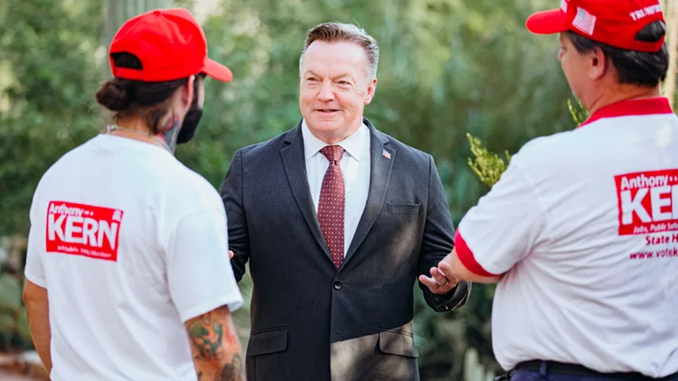
Anthony Kern is seeking to once again represent the 27th legislative district, held by incumbent Republican State Sen. Kevin Payne. Kern and Payne are the only two Republicans in the race; three Democrats have filed statements of interest.
Kern last represented that district in the Arizona Senate from 2023 to 2025. Kern departed from the state legislature in order to make his unsuccessful run for the 8th Congressional District in 2024. Prior to the state senate, Kern represented the 20th legislative district in the Arizona House of Representatives from 2015 to 2021.
While in the legislature, Kern built a reputation as one of its more outspoken conservative members. This was reflected by his membership with the Arizona Freedom Caucus, and A-ratings for conservative lawmaking from the Conservative Political Action Committee, NumbersUSA, American Conservative Union, National Rifle Association, and Keep Arizona Free.
Kern held a number of committee leadership positions, including chairmanships of the Senate Judiciary and Elections Committee and the House Rules Committee, and a vice chairmanship of the Senate Public Safety Committee.
President Donald Trump and Turning Point USA have been among a number of Republican powerhouses to take notice of Kern. Trump commended Kern as “an incredible fighter for election integrity,” and pardoned him from the 2020 Trump electors case put together by the Biden Department of Justice. Turning Point USA’s affiliate, Turning Point Action, has endorsed Kern.
Although the federal charges against Kern and other electors were dropped, Democrat Attorney General Kris Mayes has pursued her own case. A court of appeals ruled last month in a loosely related case that Mayes illegally withheld communications in which she conspired with States United Democracy Center to prosecute Trump’s allies.
Prior to joining the legislature over a decade ago, Kern worked in municipal code enforcement and other public safety roles in the West Valley.
It appears that this background — combined with his repeated public commitments to limiting administrative rulemaking and expanding legislative oversight of regulations — has influenced a take from Kern that puts him at odds with other Republican lawmakers, though not with fellow conservatives.
Kern’s platform includes an opposition to automatic license plate readers (APLRs), such as the Flock Safety cameras. Unlike Kern, Payne as chairman of the Senate Public Safety Committee sponsored a bill in support of APLRs earlier this year, SB 1111.
Other aspects of Kern’s platform include healthcare reform, proposing health providers must offer one single price for products and services, and health insurance premiums and medical expenses must be tax-free; and private property protections, proposing a removal of certain alleged loopholes to squatter prevention laws.
Kern has described himself as pro-life, an election integrity advocate, an opponent to illegal migration, and a supporter of parental rights and school choice.
He has lived in LD27 for nearly 40 years and attends Fresh Start Church in Peoria.
The Arizona Clean Elections Commission is scheduled to host the LD27 primary debate on June 22.
AZ Free News is your #1 source for Arizona news and politics. You can send us news tips using this link.
Arizona Senate President and AG candidate Warren Petersen says that Democrat Attorney General Kris Mayes is overseeing a “culture of corruption,” pointing to a federal probe request and the arrest of a top aide as signs of a deepening crisis inside the Attorney General’s Office.
In a statement emailed by his campaign, Petersen said a “pattern of misconduct, corruption, and political weaponization” had taken root under Mayes and now represents “a betrayal of public trust” for Arizona families, law enforcement, and state institutions.
Petersen highlighted two recent developments: a formal request from U.S. Rep. Abe Hamadeh for a federal investigation into alleged bribery and prosecutorial misconduct and the arrest of Mayes’ state government division chief, Vanessa Hickman, on felony charges linked to stolen property.
Hamadeh Seeks Federal Probe Into Alleged ‘Pay-to-Play’ Scheme
Petersen’s statement leans heavily on a recent move by Congressman Abe Hamadeh (R-AZ08), who has asked the U.S. Department of Justice to investigate what he calls a “coordinated bribery and prosecutorial misconduct scheme” involving Mayes, the Democratic Attorneys General Association (DAGA), and the States United Democracy Center (SUDC).
In a detailed letter, Hamadeh pointed to court filings in the ongoing alternate electors prosecution and alleged that DAGA sent a total of $200,000 to Mayes’ political operation during key points in the case:
$50,000 shortly after Mayes retained SUDC in May 2023
$150,000 shortly after indictments were announced in April 2024
Hamadeh argued that the timing raises “significant concerns about quid pro quo arrangements,” and criticized what he described as an “unprecedented attorney-client relationship” between the Attorney General’s Office and SUDC, a politically aligned nonprofit tied to national Democratic legal networks.
This Week From The Office of Congressman Hamadeh
• Keeping My Commitment • ICYMI – Rep. Hamadeh Calls for Bondi Probe of 'Rogue' Dem AGs
— Office of Congressman Abe Hamadeh (@RepAbeHamadeh) November 21, 2025
“Many of the individuals involved in this scheme have engaged in highly questionable activity, and as I wrote in my letter to Attorney General Bondi, their rogue and unethical conduct is not isolated to Arizona,” Hamadeh said.
“As a former prosecutor, it is unimaginable to me that these officers of the court allegedly conspired to deny citizens their fundamental constitutional rights. Yet, it appears that is exactly what happened.”
The Department of Justice has not publicly indicated whether it will open a formal investigation, and Mayes’ office has not yet issued a direct response to Hamadeh’s allegations, according to recent coverage.
Mayes Division Chief Arrested on Felony Charges
The second case cited by Petersen is the arrest of Vanessa Hickman, who served as state government division chief under Mayes. Hickman was arrested last week by U.S. Postal Inspection Service agents and faces two felony counts of “controlling and trafficking stolen property” tied to a misdelivered package containing roughly $40,000 in jewelry, according to Phoenix New Times.
In a statement to the outlet, Mayes’s spokesman, Richie Taylor, said, “The allegations against Ms. Hickman are serious for any state employee, particularly someone in a leadership position.”
Hickman was placed on administrative leave after federal authorities notified the Attorney General’s Office of the investigation, and later resigned. However, she was still listed on the agency’s website as of this week, the Times reported.
Hickman is no longer employed with the Attorney General's Office, according to spokesperson Richie Taylor. https://t.co/43y2b0Z97K via @azcentral
Petersen argued that Hickman’s brush with the law was preceded by “serious allegations against Hickman—including fraud, conversion, and breach of fiduciary duty.”
“Mayes’ office had been warned by the city of Peoria nearly two years earlier about serious allegations against Hickman—including fraud, conversion, and breach of fiduciary duty—yet Mayes kept her in a position of authority,” the statement said.
Before joining Mayes’ team in January 2023, Hickman served as Peoria’s city attorney. The City of Peoria later sued Hickman over a six-figure severance, accusing her of unjust enrichment linked to a $139,000 payout the city says she wasn’t entitled to, according to the Arizona Republic.
According to an Arizona Daily Independent report, Peoria Mayor Jason Beck sent a letter to Mayes in March warning about those allegations and urging the Attorney General to investigate. Mayes declined the request and dismissed it as a “political stunt.”
“These incidents are not accidents,” Petersen said of both the Hamadeh complaint and Hickman’s arrest. “They are the direct result of failed leadership and a culture of corruption that Kris Mayes has allowed to take root in the Attorney General’s Office.”
Hickman has previously pushed back on Peoria’s claims. She filed a defamation countersuit against city officials over their communications with Mayes’ office, which was dismissed by a Maricopa County Superior Court judge on Jan. 7, according to court records and local reporting per AZCentral.
The current criminal case against Hickman has been submitted to the Maricopa County Attorney’s Office for a charging decision. However, county prosecutors said they had not yet received it as of last week, according to Phoenix New Times.
“I will restore honesty, transparency, and integrity,” Petersen said in his release. “I will rebuild trust with law enforcement and put the full weight of the Attorney General’s Office back where it belongs—behind the safety, security, and rights of Arizona families. This race is about defending every neighborhood, rural community, border town, and law-abiding Arizonan.”
On his campaign site, Petersen frames his bid as an effort to “restore trust to Arizona’s Attorney General Office” and to enforce the law “as written—not based on politics or personal opinion,” emphasizing backing for law enforcement, crime-victim rights, and protecting Arizona’s sovereignty against “unconstitutional mandates, burdensome regulations, and attacks on our rights.”
A recent whistleblower filing alleges Attorney General Kris Mayes was paid to prosecute President Donald Trump’s supporters.
According to the whistleblower, Christina Bobb — one of the indicted former Trump lawyers and current senior elections counsel for the Republican National Committee — Mayes inadvertently disclosed in filings her receipt of $200,000 from a Democratic Party offshoot founded in the 2020 election cycle for the purpose of defeating Trump and his allies.
Christina Bobb just dropped a huge bombshell. The Arizona AG (the position that rightfully should have gone to @AbrahamHamadeh but that is another story) has been pursuing Trump supporters under the false electors hoax. It turns out the AG followed a prosecutorial blueprint given… https://t.co/vqWgRnbsUi
The funds came from States United Democracy Center (SUDC), which the complaint alleged was payment to grant the organization prosecutorial influence over Mayes’ case against Trump’s 2020 attorneys, allies, and electors. The payment came in two allotments: $50,000 and $150,000.
“Prosecutors claim on the record and in emails that States United represents their office,” stated the complaint.
SUDC delivered a document to Mayes in the summer of 2023 proposing the charges to be brought against Trump’s foremost 2020 supporters. Mayes’ chief deputy attorney general, Dan Barr, told Capitol Media Services last December that the SUDC document “did not have a significant, if much, impact at all” in their case against the Trump 2020 electors.
Consistent with Mayes’ ongoing resistance to disclose further details of their working relationship with SUDC as related to the prosecution of Trump supporters, Barr declined to “get into the inner workings” of their relationship with SUDC.
Two key participants within SUDC involvement in Mayes’ prosecution have a history of high-profile actions taken to undermine Trump.
SUDC founder Norm Eisen was co-counsel for the House Judiciary Committee during the first impeachment of Trump in 2020.
The attorney on SUDC filings, Marc Elias, was counsel for former presidential candidate Hillary Clinton’s campaign. Elias also coordinated the Steele dossier that would serve as the basis for the falsified allegations of Russia interference in the 2016 election. In recent years, Elias has been the left-leaning legal bully stick ensuring the success of Democrat-led election reforms and demise of Republican-led election reforms.
The whistleblower complaint also questioned whether Mayes would receive a third payment upon a successful conviction.
Bobbs’ complaint was filed alongside a motion to disqualify Mayes and SUDC from continuing prosecution.
The motion came shortly after a Maricopa County Superior Court remanded Mayes’ case back to the grand jury for violating due process.
In September, several months after this motion was filed, Mayes lost her bid to continue prosecution with the court of appeals.
Mayes not only has these recent court outcomes stacked against her case — she has federal pressures as well.
Last Friday, President Donald Trump pardoned his key 2020 supporters through a proclamation — including those whom Mayes seeks to prosecute.
“This proclamation ends a grave national injustice perpetrated upon the American people following the 2020 Presidential Election and continues the process of national reconciliation,” stated Trump.
Pinal County Attorney Brad Miller responded to the pardons with the prediction that Mayes would drop the case, saying she had “no choice” in a Tuesday interview with The Gateway Pundit.
AZ Free News is your #1 source for Arizona news and politics. You can send us news tips using this link.
Mark Meadows, former White House Chief of Staff, has filed a motion for the Maricopa County Superior Court to dismiss charges against him related to the prosecution of Arizona’s Republican alternate electors. Meadows argues that the charges made by Democratic Attorney General Kris Mayes are “politically motivated.”
“Today we filed in the Arizona court a motion to dismiss Kris Mayes’s politically motivated charges against Mr. Meadows, which are clearly forbidden by the Constitution’s Supremacy Clause,” said Meadows’ attorney George J. Terwilliger III. “The West Wing of the White House is the beating heart of the Executive Branch, and the Supremacy Clause bars states from attempting to police federal officials, like Mr. Meadows, who worked there. For too long, Mr. Meadows has been wrongfully included in this case and the Attorney General ought to admit the error of her ways and voluntarily dismiss this case now.”
As reported by KJZZ, another of Meadow’s attorneys, Ann Chapman, explained, “States lack jurisdiction to prosecute federal officials for conduct taken within the scope of their federal offices and duties because the Supremacy Clause bars such claims.”
Chapman emphasized that given Meadows lacked any role in President Trump’s campaign, everything he did was in his capacity as White House Chief of Staff. She told the outlet that “Meadows held no role in the president’s reelection campaign,” and that he was “responsible in his capacity as chief of staff for coordinating the president’s time and attention with the campaign.”
In April 2024, Mayes indicted 18 defendants, including Arizona’s 11 alternate electors who prepared a contingent certification for President Donald Trump after the 2020 election, naming Trump an “unindicted co-conspirator.” Earlier this month. the Maricopa County Superior Court ruled that Attorney General Kris Mayes must redo her entire case.
MEADOWS FILES FOR DISMISSAL OF POLITICALLY MOTIVATED LAWSUIT
FOR IMMEDIATE RELEASE May 27, 2025
Washington, D.C. – Statement from the Honorable George J. Terwilliger III, counsel to Mark Meadows: pic.twitter.com/0ndShzb6EI
Richie Taylor, a spokesman for the Arizona Attorney General, stated, “We vehemently disagree with the court, and we will file a special action to appeal the ruling.”
Mel McDonald, a former metro Phoenix county judge and U.S. Attorney for Arizona, explained to the Associated Press that courts remand cases to grand juries when prosecutors present misleading or incomplete evidence or fail to properly instruct jurors on the law.
“They get granted at times,” he said, but noted, “It’s not often.”
On May 19, 2025, Maricopa County Superior Court Judge Sam J. Myers dealt a significant setback to prosecutors by ordering the case against seven Trump campaign advisors and the 11 alternate electors back to a grand jury. Myers ruled that Mayes’ team failed to provide the text of the 1887 Electoral Count Act, central to the defense’s argument.
Defense attorney Stephen Binhak told the Washington Post, “We are extremely pleased with the court’s ruling, and we think the judge got it exactly right.”