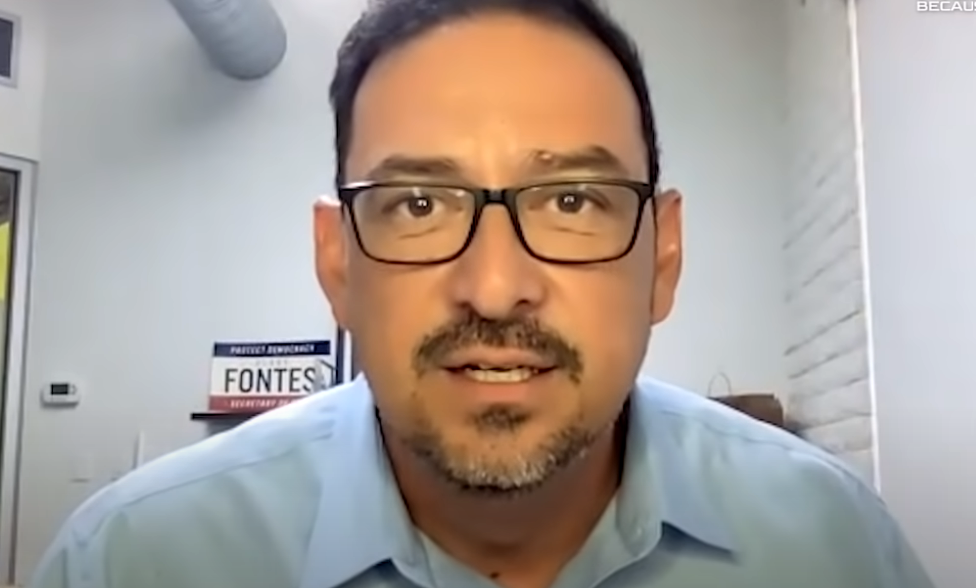
On Thursday, America First Legal announced that the organization has launched a lawsuit against Arizona Secretary of State Adrian Fontes and the Secretary of State’s Office on behalf of Strong Communities Foundation of Arizona, also known as EZAZ.org. The foundation and America First Legal contend that by refusing to release a list of more than 218,000 individuals who illegally registered to vote without providing proof of citizenship, Fontes is violating the law.
The flaw at the center of both cases was revealed to the Arizona voters when Maricopa County Recorder Stephen Richer realized the flaw’s implication, that tens of thousands of people were on the voter list without proof of citizenship, and brought an Emergency Petition to the Arizona Supreme Court.
As previously reported by AZ Free News, the Arizona Supreme Court ruled on Sep. 20th that almost 98,000 Maricopa County voters whose citizenship documents got caught up in a coding error will be allowed to vote the full ballot.
According to America First Legal, in a matter of hours, AFL filed a public records request on behalf of EZAZ.org calling on Fontes to produce the list of voters he had identified as being unlawfully registered. Fontes denied the request and unleashed a bizarre accusatory response through his attorney.
AFL wrote, “Rather than treating constituents with respect and decorum, their response was a bombastic tirade that invoked a bizarre conspiracy theory accusing EZAZ.org of secretly planning to harass the voters on the list. There is, of course, no evidence to support Secretary Fontes’s conspiracy theory, and EZAZ.org has no intention of harassing anyone. Secretary Fontes also feebly claimed that compiling the list would be too hard for his staff. None of these excuses hold water. Fontes’s staff has already compiled the list–that’s how they know the number of affected voters. And there is no risk that these voters will be harassed–EZAZ.org’s mission is all about protecting voters.”
James Rogers, America First Legal Senior Counsel, explained in a statement, “There have been major failures in the administration of just about every general election in Arizona from 2016 until now. It’s no wonder that Arizonans’ trust in their electoral system is at an all-time low. And every time anyone expresses concern, how does Secretary Fontes react? Victim blaming.”
“His patronizing response is always to attack voters for caring about the integrity of their system and expecting that public officials follow the law. But how can Arizonans trust their elections when the person in charge of administering them is so fervently opposed to basic transparency? That is not what Arizonans expect from their elected leaders. The law requires Secretary Fontes to produce these records, and AFL will work to hold him accountable until he does,” said James Rogers.
“America First Legal Sues Arizona Secretary of State’s Office for Illegally Withholding List of 218,000 Registered Voters Who Have Not Provided Proof of Citizenship.” https://t.co/EVPZcBkyGw
In the text of the lawsuit, AFL argues, “By refusing public access to these records, the Defendants frustrate the core purpose of the Public Records Law, to ‘monitor the performance of the government officials.’” The suit continues, “And because these records deal with a pressing issue of immediate public concern, time is of the essence. The Defendants should be ordered to immediately fulfill Plaintiff’s public records request.”
In a letter responding to the request, cited by the New York Post, the Secretary of State’s Office said, “We fear, especially based on SCF’s filings, that its true desire here is not to keep watch on government actions — which our public records laws are designed to facilitate — but instead harass and intimidate voters in the midst of an election and whose rights Secretary Fontes has already vindicated before Arizona’s highest court.”
Stephen Miller, former Senior Advisor to President Donald Trump and America First Legal President said in a statement, “America First Legal continues to lead the fight for election integrity. We are suing the state of Arizona for refusing to provide the list of 218,000 voters who failed or refused to establish citizenship. It is absolutely imperative that we stop the dire threat of illegal alien voting, which is the gravest form of foreign election interference.”
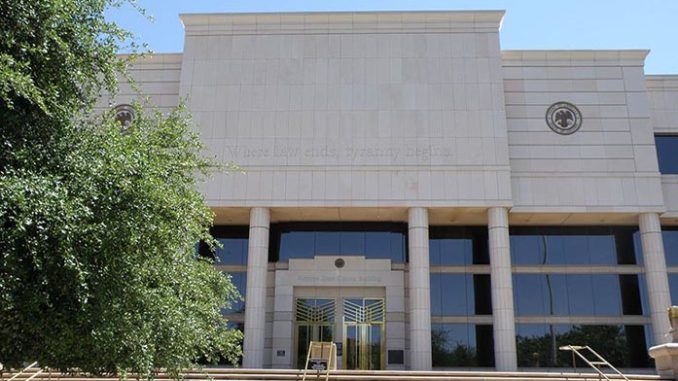
The Arizona Supreme Court ruled on Friday that nearly 98,000 Maricopa County voters whose citizenship documents got caught up in a coding error will be allowed to vote full ballot in November. Maricopa County Recorder Stephen Richer had moved to have them relegated to voting ‘Fed Only’ in November.
The court received several amicus briefs from voters and organizations across the political spectrum arguing against the move, including the Arizona Republican Party; the League of Women Voters of Arizona; Coconino County Recorder Patty Hansen and Pima County Recorder Gabriella Cazares-Kelly; as well as the Carlos Apache Tribe, Living United for Change in Arizona, League of United Latin American Citizens of Arizona, Mi Familia Vota, and the ACLU of Arizona.
The Republican Party of Arizona (AZGOP) filed an amicus brief Thursday calling upon the court to intervene and prevent the removal of 98,000 voters from the rolls whose registrations were potentially endangered by a controversial clerical error by state officials.
On Tuesday, Arizona’s Democrat Secretary of State Adrian Fontes announced that 97,000 inividuals would be impacted by an error that could prevent them from voting in state-level elections such as state legislative races, initiatives, and referenda. The error affects voters who were issued an Arizona driver’s license prior to October 1, 1996. The figure represents over 2.5% of the state’s total registered electorate. The outlet noted that a technical issue reportedly caused the error which has been resolved, however, the status of those affected is unclear.
In a statement published Thursday the AZGOP announced:
“Today, the Republican Party of Arizona filed an amicus brief in the Arizona Supreme Court supporting the preservation of voter rights in the case involving nearly 100,000 voters whose registration statuses were jeopardized by a state government clerical error.
The AZGOP urges the court to protect voters from sudden disenfranchisement and argues that the requested relief from Petitioner Maricopa County Recorder Stephen Richer violates both state and federal law.
The AZGOP’s amicus brief notes the importance of adhering to the National Voter Registration Act (NVRA), which prohibits systematic voter removals within 90 days of a federal election, and argues that the removal of voters based on this clerical error violates due process and the U.S. Constitution. The AZGOP maintains that any action taken to correct these registration issues should not result in the disenfranchisement of voters who have long participated in Arizona’s elections without issue.”
Gina Swoboda, AZGOP Chair said in a statement:
“Regardless of any outcome on this matter, all of these voters will receive a Federal Only ballot which permits them to vote for President, U.S. Senate, and U.S. Congress. The only question before us is if these voters, who have possessed an Arizona driver’s license since before October 1996, should be denied the right to vote for their representatives in the Arizona legislature, county, school board, and ballot measure contests.
Our brief makes it clear: nearly 100,000 Arizona voters should not be penalized for a mistake made by the government. We will not stand by as voters are disenfranchised, especially so close to an election. The law requires that any changes to voter registration or eligibility must be handled carefully and in accordance with federal and state law. Rushing to disenfranchise voters now would not only be illegal but would severely undermine confidence in our elections.”
In a lengthy post to X, Richer justified his lawsuit saying:
“My office discovered this issue last week, and we have been working with the Governor’s Office, the Secretary’s Office, the MVD, and the Attorney General to fix this moving forward. The number is about 97,000 registrants across the state. All of these people have attested under penalty of law that they are U.S. citizens. And, in all likelihood, they almost all U.S. Citizens. But they have NOT provided documented proof of citizenship. Moving forward (2025 onward), everyone agrees we need DPOC for those voters for them to vote a full ballot. But the Secretary and I have different opinions on what the law requires for the November 5, 2024 General Election. It is my position that these registrants have not satisfied Arizona’s documented proof of citizenship law, and therefore can only vote a ‘FED ONLY’ ballot.”
Later today, my office (@RecordersOffice) is suing the Secretary's office (@AZSecretary) regarding how to handle certain voters who need to provide documented proof of citizenship.
Since 2004, Arizona has been the only state in the country to require that a voter provide…
— Stephen Richer—MaricopaCountyRecorder (prsnl acct) (@stephen_richer) September 17, 2024
In the text of the amicus brief, the AZGOP argues that the declaratory judgment requested by Maricopa County Recorder Stephen Richer would stand in violation of both the First and Fourteenth Amendments to the U.S. Constitution, Arizona’s Free and Equal Elections Clause, as well as the National Voter Registration Act. The party’s legal team explained, “It is difficult to imagine state action that would impose a more ‘severe’ burden on the right to vote than abruptly informing an individual who has lived and voted in Arizona for decades—and previously voted in all elections, state and federal—that they must suddenly prove that they are a U.S. citizen in the handful of days remaining before Arizona’s October 7 voter registration deadline if they want to vote in state elections this year.”
BREAKING, VICTORY: AZ Supreme Court REFUSES to Order Recorders To Move 98,000 Long-time Arizonans To Fed-Only List Weeks Before Ballots Hit the Mail
Chief Justice Ann Scott Timmer writing for the majority ruled:
“In sum, Richer has not established that the county recorders have statutory authority to remove the Affected Voters from being able to vote in the upcoming 2024 General Election for federal offices and with respect to matters on an Arizona ballot. This is particularly true under the present facts, where a state administrative failure permitted the Affected Voters to be registered without confirming that they provided DPOC when they received their driver’s licenses and where there is so little time remaining before the beginning of the 2024 General Election.”
She continued, “Arizona law provides that ‘[w]hen the county recorder obtains information pursuant to this section and confirms that the person registered is not a United States citizen,’ the county recorder is to initiate a process to cancel a registration that includes sending the person notice that the person’s registration will be canceled in thirty-five days unless the person provides satisfactory evidence of United States citizenship. A.R.S. § 16-165(A)(10). Although challenges are pending to various aspects of the statute, subsection (A)(10) recognizes the right of any voter to notice and an opportunity to contest any determination of a voter’s ineligibility. A county recorder can therefore proceed with respect to individual voters under § 16-165(A)(10) as long as the provision’s due process requirements are followed… Regardless, we are unwilling on these facts to disenfranchise voters en masse from participating in state contests. Doing so is not authorized by state law and would violate principles of due process.”
The Arizona Free Enterprise Club (AFEC) is demanding an investigation into an alleged misuse of taxpayer funds by Secretary of State Adrian Fontes.
AFEC published a press release on Tuesday accusing Fontes of misusing taxpayer funds by filing a “politically motivated” brief in the ongoing Arizona Supreme Court case, Smith v. Fontes. The organization also requested that Fontes recuse himself from all ballot tabulation procedures concerning the other initiatives.
“By filing his brief at the Arizona Supreme Court, Fontes unequivocally signaled his position that 40,000 duplicate signatures should be ignored and counted in favor of passing Proposition 140,” said AFEC in its press release. “In short, to Fontes, the ends justify the means to ensure that Arizona’s elections system can be operated like California’s radical system.”
AFEC and other critics compare the components within Proposition 140 to current election procedures exercised by California.
Proposition 140 seeks to remove the partisan split in primary voting — instead implementing open, or “jungle,” primaries — and determine winners using ranked-choice voting. Ranked-choice voting allows voters to rank their preferred candidates each election until one candidate accrues over 50 percent of the vote.
That claim of political motivation stems from Fontes’ role as a “team member” for the nonprofit organization (Save Democracy) supporting the political action committee (Make Elections Fair Arizona) pushing Proposition 140. Those two entities are also united by the involvement of Sarah Smallhouse as their president and treasurer, respectively: a longtime Democrat donor from Tucson who served as leadership for a University of Arizona board and the Southern Arizona Leadership Council.
Fontes’ brief petitioned the court to count any votes cast for Proposition 140, even if the ongoing review of the ballot-qualifying signatures determined that there weren’t enough signatures gathered. Fontes argued that the proposition should be considered valid since the ballots were already being printed with the contested proposition on them.
“Once the ballots have gone to print, it is in the hands of Arizona’s voters,” said Fontes. “The person contesting an issue (or candidate) can make a case to the voters, but the Courts cannot usurp the voters’ decision once it goes to them.”
AFEC sued to stop Proposition 140 earlier this summer after reportedly discovering that over half of the gathered signatures were in violation of state law — around 40,000 duplicates. Should all those alleged duplicate signatures be removed, the proposition would lack the number of signatures required to qualify for the ballot.
AFEC President Scot Mussi said in a statement that Fontes’ brief amounted to the secretary of state taking a side in a ballot measure rather than maintaining an impartial role in the elections process.
“Far from acting as a fair and impartial elections chief, Fontes has officially taken a side in a controversial measure that would be potentially on the ballot, showing Arizonans that he is using taxpayer dollars to make the case for a California-style amendment that would fundamentally transform the way we vote and select our candidates for public office,” said Mussi. “This is not saving democracy; this is trampling the will of the people and the laws that govern how elections should be executed.”
AZ Free News is your #1 source for Arizona news and politics. You can send us news tips using this link.
Arizona voters should be able to have complete trust in their elected officials to conduct themselves honorably, ethically, and lawfully in every matter concerning our sacred elections.
Too bad Secretary of State Adrian Fontes never got the memo.
In the midst of firing off baseless attacks against our organization after a court ruled in our favor against his radical Elections Procedures Manual, Fontes found a new way to violate the ethics of his office…and maybe the law.
Last week, in an unexpected, politically motivated, and potentially unlawful use of taxpayer dollars, Fontes filed a brief at the Arizona Supreme Court in an effort to ensure that votes for Prop 140 are counted in the November General Election—regardless of its eventual legality.
Think about that for a moment. By filing this brief, Adrian Fontes—the top election official in our state—unequivocally signaled his position that 40,000 duplicate signatures should be ignored and counted in favor of passing Prop 140. In short, this means that for Fontes, the ends justify the means to ensure that Arizona adopts a California-style election scheme that includes ranked-choice voting and jungle primaries. But that shouldn’t come as much of surprise…because it’s exactly what he’s been working for…
Secretary of State Adrian Fontes argued in a new brief for an ongoing court case that duplicate signatures shouldn’t be cause for Proposition 140 to be removed from the ballot. Challengers to the proposition say they found around 40,000 duplicate signatures.
Prop 140, the Make Elections Fair Act, proposes open primaries (called “jungle” primaries by opponents) which remove the partisan segregation defining Arizona elections, as well as the implementation of ranked-choice voting.
Fontes is one of the listed “team members” for Save Democracy, the nonprofit entity supporting the political action committee pushing the measure, Make Elections Fair Arizona.
Save Democracy’s president, Sarah Smallhouse, also serves as treasurer of the Make Elections Fair Committee. Fontes also conducted a webinar sponsored by Save Democracy in which he advocated for open primaries.
In the brief issued on Friday for the case Smith v. Fontes, Fontes argued that the proposition should be considered valid since the ballots had already gone to print with the contested proposition included. Otherwise, the secretary argued, the court would be denying Arizonans their right to “free and equal” elections.
“Once the ballots have gone to print, it is in the hands of Arizona’s voters,” said Fontes. “The person contesting an issue (or candidate) can make a case to the voters, but the Courts cannot usurp the voters’ decision once it goes to them.”
Fontes proposed that those challengers to the validity of Prop 140’s gathered signatures should seek recourse through future elections.
“After investing their time educating themselves about this ballot measure, it would be wrong for the Arizona electorate later to be told their vote will not be counted,” said Fontes. “Given the far-reaching implications of this Court potentially enjoining the canvass, the Secretary requests this Court to reconsider its previous ruling and affirm the principle that once the ballots have gone to print, any challenge must end.”
The Arizona Free Enterprise Club (AFEC) sued to stop the Make Elections Fair Act after reportedly discovering over half of the proposition’s gathered signatures were gathered in violation of state law.
🚨 Second lawsuit filed!!
If the unconstitutionality of the the radical Make Elections Fair Initiative wasn’t bad enough, it turns out after a thorough review of their petitions, that over half of their signatures have been collected in violation of state law! https://t.co/mUMNXsOub7pic.twitter.com/ztrwbIIFaw
— Arizona Free Enterprise Club (@azfec) July 27, 2024
The Arizona Supreme Court sided with AFEC’s challenge last month, ruling that the lawsuit should continue in order to determine whether the tens of thousands of challenged signatures were valid (around 40,000), even though ballots began to be printed on the same day it handed down its decision.
The state supreme court ordered that an injunction be issued preventing the counting of any votes on the proposition should it be discovered that the proposition lack the required number of signatures.
AFEC reported discovering that, of the 40,000 duplicates, around 250 individuals had signed their name five or more times. One individual reportedly signed 15 times.
AFEC has argued that the mass amount of duplicate signatures indicated that Fontes shouldn’t have approved the proposition for inclusion on the ballot in the first place.
With 40,000 duplicate signatures, it's clear that #Prop140 should’ve never been on the ballot in the first place because the people of Arizona don’t want to follow in California’s footsteps with jungle primaries or ranked choice voting.https://t.co/RXH6xGdcMG