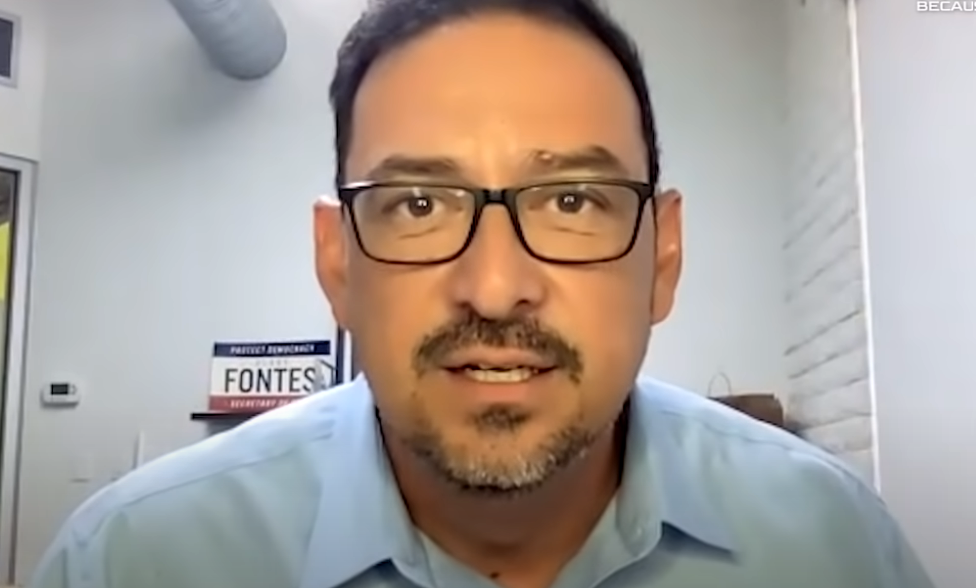
The Maricopa County Superior Court has denied an attempt by Secretary of State Adrian Fontes to bar the release of Maricopa County’s absentee ballot envelopes from the 2022 election.
Last Thursday, Judge John Blanchard denied Secretary of State Adrian Fontes’ motion to dismiss the request for the ballot data made by election integrity activists: We the People Arizona Alliance (WPAA), represented by failed gubernatorial (now Senate) candidate Kari Lake’s counsel challenging the 2022 election results, Bryan Blehm.
Blanchard ordered Fontes to work on a solution with WPAA and, at minimum, provide a sworn affidavit of the difficulties his office would have in providing the envelopes. The judge also gave WPAA permission to resolve these difficulties with Fontes or bring suggested remedies to the court.
“[T]he parties have not had a meaningful opportunity to discuss, test, and explore the stated technological and practical reasons why [the secretary of state] cannot comply with the public records request,” said Blanchard. “[T]he parties shall meet and confer regarding the Secretary of State’s reasons for refusing to produce the data that is responsive to [the request].”
During last week’s hearing on the case, Kyle Cummings with the attorney general’s office claimed that election officials would have to pull each individual voter file in order to access the ballot envelopes. Cummings said that such an undertaking would be far too time-intensive and costly for the secretary of state.
“The secretary [of state’s] folks who manage their database and their systems said that, ‘Hey, we can’t produce this, it would have to be done individually, we cannot just gather it all together,’” said Cummings. “The secretary’s office does not have the time, resources, or manpower to pull at least one million individual entries for the request[.]”
Blehm countered that a database administrator could “easily” pull that data and consolidate it into one electronic file. He noted that the database lead for the secretary of state’s office should be made to testify on why that isn’t the case.
“If they’re going to continue to take the approach that they have to run an individual query for each of these five things of data for over a million voters, I would like the opportunity to depose their database administrator or data manager to dive into this,” said Blehm.
Absentee voting remains the primary method of ballot casting in Arizona. As of Monday, Fontes reported over 4.1 million registered voters in the state, with Republicans wresting the majority from independent voters: about 1.42 million Republicans and over 1.41 million independents.
Over 1.2 million voters registered as Democrats, over 32,400 registered as libertarians, over 25,900 registered as No Labels Party, and just over 2,500 registered as Green Party.
PRESS RELEASE: STATEWIDE VOTER REGISTRATION REPORT NOW REFLECTS FIVE PARTIES – For more information visit – Voter Registration Statistics | Arizona Secretary of State (https://t.co/6UIaW6Rtzq) pic.twitter.com/b4Zt20MURM
Secretary of State Adrian Fontes pledged to have his office take a more assertive posture against misinformation for the 2024 election.
Fontes made the promise during an interview with 12 News on Sunday. The secretary of state said that his office would even take on the speech of other elected officials, if need be.
“You’re going to see a much more assertive attitude against folks who are lying about elections,” said Fontes. “What they’re doing is creating mistrust between regular citizens where there shouldn’t be any. None of the allegations about fraud, none of the Big Lie has been proven true.”
Fontes didn’t deny that his office may take legal action against perceived misinformation. As an example of the type of misinformation his office would target, Fontes said that Arizona voters use paper ballots — not voting machines — to cast their vote.
“We’re not going to play the role of victim. What we’re going to do is come right out and speak directly to the voters,” said Fontes. “When somebody says, ‘Well, you’ve got a problem with voting machines in Arizona.’ Well, guess what, we don’t have voting machines in Arizona. We vote on paper ballots; every ballot in Arizona has always been cast on paper ballots. You saying ‘voting machines’ is a lie. That’s the kind of assertiveness we’re going to have in our communications strategy.”
Technically, “voting machines” are those pieces of equipment that record votes electronically without paper. Arizona doesn’t have voting machines, but it does have equipment to tabulate votes, which are cast by paper ballot.
Since taking office, Fontes has pledged to combat mis- and disinformation. Fontes declared that election disinformation amounted to “terrorism” and the individuals behind the rhetoric were “fascists” in an interview with MSNBC shortly after being sworn into office. Fontes urged the public to “attack” the election disinformation.
“These new American fascists, these MAGA fascists — you call them denialists, they are fascists — we need to call them who they are,” said Fontes. “We’ve got to stop pretending that their feelings matter. These are people who are threatening the lives of our neighbors, our family members, and they’re threatening the health of our democracy.”
Vigor and strength. That’s the only way we protect our election workers and fight back against disinformation. Thank you @AliVelshi for speaking with me. https://t.co/XbZmJuQNgp
Fontes’ predecessor, now Gov. Katie Hobbs, also took an assertive posture against misinformation regarding elections. Hobbs coordinated with the Center for Internet Security (CIS), a government-funded organization, to censor online speech concerning the 2020 election.
Hobbs’ former chief of staff, Allie Bones, told reporters around the time of Hobbs’ inauguration that it was the job of governments to remove disinformation from the public square.
Hobbs was one among many government officials that coordinated with social media companies to suppress and censor speech on major public issues. Last fall, the Supreme Court agreed to take up a case concerning this coordination, Murthy v. Missouri. The court also granted a request from the Biden administration to block a lower court’s order preventing government officials from communicating with social media companies regarding content moderation policies.
Hobbs’ actions inspired the creation of a new ad hoc committee in the state legislature to review government officials’ relationships with social media companies. That House Ad Hoc Committee on Oversight, Accountability, and Big Tech convened three times in September, October, and December.
Corinne Murdock is a reporter for AZ Free News. Follow her latest on Twitter, or email tips to corinne@azfreenews.com.
Arizona has a new Elections Procedures Manual for the 2024 cycle, though litigation is all but certain from state Republicans.
On Saturday, just before the statute-mandated deadline of December 31, Democrat Adrian Fontes issued the 2023 Election Procedures Manual, after securing approvals from his fellow Democrat officeholders, Governor Katie Hobbs and Attorney General Kris Mayes. In a statement to accompany the release of the manual, Fontes said, “Free, fair and secure elections have been this group’s commitment to the voter from the very beginning. This is what happens when a committed group of leaders comes together to serve their community. It’s good for our democracy and it’s good for Arizona.”
For the first time since 1978-1979, Democrats control the top three statewide offices in Arizona (Governor: Bruce Babbitt, Attorney General: John LaSota, Secretary of State: Rose Mofford). One of the most significant consequences of securing this power trifecta is the ability to negotiate, craft, and green light the state’s Election Procedures Manual without initial interference from opposing political voices, as required by law every two years.
Arizona Republicans were quick to push back against the elections manual and signaled a willingness to challenge the legality of its contents in court. House Speaker Ben Toma stated, “A lawful Elections Procedures Manual is paramount for the integrity of our elections. It’s been a top priority of the Arizona House Republican Caucus. I’m disappointed that SoS Fontes refused to correct many objections we raised in our comment to the EPM draft. We are preparing for litigation.”
The speaker’s reference to previous ‘objections’ harkened to an August public comment letter, which was submitted by Senate President Warren Petersen and Toma to the Arizona Secretary of State’s Office after they reviewed the draft manual. Then, the legislators had identified their chief concern with Fontes’ initial offering, which was the “unlawful delay in the implementation of a 2021 state law that helps prevent voter fraud by requiring county recorders to remove any voters registered on the active early voter list who have not cast a ballot during two consecutive election cycles and have not responded to notification from the recorder that they wish to continue participation.” Petersen and Toma asserted that the consequence of this delay would be the perpetuated issuance “of ballots being sent to the homes of voters who may have moved or no longer wish to participate in this process, opening the door for ballots getting into the hands of unintended individuals.”
In a new statement after the release of the approved EPM, Petersen said, “We warned the SOS early on that we would sue if the Elections Procedure Manual was not corrected to reflect the laws passed by the legislature. Unfortunately that did not happen. I imagine there will be many plaintiffs joining the Senate in protecting our elections.”
We warned the SOS early on that we would sue if the Elections Procedure Manual was not corrected to reflect the laws passed by the legislature. Unfortunately that did not happen. I imagine their will be many plaintiffs join the Senate in protecting our elections.
Arizona Republican Party Chairman, Jeff DeWit, also promised legal action against the manual, calling it an “egregious destruction of election fairness by the Democrats.”
The AZGOP shared four “concerning elements” from its cursory review of the manual: limitation of free speech, restriction of voter challenges, exclusion of Republican oversight, and refusal to heed legal precedent. In its press release, the state Republican party charged Fontes with “trying to take powers from the state legislature that are not his to take.”
Representative Alexander Kolodin weighed in on the EPM, writing, “Fontes’ EPM is not an Elections Procedures Manual, it is a how-to manual to disenfranchise Republican voters and a breathtakingly unlawful power grab. It cannot be allowed to stand!”
Fontes' EPM is not an Elections Procedures Manual, it is a how-to manual to disenfranchise Republican voters and a breathtakingly unlawful power grab. It cannot be allowed to stand! https://t.co/gZ4oHQ6SIC
While most Arizona Republicans are united in opposition to the 2023 EPM, so, too, are Democrats in their support of the Secretary of State’s submission. Governor Katie Hobbs, who preceded Fontes, said, “Partisan politics should have no role in how we run our elections. This EPM builds on the 2019 EPM and 2021 draft EPM from my tenure as Secretary of State and will ensure dedicated public servants from across the state will have the guidelines they need to administer free and fair elections. Together, we can protect our democracy and make sure every Arizonan has the opportunity to have their voice heard.”
As Secretary of State, Hobbs was required to finalize the EPM in 2021, but a divided government shared with Republican Governor Doug Ducey and Attorney General Mark Brnovich stymied the quest to secure a green light for the manual. Hobbs and Brnovich were also mired in an ongoing political feud, which resulted in legal bar charges that the Secretary of State brought against the state’s top prosecutor and several of his attorneys. After receiving Hobbs’ updated manual, Brnovich sued the SOS “to compel her production of a lawful EPM.” Brnovich alleged that “the SOS failed to provide the Governor and Attorney General with a lawful manual by October 1, 2021, as required, and instead included nearly one-hundred pages of provisions not permitted under the EPM statute.” The challenge from the former Attorney General was rendered unsuccessful, and the state was forced to revert to the previous cycle’s EPM (2019) to govern the 2022 races.
Daniel Stefanski is a reporter for AZ Free News. You can send him news tips using this link.
We’re less than a year away from our next election, and if Arizona Secretary of State Adrian Fontes is serious about doing his job, his primary focus should be on ensuring a process where it is easy to vote and hard to cheat. Instead, Fontes has been attempting to implement an Elections Procedures Manual (EPM) that is ripe with unlawful provisions all while ignoring a giant (and growing) elephant in the room.
In its last two quarterly reports to the Arizona state legislature, the Secretary of State’s office reported that over 78,000 individuals have been identified on our state’s voter rolls as noncitizens or nonresidents. This number includes:
Over 53,200 individuals who were reported to have been issued a driver’s license or the equivalent of an Arizona nonoperating license ID in another state.
Over 1,300 individuals who admitted to not being a U.S. citizen on a jury questionnaire.
Over 23,600 individuals who admitted to not being a resident of a county on a jury questionnaire.
These numbers should be great cause for alarm—especially when you consider how close some of our state’s races were in 2022—and these individuals should be immediately removed from our state’s voter rolls. So, what did Fontes do in response to this news?
The Arizona Republican Party (AZGOP) gained a significant victory this week over Democrat Secretary of State Adrian Fontes.
On Monday, the AZGOP announced that the ‘Patriot Party’ “failed to secure enough valid signatures to qualify for the 2024 ballot,” crediting the “unwavering dedication of over 50 volunteers who…meticulously reviewed over 37,000 signatures by hand.”
FOR IMMEDIATE RELEASE: AZGOP Succeeds in Upholding Integrity of the Petition Signing Process
In that communication, the AZGOP explained that the “Liberal Democrat Adrian Fontes quietly and drastically changed his procedures on political party petition filings and denied observer access and public records requests by the Arizona Republican Party.” According to the AZGOP, this occurred when Secretary Fontes allegedly failed “to notify the political parties with ballot access that an appointment had been made by the ‘Patriot Party’ to file signatures on their Petition for Political Party recognition.”
In their release, the AZGOP asserted that Fontes’ actions with the ‘Patriot Party’ filing was “a big departure from what (he) did when ‘No Labels’ filed,” adding that the Secretary’s motivation in running his office is “to help the Democrat Party and hamper (Arizona Republicans).”
The AZGOP outlined the process by which Secretary Fontes “conducted the No Labels filing,” which included the following steps:
The Democrat, Republican, and Libertarian parties of Arizona were informed about the filing appointment ahead of time.
All three recognized political parties were permitted to have observers present for the entire intake and SOS scanning of petitions with full observer coverage for chain of custody transition.
The scans of the petitions, as filed, prior to SOS processing, were made available the morning after filing through a secure fileshare provided by SOS.
The fileshare to which counties upload their processed samples was made available to all recognized political parties so that they could follow the filing process throughout.
As the release concluded, the AZGOP demanded that Secretary Fontes “restore the long history of impartiality that existed in the SOS’s office under Secretary Reagan, Secretary Bennett, Secretary Brewer and others.” The party asked for the Secretary of State’s Office to “fulfill (their) public records requests in a timely manner and maintain a fair and unbiased process for all filings made in (the) office.”
The AZGOP threatened Fontes with litigation if he were to “move to validate (the ‘Patriot Party’) as (an actual party) regardless in a partisan effort to hamper the Republican Party. That threat appears to be neutralized thanks to the State Republican Party’s hard work to go through the signatures itself.
With the saga of the petition signatures moving to the rearview window, the AZGOP is focusing on an extremely important election season in 2024, boasting of a “grassroots army of over 5,500 precinct committeemen in Arizona, combined with an additional 20,000 party volunteers.” The AZGOP noted that Arizona Republicans are “united in our mission to register more voters, champion family values, strengthen the economy, and advocate for better educational outcomes and parental choice.”
Daniel Stefanski is a reporter for AZ Free News. You can send him news tips using this link.