by AZ Free Enterprise Club | Nov 19, 2023 | Opinion
By the Arizona Free Enterprise Club |
If you look up “failure” in the dictionary, it’s probably only a matter of time until you start seeing images of Katie Hobbs’ time as Governor of Arizona. Hobbs kicked off her reign back in January and immediately got off to a rocky start. After being in office for just over a month, Hobbs had her inauguration fund called into question, had her pick to lead the Arizona Democratic Party rejected, and was booed at the 16th Hole of the Waste Management Phoenix Open.
If that wasn’t enough, Hobbs’ nominations for agency directors have been a complete disaster. Her pick to lead the Department of Health Services, Dr. Theresa Cullen, was rejected for her COVID imperialism. Her nominee for Housing Director was rejected due to a history of plagiarism. And she was forced to withdraw her nominee for Arizona Registrar of Contractors, former Democratic State Senator Martín Quezada, over his alliance with antisemitic extremism. It’s no wonder why Hobbs was listed as one of the least popular governors in the nation.
That’s probably why Hobbs is willing to do anything she can to get some good publicity, but her latest stunt was another misfire…and broke the law…
>>> CONTINUE READING >>>
by Corinne Murdock | Nov 3, 2023 | News
By Corinne Murdock |
Gov. Katie Hobbs is now taking credit for the family tax rebate she opposed initially — and had a state agency break the law in doing so, according to legislative leaders.
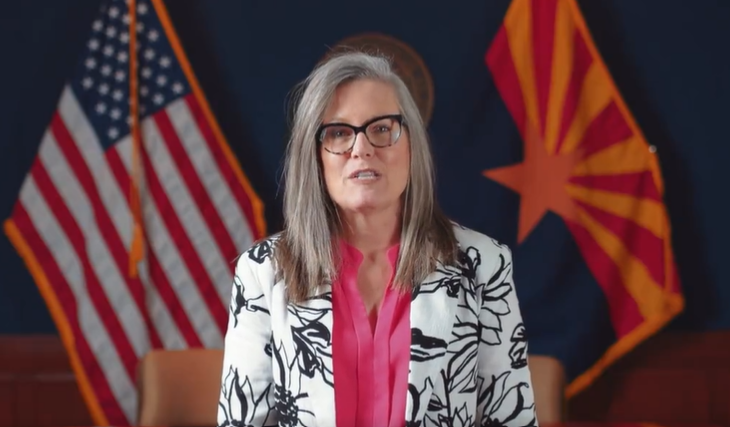
Hobbs championed the tax rebate on Tuesday with several surprise links crediting herself for the Arizona Families Tax Rebate Program, including an Arizona Department of Revenue (ADOR) application page for the program displaying her headshot. In a video and press release, Hobbs indicated that she played a major role in passing and had always fully supported the initiative.
“I made a promise that when I took office, I would take every opportunity I had to make it easier for Arizonans to provide for their families,” said Hobbs. “I’m so pleased to be able to deliver this relief.”
However, the webpage and promotional material in concert with Hobbs’ announcement runs afoul of the law on the rebate.
“[N]o letter relating to the Arizona families tax rebate issued under this section shall be sent from the governor’s office, be sent on the governor’s letterhead, or reference the governor’s office,” read SB 1734.
Sen. President Warren Petersen (R-LD14) and House Speaker Ben Toma (R-LD27) issued a cease and desist letter to ADOR over Hobbs’ announcement. The letter declared that the application page that Hobbs directed Arizonans to use was an impermissible detour and an illegal expenditure of public funds.
“While any violation of a controlling statute is troubling in its own right, the Department’s letter compounds an institutional insult with injury to Arizona taxpayers by unlawfully expending significant sums of public money to disseminate what is, in part, a political message,” stated the letter.
The budget did include a somewhat prophetic provision concerning Hobbs: a worry that the governor would subvert policy for political gain.
“Animating this provision was the Legislature’s concern that Governor Katie Hobbs would subvert a commonsense policy measure into a self-serving political stunt on the taxpayers’ dime,” stated the cease and desist letter. “[T]he Department impermissibly misdirected rebate recipients on a detour through the Governor’s curated, self-promotional online platform. This is clear violation of Arizona law.”
State Sen. Jake Hoffman (R-LD15), chairman of the Arizona Freedom Caucus, lamented that ADOR would be on the hook for Hobbs’ public relations display.
“The sad reality exposed by this situation is that Katie Hobbs doesn’t care about anyone other than herself. She tried to play fast and loose with the law, as she so often does, and forced Director Woods to violate it,” said Hoffman. “Thanks to Hobbs, he is now personally liable for $2M+ in illegally spent funds, a 20 percent penalty, court costs, and attorneys’ fees. And with a statute of limitations of 5 years, Katie has given Director Woods the gift of many sleepless nights for years to come.”
Hoffman advised other government agencies to take heed of ADOR’s alleged mistake by resisting pressure from the governor to act and by keeping receipts for everything the governor and her office may request.
Concerning Hobbs taking credit for the program, State Sen. President Pro Tempore T.J. Shope (R-LD16) indicated in a response post that she wanted “no part” of it. Shope said credit was due to the Arizona Freedom Caucus.
“I know the Governor wanted no part of this tax rebate but thankfully, the @AZSenateGOP & @AZHouseGOP caucuses, led by the @AZFreedomCaucus, stood strong and demanded it be part of the State Budget,” said Shope.
State Rep. Austin Smith responded that no House or Senate Democrats contributed to the tax rebate package initiated by the Arizona Freedom Caucus.
Hobbs’ spokesman, Christian Slater, told Capitol Media Services that the governor had supported the tax rebate by signing the budget, despite her initial opposition to the program.
The Sen. Republican Caucus similarly criticized Hobbs for failing to ascribe credit to those who came up with and fought for the rebate.
“You’re a little late to the party,” said the caucus. “Glad you love Republican policies as much as we do. They really do make our state a better place to live, work, and play.”
Sam Stone, “Breaking Battle” radio show host and former Phoenix City Council candidate, called Hobbs’ 180 on the program “pathetic.”
The Arizona Families Tax Rebate Program entitles Arizona taxpayers with dependent children a single payment of up to $750. Approximately 750,000 Arizona families may be eligible.
The rebate metes out to $250 per dependent under the age of 17 and $100 per dependent over the age of 17 as claimed on 2021 returns. A taxpayer can’t claim more than three dependents, regardless of age.
Eligible taxpayers are those who: filed a full-year resident personal income tax return for the 2021 tax year; claimed at least one dependent tax credit for the 2021 tax return; filed the 2021 tax year Arizona personal income tax return as the only taxpayer on a single, married filing separate, or Head of Household return, or as the primary or first-listed taxpayer if filed jointly; and had at least $1 in Arizona personal income tax liability in tax year 2021, 2020, or 2019.
Corinne Murdock is a reporter for AZ Free News. Follow her latest on Twitter, or email tips to corinne@azfreenews.com.
by Corinne Murdock | Oct 9, 2022 | News
By Corinne Murdock |
During her last year in the State Senate in 2018, Democratic gubernatorial candidate Katie Hobbs backed a bill to add 131 new tax auditors, managers, and staff to the Arizona Department of Revenue (ADOR) using $8.3 million in state funds. At the time, Hobbs was the State Senate’s minority leader.
Throughout her gubernatorial campaign, Hobbs said she would lighten the tax process burden for the working class if elected. Hobbs also pledged to cut income taxes for 800,000 families if elected governor.
Additionally, Hobbs promised that working-class Arizonans wouldn’t pay “a center higher” for her economic plan, nor would they face unnecessary tax burdens.
Hobbs’ proposed plan to increase ADOR was similar to the Biden administration’s recent accomplishment: expanding the IRS. In August, Congress voted to increase the size of the IRS by about 87,000 agents through the Inflation Reduction Act (IRA), a repackaged version of President Joe Biden’s Build Back Better (BBB) Act. Republicans decried the provision as a weaponization of the IRS that would cause disproportionate harm to the working class. Democrats dismissed those concerns, insisting that the IRS would only target the wealthy not paying their fair share of taxes, and that the IRA would mitigate inflation.
Last year, over 50 percent of all IRS audits targeted taxpayers making under $75,000 a year, which applies to about 171.6 million Americans (52 percent). About 25 percent of IRS audits applied to taxpayers making between $75,000 to $200,000, which applies to about 118.8 million Americans (36 percent).
In all, 75 percent of audits may apply to the 290.4 million Americans that comprise 88 percent of the population (about 330 million).
The bill that Hobbs cosponsored in 2018, SB1324, proposed the addition of two corporate income tax audit managers, 28 corporate income tax auditors, two transaction privilege tax managers, 28 transaction privilege tax auditors, two transaction privilege tax license compliance staff managers, 18 transaction privilege tax license compliance staff members, 40 tax collectors, and 11 support staff members.
The bill died quietly, having never received a vote in any committee. Its House companion, HB2137, experienced the same fate.
At the time, Governor Doug Ducey expressed a desire to expand ADOR — but by 25 tax collector positions that had been eliminated several years prior, about 80 percent less than what HB2137/SB1324 proposed. Ducey was looking for ways to make up about $83 million in lost audit revenue.
Corinne Murdock is a reporter for AZ Free News. Follow her latest on Twitter, or email tips to corinne@azfreenews.com.
by Terri Jo Neff | Aug 28, 2021 | News
By Terri Jo Neff |
As if the last 17 months haven’t been complicated enough, the Arizona Department of Revenue announced Thursday that some taxpayers who received income in 2020 from the $12.5 billion paid out by the state for unemployment insurance benefits and pandemic unemployment assistance may be eligible for a tax refund.
The refund can be obtained by filing an Arizona Form 140X amended return. But that is where the simple part ends.
The possibility of a refund affects those Arizonans who received unemployment payments in 2020 and filed their state income tax return on or before March 11, 2021. That’s the date the American Rescue Plan Act of 2021 was signed by President Joe Biden, making up to $10,200 of unemployment benefits exempt from federal income taxes in 2020.
Gov. Doug Ducey later signed legislation which mirrored the federal exemption, meaning many Arizonans with 2020 unemployment income likely filed a state tax return under the old tax code.
ADOR could have created a computer program to identify the affected taxpayers who filed on or before March 11 and send them a notification. Instead, the burden is on Arizonans to navigate a maze of “if this, then that” instructions from ADOR in order to obtain a refund.
To start with, the Arizona Form 140X cannot be filed unless the taxpayer’s 2020 federal tax return has been amended first. The IRS is already doing that for some taxpayers and even sending an adjustment notice with a refund check. Everyone else is responsible for preparing and filing an amended federal return.
Either way, Arizonans eligible for a refund due to overpaying taxes on their 2020 unemployment benefits must wait for the IRS to confirm the federal return has been adjusted. And then they have to ask the IRS for a “transcript” after the amended federal return is processed.
Once that is done, a taxpayer can complete the Arizona Form 140X. However, it cannot be e-filed through ADOR’s website; it must be printed out and mailed in.
On the upside, Arizonans have four years to amend their state income tax return to claim a refund for overpayment of unemployment income. An amended 2020 return filed in 2022, however, could trigger the need for an amended return in 2021.
Most Arizona residents will be able to complete the Arizona Form 140X by following simplified instructions provided at https://azdor.gov. However, part-year residents and nonresidents must follow the full instructions for Form 140X.