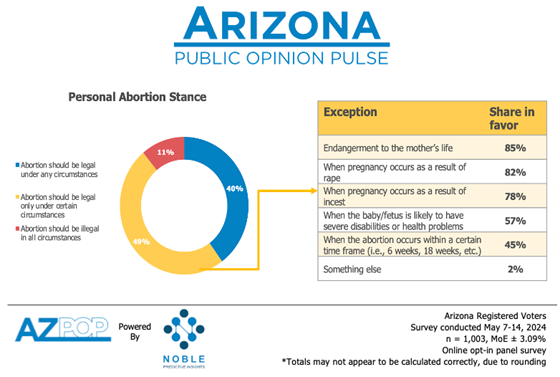
The latest poll released from Noble Predictive Insights has shown that, when compared to a pre-abortion ban reversal poll last year, public opinion on abortion in Arizona has remained largely the same, with the state’s apparent rejection of abortion on demand or “legal under any circumstances” remaining consistent with 60% of respondents. Of the voters opposed, 11% said abortion should be illegal regardless of circumstances while 49% said it should be permitted “only under certain circumstances.”
The poll, conducted by NPI from May 7-14, compared consistently with a similar February poll that predated the state Supreme Court ruling on the 1864 abortion ban re-activated by the reversal of the Roe v. Wade ruling. David Byler, NPI Chief of Research said in a press release, “When Roe was overturned, a significant chunk of the electorate moved left on abortion. But the 1864 law didn’t have a comparable effect in Arizona. The governor and legislature moved quickly on the 1864 law, so it didn’t change the landscape much.”
Among the voters who agreed that abortion is acceptable under “certain circumstances” the support for each reason broke down as:
Cases where the mother’s life was endangered (85%)
Instances of rape (82%)
Cases of incest (78%)
Babies at risk of severe complications (57%)
Within a certain timeframe (45%)
47% support within the first 6 weeks of pregnancy (within the first missed menstrual cycle/prior to a heartbeat).
43% support up to 15 weeks (roughly the end of the first trimester of pregnancy).
Support significantly drops off at 24 weeks or late-term with only 9% and again at 40 weeks or full-term at just 1%.
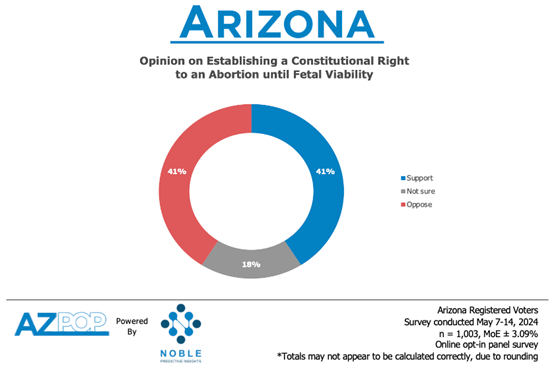
The pro-abortion politicos and activists who are working on a ballot initiative to enshrine a “right to abortion” up to any point before fetal viability (typically between 22-24 weeks) are likely to find the battle a contentious one with Arizonans evenly split according to NPI at 41% in favor and 41% against, fighting for the 18% of undecided voters.
As noted above, only 9% of those polled were comfortable with the 22-24 week timeframe with a majority of the support resting at the six and fifteen week marks. Arizona’s current statute places the limit at fifteen weeks already.
As reported by Tucson.com, the language of the initiative could prove even more problematic with the determining point of “fetal viability” being “in the good faith judgment of a treating health care professional, is necessary to protect the life or physical or mental health of the pregnant individual.”
The poll also indicated that abortion, though important, is hardly an Arizonan’s top priority. Twenty-two percent of registered voters in Arizona said that immigration was the most important of their top three issues, with abortion only amounting to 12%. Inflation weighed heavily with 19% of voters naming it as their top issue. Affordable housing accounted for 12% of the first choice with climate change, taxes, national defense, healthcare, education, the income gap, LGBT rights, and gun policies all coming it at single digits.
Simply put, Tuesday’s poll appears to indicate that the upcoming election in Arizona could be far more decisively driven by economic factors than abortion, an issue where Arizonans’ opinions seem to be largely locked-in.
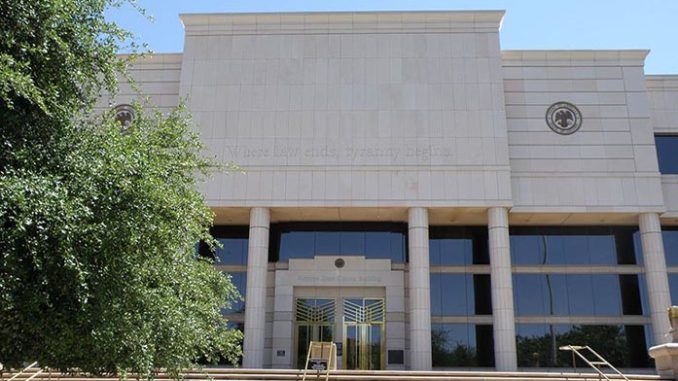
The Arizona Supreme Court has once again pumped the brakes on the state’s total abortion ban which dates back to pre-statehood days.
The order in the case, Planned Parenthood v. Hazelrigg, offered a temporary lifeboat for abortion supporters awaiting possible appeal. The court’s order, combined with the separate directive in Isaacson v. Arizona, means the abortion ban won’t go into effect until Sept. 26 of this year.
The Arizona Supreme Court rejected attempts to nullify the total abortion ban last month. That ruling, posted here, reflected the justices’ commitment to following their “limited constitutional role and duty to interpret the law as written” and deferring to the legislature.
“To date, our legislature has never affirmatively created a right to, or independently authorized, elective abortion,” ruled the court. “We defer, as we are constitutionally obligated to do, to the legislature’s judgment, which is accountable to, and thus reflects, the mutable will of our citizens.”
A version of the total abortion ban dated back to Arizona’s territorial days, to the final year of the Civil War: 1864. The law on the books, A.R.S. § 13-3603, prohibits abortions except when necessary to save the mother’s life.
The Supreme Court’s injunction only served to reduce the amount of time the ban would be enforced. The Arizona legislature passed a bill repealing the total abortion ban; Governor Katie Hobbes signed the bill earlier this month.
Arizona’s 1864 abortion ban is now officially where it belongs — in the past. https://t.co/sT7LETOuFn
Currently, state law banning abortions after 15 weeks remains in effect.
An activist group hopes to end all restrictions on abortion in the state by enshrining abortion as a constitutional right.
Arizona for Abortion Access is gunning to secure a constitutional amendment question on the November ballot. Most of the group’s funding has come from out of state. The activists have until July 3 to gather just over 383,900 valid signatures for ballot referral.
Leftist organizations and Democrats, including Hobbs, are in full support of making abortion a constitutional right.
In response to her signing the bill repealing the total abortion ban, Hobbs’ administration rolled out a website advocating for unfettered abortion access, painting those opposed to abortion as “radical extremists.”
The website also depicted crisis pregnancy centers as inaccurate and deceptive operations, citing an Attorney General Kris Mayes webpage portraying these centers as predatory with personal health information and potentially even dangerous.
Repealing this 1864 ban is a major victory for reproductive rights. But the fight isn’t over — right now Arizona women are still living under these extreme abortion bans.
Mayes celebrated the court’s decision. She said that her office may use the time afforded them to petition the U.S. Supreme Court.
“I am grateful that the Arizona Supreme Court has stayed enforcement of the 1864 law and granted our motion to stay the mandate in this case for another 90 days,” said Mayes. “During this period, my office will consider the best legal course of action to take from here, including a potential petition for certiorari to the U.S. Supreme Court.”
Apart from the additional stay granted, Mayes said that she opposed the Arizona Supreme Court’s ruling. Mayes indicated that abortion was a form of medical care.
“I continue to believe this case was wrongly decided, and there are issues that merit additional judicial review,” said Mayes. “I will do everything I can to ensure that doctors can provide medical care for their patients according to their best judgment, not the beliefs of the men elected to the territorial legislature 160 years ago.”
My Statement on Arizona Supreme Court Ruling Granting Additional Stay of 1864 Abortion Law. pic.twitter.com/8akSTWR3jt
— AZ Attorney General Kris Mayes (@AZAGMayes) May 13, 2024
Former Attorney General Mark Brnovich, during his last months in office, backed the total abortion ban.
AZ Free News is your #1 source for Arizona news and politics. You can send us news tips using this link.
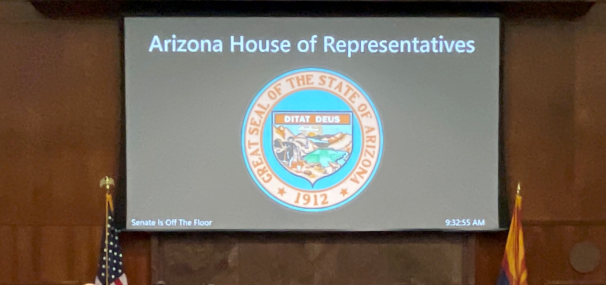
The Arizona House voted on Wednesday to repeal the state’s total abortion ban in a close 32-28 vote. The repeal is now in the Senate’s hands.
Three Republicans joined Democrats to eradicate Arizona’s abortion ban: Tim Dunn, Matt Gress, Justin Wilmeth. The repeal would mean that another existing law restricting abortions after 15 weeks goes into effect.
The historic abortion ban predates Arizona’s statehood and lasted up until the Supreme Court’s codification of abortion in 1973 through Roe v. Wade.
House Speaker Ben Toma, congressional candidate for District 8, said in a press release that the vote was rushed, a grave error that would allow for the slaughter of unborn children for up to 15 weeks.
“It would have been prudent and responsible to allow the courts to decide the constitutionality of the pre-Roe law,” said Toma. “I feel compelled to reiterate my personal view that this decision to repeal the abortion ban in Arizona effectively means that we are allowing the murder of unborn children up to 15 weeks of pregnancy.”
Toma chided Democrats for a lack of decorum on the House floor, citing outbursts and personal attacks. The speaker also warned that the opposing party would continue to push for a wider window for abortions, all the way up to birth — effectively, infanticide.
“Democrats are pushing radicalism and will not relent until Arizona recognizes abortion on demand and abortion through 9 months of pregnancy,” said Toma.
🚨Statement from Arizona House Speaker @RepBenToma on today’s vote on HB 2677:
“I fervently disagree with my Democrat colleagues who advocate for extremism through unlimited, unrestricted, and unregulated abortions. Abortions are not healthcare. Abortion kills life. Abortion… pic.twitter.com/X7QsmWulzK
— Arizona House Republicans (@AZHouseGOP) April 24, 2024
One of the three Republicans to join Democrats to repeal the abortion ban, Dunn, defended his vote in a press release insisting that he is pro-life, but that abortions should still be allowed in cases of rape and incest — situations for which the historic abortion ban didn’t grant exceptions. Dunn said his decision was the “most pro-life vote” possible.
“Should the pre-Roe law remain in effect, I firmly believe more lives will be lost over time. The public backlash would result in codifying disturbing and unlimited abortions in the Arizona Constitution, which is something that I cannot allow to happen,” said Dunn.
I hope you will join me in encouraging a culture of life, one that supports mothers, children, families and always stands for the unborn. pic.twitter.com/C6E6916vl5
Gress also issued a press release claiming he is pro-life. However, Gress didn’t go into details about how the abortion ban went too far. Rather, Gress lumped those supportive of total abortion bans and those supportive of unfettered abortion together as extremists.
“As someone who is both pro-life and the product of strong women in my life, I refuse to buy into the false notion pushed by the extremes on both sides of this issue that we cannot respect and protect women and defend new life at the same time,” said Gress.
Democratic lawmakers celebrated the vote. The author of the bill repealing the historic abortion ban, House Bill 2677, was Democratic Representative Stephanie Stahl Hamilton.
The House narrowly rejected a motion to transmit the bill immediately to Governor Katie Hobbs, 30-30, should the Senate have returned the bill unamended. Gress was the sole Republican who joined his Democratic colleagues in voting for that motion.
Hobbs praised the abortion ban repeal, calling the law “archaic” and a threat to women’s lives. As Toma predicted, Hobbs indicated that the securing of abortions up to 15 weeks was only the beginning.
“I will do everything I can to stop harmful legislation that strips women’s control of their bodies. But there is much more to do,” said Hobbs. “I encourage each Arizonan to continue to speak out and fight for your reproductive freedoms.”
I’m thrilled the House has finally decided to do the right thing and repeal the archaic 1864 near-total abortion ban, which would have jailed doctors & threatened women’s lives.
It’s time for the Senate to follow suit and send the repeal to my desk. Immediately.
Have you been approached by someone at a store or restaurant, asking you to sign a petition related to reproductive rights or women’s healthcare, called the Arizona Abortion Access Act? If yes, it is important to understand what the initiative means.
According to the language of the initiative, every individual has the fundamental right to an abortion. The state cannot pass any law, regulation, policy, or practice that denies, restricts, or interferes with an abortion after fetal viability that a healthcare professional deems necessary to protect the life or physical or mental health of the pregnant person.
Let’s break down what this means. ‘After fetal viability’ means that anyone can have an abortion up to birth. The term ‘healthcare professional’ refers to anyone in the healthcare field, including nurses, PAs, and RNs. This means that all healthcare professionals will be allowed to perform abortions, even if they do not have hospital privileges.
Furthermore, the language refers to ‘pregnant individuals,’ which doesn’t specifically mention adult women. This definition is vague and supersedes the current law that requires parental consent for a minor to have an abortion. As a result, any person can bring in a minor for an abortion, without the involvement or discussion with a parent.
It is important to note that this initiative is a ballot initiative, not a legislative bill that amends the Arizona Revised Statutes. If it passes, it will enshrine this into our state constitution, and subsequent legal changes and challenges will be out of the hands of our elected officials.
Therefore, Arizona voters must read and understand the language of this initiative before signing it. If you are not clear on the language, decline to sign.
The Honorable Jill Norgaard served in the Arizona State House from 2014-2018. She is the former First Vice Chairman of the AZGOP and Fair Maps of Arizona Redistricting Co-Chair.
A majority of Republicans in Arizona’s Legislature held the line Wednesday to preserve the state’s near abortion ban.
On Wednesday morning, the Arizona House of Representatives gaveled into session for the first time this week, giving a coalition of members the opportunity to repeal a broad abortion ban that the State Supreme Court had reinstated earlier this month.
Since the Arizona Supreme Court’s historic opinion on the statute, Democrats and some Republicans have sought to repeal the 1864 abortion policy, which has been ratified by the state legislature several times, including in a 2022 bill that established a 15-week abortion ban before the U.S. Supreme Court overturned Roe v. Wade. A coalition attempted to call up a proposal, HB 2677, from Democrat State Representative Stephanie Stahl Hamilton, which would repeal the law. Members did not have a chance to vote on the bill due to a chaotic scene on the floor, that included a successful motion to recess and adjourn for the week.
Stahl Hamilton wasted little time on Wednesday in trying to call up her bill for consideration, but was thwarted by a point of order from Republican State Representative Jacqueline Parker, who highlighted a rule of the chamber giving the Speaker veto power over these procedures. Speaker Pro Tempore Travis Grantham asked Speaker Ben Toma for his decision, and Toma exercised his right to veto Stahl Hamilton’s request. After a couple of split procedural votes to override the Speaker’s action, which Republican Representative Matthew Gress joined with Democrats, the House recessed without any progress in repealing the near abortion ban.
Democrat Governor Katie Hobbs reacted to the latest from the State House, expressing her outrage over the inability to repeal the near abortion ban. She wrote, “Extremist Republicans in the Legislature have failed again to do the right thing. In just one week living under this new reality, women, doctors, and healthcare providers have already begun to feel the devastating effects of living under a total abortion ban. We cannot go on like this.”
Extremist Republicans in the Legislature have failed again to do the right thing. In just one week living under this new reality, women, doctors, and healthcare providers have already begun to feel the devastating effects of living under a total abortion ban. We cannot go on like…
Hobbs added, “I will continue to call on the Legislature to do its job and repeal this law. In the meantime, I remain committed to protecting the freedoms of every single Arizonan, and I am working to make sure women are able to access the care they need.”
A Republican running for State Representative pointed out that, unlike Hobbs’ claim that effects were already being felt, the law was not even in effect yet, due to instructions from the Arizona Supreme Court.
This is a lie. The law that the Supreme Court ruled on is still not in effect. So what effects are women in Arizona feeling from a law that is not in effect? https://t.co/0hIjgnCx8x
The Arizona Senate gaveled into its session in the afternoon and experienced a surprise action from Democrats, who, led by Senator Anna Hernandez, gained recognition for a motion to introduce a bill after the designated legislative deadline. Two Republicans joined with all Democrats to support Hernandez’s motion, which allows the chamber to fast-track a repeal of the controversial abortion law.
— Arizona Senate Democrats (@AZSenateDems) April 17, 2024
Both chambers adjourned for the week, leaving the near abortion ban intact through the weekend at least. If the abortion law in question is repealed, the state would likely revert to the recent 15-week abortion limit passed by lawmakers in 2022, marking the first time in the state’s history that the Arizona Legislature “affirmatively created a right to, or independently authorized, elective abortion” – as pointed out by the State Supreme Court in its opinion last week. That limit is sure to be expanded with a constitutional amendment that is likely to make the November General Election ballot.
Daniel Stefanski is a reporter for AZ Free News. You can send him news tips using this link.