Reports have emerged that voters may have had their registration addresses moved by Arizona’s Motor Vehicles Division (MVD) without their consent, potentially jeopardizing their ability to vote.
Such unintended disenfranchisement occurred for thousands of voters in the 2022 midterm election.
The renewed concern for the eligibility of an untold number of legal voters emerged after GOP congressional candidate Abraham Hamadeh’s counsel, Jen Wright, brought up their discovery from earlier this year that the MVD moved the voter registration address for thousands of voters without their consent.
🚨ATTN: ARIZONA VOTERS🚨
In @AbrahamHamadeh’s case we found THOUSANDS of voters’ registration address was moved based on ANY interaction with MVD.
CHECK YOUR REGISTRATION NOW TO CONFIRM YOU ARE REGISTERED AT YOUR CURRENT, PRIMARY RESIDENCE.https://t.co/So7VKN545E
Wright was referencing the Hamadeh v. Mayes case, which the Arizona Court of Appeals decided in April.
In that case, Hamadeh’s counsel explained that they discovered voters who owned other properties in addition to their primary residence and found themselves disenfranchised.
“[A]fter interviewing hundreds of those voters, we found that many are voters who have connections to properties outside of their home county; and due to no fault of their own, but instead changes to the statewide computer system, their registration was moved from their county of residence to the county where they had some connection without the voter’s express knowledge, consent or intent in a way that lacks a requisite procedural due process requirement necessitated before depriving someone of their sacred right to vote,” stated counsel. “[I]t appears that more than 1,100 election day provisional voters were, we believe, wrongly disenfranchised. Turns out, with many of these declarations we have their voting record and history, and we can see when and how it was changed, and it was not by their own intent; and we know their intent because they did not show up to vote in the secondary county that was assigned to them.”
The MVD process that impacted those 1,100 voters went into place in April 2020. The court of appeals said that those Arizonans’ votes still couldn’t count since their registrations reflected an address outside the precinct they attempted to vote in, regardless of the change being made by MVD without the knowledge or consent of the voters.
“[E]ven if voters cast provisional ballots in the wrong precinct because of the alleged faulty but unchallenged election procedure, the voters still were not registered to vote in the precincts where they cast those provisional ballots,” stated the court. “Arizona law simply does not authorize opening the envelopes and counting those ballots.”
This hasn’t been the only case recently in which MVD interactions jeopardized Arizonans’ right to vote.
Last month, the Arizona Supreme Court ruled that nearly 100,000 longtime Arizona voters caught up in an MVD coding error were allowed to vote, despite a challenge from Maricopa County Recorder Stephen Richer, who put the blame on voters and asked that they be limited to voting a federal ballot only.
The Arizona Supreme Court ruled that those voters were eligible to vote. Chief Justice Ann Scott Timmer ruled that the fault was with the state, not the voters, for their registration changing.
“[A] state administrative failure permitted the Affected Voters to be registered without confirming that they provided DPOC when they received their driver’s licenses and where there is so little time remaining before the beginning of the 2024 General Election,” said Timmer.
AZ Free News is your #1 source for Arizona news and politics. You can send us news tips using this link.
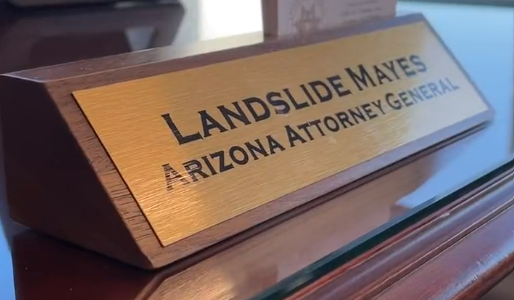
Attorney General Kris Mayes’ official name plaque reads “Landslide Mayes”: a tease of her win last year over opponent Abe Hamadeh.
In a video commemorating the two-year mark of former Arizona Attorney General Grant Woods’ passing, Mayes revealed she uses his desk and hoped her legacy would be comparable to his. The video opened with a shot of her desk, with her name plaque reading “Landslide Mayes,” rather than her name.
“If you were to ask me what AG in the past do you consider yourself most like?’ I hope at the end of this people say I was most like Grant Woods, and I work off the premise that he did this job better than anybody ever has,” said Mayes.
It’s been two years since we lost former Attorney General Grant Woods — a good friend and an inspiration. It’s an honor to sit at his desk every day. pic.twitter.com/ttCjtXKQx4
Mayes’ tease about not being a “landslide” winner refers to her slim victory margin; critics, including her opponent, have argued that this margin is inaccurate due to the myriad problems experienced by voters leading up to and on Election Day. Hamadeh maintains that Mayes’ 280-vote margin with which she claimed victory last November — which was nearly halved following a recount — would disappear following the inclusion of the thousands of allegedly uncounted, valid provisional votes.
Earlier this month, the Arizona Supreme Court rejected Hamadeh’s appeal and ordered him to pay over $40,000 in legal fees to Mayes. Following the ruling, Hamadeh announced his bid to take over for retiring Rep. Debbie Lesko (R-AZ-08).
Woods served as Arizona’s attorney general from 1991-1999. Although registered as a Republican, Woods stood out for his opposition to virtually all positions taken by the Republican Party. Woods worked against the GOP opposition to the statewide recognition of the Martin Luther King, Jr., holiday, and support for both the English-only initiative and the Chandler roundup.
Chicanos Por La Causa (CPLC) honored Woods for his work in 2011. In a video highlighting his work, Woods said he would reach beyond his authority to take political action.
“Even though it wasn’t my jurisdiction, I definitely stuck my nose into that one [the Chandler roundup], and we stopped it,” said Woods.
The Chandler roundup, formally known as “Operation Restoration,” was a mass arrest of hundreds of suspected illegal immigrants from July 27 to 31 of 1997. Patrolling officers would arrest any Hispanic individual they stopped who couldn’t provide proof of citizenship. A total of 432 illegal immigrants were deported.
Woods also fought against the state legislature’s bill enabling law enforcement to ask individuals for proof of citizenship and investigate immigration status if illegal immigration is suspected: SB1070. The Supreme Court upheld the law in 2012 in part, striking down other provisions enabling police to arrest without a warrant on suspicion of illegal immigration, criminal charges for immigrants failing to carry federal registration papers, and criminal charges for immigrants seeking or accepting work without authorization.
“I know from being a native Arizonan that our Mexican heritage is part of what it means to be Arizonan, and somehow that’s been perverted,” said Woods.
Under the first year of the Biden administration, Woods denied the reality of the border crisis — going further than even Sens. Mark Kelly (D-AZ) and Kyrsten Sinema (I-AZ).
We don’t need our Democratic Senators-either one of them—stoking the fake “crisis” at the border. It’s a cynical Republican ploy trotted out when convenient. Time would be better spent on actually helping solve the problem. Bad take on a great speech. https://t.co/BEDavSDvIj
Woods also supported abortion, decrying former Gov. Doug Ducey for signing onto a 2021 petition to the Supreme Court to overturn Roe v. Wade.
“I was elected statewide twice as a pro-choice Republican,” said Woods. “There [are] a lot of Arizonans who don’t want the government interfering in the most personal decisions between a woman and her doctor.”
That’s sad. The fight for choice continues. I was elected statewide twice as a pro-choice Republican. There a lot of Arizonans who don’t want the government interfering in the most personal decisions between a woman and her doctor. https://t.co/Q3WhubJqvl
Prior to serving as attorney general, Woods was late Sen. John McCain’s chief of staff when he was a congressman, and endorsed both Democratic presidential candidates in the last two elections: Hillary Clinton in 2016 and Joe Biden in 2020.
@Hillary Clinton is the most qualified nominee ever. Trump's the least qualified. Stakes are too high to be on the sidelines. I'm w/Hillary.
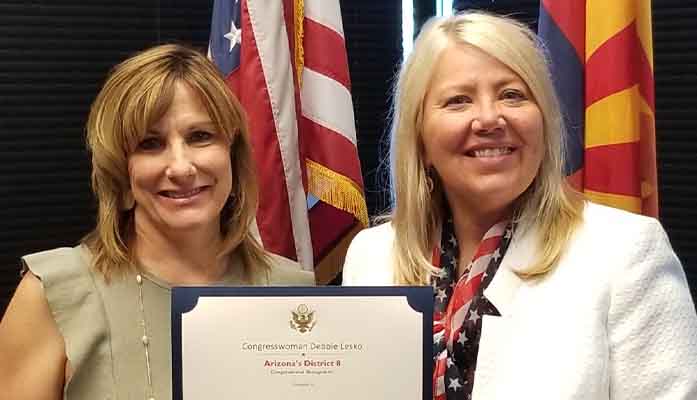
Rep. Debbie Lesko (R-AZ-08) announced Tuesday that she won’t be seeking re-election in 2024.
In a press release, Lesko cited family as her main reason for retiring from the job.
“I want to spend more time with my husband, my 94-year-old mother, my three children, and my five grandchildren,” said Lesko. “Spending, on average, three weeks out of every month away from my family and traveling back and forth to Washington, D.C. almost every weekend is difficult.”
Lesko also cited the increased difficulty of passing legislation, declaring the nation’s capital to be broken.
Lesko assumed office in 2018, succeeding the retired former Rep. Trent Franks in a special election. Of the 102 bills she introduced, two became law.
One was HR 6400, which directed U.S. Customs and Border Protection (CBP) to submit to the congressional homeland security and tax committees a threat and operational analysis of U.S. air, land, and sea ports of entry.
The other law was HR 6016, naming a U.S. Postal Service facility in Surprise as the “Marc Lee Memorial Post Office Building.”
The Heritage Foundation, one of the biggest conservative activist organizations, rates Lesko at a 100 percent conservative voting record. Lesko is a member of the House Freedom Caucus.
Lesko will serve through the end of her term in 2025.
As one of her recent major acts in Congress, Lesko has backed Rep. Jim Jordan (R-OH-04) in the contentious House Speaker race. Jordan failed a second time to receive enough votes for the speakership on Wednesday.
22 voted against Jordan: Reps. Don Bacon (NE), Vern Buchanan (FL), Ken Buck (CO), Lori Chavez-Ramer (OR), Anthony D’Esposito (NY), Mario Diaz-Balart (FL), Jake Ellzy (FL), Drew Ferguson (GA), Andrew Garbarino (NY), Carlos Gimenez (FL), Tony Gonzales (TX), Kay Granger (TX), John James (MI), Mike Kelly (PA), Jennifer Kiggans (VA), Nick LaLota (NY), Michael Lawler (NY), Mariannette Miller-Meeks (IA), John Rutherford (FL), Michael Simpson (ID), Pete Stauber (MN), and Steve Womack (AR).
All Democrats voted for their minority leader, New York Rep. Hakeem Jeffries.
I voted for @Jim_jordan yesterday in the GOP conference and plan to vote for him next week if Jim decides to take the vote to the House floor. https://t.co/xazOa9pSnY
Several hours after Lesko issued her announcement, Republican attorney general candidate Abe Hamadeh announced his candidacy to replace Lesko. Hamadeh cited former President and 2024 presidential candidate Donald Trump as his main reason for running.
“President Trump is under attack,” said Hamadeh. “He needs back up — and I’m ready to help him Make America Great Again.”
Our country is in desperate need of courageous fighters, and that’s why I’m proud to announce I’m running for Congress in Arizona’s 8th District.
Have you ever shown up to vote and were told at the voting location that your voting information does not match the information on your driver’s license? If this has happened to you, have you wondered if your vote was counted?
We finally know why this happens! And there’s someone fighting for you!
EZAZ.org put out a Call to Action for its Grassroots to speak at the Maricopa County Board of Supervisors Meeting on September 27. One of the talking points included that voters are unknowingly being re-registered as a different political party or even in a different county than the county they live in. One of the commenters utilized this talking point.
Maricopa County’s legal team followed up by stating that during the MVD and Service Arizona process, when someone re-registers their vehicle in another county, sometimes the opt-out box is mischecked and changes voter registration without the voter knowing. Maricopa County Elections Director, Scott Jarrett, agreed.
👁🎥Maricopa Caught on VIDEO🎥👁@maricopacounty Board of Supervisors County lawyer & @RecordersOffice's Election Director admitted voters' registrations are being changed without the voter's knowledge‼️‼️‼️
Yes, this is the same elections department run by Maricopa County Recorder Stephen Richer. Both offices stated that the MVD and Service Arizona process is allowed under state statute. They are saying their hands are tied, and they can’t do anything about it.
This means that a voter could get mismatched information or be registered under the wrong party affiliation for something like re-registering a vehicle, registering a new vehicle, or getting a new license… And the voter wouldn’t even know until it’s too late!
So, then what would happen? If someone shows up to vote and their voting registration information is different from the information on their driver’s license, the voting location provides what is called a provisional ballot.
The Arizona Secretary of State’s Office says, “Provisional ballots are a fail-safe measure designed to ensure that all eligible voters have their ballots counted.” The county is supposed to go back and determine if voters who cast provisional ballots were legal and then count the ballots of those who are legal. But if provisional ballots are such a fail-safe measure, then consider this.
There are currently over 9,000 provisional ballots not counted in the Arizona Attorney General race. Abe Hamadeh is still fighting in the courts because his team has discovered many of these voters tend to vote in every election and some were mysteriously re-registered in another county. There are only 280 votes separating Mayes from Hamadeh.
Abe’s team has been trying for months to get access to the envelopes of provisional ballots to verify information of those who did cast a vote in such a way, but the counties have not allowed this to happen. This is ridiculous!
It’s time for the MVD and Service Arizona to change its misguided process. And it’s time for the courts to force the counties to allow Abe’s team to inspect the provisional ballot envelopes. After all, real election integrity ensures that every legal vote is counted.
Jeff Caldwell currently helps with operations at EZAZ.org. He is also a Precinct Captain, State Committeeman, and Precinct Committeeman in Legislative District 2. Jeff is a huge baseball fan who enjoys camping and exploring new, tasty restaurants! You can follow him on X here.
A long-awaited elections challenge from the 2022 political cycle has finally been filed.
On Tuesday, 2022 Republican nominee for Arizona Attorney General, Abraham Hamadeh, filed an Appeal and Motion to Expedite in the Arizona Court of Appeals.
In a statement Tuesday night, Hamadeh said, “My legal team has just filed our Appeal on our election challenge and Motion to Expedite. Arizonans deserve to have their lawfully elected Attorney General to hold that office, and our state constitution demands it. With the numerous irregularities in the election, the initial trial, and numerous delays at the trial court, it’s long overdue that the judiciary expedite and take our claims seriously that thousands of lawful votes remain uncounted in the closest election in Arizona with the biggest recount discrepancy in history.”
The Arizona Attorney General’s race was decided late in 2022 – and long after the November General Election – with Democrat Kris Mayes over Hamadeh by 280 votes, triggering the Republican’s election challenges.
Hamadeh’s efforts to bring transparency to his razor-thin election result have continued long after his Democrat opponent, Kris Mayes, took office in January. Mayes has continued to show little public interest in the case, allowing her attorneys to handle matters in the courtroom while she continues to revamp the Arizona Attorney General’s Office from the policies of her predecessor, Republican Mark Brnovich.
The comments from Hamadeh also touched on his thoughts regarding the state of election integrity across Arizona and the country – especially how this issue pertained to his specific case. He shared, “Our democracy demands honesty, transparency, and accountability in order to rebuild the trust that so many Arizonans have lost in our elections. Our case seeks to enfranchise over 9,000 voters who voted on Election Day and did their part to have a say in their government. Their constitutional right to vote matters and their votes deserve to be counted.”
The Republican challenger promised a continued fight in court “to ensure that the will of the people is honored, and that our laws are upheld.”
Daniel Stefanski is a reporter for AZ Free News. You can send him news tips using this link.